Unit 1 · Topic 1.4 · about 30 minutes · 7 parts · 13 scored checks, 2 of them multiple choice, plus 1 from earlier lessons
AP Physics C: Mechanics 1.4: Reference Frames and Relative Motion
Unit 1: 10 to 15% of the multiple-choice section
What you'll be able to do
- Describe the reference frame of a given observer, and how the choice of frame sets the size and direction of the quantities that observer measures.
- Describe the motion of an object as measured by observers in different inertial reference frames, converting positions and velocities between frames and comparing accelerations.
Key vocabulary
| Term | What it means | The exam trap |
|---|---|---|
| Reference frame | The set of axes, an origin and directions, that an observer uses to measure positions and velocities, at rest relative to that observer. | A frame also fixes which direction counts as positive, so state the frame and its positive direction before you give any sign. |
| Observer | The person or instrument making a measurement, whose frame the measurement is taken in. | An observer is not the same as the object being described: the same train can be the observer in one question and the moving object in the next. |
| Inertial reference frame | A reference frame that is not accelerating: at rest, or moving at a constant velocity relative to other inertial frames. | Constant speed is not enough. A frame on a carousel turning at a steady speed changes direction, so it is accelerating. |
| Relative velocity | An object's velocity as measured in a particular frame; is the velocity of A measured in B's frame. | A speedometer reading is a speed relative to the road. A velocity with no frame named usually means relative to the ground, but that is a choice, not a rule. |
 Tap to open the picture full size
Part 1 Think first Walking in the rain
Commit to a guess first. Being wrong now makes the right idea stick better.
Predict first
On a day with no wind, rain falls straight down. You start walking fast across a parking lot with an umbrella. How should you hold the umbrella to keep the most rain off you?
In short. A reference frame is the set of axes an observer measures from, and an object's velocity measured by one observer is its velocity relative to a second frame plus that frame's velocity relative to the observer, added as vectors.
- Position, displacement and velocity depend on the frame: two observers can measure different sizes and different directions for the same motion.
- To convert, add velocities tip to tail, , with signs in one dimension and components in two.
- Differentiate the conversion and the frame's constant velocity drops out, so every inertial observer measures the same acceleration.
Part 2 Learn it Four ideas, with a check after each
2a. Every measurement has an observer
Every measurement of motion is made by someone, from somewhere. A reference frame is the set of axes an observer measures from: an origin and directions that stay at rest relative to that observer. Position, displacement and velocity are all measured in some frame, and the frame decides both their size and their direction.
Picture a train moving east along a straight track at 20 m/s relative to the ground. Ana sits in her seat. Measured in the train's frame, Ana's velocity is zero. Measured in the frame of Ben, who stands on the platform, Ana moves at 20 m/s east. Neither of them is wrong. They are answering different questions.
Ana sees it the other way around. In her frame, the platform, with Ben on it, slides past at 20 m/s west. Write for the velocity of A measured in B's frame. Then swapping the observer and the observed reverses the direction:
Unless a problem says otherwise, every frame in this course is inertial: it is not accelerating relative to the others. It may be at rest or move at a constant velocity, but it does not speed up, slow down or turn.
Quick check · Fill the statement
A ferry moves north at a steady 6 m/s relative to the dock. A passenger stands still on its deck, and a worker stands on the dock.
In the dock worker's frame, the passenger's velocity is . In the passenger's frame, the dock worker's velocity is .
2b. Converting a velocity from one frame to another
To convert a velocity into a new frame, add the velocity of the old frame relative to the new one. A passenger P walks along a train T, which moves relative to the ground G:
The inner letters match (T and T), and the outer ones, P and G, name the answer. Checking that pattern catches most mix-ups.
In one dimension the vectors become signed numbers. Take east as positive and let the train move at m/s. A passenger walking toward the front at 1.5 m/s has m/s. One walking toward the back has m/s, still moving east, only more slowly.
To find how one moving object looks from another, put the observer second and use :
Subtract the observer's velocity from the object's, both with their signs. Two cars side by side at the same velocity measure each other at rest.
Quick check · Calculate
On a straight highway, a car drives north at 30 m/s and a truck drives south at 22 m/s, both relative to the road. Take north as positive. What is the truck's velocity measured by the driver of the car?
2c. In two dimensions, add tip to tail
The same equation holds in two dimensions, but now the velocities point in different directions, so add them as vectors: tip to tail, or component by component.
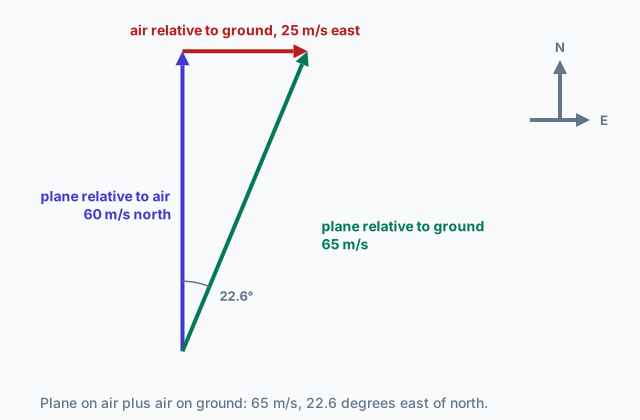
The figure at the top of this page shows a plane pointed due north, flying at 60 m/s relative to the air, while the wind carries the air east at 25 m/s relative to the ground. With east as and north as ,
Its speed relative to the ground is m/s, at east of north. Adding the speeds, 85 m/s, would be right only if the wind blew straight along the plane's heading.
Perpendicular components do not affect each other. The wind adds an east component, but the plane still covers ground northward at 60 m/s, exactly as it would in still air. So a pilot who points due north and flies for one minute ends up 3.6 km north and 1.5 km east of the start, and never reaches a target due north without turning into the wind.
Quick check · Calculate
A river 90 m wide flows east at 1.2 m/s relative to its straight banks. A kayaker points her kayak due north, straight across, and paddles at 1.8 m/s relative to the water. Take east as positive. How far east of her starting point does she reach the far bank?
2d. Every inertial observer measures the same acceleration
Positions convert the way velocities do. A toy car C rolls along the floor of a train T, at measured from the back of the train, and the back of the train is at measured from a post on the ground G. Then .
Differentiate once and you get the velocity rule from before. Differentiate again:
The train is an inertial frame, so is constant and its derivative is zero. That leaves : observers in different inertial frames disagree about where an object is and how fast it moves, but they measure the same acceleration.
Suppose , in meters and seconds, the train moves east at a constant 12 m/s, and the back of the train passes the post at . With east positive, . The two velocities, and in m/s, differ by 12 m/s at every instant. Differentiate either one and you get 1.0 m/s².
Quick check · Decide and justify
A train moves east along a straight track at a constant 15 m/s relative to the ground. A passenger holds a coin still and lets it go. A person on the platform watches the same coin fall. Is the coin's acceleration measured by the person on the platform the same as the acceleration measured by the passenger?
Which reason supports your answer?
Part 3 Watch it done A drone flies north in a crosswind
Watch each step, then do the last one yourself.
A delivery drone must fly due north relative to the ground to reach a house. It flies at 10 m/s relative to the air, and a wind carries the air east at 6.0 m/s relative to the ground. Take east as and north as . Which way must the drone point, and how fast does it move relative to the ground?
Step 1 · Write the vector equation
, with m/s. The drone has to end up moving due north, so has no component.
Step 2 · Cancel the wind's east component
The components must add to zero, so the drone's velocity relative to the air has an component of m/s. Its air speed is 10 m/s, so it points at an angle west of north with , giving west of north.
Why this step?
Why point the drone into the wind instead of due north?
Pointed due north, the drone would keep the wind's 6.0 m/s east component the whole trip and drift steadily east of the house, as the plane in the figure at the top of the page does. Turning partly west spends some of its own velocity canceling the wind's.
Your step · Calculate
Finish it. What is the drone's speed relative to the ground while it flies due north?
m/s
Part 4 Try it New situations
Try it · Rank it
A wide river flows east at 1.5 m/s relative to the shore. Three kayakers each paddle at 2.0 m/s relative to the water: kayaker A points east, downstream; kayaker B points west, upstream; and kayaker C points north, straight across. Rank the kayakers by their speed relative to the shore.
Fastest first
Give each one a place, 1 for first. Give two the same place if they are equal.
Your ranking: none yet
Try it · Calculate
A flatcar rolls east along a straight track at a constant 4.0 m/s relative to the ground. A small robot drives along the flatcar, and its position measured from the back of the flatcar toward the front, which faces east, is , in meters and seconds. Take east as positive. What is the robot's velocity relative to the ground at s?
On paper. Draw kayaker C's velocities to scale, tip to tail, with a labeled scale such as 1 cm for 0.5 m/s: her velocity relative to the water, then the current's velocity relative to the shore from its tip, then their sum from the start of the first to the tip of the second. Label each arrow with what it is relative to. Measure the angle between her heading and her actual path, and check it against .
Part 5 Explain it Reason it, then derive it
Nothing you type leaves this page. Check your answer against the model and each scoring point.
Free response is 50% of the exam score. This one is shaped like Question 4, Qualitative/Quantitative Translation.
Free-response practice · Question 4 style
A conveyor belt in a warehouse moves east at a constant speed relative to the floor; take east as positive. A small robot sits at rest on the belt. At , just as it passes a mark on the floor, the robot starts to drive east along the belt. Its velocity relative to the belt is , where is a positive constant.
(a) Without writing or deriving equations, describe how the robot's velocity measured by an observer standing at the mark compares with its velocity measured by an observer riding on the belt at the same instant. Then describe how their measurements of the robot's acceleration compare.
(b) Derive expressions for the robot's velocity, acceleration and position measured by the observer at the mark, with the mark as the origin. Express your answers in terms of , and .
(c) Explain how your expressions in part (b) are consistent with your reasoning in part (a).
Model answer
(a) The observer at the mark sees the robot carried east by the belt as well as driving along it, so at every instant the velocity measured from the mark is greater, by the belt's velocity east. The belt's velocity never changes, so the two velocities change by the same amount over any interval, and the two observers measure the same acceleration.
(b) Adding the belt's velocity, . Then . The robot is at the mark at , so .
(c) The observer riding on the belt measures , so the velocity measured from the mark is the rider's plus the constant at every instant, as part (a) says. The derivative of the constant is zero, so both observers get , the same acceleration, as part (a) predicts.
Score your own answer. This is a self-check, not a grade. Tick each point your answer makes.
Part 6 Check yourself Two sensors, one robot
The case questions use the sensor readings. Answer them from those.
A toy robot rolls east along a long hallway; take east as positive. Sensor F is fixed to the floor. Sensor C rides on a cart that rolls east at a constant velocity. At the two sensors are side by side, both pointing east at the robot, and each records the robot's distance ahead of it.
| (s) | Sensor F (m) | Sensor C (m) |
|---|---|---|
| 0 | 2.00 | 2.00 |
| 1.0 | 2.31 | 0.79 |
| 2.0 | 3.19 | 0.21 |
| 3.0 | 4.70 | 0.19 |
| 4.0 | 6.81 | 0.81 |
Case question 1 · Multiple choice
According to the readings, which way does the robot move from to s, as measured in each sensor's frame? East is positive.
Case question 2 · Calculate
Using only the readings at and s, what is the velocity of the cart carrying sensor C, relative to the floor? East is positive.
Case question 3 · Multiple choice
The class fits each sensor's readings with a quadratic in . The fit to sensor F's readings gives the robot an acceleration of 0.60 m/s² east. Within measurement error, what acceleration should the fit to sensor C's readings give?
The rest stand on their own and do not use the case.
Check yourself · Sort it
Two observers in inertial frames that move relative to each other watch the same events. Tap a card, then say whether the quantity is the same for both of them or depends on the observer's frame.
Same for both
Depends on the frame
Check yourself · Spot the error
A plane flies east at 80 m/s relative to the air, and a wind carries the air west at 20 m/s relative to the ground. A student finds the plane's velocity relative to the ground. Tap the first line with a mistake.
Part 7 Keep it Bring back earlier ideas
Converting between frames stands on adding vectors from Topic 1.1, and its moving observers run on the kinematics of Topic 1.3. Pulling them back up is what makes them last.
Bring it back · Calculate
Two velocities are m/s and m/s. What is the magnitude of ?
On paper. For the cart in the sketch question, draw its position graph for the same 4 s directly above your velocity sketch, on the same time scale, with the cart starting at the origin. Use the velocity graph to decide where the position graph is steepest and whether it is ever level. Then draw the cart's motion diagram with a dot every second, and check that its gaps tell the same story as your two graphs.
From 1.3 Representing Motion · Calculate
Two identical cars brake on the same dry road with the same constant acceleration until they stop. Car B is moving 3 times as fast as car A when its brakes go on. What is the ratio of B's stopping distance to A's, ?
In three lines
- A reference frame is the set of axes an observer measures from, and it sets the size and direction of every position, displacement and velocity that observer reports.
- Convert with , using signs in one dimension and components in two, and remember .
- Between inertial frames the velocities differ by a constant, so every inertial observer measures the same acceleration.
Exam strategy for this topic
- Section I, Multiple Choice: 42 questions in 85 minutes.
- Section II, Free Response: 4 questions in 95 minutes.
- This lesson's Explain it is shaped like free-response question 4, Qualitative/Quantitative Translation.
- A four-function, scientific, or graphing calculator is allowed on both sections of the exam.
On a free-response question, name the frame on every velocity, with subscripts or in words, and write the vector equation before any numbers: . State your positive direction. In two dimensions, add components, not speeds, and give the direction of your answer as well as its size.
Questions students ask
Which frame is the right one to use?
Any inertial frame gives correct physics. Pick the one that makes the problem simplest, often the ground, and state it. If the question asks what a particular observer measures, convert into that observer's frame at the end.
How do I keep the subscripts straight?
Read as the velocity of A measured by B. In the inner letters match and the outer ones name the answer. Swapping the two letters of one velocity reverses its direction.
Why is the acceleration the same in every inertial frame when the velocity is not?
Two inertial frames move at a constant velocity relative to each other, so an object's velocities in the two frames always differ by that same constant. Acceleration is the derivative of velocity, and the derivative of a constant is zero.
Do I need to worry about frames that accelerate?
Not unless a problem says so. In this course you may assume a problem's frame of reference is inertial unless it states otherwise.
Is this the same as relativity?
It is the everyday version. Adding velocities this way works for every speed you meet in mechanics. It breaks down only at speeds near the speed of light, which this course does not cover.
Course alignment, for teachers
AP Physics C: Mechanics topic 1.4, Unit 1: Kinematics.
- Skill 1.A: Create diagrams, tables, charts, or schematics to represent physical situations.
- Skill 2.B: Calculate or estimate an unknown quantity with units from known quantities, by selecting and following a logical computational pathway.
- Skill 2.C: Compare physical quantities between two or more scenarios or at different times and/or locations within a single scenario.
- Skill 3.B: Apply an appropriate law, definition, theoretical relationship, or model to make a claim.
This lesson maps all 5 essential knowledge statements of the topic to the part that teaches each one: 5 are checked by a scored question. The map is in the lesson file.