Unit 1 · Topic 1.5 · about 30 minutes · 7 parts · 15 scored checks, 2 of them multiple choice
AP Physics C: Mechanics 1.5: Motion in Two or Three Dimensions
Unit 1: 10 to 15% of the multiple-choice section
What you'll be able to do
- Describe the motion of an object moving in two dimensions by separating it into perpendicular components, each analyzed with one-dimensional kinematics, including projectile motion.
Key vocabulary
| Term | What it means | The exam trap |
|---|---|---|
| Component | The part of a vector along one axis, such as , the -component of a velocity; a vector in a plane is the sum of its - and -components. | A component is a signed number, not just a length: on an axis with right as positive, a ball moving left has a negative . |
| Position vector | The vector from the origin to an object, whose components are the object's coordinates. | A position vector depends on where you put the origin, and a displacement, a change in , does not. |
| Projectile motion | Two-dimensional motion with zero acceleration in one dimension and constant, nonzero acceleration in the other, such as an object in flight near Earth's surface when air resistance is ignored. | The model leaves out air resistance, so it fits a thrown ball well and a falling leaf or a badminton shuttle badly. |
| Trajectory | The path an object traces through space, drawn as one coordinate against another, such as against . | A trajectory has positions on both axes and time on neither, so it is not a position-time graph, and its shape does not show when the object was where. |
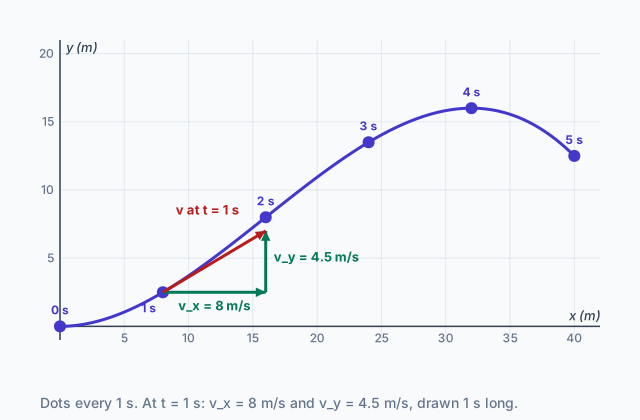 Tap to open the picture full size
Part 1 Think first Two coins leave a table
Commit to a guess first. Being wrong now makes the right idea stick better.
Predict first
You hold one coin just past the edge of a table, level with the tabletop, and set a second coin on the tabletop at the edge. At the same instant, you let the first coin drop and flick the second one so it flies off the edge horizontally. Ignore air resistance. Which coin hits the floor first?
In short. Motion in two dimensions is two one-dimensional motions happening at once: split position, velocity and acceleration into perpendicular components, treat each component with the one-dimensional relationships, and combine them at the end.
- Each component has its own velocity and acceleration, found by differentiating or integrating that component alone, and either one can be nonuniform.
- An acceleration along one axis changes the motion along that axis only; the motion along a perpendicular axis carries on as before.
- A projectile has zero acceleration in one dimension and a constant, nonzero acceleration in the other: near Earth's surface, ignoring air resistance, and with up positive.
Part 2 Learn it Four ideas, with a check after each
5a. Split the motion into components
An object moving in a plane has a position vector , so describing where it is takes two functions of time, and . Its velocity has a component along each axis, and each one is the derivative of that coordinate alone:
Each component is a one-dimensional problem, so everything from Topics 1.2 and 1.3 applies to it on its own, with its own signs. Then combine the components to describe the whole motion. The speed is the magnitude of the velocity vector, and its direction comes from the ratio of its components:
The drone at the top of this page follows and , in meters and seconds, with horizontal and up. At s, m/s and m/s. Its speed is m/s, directed about above the horizontal. Notice that 9.2 m/s is not : perpendicular components combine like the sides of a right triangle.
Quick check · Calculate
A radio-controlled car drives across a flat parking lot, with east as and north as . Its position is , with in meters and in seconds. What is the car's speed at s?
5b. Each component has its own rates of change
The acceleration splits the same way, and , and nothing makes the two components alike. They can have different sizes, and either one can be constant or change with time.
For the drone at the top of the page, m/s at every instant, so . Meanwhile , so , which is m/s² at launch, zero at 2 s and negative after that. One component is uniform and the other is not, in the same motion.
Going the other way works one component at a time too. Integrate each acceleration component and add that component's own starting value:
The acceleration vector need not point along the velocity. At s the drone moves up and to the right, but its acceleration, m/s² straight up, has no horizontal part at all.
Quick check · Fill the statement
A hovercraft glides across a flat field, with east as and north as . At its velocity is m/s, and its acceleration is , with in m/s² and in seconds.
At s, the hovercraft's is and its is , and its acceleration points .
5c. One component changes, the other carries on
Because changes only and changes only , the motion in one dimension can be changed without causing any change in a perpendicular dimension.
Picture a spacecraft coasting north through deep space at a steady 300 m/s, with east as and north as . Suppose a side thruster gives it an acceleration due west for a moment. Its changes from zero to some westward value. Its has nothing acting on it, because the acceleration has no north or south component, so is still 300 m/s afterward. The spacecraft's speed and direction both change, but only through the new .
The coins in Think first are the same idea turned on its side. The flick gave one coin a horizontal velocity and changed nothing about its vertical motion, so both coins fell with the same at every instant.
The one quantity the two components share is time. Whatever you find about the timing from one component, such as how long an object is in the air, holds for the other.
Quick check · Decide and justify
A puck slides east at 5.0 m/s on frictionless ice; take east as and north as . For 0.20 s an air jet gives it an acceleration of 15 m/s² due north, and then the jet stops. After the jet stops, how does the puck's east component of velocity compare with 5.0 m/s?
Which reason supports your answer?
5d. Projectiles
A projectile is the special case where one component of the acceleration is zero and the other is constant and nonzero. Near Earth's surface, ignoring air resistance, an object in flight has and , with up and m/s².
Integrate each component from launch, at position with velocity components and :
Horizontally the object moves at a constant velocity; vertically it moves exactly as if it had been thrown straight up or down with . Because is constant, the constant-acceleration equations of Topic 1.3 apply to the vertical component, with in them, never the launch speed.
A launch speed at angle above the horizontal splits into and .
A typical plan: find the time from the vertical motion, where you know the height and , then use that time in the horizontal motion. At the top of the path , but is not zero and the acceleration is still downward.
Quick check · Calculate
A ball rolls off the edge of a horizontal table 0.80 m high, leaving the edge at 2.5 m/s horizontally. Take in the direction the ball rolls and up, and ignore air resistance. How far from the foot of the table, measured along the floor, does the ball land?
Part 3 Watch it done A kicked ball on a level field
Watch each step, then do the last one yourself.
A soccer ball is kicked from level ground with velocity m/s, with horizontal in the direction of the kick and up. Ignore air resistance and use m/s². How far from the kick does the ball land?
Step 1 · Integrate the acceleration, one component at a time
The acceleration is m/s². So m/s throughout, and . Integrating again from the origin, and .
Step 2 · Find the time from the vertical motion
The ball lands when : , so (the kick) or s. The landing is at 3.0 s. The horizontal component played no part in finding it.
Why this step?
Why not use the time when ?
Setting gives 1.5 s, which is the top of the path, where only the vertical component is zero. On level ground the ball takes as long to come down as to go up, so the flight lasts twice that. The landing is where the height returns to zero, so solve .
Your step · Calculate
Finish it. How far from the kick, measured along the level ground, does the ball land? Take in the direction of the kick.
m
Part 4 Try it New situations
Try it · Rank it
Three balls are launched from the same spot on level ground, with horizontal and up; ignore air resistance. Their launch velocities, in m/s, are: ball A, ; ball B, ; ball C, . Rank the balls by how long each stays in the air.
Longest first
Give each one a place, 1 for first. Give two the same place if they are equal.
Your ranking: none yet
Try it · Calculate
A rover starts at the origin of a flat test field, with east as and north as . At its velocity is m/s, and its acceleration is , with in m/s² and in seconds. How far is the rover from its starting point at s?
Try it · Put it in order
A ball is thrown at an angle above the horizontal from the top of a cliff, and you want to know how far from the base of the cliff it lands. Put the steps in order.
On paper. For the kicked ball in Watch it done, sketch its path with and axes labeled in meters. Mark its positions at , 1.5 s and 3.0 s. At each one, draw the velocity as an arrow, then draw its horizontal and vertical component arrows from the same point, labeled with their values. Use the same length for every 5 m/s. There is nothing to submit; check that your horizontal arrows are all the same length and that your vertical arrows shrink, vanish at the top and grow again pointing down.
Part 5 Explain it Graph it, derive it, connect them
Nothing you type leaves this page. Check your answer against the model and each scoring point.
Free response is 50% of the exam score. This one is shaped like Question 2, Translation Between Representations.
Free-response practice · Question 2 style
A ball is launched from level ground with an initial velocity whose horizontal component is and whose vertical component is , both positive. Take horizontal in the direction of launch and up, and ignore air resistance.
(a) On paper, sketch graphs of and of as functions of time , from launch until the ball lands at time . Label the value of each component at and at .
(b) Starting from , derive an expression for in terms of and .
(c) Derive an expression for the horizontal distance the ball travels before landing, in terms of , and .
(d) A second ball is launched from the same spot with the same and twice the . A student says the second ball stays in the air longer because it is moving faster. Using your graphs and your expressions, explain whether the student is right, and how the second ball's range compares with the first's.
Model answer
(a) is a horizontal line at from to . is a straight line with slope , from at through zero at to at .
(b) , and . The ball lands when again, at , so .
(c) , so and .
(d) The student is wrong. depends on and only, and the second ball's graph is the same line as the first's, reaching at the same , so both balls stay up for the same time. Its graph is a line twice as high, so the area under it over the same , the horizontal displacement, is twice as large: is proportional to , and the range doubles.
Score your own answer. This is a self-check, not a grade. Tick each point your answer makes.
Part 6 Check yourself A ball rolls off a bench
The case questions use the video readings. Answer them from those.
A student films a ball rolling off the edge of a stage 1.5 m above the floor and uses video analysis software to mark the ball's center in each frame. The origin is the ball's position as it leaves the edge, with horizontal in the direction the ball rolls and up. Some of the marked positions:
| (s) | (m) | (m) |
|---|---|---|
| 0 | 0.000 | 0.000 |
| 0.10 | 0.151 | −0.050 |
| 0.20 | 0.299 | −0.195 |
| 0.30 | 0.452 | −0.442 |
| 0.40 | 0.600 | −0.785 |
| 0.50 | 0.749 | −1.224 |
Case question 1 · Multiple choice
What do the marked positions show about the ball's acceleration after it leaves the stage? Up is positive.
Case question 2 · Calculate
Using the marked positions at s and s, estimate the ball's speed at s.
The rest stand on their own and do not use the case.
Check yourself · Sort it
A ball is thrown at an angle above the horizontal over level ground; ignore air resistance. Tap a card, then say what the quantity does between the throw and the landing.
Changes
Stays the same
Check yourself · Spot the error
A ball is thrown from level ground with velocity m/s, with horizontal and up. Ignore air resistance and use m/s². A student finds how high it rises. Tap the first line with a mistake.
Check yourself · Match
In each motion, is horizontal in the direction the object moves and is up. Match each motion to its acceleration components.
Part 7 Keep it Bring back earlier ideas
This lesson stands on the one-dimensional kinematics of Topic 1.3 and the vector addition of Topic 1.4. Pulling them back up is what makes them last.
Bring it back · Multiple choice
A boat heads due north across a river at 4.0 m/s relative to the water, and the water flows due east at 3.0 m/s relative to the shore. What is the boat's speed relative to the shore?
Bring it back · Calculate
A car moving east at 12 m/s brakes with a constant acceleration of 3.0 m/s² directed west. Take east as positive. How far does the car travel before it stops?
In three lines
- Split a two-dimensional motion into perpendicular components and treat each with the one-dimensional relationships, differentiating or integrating each component on its own.
- The components can differ and can be nonuniform, and an acceleration along one axis leaves the perpendicular motion unchanged; time is what they share.
- A projectile has and : constant horizontal velocity, and vertical motion like a ball thrown straight up.
Exam strategy for this topic
- Section I, Multiple Choice: 42 questions in 85 minutes.
- Section II, Free Response: 4 questions in 95 minutes.
- This lesson's Explain it is shaped like free-response question 2, Translation Between Representations.
- A four-function, scientific, or graphing calculator is allowed on both sections of the exam.
On a free-response question about motion in a plane, write the two components side by side: the acceleration, velocity and position for in one column and for in the other, each with its own starting values and signs. Find the time from the component where you know the most, usually the vertical one, then carry that time into the other. Combine the components only at the end, and only when the question asks for a speed, a distance or a direction.
Questions students ask
Can I use the launch speed in the kinematics equations?
Only after you split it. Each one-dimensional equation describes one component, so the vertical equations take and the horizontal ones take . The launch speed itself appears in neither.
Is a projectile's velocity zero at the top of its path?
No. Only the vertical component is zero there. The horizontal component is the same as at launch, so the object is still moving, at its lowest speed of the flight, and its acceleration is still downward.
What if one component's acceleration changes with time?
Then that component is not a projectile's, and the constant-acceleration equations do not fit it. Integrate that component's acceleration, with its own starting value, exactly as in one dimension. The other component is unaffected.
Do I need to analyze motion in three dimensions?
No. This course expects you to analyze motion in two dimensions with numbers; describing three-dimensional motion belongs to AP Physics C: Electricity and Magnetism. A third axis would add a -component that works the same way.
Why do we ignore air resistance?
The projectile model leaves it out so that the horizontal acceleration is zero and the vertical one is constant. For a dense, slow object over a short flight that is a good approximation. Unit 2 treats resistive forces when they matter.
Beyond the AP Exam
College Board sets this limit on what the AP Exam asks about this topic. Anything past it is not on the exam.
AP Physics C: Mechanics only expects students to quantitatively analyze the motion of an object in two dimensions. AP Physics C: Electricity and Magnetism expects students to also qualitatively describe the motion of a particle in three dimensions.
Course alignment, for teachers
AP Physics C: Mechanics topic 1.5, Unit 1: Kinematics.
- Skill 1.B: Create quantitative graphs with appropriate scales and units, including plotting data.
- Skill 2.A: Derive a symbolic expression from known quantities by selecting and following a logical mathematical pathway.
- Skill 2.D: Predict new values or factors of change of physical quantities using functional dependence between variables.
- Skill 3.A: Create experimental procedures that are appropriate for a given scientific question.
- Skill 3.C: Justify or support a claim using evidence from experimental data, physical representations, or physical principles or laws.
This lesson maps all 4 essential knowledge statements of the topic to the part that teaches each one: 4 are checked by a scored question. The map is in the lesson file.