Unit 2 · Topic 2.1 · about 30 minutes · 7 parts · 15 scored checks, 3 of them multiple choice
AP Physics C: Mechanics 2.1: Systems and Center of Mass
Unit 2: 20 to 25% of the multiple-choice section
What you'll be able to do
- Describe a system: what is in it, how its parts interact with each other and with the environment, and when it can be treated as a single object.
- Describe where a system's center of mass is relative to its parts, using symmetry, a mass-weighted sum, or an integral over a continuous object.
Key vocabulary
| Term | What it means | The exam trap |
|---|---|---|
| System | An object or a collection of objects chosen for analysis; everything outside it is the environment. | A system need not be one solid thing: a swarm of bees or the gas in a tank can be a system. |
| Center of mass | The average position of a system's mass with each position weighted by its mass, for separate objects. | It is a position, not a piece of the object, so there need not be any material at it. |
| Line of symmetry | A line that divides an object or system into two mirror-image halves; when the mass is spread symmetrically, the center of mass lies on it. | A symmetric shape is not enough on its own; the mass has to be spread symmetrically too. |
| Linear mass density | The mass per unit length at a point on a rod, , the derivative of the rod's mass with respect to position along it. | is a value at a point, so on a rod that is not uniform it changes from one end to the other. |
| Mass density | The mass per unit volume, ; integrating it over a solid's volume gives the solid's mass, . | is per volume and is per length, so check which one a question gives before you integrate. |
 Tap to open the picture full size
Part 1 Think first A hammer in the air
Commit to a guess first. Being wrong now makes the right idea stick better.
Predict first
A hammer is tossed across a gym so that it tumbles end over end as it flies. Is there any point on the hammer that follows a smooth arc, the way a tossed ball does?
In short. A system is the object or group of objects you choose to analyze, and its center of mass is the mass-weighted average position of its mass, , or when the mass is spread out.
- A system's properties come from the interactions inside it, and when those do not matter for a question the whole system can be treated as one object.
- That object has the system's total mass and sits at the center of mass, which lies on any line of symmetry of the mass.
- For a rod, write , where , and integrate both and over its length.
Part 2 Learn it Four ideas, with a check after each
2a. Choosing a system
A system is whatever you choose to analyze: one object, or several objects taken together. Everything outside it is the environment. The choice is yours, and a good choice makes a question easier.
A system's properties come from the interactions between the objects inside it. Three train cars coupled together roll as one unit because the couplings push and pull on each car. Uncouple them and the same three cars no longer move as one. The couplings, not the cars alone, give the system that property.
When what goes on inside a system does not matter for your question, treat the whole system as a single object, the same object model Topic 1.2 used for one cart.
That does not mean every part moves the same way. Objects within a system can behave differently from each other and from the system as a whole. On the tumbling hammer, the head and the end of the handle loop around while one point between them follows a smooth arc. Chunk 2c names that point.
Quick check · Decide and justify
A diver leaves a springboard, tucks into two somersaults and straightens out before she reaches the water. You want to predict how long she is in the air. Can you model the diver as a single object for this question?
Which reason supports your answer?
2b. What crosses the boundary, and what is inside
A system can also interact with its environment, and those interactions can carry energy or mass across its boundary. A mug of hot cocoa on a desk gives energy to the room. A rocket firing its engine throws gas out of its nozzle, so the rocket by itself is losing mass. Draw the boundary around the rocket and all the gas it has thrown out instead, and no mass leaves. The choice of system decides what crosses.
How a system is built inside affects how you analyze it. Drop a solid rubber ball and a bag of sand of the same mass. They fall the same way, but the ball bounces and the bag lands with a thud, because the grains of sand slide past each other on impact. For the fall, either one can be a single object; for the landing, the inside of the bag matters.
Changing a variable outside a system can change its substructure, how its parts are arranged and held together. Pull harder and harder on a chain and at some point a link breaks, so one chain becomes two pieces.
Quick check · Sort it
Each card names a system. Tap a card, then say whether mass crosses that system's boundary.
Mass crosses the boundary
No mass crosses the boundary
2c. The center of mass of separate objects
A system's center of mass is the average position of its mass, with each position weighted by the mass there. For objects along one axis,
Each position counts in proportion to its mass, so the center of mass sits closer to the heavier objects. A 2.0 kg block at and a 6.0 kg block at m give m, three quarters of the way to the heavier block. In two dimensions, find and separately with the same formula.
Symmetry can save the arithmetic. When mass is spread symmetrically, the center of mass lies on every line of symmetry. A uniform meter stick balances at its 50 cm mark, and a uniform ring's center of mass is at the center of the ring, where there is no mass at all.
This point is what lets you treat a system as one object: a system can be modeled as a single object, with the system's total mass, located at its center of mass. The smooth arc of the tumbling hammer is the path of its center of mass.
Quick check · Calculate
A light rod 1.00 m long, whose own mass you can ignore, carries three small clamps: 1.0 kg at its left end, 3.0 kg at 0.40 m from the left end and 4.0 kg at its right end. Take the left end as , with right as positive. Where is the center of mass of the rod and clamps?
2d. Spread-out mass: integrate
A rod or a beam is not a few separate masses; its mass is spread along it. Cut it into thin slices, each a differential mass , and the sum becomes an integral:
To integrate along a rod, write in terms of position. The linear mass density is the derivative of the mass of the rod from one end out to position : . A slice of width then has , and
Before you integrate, set the limits at the rod's two ends in your coordinates and write for a slice at a general position ; the integral then adds every slice once.
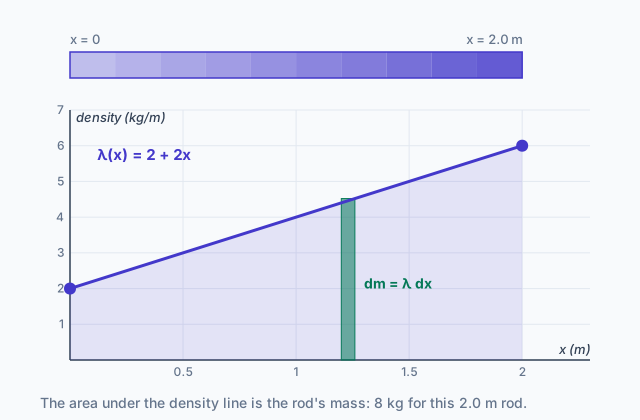
Take a 2.0 m rod with , in kg/m, so its density rises from 2 kg/m at one end to 6 kg/m at the other. Its mass is the area under that line, kg. The numerator is kg·m, so m, past the middle and toward the denser end. For a uniform rod, is constant and , as symmetry says.
For a flat sheet or a solid, integrate a density over the area or the volume instead. With the mass density , mass per unit volume, .
Quick check · Calculate
A thin rod lies along the x axis from to m, with positive to the right. Its linear mass density is , with in kg/m and in meters. Where is the rod's center of mass?
Part 3 Watch it done A tapered pole
Watch each step, then do the last one yourself.
A wooden pole 1.0 m long is thinner at one end. Put its thin end at and take positive toward the thick end. The mass of the part of the pole from the thin end out to position is , with in kilograms and in meters. Where is the pole's center of mass?
Step 1 · Find the density from the mass function
, in kg/m. It runs from 1.2 kg/m at the thin end to 2.4 kg/m at the thick end.
Step 2 · Find the total mass
kg. Integrating the density gives the same mass: kg.
Why this step?
Why not put straight into ?
is the mass of everything from the thin end out to , not the mass of one thin slice. A slice of width at position has mass . Using instead would count the inner part of the pole again for every slice farther out.
Step 3 · Set up the numerator
, in kg·m.
Your step · Calculate
Finish it. How far from the thin end is the pole's center of mass? Positive is toward the thick end.
m
Part 4 Try it New situations
Try it · Rank it
Three light sticks, each 1.00 m long with mass you can ignore, carry small blocks. Positions are measured from each stick's left end. Stick A: 1.0 kg at 0 and 1.0 kg at 1.00 m. Stick B: 2.0 kg at 0.20 m and 1.0 kg at 1.00 m. Stick C: 1.0 kg at 0.25 m and 1.0 kg at 0.75 m. Rank the sticks by how far their center of mass is from the left end.
Farthest first
Give each one a place, 1 for first. Give two the same place if they are equal.
Your ranking: none yet
Try it · Calculate
A shelf bracket is two thin, uniform steel bars welded at a right angle. Put the corner at the origin, with along the horizontal bar and up along the vertical bar. The horizontal bar is 0.60 m long with mass 1.5 kg; the vertical bar is 0.40 m long with mass 0.50 kg. What is the x coordinate of the bracket's center of mass?
On paper. Draw the bracket to scale on a grid, with both axes labeled in meters. Mark the center of mass of each bar, then the bracket's, using your x coordinate above and a y coordinate you find the same way. Notice where the bracket's center of mass lands compared with the steel. There is nothing to submit here; compare your drawing with the explanation once you have answered.
Part 5 Explain it Claim first, then derive
Nothing you type leaves this page. Check your answer against the model and each scoring point.
Free response is 50% of the exam score. This one is shaped like Question 4, Qualitative/Quantitative Translation.
Free-response practice · Question 4 style
A thin rod of length lies along the x axis from to , with positive to the right. Its linear mass density grows steadily from zero at the left end: , where is a positive constant.
(a) Is the rod's center of mass to the left of , at , or to the right of it? Justify your claim without deriving or using an equation.
(b) Derive expressions for the rod's total mass and the position of its center of mass , in terms of and .
(c) Explain how your result in part (b) agrees with your claim in part (a).
Model answer
(a) To the right of . The density grows from left to right, so the right half of the rod holds more mass than the left half. The center of mass is an average of position weighted by mass, so it is pulled toward the half that holds more mass.
(b) With : , and . So .
(c) is greater than , so the center of mass is right of the middle, as claimed in (a). The right half holds , three quarters of the mass, which is why the center of mass moves past the middle. cancels, so the location depends only on how the mass is spread along the rod, not on how dense the rod is overall.
Score your own answer. This is a self-check, not a grade. Tick each point your answer makes.
Part 6 Check yourself A robot on a plate
The case questions use the table. Answer them from it.
A robotics team mounts three parts on a flat plate 0.50 m wide and 0.70 m long, light enough that its mass can be ignored. Each part's position is where its own center of mass sits, measured from the plate's back left corner, with to the right and forward.
| Part | Mass (kg) | (m) | (m) |
|---|---|---|---|
| Battery | 2.0 | 0.10 | 0.20 |
| Motor | 1.0 | 0.40 | 0.10 |
| Sensor arm | 1.0 | 0.30 | 0.60 |
Case question 1 · Calculate
Using the table, what is the y coordinate of the robot's center of mass? Forward is positive.
Case question 2 · Multiple choice
The team slides the battery from m to m without changing its y position. Nothing else moves. How does the robot's center of mass change? Positive x is to the right.
Case question 3 · Multiple choice
Later the robot drives off the end of a ramp and flies through the air before it lands, with its parts held firmly where the table puts them. To predict the path of the robot as a whole, the team models it as one 4.0 kg object. Where on the plate, as , should that object be placed?
The rest stand on their own and do not use the case.
Check yourself · Spot the error
The mass of a wire from its end at out to position is , with in kilograms and in meters. The wire is 2.0 m long. A student finds its center of mass. Tap the first line with a mistake.
Check yourself · Fill the statement
A sealed plastic bag of ice cubes is left on a kitchen counter while the room warms up. The system is the bag and everything inside it.
The room's is a variable outside the system. As it rises, energy enters the system and the system's changes, from solid cubes to liquid water. Because the bag is sealed, the system's total mass .
Check yourself · Decide and justify
A friend tosses a water balloon across a yard to you. You want to predict whether it bursts when you catch it. Can you model the water balloon as a single object for this question?
Which reason supports your answer?
Part 7 Keep it Bring back earlier ideas
This lesson stands on the calculus and the components of Unit 1. Pulling them back up is what makes them last.
Bring it back · Calculate
A cart's velocity is , with in meters per second and in seconds. Take right as positive. What is the cart's displacement from to s?
Bring it back · Multiple choice
A ball rolls off the edge of a level table and falls to the floor. Ignore air resistance. Take as horizontal, in the direction the ball rolls, and as up. After it leaves the table and before it lands, which describes its velocity components?
In three lines
- A system is what you choose to analyze; its properties come from interactions inside it, and its boundary decides whether mass or energy crosses.
- When the inside does not matter, model the system as one object with its total mass at its center of mass, , which lies on any line of symmetry.
- For spread-out mass, write and integrate: and .
Exam strategy for this topic
- Section I, Multiple Choice: 42 questions in 85 minutes.
- Section II, Free Response: 4 questions in 95 minutes.
- This lesson's Explain it is shaped like free-response question 4, Qualitative/Quantitative Translation.
- A four-function, scientific, or graphing calculator is allowed on both sections of the exam.
When a question asks for the center of mass of something whose mass is spread out, start by writing in terms of a position variable, such as . Then set up both integrals, and , with their limits before you substitute any numbers. When a part asks for a claim without equations, argue from where the mass is concentrated.
Questions students ask
Does the center of mass have to be inside the object?
No. It is an average position, and for a ring, a horseshoe or an L-shaped bracket it lands in empty space. The system still behaves, for its motion as a whole, as if all its mass were at that point.
When can I treat a system as a single object?
When the motion and interactions of its parts do not matter for the question you are asking. To find how far a kicked soccer ball travels, a single object works; to predict how a stack of boxes on a cart topples when the cart stops short, the boxes' motion relative to each other matters and it does not.
Do I need calculus to find a center of mass in Physics C?
Yes, for spread-out mass. The course includes for a nonuniform object and finding a total mass by integrating a density, so expect to integrate a density function along a rod.
What is the difference between and ?
is mass per unit length, used for a rod or a wire, in kg/m. is mass per unit volume, used for a solid, in kg/m³. Each one integrated over its length or volume gives the total mass.
How do I use symmetry to find a center of mass?
If the mass is spread symmetrically about a line, the center of mass is on that line. Two lines of symmetry cross at the center of mass, which is why a uniform rectangular plate's center of mass is at its middle.
Course alignment, for teachers
AP Physics C: Mechanics topic 2.1, Unit 2: Force and Translational Dynamics.
- Skill 1.A: Create diagrams, tables, charts, or schematics to represent physical situations.
- Skill 2.B: Calculate or estimate an unknown quantity with units from known quantities, by selecting and following a logical computational pathway.
- Skill 2.C: Compare physical quantities between two or more scenarios or at different times and/or locations within a single scenario.
- Skill 3.B: Apply an appropriate law, definition, theoretical relationship, or model to make a claim.
This lesson maps all 12 essential knowledge statements of the topic to the part that teaches each one: 12 are checked by a scored question. The map is in the lesson file.