Unit 2 · Topic 2.2 · about 30 minutes · 7 parts · 14 scored checks, 2 of them multiple choice
AP Physics C: Mechanics 2.2: Forces and Free-Body Diagrams
Unit 2: 20 to 25% of the multiple-choice section
What you'll be able to do
- Describe a force as an interaction between two objects or systems.
- Describe the forces exerted on an object or system using a free-body diagram, and choose axes that turn the diagram into equations.
Key vocabulary
| Term | What it means | The exam trap |
|---|---|---|
| Force | A push or pull that one object or system exerts on another, a vector with a size and a direction, measured in newtons. | A force's size alone is only half of it; a force always has a direction too, and two forces of the same size can point different ways. |
| Contact force | A force between two objects or systems that touch, such as a normal force, friction or the tension in a rope. | In this course one surface's push on another is usually split into two named forces, the normal force across the surface and friction along it. |
| Free-body diagram | A diagram of one object or system as a dot at its center of mass, with each force its environment exerts on it drawn as an arrow starting on the dot. | A free-body diagram is drawn for one chosen object or system at a time, and changing the choice changes which arrows belong. |
| Center of mass | The point where a system can be treated as though all of its mass were located; the dot of a free-body diagram stands for it. | The center of mass need not lie inside the material: for a ring or a horseshoe it is in the empty space. |
 Tap to open the picture full size
Part 1 Think first Stuck in the middle of the cabin
Commit to a guess first. Being wrong now makes the right idea stick better.
Predict first
An astronaut floats at rest in the middle of a space station cabin, touching nothing, out of reach of every wall. Ignore the air. She swings her arms and kicks her legs as hard as she can. Can she get her body as a whole moving toward a wall?
In short. A force is a push or pull that one object or system exerts on another, and a free-body diagram shows every force the environment exerts on one chosen object as an arrow from a dot at its center of mass.
- Every force has two objects, the one exerting it and the one it is exerted on, and nothing can exert a net force on itself.
- Contact forces, such as a normal force, friction and tension, are the large-scale total of electric forces between the atoms of two touching surfaces.
- Draw each force once, as a straight arrow from the dot, with no components; then take one axis along the acceleration and write the equations.
Part 2 Learn it Four ideas, with a check after each
2a. Every force takes two objects
A force is a push or a pull, and it always involves two objects or systems: one exerts it, and the other has it exerted on it. A force has a size and a direction, so it is a vector, measured in newtons (N).
So name every force by both objects: "the force exerted by the rope on the sled." If you cannot say what exerts a force, it is not a force. A hockey puck that has left the stick keeps sliding, but nothing is pushing it along. The stick's push ended when the stick stopped touching it.
The two objects have to be different. An object or system cannot exert a net force on itself. Grab your own belt and pull up. Your hands pull up on the belt, and the belt pulls down on your hands. Both forces are exerted by one part of the system "you" on another part, so together they give the system no net push. To change how a system moves, something outside it has to push or pull on it.
Quick check · Decide and justify
A toy cart sits at rest on a level floor, and friction is negligible. A strong magnet is fixed to the end of a stiff rod, and the other end of the rod is bolted to the cart, so the magnet is held just in front of a steel plate on the cart's front. The magnet pulls the plate toward itself. Does the cart start to roll?
Which reason supports your answer?
2b. Contact forces are electric, up close
Most forces in mechanics are contact forces. They act only while two objects touch: the floor pushing up on your shoes, a rope pulling a sled, a road's friction on a tire, the air pushing back on a cyclist.
Zoom in to the atoms and touching looks different. Each atom is a tiny nucleus with electrons around the outside. When two surfaces press together, the electrons in the outer atoms of one repel the electrons in the outer atoms of the other. A contact force is the macroscopic total of a huge number of these interatomic electric forces. The floor pushes up on your shoe because its atoms, squeezed a little closer than they settle, push back electrically. You never add those atomic forces up; you draw their total as one arrow.
Other forces act without touching. Earth's gravitational force pulls on a ball in midair, and a magnet pulls a paper clip across a gap. Each still has an object that exerts it: Earth, or the magnet.
Quick check · Fill the statement
A sneaker rests on a gym floor. Tap a blank, then a word.
The floor's upward push on the sneaker is a force. At the scale of atoms, it is the total of a huge number of forces between the atoms of the floor and the atoms of the sneaker. Earth's gravitational pull on the sneaker is exerted .
2c. Drawing the free-body diagram
A free-body diagram shows the forces exerted on one object or system by its environment, and nothing else. Build one in this order.
- Choose the object or system and draw it as a dot. The dot stands for its center of mass, and the system is treated as though all of its mass were there.
- Add the forces that act without touching. Near Earth, that is usually the gravitational force, straight down.
- Go around the object and add one force for each thing that touches it.
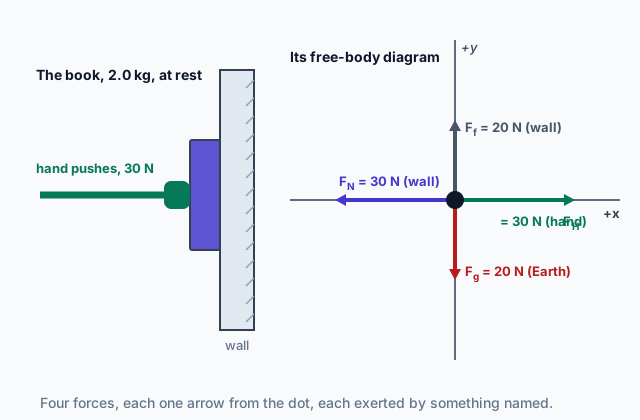
- Draw each force as one straight arrow that starts on the dot and points the way the force points, labeled with a symbol and what exerts it. Two forces that point the same way go side by side, not on top of each other.
Take a book held against a wall. Earth pulls it down, the hand pushes it into the wall, and the wall touches it, pushing back with a normal force and holding it up with friction.
Leave off forces the object exerts on other things (the book's push on the wall belongs on the wall's diagram), components, a net force arrow and any "force of motion".
Quick check · Draw the forces
A tennis player hits a ball, and it leaves the racket moving up and to the right. Air resistance is negligible. Build the free-body diagram of the ball a moment later, while it is still rising.
The dot is the ball. One diagram that fits
Pick each force exerted on the ball, then choose the way it points. The arrows are drawn for you.
2d. From the diagram to equations
A free-body diagram is how you get to equations. Choose axes, then add up the parts of the forces along each one.
The choice that saves work is one axis parallel to the acceleration. Then the acceleration lies along a single axis, and on the perpendicular axis it is zero.
When the motion is given as a function, a derivative tells you where the acceleration points. A crate slides along a straight ramp with position measured along the ramp, in meters and seconds, with up the ramp positive. Its acceleration is m/s², so it points down along the ramp's surface. Take one axis along the ramp and the other perpendicular to it.
With those axes, the normal force lies on an axis, and the gravitational force is the one to split: along the ramp and into it, where is the ramp's angle. The components go in your equations, never on the drawing. Across the ramp there is no acceleration, so the parts there add to zero: . Along the ramp they add to , the relationship Topic 2.5 develops.
Quick check · Multiple choice
A box sits on a ramp fixed inside a delivery van and does not slide. The ramp is tilted 20° above the horizontal. The van speeds up along a straight, level road, and its position is , with in meters, in seconds and forward as positive. You will write equations from the box's free-body diagram on perpendicular axes, with the box's whole acceleration along one axis so that the parts of the forces along the other axis add to zero. Which pair of axes does that?
Part 3 Watch it done A cart hauled up a ramp
Watch each step, then do the last one yourself.
A winch hauls a 40 kg cart up a straight ramp tilted 30° above the horizontal, with its cable parallel to the ramp. Friction is negligible. The cart's position along the ramp, measured from the bottom with up the ramp positive, is , with in meters and in seconds. Use m/s². What is the tension in the cable at s?
Step 1 · List the forces on the cart
Earth pulls it down with N. Two things touch it: the ramp, which pushes with a normal force perpendicular to its surface, and the cable, which pulls with a tension up along the ramp. The winch pulls on the cable, not on the cart, so it gets no arrow of its own.
Step 2 · Draw it
A dot for the cart with three arrows starting on it: straight down, perpendicular to the ramp and away from it, and along the ramp toward the top. Gravity stays straight down even though the ramp is tilted.
Why this step?
Why not add an arrow for pointing down the ramp?
That is a component of the gravitational force, which is already on the diagram. A second arrow would count Earth's pull twice. Components appear in the equations, after you choose axes, never on the drawing.
Step 3 · Choose axes from the acceleration
Differentiate the position twice: and . The acceleration is along the ramp and positive, so up the ramp. Take up along the ramp and perpendicular to it, away from the surface. Now only has to be split.
Step 4 · Write the equations
Along the ramp: . Across it, where the acceleration is zero: , so N.
Your step · Calculate
Finish it. A 40 kg cart is hauled up a frictionless ramp tilted 30° above the horizontal by a cable parallel to the ramp, and its position along the ramp is , with in meters, in seconds and up the ramp positive. Using with m/s², what is the tension in the cable at s?
N
Part 4 Try it New situations
A tilted surface with motion along it, then three blocks on level floors. For the skier, picture axes along the slope and across it before you choose directions.
Try it · Draw the forces
A skier glides straight down a slope that drops to the right at 20° below the horizontal, speeding up. Friction from the snow is negligible, but air resistance is not. Build her free-body diagram, choosing each force's direction from the slope's directions and its length compared with the others. When one force is smaller than another, even slightly, draw its arrow shorter.
The dot is the skier. One diagram that fits
Pick each force exerted on the skier, then choose the way it points and how long its arrow is compared with the others. The arrows are drawn for you.
Try it · Rank it
Three identical 5.0 kg blocks sit on level floors, and none leaves its floor. A rope pulls block A with 20 N at 30° above the horizontal. A hand pushes block B with 20 N at 30° below the horizontal. A rope pulls block C with 20 N horizontally. Use m/s² and take up as positive. Rank the blocks by the normal force the floor exerts on each.
Greatest first
Give each one a place, 1 for first. Give two the same place if they are equal.
Your ranking: none yet
Part 5 Explain it Diagram, expression and graph
Nothing you type leaves this page. Check your answer against the model and each scoring point.
Free response is 50% of the exam score. This one is shaped like Question 2, Translation Between Representations.
Free-response practice · Question 2 style
A student pulls a sled of mass to the right across level ice with a rope held at a fixed angle above the horizontal. Friction and air resistance are negligible. The sled starts from rest at , and the student pulls harder and harder, so that the tension in the rope is , where is a positive constant. Take right as and up as .
(a) On paper, draw the free-body diagram of the sled while it is on the ice. Draw each force as a straight arrow starting on the dot, and label what exerts it.
(b) Starting from your diagram, derive an expression for the normal force that the ice exerts on the sled as a function of time, in terms of , , , and .
(c) On paper, sketch against from until the sled begins to lift off the ice. Label both intercepts in terms of the given quantities.
(d) Explain how the slope of your graph in (c) follows from the tension arrow on your diagram.
(e) A classmate says the normal force on the sled must equal , because the sled stays on level ice. Use your diagram to explain why the classmate is wrong.
Model answer
(a) A dot with three arrows starting on it: , exerted by Earth, straight down; , exerted by the ice, straight up; and , exerted by the rope, up and to the right at above the horizontal. No separate arrows for the parts of , no net force and no force of motion.
(b) The sled stays on the ice, so and the vertical parts add to zero: , so .
(c) A straight line with slope , starting at when and falling to at , when the rope's upward pull alone holds the sled up.
(d) The tension is the only force on the diagram that changes, and only its vertical part, , enters the vertical equation. That part grows by every second, so the ice has to push less every second, which is the slope . A steeper rope puts more of the growing tension into the vertical, so the line falls faster.
(e) The diagram has two upward forces, not one: the rope pulls partly upward, with vertical part , so the ice only has to supply the rest of the upward force that balances . The normal force is , less than for every .
Score your own answer. This is a self-check, not a grade. Tick each point your answer makes.
Part 6 Check yourself A ride on a force plate
The case questions use the force plate readings and the velocity fit. Answer them from those.
A 50 kg student stands on a force plate on the floor of an elevator; take up as positive and use m/s². The plate measures the force it exerts on her. The elevator starts from rest and rides down about two floors. A motion sensor's software fits the elevator's velocity with , with in meters per second and in seconds, for s. Some of the plate's readings:
| (s) | Plate force (N) |
|---|---|
| 0 | 398 |
| 1.0 | 452 |
| 2.0 | 501 |
| 3.0 | 547 |
| 4.0 | 603 |
Case question 1 · Draw the forces
Using the case, build the free-body diagram of the student at s, when the elevator is moving down and speeding up.
The dot is the student. One diagram that fits
Pick each force exerted on the student, then choose the way it points and how long its arrow is compared with the others. The arrows are drawn for you.
Case question 2 · Calculate
Using the fit and the fact that the vertical parts of the forces on the student add to , how large is the force the plate exerts on her at s? Up is positive.
Case question 3 · Multiple choice
Using the fit and the fact that the vertical parts of the forces on the student add to , at what time is the force the plate exerts on the student equal to her gravitational force?
The rest stand on their own and do not use the case.
Check yourself · Spot the error
A 3.0 kg box sits at rest on a rough ramp tilted 30° above the horizontal. A student builds its free-body diagram and writes an equation for each axis, using m/s². Tap the first line with a mistake.
Check yourself · Sort it
A backpack full of books hangs at rest by its strap from a hook on a coat stand, touching nothing else. Take the backpack and the books inside it as the system. Tap each force, then say whether it belongs on the system's free-body diagram.
On the diagram
Not on the diagram
Part 7 Keep it Bring back earlier ideas
The dot on a free-body diagram is a center of mass from Topic 2.1, and a projectile's motion from Topic 1.5 is what one downward force produces. Pulling them back up is what makes them last.
Bring it back · Calculate
A thin rod 2.0 m long lies along the x-axis from to m. Its linear mass density is , with in kilograms per meter and in meters, so it gets heavier toward m. At what value of is its center of mass?
Bring it back · Calculate
A ball rolls off a level ledge 20 m above the ground, moving horizontally at 12 m/s. Air resistance is negligible; use m/s². How far from the base of the ledge, measured horizontally, does the ball land?
In three lines
- A force is one object or system pushing or pulling on another, a vector named by both objects, and nothing exerts a net force on itself.
- Contact forces are the large-scale total of electric forces between atoms; gravity acts without touching.
- A free-body diagram puts each force on the object once, as an arrow from the dot; axes along the acceleration turn it into equations.
Exam strategy for this topic
- Section I, Multiple Choice: 42 questions in 85 minutes.
- Section II, Free Response: 4 questions in 95 minutes.
- This lesson's Explain it is shaped like free-response question 2, Translation Between Representations.
- A four-function, scientific, or graphing calculator is allowed on both sections of the exam.
When a free-response question asks for a free-body diagram, draw each force as one straight arrow that starts on the dot, label each with what exerts it, and put forces that point the same way side by side. Keep components off the drawing; they belong in the equations you write next.
Questions students ask
Do I draw force components on a free-body diagram?
No. Each force is drawn once, as one arrow pointing the way the force points. After you choose axes, you split the forces into components in your equations.
Is weight a force I should draw?
Yes, as the gravitational force exerted by Earth on the object, , pointing straight down. Label it with what exerts it, Earth, rather than calling it something the object has.
Why does every arrow start on one dot?
The dot stands for the center of mass, and a system can be treated as though all of its mass were there. Starting every arrow on the dot shows they all act on the same object.
How do I choose the axes?
Put one axis along the object's acceleration, which you can find by differentiating its position or velocity. Then the perpendicular axis has zero acceleration, and its forces add to zero.
Where does the force my object exerts on the floor go?
On the floor's diagram. A free-body diagram shows only forces exerted on the chosen object, and Topic 2.3 shows how each of those forces is paired with one the object exerts back.
Course alignment, for teachers
AP Physics C: Mechanics topic 2.2, Unit 2: Force and Translational Dynamics.
- Skill 1.A: Create diagrams, tables, charts, or schematics to represent physical situations.
- Skill 2.C: Compare physical quantities between two or more scenarios or at different times and/or locations within a single scenario.
- Skill 3.B: Apply an appropriate law, definition, theoretical relationship, or model to make a claim.
- Skill 3.C: Justify or support a claim using evidence from experimental data, physical representations, or physical principles or laws.
This lesson maps all 8 essential knowledge statements of the topic to the part that teaches each one: 8 are checked by a scored question. The map is in the lesson file.