Unit 2 · Topic 2.10 · about 30 minutes · 7 parts · 13 scored checks, 2 of them multiple choice, plus 2 from earlier lessons
AP Physics C: Mechanics 2.10: Circular Motion
Unit 2: 20 to 25% of the multiple-choice section
What you'll be able to do
- Describe the motion of an object moving in a circle: its acceleration toward the center and along the path, the forces that supply the acceleration toward the center, and its period and frequency.
- Describe a circular orbit with Kepler's third law, relating its period and radius to the mass of the central body.
Key vocabulary
| Term | What it means | The exam trap |
|---|---|---|
| Centripetal acceleration | The component of an object's acceleration directed toward the center of its circular path, with magnitude . | It is there even when the speed never changes; a steady speedometer reading on a curve does not mean zero acceleration. |
| Tangential acceleration | The rate at which an object's speed changes, , directed tangent to its circular path. | It changes only how fast the object goes, so an object moving at a constant speed on a circle has none, although it is still accelerating. |
| Uniform circular motion | Motion in a circular path at a constant speed. | Uniform describes the speed, not the velocity; the velocity's direction turns the whole time. |
| Period | The time to complete one full circular path, one full rotation or one full cycle of an oscillation. | On a graph of a repeating motion, measure a period from one point to the next point where the motion repeats, not from the start of the record to its end. |
| Frequency | The rate at which an object completes revolutions, in hertz (one per second), with . | A rate given per minute has to be changed to per second before it goes into with SI units. |
| Kepler's third law | For a satellite in a circular orbit of radius around a central body of mass , . | is measured from the center of the central body, not from its surface, so add the body's radius to an altitude before you use it. |
 Tap to open the picture full size
Part 1 Think first Pressed against the door
Commit to a guess first. Being wrong now makes the right idea stick better.
Predict first
You ride in the back seat of a car that turns sharply left at a steady speed. You slide across the seat until your right shoulder presses against the door, and you stay there through the turn. While the car turns, which way does the door push on you?
In short. An object moving in a circle has an acceleration component toward the center, the centripetal acceleration , and a component along the path, , whenever its speed changes.
- The net acceleration is the vector sum of the centripetal and tangential accelerations, which are perpendicular to each other.
- Real forces supply the net force toward the center: gravity, tension, a normal force or friction, acting alone, together or through their components.
- Uniform circular motion repeats with period and frequency , and a circular orbit obeys .
Part 2 Learn it Four ideas, with a check after each
2a. Acceleration toward the center
Calculus shows which way an object on a circle accelerates. Put the center at the origin and let an object move counterclockwise at a constant speed around a circle of radius :
Differentiate once and , which has size and is perpendicular to , tangent to the circle. Differentiate again and . The minus sign says the acceleration points from the object back toward the center, and its size is , usually written
with the radius of the path. This is the centripetal acceleration: the component of the acceleration directed toward the center of the path.
If the speed also changes, the acceleration has a second component along the path, the tangential acceleration . The two are perpendicular, and the net acceleration is their vector sum. A runner on a curve of radius 25 m, moving at 5.0 m/s and speeding up at 0.50 m/s², has m/s² and a net acceleration of m/s².
Quick check · Calculate
A test car drives counterclockwise, seen from above, around a flat circular track of radius 40 m. The distance it has covered along the track is , with in meters and in seconds, so it is speeding up. What is the magnitude of the car's net acceleration at s?
2b. Real forces supply it
Newton's second law says the net force points the same way as the acceleration. So for an object moving in a circle, the force components toward the center must add up to
"Centripetal" names a direction, not a new kind of force. On a free-body diagram you draw only the forces something actually exerts: gravity, tension, a normal force, friction. Then you ask which of them point toward the center.
Sometimes it is a single force. A puck on a string sliding in a circle on frictionless ice has only the string's tension pointing toward the center. Sometimes it is more than one force. At the top of a vertical loop, a roller coaster car rides upside down with the track above it, so the track's normal force and gravity both point down, toward the center:
The track can only push, so can never be negative. The smallest speed that keeps the car on the circle makes , leaving gravity as the only force that causes the centripetal acceleration: , so
Any slower and gravity pulls the car down more sharply than the loop curves, so it falls away from the track.
Quick check · Draw the forces
A student swings a pail of water in a vertical circle at the end of a rope. At the very top of the circle the pail is upside down, moving to the left, and the rope is taut. Air resistance is negligible. Build the free-body diagram of the pail and the water together at that instant.
The dot is the pail and the water. One diagram that fits
Pick each force exerted on the pail and the water, then choose the way it points. The arrows are drawn for you.
2c. Components of forces
Often no force points straight at the center, and only a component of a force does the job. Use one axis toward the center and one along the vertical: the acceleration is horizontal, so it lies along one axis.
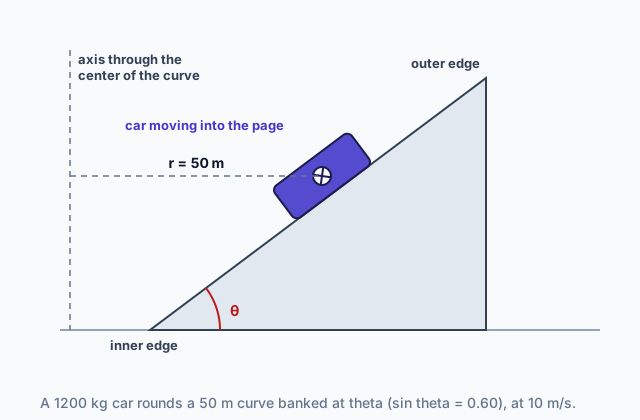
A banked curve. A road tilted toward the center of a curve pushes on a car perpendicular to its surface, so the normal force leans toward the center. Its horizontal component, , points toward the center, and its vertical component, , holds the car up. Static friction acts along the road's surface, so its horizontal component can add to the normal force's part or work against it, depending on which way along the slope friction points.
A conical pendulum. A ball on a string swings in a horizontal circle, so the string sweeps out a cone at an angle from the vertical. Only two forces act: gravity and tension. The tension's vertical component balances gravity, and its horizontal component points toward the center of the circle:
That is two equations in two unknowns, the tension and the speed. Notice that is the radius of the horizontal circle, not the length of the string.
Quick check · Calculate
A 0.20 kg ball hangs from a light string 0.50 m long and swings in a horizontal circle of radius 0.30 m, counterclockwise seen from above, so the ball stays 0.40 m below the point where the string is tied. Air resistance is negligible; use m/s². What is the ball's speed?
2d. Period, frequency and orbits
Motion in a circle at a constant speed is uniform circular motion, and it repeats. The period is the time to complete one full circular path, and the same word names the time for one full rotation or one full cycle of an oscillation. The frequency is the rate at which revolutions are completed, in revolutions per second, or hertz:
In one period the object goes once around, a distance , so , or .
For a satellite in a circular orbit, the gravitational force from the central body is the only force, so it alone causes the centripetal acceleration. Background from Topic 2.6: two objects of mass and whose centers are apart attract each other with a force of size . Setting that equal to with gives Kepler's third law for a circular orbit:
The satellite's own mass cancels. The period and radius depend only on each other and on the mass of the central body, which is how astronomers weigh a planet by timing its moons.
Quick check · Fill the statement
The tip of a ceiling fan blade moves at a steady speed around a circle of radius 0.60 m, counterclockwise seen from below, and makes 120 revolutions every minute.
The tip's frequency is , its period is , and its speed is .
Part 3 Watch it done A car on a banked curve
Watch each step, then do the last one yourself.
A 1200 kg car rounds a curve of radius 50 m at a steady 10 m/s, counterclockwise seen from above. The road is banked at an angle with and , about 37°, rising toward the outside of the curve. Take horizontal toward the center of the curve and up, and use m/s². What static friction force does the road exert on the car?
Step 1 · List the forces and the acceleration
Three forces act on the car: gravity, N, straight down; the normal force , perpendicular to the road, leaning toward the center; and static friction along the road's surface. Take as pointing up the slope; if it comes out negative, it points down the slope. The car's acceleration is m/s², horizontal, toward the center.
Why this step?
Why horizontal and vertical axes, and not axes along the slope?
The acceleration is horizontal, toward the center of the curve. With a horizontal axis the whole acceleration lies along it, so the vertical forces just add to zero. Axes along the slope would split the acceleration into two parts, and both equations would carry it.
Step 2 · Write one equation per axis
The normal force has parts toward the center and up. Friction up the slope has parts , away from the center, and , up. So
Step 3 · Solve for the normal force
Multiply the first equation by and the second by and add them; the friction terms cancel and . So N.
Your step · Calculate
Finish it. How large is the static friction force the road exerts on the car? Up the slope is positive for friction.
N
Part 4 Try it New situations
Try it · Decide and justify
A puck tied to a string slides in a circle on frictionless, horizontal ice, counterclockwise seen from above; take east as and north as . The string is the only horizontal force on the puck. Just as the puck passes the point due east of the center, moving north, the string snaps. Which way does the puck move just after?
Which reason supports your answer?
Try it · Match
An object moves in a circle at a constant speed. Match each change to what happens to its centripetal acceleration.
Try it · Rank it
Three children ride playground merry-go-rounds that turn at steady rates, counterclockwise seen from above. Ana sits 1.0 m from the center of a ride that turns once every 4.0 s. Ben sits 2.0 m from the center of the same ride. Cara sits 2.0 m from the center of a different ride that turns once every 8.0 s. Rank the children by the size of their centripetal acceleration.
Greatest first
Give each one a place, 1 for first. Give two the same place if they are equal.
Your ranking: none yet
On paper. The car from Watch it done now rounds the same banked curve at 25 m/s, faster than the speed, about 19 m/s, at which the road would need no friction at all. Draw its free-body diagram: each force a straight arrow starting on the dot, labeled with what exerts it, and no centripetal force. Decide which way friction points along the slope at this speed. Then write the horizontal and vertical equations from your diagram and check that the signs agree with your choice. There is nothing to submit here.
Part 5 Explain it Predict it, derive it, then compare
Nothing you type leaves this page. Check your answer against the model and each scoring point.
Free response is 50% of the exam score. This one is shaped like Question 4, Qualitative/Quantitative Translation.
Free-response practice · Question 4 style
A car of mass drives over the top of a hill at speed , moving to the right. Near the top, the road's cross section is a circular arc of radius that curves downward on both sides. Take up as positive, and ignore any forces along the road at the top.
(a) On paper, draw the free-body diagram of the car at the top of the hill. Draw each force as a straight arrow starting on the dot, and label what exerts it.
(b) Without writing equations, predict whether the normal force from the road at the top is greater than, less than or equal to . Briefly explain your reasoning.
(c) Derive an expression for the normal force exerted by the road on the car at the top, in terms of , , and .
(d) Explain whether your expression in (c) agrees with your prediction in (b). Then use it to find the greatest speed at which the car can pass over the top without leaving the road, and explain why.
Model answer
(a) A dot with two arrows: , exerted by Earth, straight down, and , exerted by the road, straight up. No centripetal force and no force of motion.
(b) Less than . At the top the car moves on a circle whose center is below it, so its acceleration points down, toward the center. The net force must point down too, so the downward gravitational force has to be larger than the upward normal force.
(c) With up as positive, the acceleration is , so and .
(d) It agrees: is minus a positive amount, so it is less than at any speed, and it gets smaller as the car goes faster. The road can only push, so cannot drop below zero. Setting gives . Faster than that, gravity alone cannot give the car the downward acceleration that following the arc takes, so the car leaves the road.
Score your own answer. This is a self-check, not a grade. Tick each point your answer makes.
Part 6 Check yourself Weighing a planet by its moons
The case questions use the probe's table. Answer them from it.
A space probe orbiting a distant gas giant times four of the planet's moons. Each moon's orbit is close to a circle centered on the planet, and all four moons orbit counterclockwise as seen from above the planet's north pole. The table gives each orbit's radius , measured from the planet's center, and each moon's measured period .
| Moon | ( m) | ( s) |
|---|---|---|
| A | 2.00 | 0.770 |
| B | 3.00 | 1.412 |
| C | 5.00 | 3.046 |
| D | 8.00 | 6.150 |
Case question 1 · Multiple choice
The probe team wants a graph of the table's data that is a straight line through the origin, so they can find the planet's mass from its slope. What should they plot?
Case question 2 · Calculate
Using moon B's radius and period and N·m²/kg², what is the planet's mass? Give your answer in units of kg.
Case question 3 · Multiple choice
A fifth moon is found orbiting the same planet at m, twice moon D's orbital radius. What period does Kepler's third law predict for it?
The rest stand on their own and do not use the case.
Check yourself · Sort it
Tap a card, then say what supplies the object's centripetal acceleration. Friction and air resistance are negligible unless a card names them.
One force aimed at the center
Two forces aimed at the center
Part of a force aimed elsewhere
Check yourself · Spot the error
A 0.50 kg ball on a 0.80 m string swings in a vertical circle. At the lowest point it moves to the right at 4.0 m/s. Take up as positive and use m/s². A student finds the tension in the string there. Tap the first line with a mistake.
Part 7 Keep it Bring back earlier ideas
This lesson stands on Newton's second law and on splitting forces into components. Pulling them back up is what makes them last.
On paper. A cart rides on a level aluminum track with negligible friction, and a magnet under it produces a braking force . A string over a pulley at the end of the track ties the cart to a hanging mass, so the hanging weight pulls the cart forward. With hanging weights of 0.10, 0.20, 0.30, 0.40 and 0.50 N, a class measured terminal speeds of 0.41, 0.78, 1.22, 1.59 and 2.02 m/s. Plot terminal speed against hanging weight, with a scale and units on each axis, and draw a best-fit line. Then describe how you would measure one of those terminal speeds in your own lab: what you would record, and how your data would show that the cart had stopped speeding up. There is nothing to submit here.
Check your graph: the points lie close to a line through the origin with slope about 4.0 m/s per newton. Since , the slope is , so kg/s. To show a run reached terminal speed, record position against time with a motion sensor and show that the velocity over the last few intervals stays the same within the sensor's precision.
From 2.9 Resistive Forces · Rank it
Four parachute toys are dropped from rest from a high balcony; take down as positive and use m/s². Model each one's air resistance as . Toy A has a mass of 0.10 kg and kg/s; toy B, 0.20 kg and 0.20 kg/s; toy C, 0.20 kg and 0.40 kg/s; toy D, 0.30 kg and 0.50 kg/s. Rank the toys by terminal speed.
Greatest first
Give each one a place, 1 for first. Give two the same place if they are equal.
Your ranking: none yet
A tilted surface with motion along it, then three blocks on level floors. For the skier, picture axes along the slope and across it before you choose directions.
From 2.2 Forces and Free-Body Diagrams · Rank it
Three identical 5.0 kg blocks sit on level floors, and none leaves its floor. A rope pulls block A with 20 N at 30° above the horizontal. A hand pushes block B with 20 N at 30° below the horizontal. A rope pulls block C with 20 N horizontally. Use m/s² and take up as positive. Rank the blocks by the normal force the floor exerts on each.
Greatest first
Give each one a place, 1 for first. Give two the same place if they are equal.
Your ranking: none yet
In three lines
- An object moving in a circle has a centripetal acceleration toward the center and, when its speed changes, a tangential acceleration ; the net acceleration is their vector sum.
- Real forces supply the net force toward the center, alone, together or through their components; at the top of a loop the minimum speed is .
- Period and frequency are reciprocals, for uniform circular motion, and a circular orbit obeys .
Exam strategy for this topic
- Section I, Multiple Choice: 42 questions in 85 minutes.
- Section II, Free Response: 4 questions in 95 minutes.
- This lesson's Explain it is shaped like free-response question 4, Qualitative/Quantitative Translation.
- A four-function, scientific, or graphing calculator is allowed on both sections of the exam.
On a free-response question about circular motion, draw only real forces, then write the second law along the radius with toward the center as positive: the force components toward the center add up to . Write that equation in symbols before you put in any numbers.
Questions students ask
Is there a centrifugal force pushing outward?
Not in a frame attached to the ground, which is where this course does its analysis. The outward feeling in a turning car is your body keeping its motion while the car turns, until the seat or the door pushes you inward. Every real force on an object moving in a circle has to be named by what exerts it, and none of them pushes outward.
Why is the minimum speed at the top of a vertical loop ?
At the top, the track's push and gravity both point down toward the center, so . The track can only push, so the smallest speed is the one that makes , leaving and .
Does a heavier satellite take longer to orbit?
No. In the satellite's mass appears on both sides and cancels, so the period at a given radius depends only on the mass of the central body.
How do I know which way friction points on a banked curve?
Assume a direction along the slope, write the horizontal and vertical equations, and solve. A negative answer means friction points the other way. As a check, a car slower than the speed at which the road needs no friction tends to slide down, so friction points up the slope, and a faster car needs friction pointing down the slope.
What changes when the speed on the circle is not constant?
The acceleration gains a tangential component, , along the path. The centripetal part, , still uses the speed at that instant, and the net acceleration is the vector sum of the two.
Beyond the AP Exam
College Board sets this limit on what the AP Exam asks about this topic. Anything past it is not on the exam.
AP Physics C: Mechanics does not expect students to know Kepler's first or second laws of planetary motion.
Course alignment, for teachers
AP Physics C: Mechanics topic 2.10, Unit 2: Force and Translational Dynamics.
- Skill 1.A: Create diagrams, tables, charts, or schematics to represent physical situations.
- Skill 2.A: Derive a symbolic expression from known quantities by selecting and following a logical mathematical pathway.
- Skill 2.D: Predict new values or factors of change of physical quantities using functional dependence between variables.
- Skill 3.C: Justify or support a claim using evidence from experimental data, physical representations, or physical principles or laws.
This lesson maps all 14 essential knowledge statements of the topic to the part that teaches each one: 14 are checked by a scored question. The map is in the lesson file.