Unit 3 · Topic 3.1 · about 30 minutes · 7 parts · 13 scored checks, 1 of them multiple choice, plus 2 from earlier lessons
AP Physics C: Mechanics 3.1: Translational Kinetic Energy
Unit 3: 15 to 25% of the multiple-choice section
What you'll be able to do
- Describe the translational kinetic energy of an object in terms of its mass and velocity, , as a scalar whose value depends on the observer's frame of reference.
Key vocabulary
| Term | What it means | The exam trap |
|---|---|---|
| Translational kinetic energy | An object's translational kinetic energy is given by the equation , where is its mass and its speed. | The is the speed at one instant; an average velocity over an interval does not give the kinetic energy at any instant. |
| Scalar quantity | A quantity that has a size but no direction. Translational kinetic energy is a scalar quantity. | Writing an arrow over or reporting a kinetic energy as pointing east treats it as a vector; report only its size, in joules. |
| Frame of reference | The origin and axes, moving along with an observer, relative to which that observer measures positions and velocities. | A frame is set by how the observer moves, not by where the observer stands; two people at the same spot moving differently are in different frames. |
| Joule | The SI unit of energy: 1 J = 1 kg·m²/s². | A speed in kilometers per hour must be changed to meters per second before it goes into , or the result is not in joules. |
 Tap to open the picture full size
Part 1 Think first Twice as fast
Commit to a guess first. Being wrong now makes the right idea stick better.
Predict first
A 1000 kg car on a straight, level road speeds up from rest to 10 m/s. Later it speeds up again, from 10 m/s to 20 m/s. Which stretch takes the larger increase in the car's kinetic energy?
In short. An object's translational kinetic energy is : it grows in proportion to the mass and with the square of the speed.
- Kinetic energy is a scalar. It has no direction, it is never negative, and the kinetic energies of several objects add as plain numbers.
- From a position function, differentiate for the velocity at an instant and square it; by the chain rule, .
- Velocity depends on the observer's frame of reference, so different observers may measure different kinetic energies for the same object, each correct in its own frame.
Part 2 Learn it Four ideas, with a check after each
2a. Mass and speed squared
An object's translational kinetic energy is given by the equation
where is the object's mass and is its speed. "Translational" means the motion of the object as a whole along its path, as opposed to spinning, which comes later in the course. With mass in kilograms and speed in meters per second, comes out in joules: 1 J = 1 kg·m²/s².
The mass enters once and the speed enters squared. A 1500 kg car moving at 20 m/s has J.
When you know an object's position as a function of time, find its kinetic energy at any instant in two steps. Differentiate for the velocity, , at that instant, then square it:
The in the equation is the speed at one instant, so it comes from the derivative at that instant, not from the position or from an average over an interval.
Quick check · Calculate
A 2.0 kg cart moves along a straight track; take right as positive. Its position is , with in meters and in seconds. What is the cart's kinetic energy at s?
2b. A scalar
Translational kinetic energy is a scalar quantity: it has a size and no direction. The equation uses the speed, and the speed is squared, so the direction of motion drops out.
In two dimensions the speed comes from both velocity components, , so
A 1.0 kg puck with m/s and m/s has a speed of 13 m/s and J. A minus sign on a component tells you which way that component points, and squaring removes it.
Two results follow. Kinetic energy is never negative, and it is zero only when the object is at rest. And the kinetic energy of several objects together is the plain sum of their kinetic energies. Nothing cancels the way opposite velocities do, because there are no directions left to cancel.
Quick check · Sort it
Each card describes the velocity of the same 2.0 kg puck sliding on level ice, with east as and north as . Tap a card, then choose the puck's kinetic energy.
9.0 J
16 J
25 J
2c. It depends on who is watching
A velocity is always measured relative to something. An observer measures every velocity in their own frame of reference, the origin and axes that move along with them. Suppose a train moves east at relative to the ground, and a ball rolls east at relative to the train. A rider measures the ball's velocity as ; someone on the ground measures .
Kinetic energy uses the speed each observer measures, so different observers may measure different values of the translational kinetic energy of an object, depending on the observer's frame of reference. A passenger asleep in a seat has in the train's frame and in the ground's frame. Each value is correct in its own frame. Kinetic energy, like velocity, belongs to an object and a frame together.
Two habits follow. When you report a kinetic energy, know which frame it is in. And in one problem, measure every velocity in the same frame. Unless a problem says otherwise, use the ground's frame.
Quick check · Decide and justify
A 0.30 kg cup sits on a tray table in an airplane that flies east at a steady 250 m/s relative to the ground. A passenger is seated beside the cup. A flight attendant walks west, toward the back of the plane, at 1.0 m/s relative to the plane. Each of them finds the cup's kinetic energy in their own frame. Who measures the larger value?
Which reason supports your answer?
2d. Graphs and rates
Three graphs show what the square in does.
Kinetic energy against velocity is a parabola that opens upward, with its lowest point, , at . It is symmetric, because and give the same .
Kinetic energy against speed squared is a straight line through the origin with slope . That is how to get a mass from measured kinetic energies.
Kinetic energy against time follows from the velocity. By the chain rule,
So the slope of against is zero wherever or . When and have the same sign the object speeds up and rises; when they have opposite signs it slows down and falls. A cart that starts from rest with has , which rises faster and faster: the graph curves upward even though the velocity rises at a steady rate.
Quick check · Sketch the graph
A 0.50 kg ball is thrown straight up at 6.0 m/s and caught 1.2 s later at the height where it left the hand. Air resistance is negligible; use m/s². Sketch the ball's kinetic energy against time from 0 to 1.2 s. The first point, 9 J at , is fixed.
One shape that fits
Drag a point up or down, or tap it and use the arrow keys. The shape is checked, and so are the values the question lets you work out.
Part 3 Watch it done A passenger in a moving train
Watch each step, then do the last one yourself.
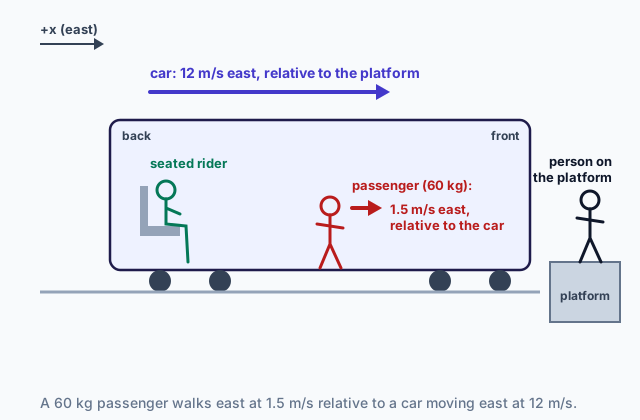
A 60 kg passenger walks toward the front of a train car at 1.5 m/s relative to the car. The car moves east at a steady 12 m/s relative to the platform, with its front facing east. A rider sits in the car, and a person stands on the platform. Take east as positive. What is the passenger's kinetic energy in the rider's frame, and in the platform's frame?
Step 1 · Find the velocity in each frame
The rider moves with the car, so in the rider's frame the passenger's velocity is m/s. The person on the platform sees the passenger carried east by the car and walking east within it, so the two velocities add: m/s.
Step 2 · Kinetic energy in the rider's frame
J.
Why this step?
Why not get the platform's value by adding the car's kinetic energy to the 67.5 J?
Velocities add from frame to frame, but kinetic energy goes with the square of the speed, and is not . It has an extra term, , that adding the two kinetic energies leaves out. Find the speed in the frame you want first, and square that.
Your step · Calculate
Finish it. What is the passenger's kinetic energy in the platform's frame?
J
Part 4 Try it New situations
Try it · Rank it
Four carts roll on level tracks. Cart A: 2.0 kg, moving east at 6.0 m/s. Cart B: 4.0 kg, moving east at 3.0 m/s. Cart C: 1.0 kg, moving east at 12 m/s. Cart D: 8.0 kg, moving west at 3.0 m/s. Rank the carts by kinetic energy.
Greatest first
Give each one a place, 1 for first. Give two the same place if they are equal.
Your ranking: none yet
Try it · Match
A cart rolls along a level track. Match each change to the cart's new kinetic energy, compared with its kinetic energy before.
Try it · Fill the statement
Two 1.5 kg carts roll toward each other on a level track; take east as positive. One moves east at 4.0 m/s and the other moves west at 4.0 m/s.
The sum of the two carts' velocities is , and the total kinetic energy of the two carts is .
On paper. For a 2.0 kg cart, make two sketches. First, sketch its kinetic energy against its velocity for velocities from m/s to m/s. Second, sketch its kinetic energy against the square of its speed, from 0 to 16 m²/s². Label each axis with its quantity and unit, and mark the kinetic energy at the largest value on each horizontal axis. Then write what the slope of the second graph equals, with its unit. There is nothing to submit here. When you have drawn both, compare: the first is a parabola that opens upward, symmetric about , from 16 J at m/s down to zero and back up to 16 J at m/s. The second is a straight line from the origin to 16 J at 16 m²/s², with slope kg, since J per m²/s² is kg.
Part 5 Explain it Predict it, derive it, then compare
Nothing you type leaves this page. Check your answer against the model and each scoring point.
Free response is 50% of the exam score. This one is shaped like Question 4, Qualitative/Quantitative Translation.
Free-response practice · Question 4 style
A student stands in a train car that moves east at a constant speed relative to the ground. She rolls a ball of mass along the floor toward the back of the car, to the west, at a speed relative to the car. Take east as positive.
(a) Suppose is much smaller than . Without writing equations, predict whether the ball's kinetic energy measured by an observer standing on the ground is greater than, less than or equal to the kinetic energy the student measures. Briefly explain your reasoning.
(b) Derive expressions for the ball's kinetic energy measured by the student and measured by the ground observer, in terms of , and , for less than .
(c) Explain whether your expressions in (b) agree with your prediction in (a).
(d) Find the value of , in terms of , for which both observers measure the same kinetic energy. Then explain how both observers can be correct when, for other values of , their values differ.
Model answer
(a) Greater. Relative to the student the ball rolls slowly, but the car carries it east at nearly the car's speed, so relative to the ground it still moves east almost as fast as the train. Kinetic energy depends on the speed each observer measures, so the ground observer's value is larger.
(b) In the student's frame the ball's velocity is , so . In the ground's frame its velocity is , so .
(c) They agree. When is much smaller than , is close to and much larger than , so and the ground observer's value is larger. More precisely, the ground value is larger whenever , that is, whenever .
(d) The values are equal when the speeds are equal: , so . Then the ball moves east at relative to the ground and west at relative to the car, and squaring removes the difference in direction. For any other the two observers measure different speeds, and since each uses the speed in their own frame, each value is correct in its own frame.
Score your own answer. This is a self-check, not a grade. Tick each point your answer makes.
Part 6 Check yourself A cart on a ramp
The case questions use the cart's readings. Answer them from the table.
A student gives a 0.60 kg cart a push up a straight ramp. A motion sensor at the foot of the ramp records the cart's velocity, with up the ramp as positive. The cart rolls up, stops for an instant and rolls back down. Friction is small enough to ignore. The table gives five of the sensor's readings, starting just after the push.
| (s) | (m/s) |
|---|---|
| 0 | 3.02 |
| 0.50 | 1.49 |
| 1.00 | 0.01 |
| 1.50 | −1.51 |
| 2.00 | −2.98 |
Case question 1 · Calculate
Using the reading at s, what is the cart's kinetic energy at that instant?
Case question 2 · Decide and justify
At which of the five readings did the cart have the least kinetic energy?
Which reason supports your answer?
The rest stand on their own and do not use the case.
Check yourself · Multiple choice
A runner moves east at a steady 5.0 m/s along a straight road. Each observer below finds the runner's kinetic energy in their own frame. Which observer measures the least kinetic energy?
Check yourself · Spot the error
A 3.0 kg cart moves along a straight track with velocity , in meters per second, with east as positive, from to s. A student finds the cart's greatest kinetic energy over that interval. Tap the first line with a mistake.
Check yourself · Select all
A 2.0 kg cart rolls east at 3.0 m/s, as measured by a person standing beside its track. Which of these would give a kinetic energy equal to the one that person measures? Select all that apply.
Select 2 answers, then check.
Part 7 Keep it Bring back earlier ideas
Two ideas from Unit 2 are due for review: centripetal acceleration from the last lesson, and friction from a few lessons back. Pulling them back up now is what makes them last.
On paper. The car from Watch it done now rounds the same banked curve at 25 m/s, faster than the speed, about 19 m/s, at which the road would need no friction at all. Draw its free-body diagram: each force a straight arrow starting on the dot, labeled with what exerts it, and no centripetal force. Decide which way friction points along the slope at this speed. Then write the horizontal and vertical equations from your diagram and check that the signs agree with your choice. There is nothing to submit here.
From 2.10 Circular Motion · Rank it
Three children ride playground merry-go-rounds that turn at steady rates, counterclockwise seen from above. Ana sits 1.0 m from the center of a ride that turns once every 4.0 s. Ben sits 2.0 m from the center of the same ride. Cara sits 2.0 m from the center of a different ride that turns once every 8.0 s. Rank the children by the size of their centripetal acceleration.
Greatest first
Give each one a place, 1 for first. Give two the same place if they are equal.
Your ranking: none yet
From 2.7 Kinetic and Static Friction · Rank it
Three crates sit on level floors, and each is pushed horizontally. Crate A: Earth pulls it down with 300 N, and ; it starts at rest and is pushed with 60 N. Crate B: Earth pulls it down with 100 N, and ; it is already sliding and is pushed along with 90 N. Crate C: Earth pulls it down with 200 N, and ; it starts at rest and is pushed with 70 N. Rank the crates by the size of the friction force the floor exerts on each.
Greatest first
Give each one a place, 1 for first. Give two the same place if they are equal.
Your ranking: none yet
In three lines
- An object's translational kinetic energy is , in joules; find at an instant by differentiating the position, then square it.
- Translational kinetic energy is a scalar: it is never negative, it does not depend on the direction of motion, and the kinetic energies of several objects add as plain numbers.
- Different observers may measure different values of an object's kinetic energy, depending on their frame of reference; find the speed in one frame and keep to it.
Exam strategy for this topic
- Section I, Multiple Choice: 42 questions in 85 minutes.
- Section II, Free Response: 4 questions in 95 minutes.
- This lesson's Explain it is shaped like free-response question 4, Qualitative/Quantitative Translation.
- A four-function, scientific, or graphing calculator is allowed on both sections of the exam.
When a free-response part asks you to compare kinetic energies, write in symbols for each case before you put in numbers, and say which frame every speed is measured in. Free-response comparisons ask you to justify, so a bare ratio with no reasoning leaves the reader nothing to credit.
Questions students ask
Can kinetic energy ever be negative?
No. The mass is positive and the speed is squared, so is zero for an object at rest and positive for any moving object, whichever way it moves.
Where does the come from?
It comes from an integral. Unit 3 builds up how a net force acting over a displacement changes an object's speed, and adding up from rest to a speed gives .
Which frame should I use?
Whichever the problem names, and the ground's frame when it names none. What matters is to measure every velocity in a problem in the same frame, and to say which one it is.
What does translational mean here?
It means the motion of the object as a whole from place to place. A spinning wheel also has kinetic energy from its rotation, which the course takes up in a later unit; this topic is only about motion along a path.
How do I find kinetic energy from a position function?
Differentiate the position to get the velocity at the instant you want, then square it and multiply by half the mass. With two components, square each one and add them before you multiply.
Course alignment, for teachers
AP Physics C: Mechanics topic 3.1, Unit 3: Work, Energy, and Power.
- Skill 1.C: Create qualitative sketches of graphs that represent features of a model or the behavior of the physical system.
- Skill 2.C: Compare physical quantities between two or more scenarios or at different times and/or locations within a single scenario.
- Skill 3.B: Apply an appropriate law, definition, theoretical relationship, or model to make a claim.
- Skill 3.C: Justify or support a claim using evidence from experimental data, physical representations, or physical principles or laws.
This lesson maps all 3 essential knowledge statements of the topic to the part that teaches each one: 3 are checked by a scored question. The map is in the lesson file.