Unit 2 · Topic 2.9 · about 30 minutes · 7 parts · 14 scored checks, 3 of them multiple choice, plus 1 from earlier lessons
AP Physics C: Mechanics 2.9: Resistive Forces
Unit 2: 20 to 25% of the multiple-choice section
What you'll be able to do
- Describe the motion of an object subject to a resistive force, by writing Newton's second law as a differential equation for velocity, solving it, and finding the terminal velocity.
Key vocabulary
| Term | What it means | The exam trap |
|---|---|---|
| Resistive force | A velocity-dependent force in the opposite direction of an object's velocity, such as . | The constant belongs to the object and what it moves through, such as a parachute's size or an oil's thickness, so it changes from one situation to the next. |
| Differential equation | An equation that relates a function to its own derivatives, such as for velocity. | Its solution is a function of time, not a single number. |
| Separation of variables | A method for solving a differential equation by moving every to the side with and every to the side with , then integrating each side. | Every , including the one inside a sum such as , has to move to the side before you integrate. |
| Terminal velocity | The maximum speed an object reaches while a constant force and a resistive force act on it in opposite directions, reached when the net force on it is zero. | The word terminal does not mean the motion ends; the object keeps moving. |
 Tap to open the picture full size
Part 1 Think first A skydiver's speed
Commit to a guess first. Being wrong now makes the right idea stick better.
Predict first
A skydiver steps out of a hovering helicopter and falls belly down, holding still, for a long time before she opens her parachute. How does her speed change during that fall?
In short. A resistive force depends on velocity and points opposite it, such as ; Newton's second law then becomes a differential equation for velocity, which you solve by separating the variables and integrating from the starting state.
- With , the second law reads plus any other forces: the acceleration depends on the velocity itself.
- Separate the variables, integrate each side between limits that describe the same two moments, and solve for ; then differentiate for acceleration and integrate for position.
- Velocity and acceleration are exponential and level off toward asymptotes set by the starting conditions and the forces. Position levels off only when no other force acts; with a constant force, it grows at a rate that approaches the terminal velocity. Terminal velocity is reached when the net force is zero.
Part 2 Learn it Four ideas, with a check after each
2a. A force that depends on velocity
Air on a falling parachute, oil on a sinking bead and the eddy currents a magnet stirs up in an aluminum track all push back on a moving object. Each is a resistive force: a force that depends on the object's velocity and points opposite to it. The simplest model makes it proportional to the velocity:
Here is a positive constant set by the object and what it moves through, with units of N·s/m, which is the same as kg/s. The minus sign is the whole point: whichever way the object moves, the resistive force points the other way.
Two things follow. The size of the force grows with the speed, so double the speed and you double the force. And an object at rest feels no resistive force at all. Unlike a weight or a steady push, a resistive force changes during the motion, because the velocity it depends on changes.
Quick check · Fill the statement
A small ball is launched straight up, rises, stops for an instant at the top and falls back down. Take up as positive, and model the air's force on it as .
While the ball rises, the resistive force on it points . At the instant the ball is at the top, the resistive force is . While the ball falls, the resistive force points .
2b. The second law becomes a differential equation
A 400 kg motorboat moving at 8.0 m/s cuts its engine and coasts in a straight line. Model the water's drag as with kg/s, and take the direction of motion as positive. The drag is the only horizontal force, so Newton's second law gives
This is a differential equation: it relates to its own derivative. You cannot integrate the right side over time, because is the unknown function of time. Instead, separate the variables, every with and every with :
Then integrate each side over limits that describe the same two moments: from the starting velocity at to the velocity at time .
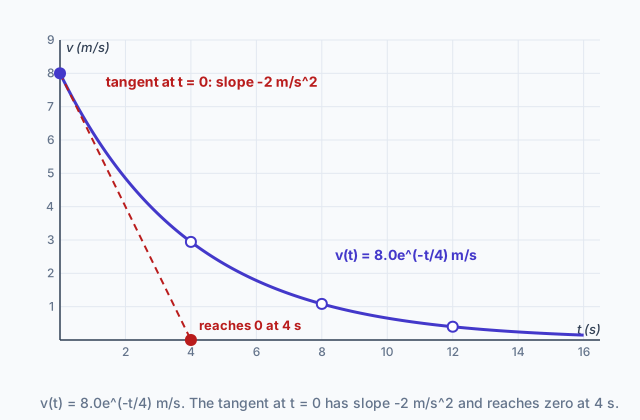
For the boat, s⁻¹, so m/s. The graph at the top of this page shows it.
Quick check · Calculate
A 2.0 kg cart coasts along a level aluminum track with negligible friction. A magnet on the cart produces a braking force with kg/s. Take the cart's direction of motion as positive. At it moves at 3.0 m/s. What is its velocity at s?
2c. Acceleration, position and asymptotes
Once you have , the rest of the motion comes from the calculus of Topic 1.2. For the boat, m/s.
Acceleration is the derivative: m/s². It starts at m/s², the slope of the dashed tangent in the graph, and shrinks along with the velocity.
Position is the integral, plus the starting position. With ,
All three are exponential, and each levels off toward an asymptote. As grows, shrinks toward zero, so the velocity and acceleration approach zero while the position approaches 32 m. The boat never quite stops, yet it never gets past 32 m, the whole area under its velocity curve.
Those asymptotes come from the starting conditions and the forces: change , , or and they move. Had the boat kept its starting deceleration, it would have stopped at 4 s, the point where the tangent reaches zero, after only 16 m.
Quick check · Decide and justify
A 0.60 kg puck slides across a level air table with negligible friction, through a magnetic field that exerts a braking force with kg/s. At it passes moving at 2.0 m/s in the direction. Does the puck ever get past m?
Which reason supports your answer?
2d. Terminal velocity
Now add a constant force that points against the resistive force. An object dropped from rest is the classic case. Take down as positive. The weight points down and the resistive force points up while the object falls, so
At the start , so the acceleration is . As the object speeds up, grows, the net force shrinks and the object gains speed more and more slowly. The velocity approaches the value at which the two forces balance and the net force is zero. That is the terminal velocity:
The constant force does not have to be a weight. A fan that pushes a cart with a steady force against a braking force gives by the same reasoning. For an object that starts from rest, the terminal velocity is the greatest speed it reaches. Notice what sets it: the forces, not the starting velocity.
For an object dropped from rest, the velocity works out to , as Watch it done shows for a parachute. Integrating it gives a position that never levels off: once the object nears terminal velocity, it falls about farther every second.
Quick check · Calculate
A 0.30 kg nose cone falls back to the ground under a small parachute. Model the air's force on it as with kg/s, and take down as positive. Use m/s². What is its terminal velocity?
Part 3 Watch it done A supply package on a parachute
Watch each step, then do the last one yourself.
A hovering drone releases a 2.0 kg supply package on a small parachute, from rest. Model the air's force on it as with kg/s, take down as positive and use m/s². Find the package's velocity as a function of time, and its velocity 1.0 s after release.
Step 1 · Write the second law
Down is positive. The weight, N, points down and the resistive force, , points up while the package falls, so , or .
Why this step?
Why not integrate with respect to to get the velocity?
The right side contains , which is the unknown function of time. To integrate over time you would already need . Moving every to the side with first leaves a time side that is easy to integrate.
Step 2 · Separate and integrate
. The package starts from rest, so the velocity side runs from 0 to while the time side runs from 0 to : , which gives .
Your step · Calculate
Finish it. Solve for the package's velocity as a function of time, then find its velocity 1.0 s after release. Down is positive. Give the velocity in m/s.
m/s
Part 4 Try it New situations
Try it · Rank it
Four parachute toys are dropped from rest from a high balcony; take down as positive and use m/s². Model each one's air resistance as . Toy A has a mass of 0.10 kg and kg/s; toy B, 0.20 kg and 0.20 kg/s; toy C, 0.20 kg and 0.40 kg/s; toy D, 0.30 kg and 0.50 kg/s. Rank the toys by terminal speed.
Greatest first
Give each one a place, 1 for first. Give two the same place if they are equal.
Your ranking: none yet
Try it · Multiple choice
A package of mass is released from rest and falls with a resistive force . Down is positive, and at release. Its velocity is . Which expression gives its position ?
On paper. A cart rides on a level aluminum track with negligible friction, and a magnet under it produces a braking force . A string over a pulley at the end of the track ties the cart to a hanging mass, so the hanging weight pulls the cart forward. With hanging weights of 0.10, 0.20, 0.30, 0.40 and 0.50 N, a class measured terminal speeds of 0.41, 0.78, 1.22, 1.59 and 2.02 m/s. Plot terminal speed against hanging weight, with a scale and units on each axis, and draw a best-fit line. Then describe how you would measure one of those terminal speeds in your own lab: what you would record, and how your data would show that the cart had stopped speeding up. There is nothing to submit here.
Check your graph: the points lie close to a line through the origin with slope about 4.0 m/s per newton. Since , the slope is , so kg/s. To show a run reached terminal speed, record position against time with a motion sensor and show that the velocity over the last few intervals stays the same within the sensor's precision.
Part 5 Explain it Derive it for a parachute that opens
On the exam this is handwritten, so answer on paper first. Nothing you type here leaves this page. Then check your answer against the model and each scoring point.
Free response is 50% of the exam score. This one is shaped like Question 1, Mathematical Routines.
Free-response practice · Question 1 style
A skydiver and her gear have total mass . She falls straight down, and at her parachute opens fully while she is moving at speed . From then on, model the air's force on her as , where is a constant and . Take down as positive.
(a) Write a differential equation for her velocity for .
(b) Derive an expression for in terms of , , , and .
(c) Derive an expression for her acceleration .
(d) On paper, sketch against from . Label and the value approaches.
(e) A classmate says that because the upward force on the skydiver is greater than her weight just after the parachute opens, she will start moving upward. Use your answers to explain why the classmate is wrong.
Model answer
(a) .
(b) Separate the variables and integrate from at to at : , so . Solving, .
(c) . Since , this is negative: the acceleration points up.
(d) A curve that starts at on the vertical axis, falls steeply at first and then more and more gently, and levels off toward a dashed horizontal line at without ever crossing it.
(e) An upward net force gives her an upward acceleration, which slows her fall; it does not reverse it. As she slows, shrinks toward , and the net force shrinks toward zero. From (b), approaches , which is positive, from above and never drops below it, so she keeps moving down.
Score your own answer. This is a self-check, not a grade. Tick each point your answer makes.
Part 6 Check yourself A fan cart on a magnetic brake
The case questions use the readings. Answer them from those.
A class puts a 0.50 kg fan cart on a level aluminum track with negligible friction. A magnet under the cart produces a braking force , and a force sensor shows that the fan pushes the cart forward with a steady 0.40 N. Take the cart's direction of travel as positive. The cart starts from rest at , and a motion sensor records its velocity:
| (s) | (m/s) |
|---|---|
| 0 | 0.00 |
| 0.5 | 0.32 |
| 1.0 | 0.50 |
| 1.5 | 0.63 |
| 2.0 | 0.69 |
| 3.0 | 0.76 |
| 4.0 | 0.79 |
| 5.0 | 0.79 |
Case question 1 · Calculate
Using the readings, estimate the braking constant . The direction of travel is positive.
Case question 2 · Decide and justify
Do the readings support the claim that the net force on the cart at s is less than half the fan's 0.40 N force? The direction of travel is positive.
Which reason supports your answer?
Case question 3 · Multiple choice
The class adds a 0.50 kg block to the cart and repeats the run from rest, with the same 0.40 N fan force and the same magnet. Compared with the first run, how does the cart's velocity behave?
The rest stand on their own and do not use the case.
Check yourself · Sort it
A raindrop falls from rest through still air. Model the air's force on it as , and take down as positive. Tap a card, then say how that quantity behaves as time goes on.
Approaches zero
Approaches a nonzero value
Grows without limit
Check yourself · Match
In each situation the only resistive force is , and is the velocity along the positive direction named. Tap a situation, then the second law for it.
Check yourself · Spot the error
A 1.5 kg cart coasts on a level magnetic braking track with negligible friction, with a braking force where kg/s. At it moves at 4.0 m/s in the positive direction. A student finds its velocity at s. Tap the first line with a mistake.
Part 7 Keep it Bring back earlier ideas
This lesson stands on Newton's second law with a force that depends on the motion, which Topic 2.8 started with springs, and on integrating to get velocity. Pulling them back up is what makes them last.
Bring it back · Multiple choice
A 3.0 kg cart starts from rest on a level track with negligible friction. A fan pushes it forward with a force that grows with time, , with in newtons and in seconds, and no other horizontal force acts. Take forward as positive. What is the cart's velocity at s?
From 2.8 Spring Forces · Calculate
A 0.60 kg cart sits on a level track with negligible friction. It is attached to an ideal spring with N/m whose other end is fixed to a wall on the left. Take right as positive, with where the spring is relaxed. The cart is pulled to m and released. What is the cart's acceleration at the moment it is released?
In three lines
- A resistive force such as points opposite the velocity and grows with speed, so Newton's second law becomes a differential equation for .
- Separate the variables, integrate between limits for the same two moments, then differentiate for acceleration and integrate for position.
- Velocity and acceleration are exponential and level off toward asymptotes set by the starting state and the forces; with a constant force, position keeps growing at nearly the terminal velocity, where the net force is zero.
Exam strategy for this topic
- Section I, Multiple Choice: 42 questions in 85 minutes.
- Section II, Free Response: 4 questions in 95 minutes.
- This lesson's Explain it is shaped like free-response question 1, Mathematical Routines.
- A four-function, scientific, or graphing calculator is allowed on both sections of the exam.
When a force depends on velocity, write Newton's second law with in it, separate the variables, and show the integral with its limits before you solve. Check your answer against the starting velocity at and against the terminal velocity you get by setting the net force to zero.
Questions students ask
Why can't I use the constant-acceleration equations here?
The resistive force depends on the velocity, so the net force and the acceleration change as the object speeds up or slows down. The constant-acceleration equations assume the acceleration never changes.
What are the units of k in F = -kv?
Newtons divided by meters per second, N·s/m, which is the same as kg/s. That is why has units of s⁻¹ and can sit in an exponent multiplied by .
Does an object ever actually reach its terminal velocity?
In the model, the velocity gets closer and closer but never quite arrives, because never reaches zero. In practice, after a few multiples of the difference is too small to measure.
Is air resistance always proportional to velocity?
No. A force proportional to velocity is the model this topic uses, and it fits slow motion through thick fluids and magnetic braking well. Faster motion through air is often better described by other models.
How do I pick the limits of integration?
Each side's limits describe the same two moments. If the object has velocity at , the velocity side runs from to and the time side from 0 to .
Course alignment, for teachers
AP Physics C: Mechanics topic 2.9, Unit 2: Force and Translational Dynamics.
- Skill 1.B: Create quantitative graphs with appropriate scales and units, including plotting data.
- Skill 2.A: Derive a symbolic expression from known quantities by selecting and following a logical mathematical pathway.
- Skill 2.C: Compare physical quantities between two or more scenarios or at different times and/or locations within a single scenario.
- Skill 3.A: Create experimental procedures that are appropriate for a given scientific question.
- Skill 3.C: Justify or support a claim using evidence from experimental data, physical representations, or physical principles or laws.
This lesson maps all 6 essential knowledge statements of the topic to the part that teaches each one: 6 are checked by a scored question. The map is in the lesson file.