Unit 2 · Topic 2.3 · about 30 minutes · 7 parts · 15 scored checks, 4 of them multiple choice
AP Physics C: Mechanics 2.3: Newton’s Third Law
Unit 2: 20 to 25% of the multiple-choice section
What you'll be able to do
- Describe the interaction of two objects or systems with Newton's third law, using a representation of the pair of forces each exerts on the other.
Key vocabulary
| Term | What it means | The exam trap |
|---|---|---|
| Newton's third law | When object A exerts a force on object B, B exerts a force on A of the same size in the opposite direction, . | Keep the subscripts in order when you write a pair: the first object exerts the force and the second receives it. |
| Internal force | A force that one part of a system exerts on another part of the same system. | Whether a force is internal depends on where you draw the system's boundary, so name the system before you sort the forces. |
| Tension | The pull a string, rope, cable or chain exerts, the net result of the forces its tiny segments exert on each other in response to an external force. | Tension is a pull along the rope. A rope can pull on an object, but it cannot push. |
| Ideal string | A string with negligible mass that does not stretch when under tension. | It is a model, so use it only when the question says or clearly implies the string is light and unstretchable. |
| Ideal pulley | A pulley with negligible mass that rotates about an axle through its center of mass with negligible friction. | The word ideal here describes the pulley, not the string over it, so check the string separately. |
 Tap to open the picture full size
Part 1 Think first Walking in a canoe
Commit to a guess first. Being wrong now makes the right idea stick better.
Predict first
A woman stands at the back of a canoe floating at rest on a still lake. She walks toward the front. Ignore any drag from the water. While she walks, what does the canoe do?
In short. Newton's third law says every force is one half of an interaction: when object A exerts a force on object B, B exerts a force on A of the same size in the opposite direction, .
- The two forces of a pair act on different objects, so they never appear on the same free-body diagram and never cancel for one object.
- Inside a system the pairs add to zero, so internal forces cannot change how the system's center of mass moves.
- Tension is the pull the segments of a rope exert on each other; it is the same everywhere in an ideal string, and it grows toward the top of a hanging rope with mass.
Part 2 Learn it Four ideas, with a check after each
2a. Forces come in pairs
Every force comes from an interaction between two objects, and an interaction always produces two forces, one on each object. When the woman in the canoe pushes back on the canoe with her foot, the canoe pushes forward on her foot. Newton's third law says those two forces are equal in size and opposite in direction:
To find the partner of a force, write it as "A on B" and swap the two objects. The partner of Earth pulling down on a bowling ball is the ball pulling up on Earth. It is not the floor pushing up on the ball: that push also acts on the ball, and two forces on the same object are never a third-law pair.
The two forces of a pair:
- act on different objects, so they never appear on the same free-body diagram and never cancel each other for one object;
- are the same type of force, so a contact push pairs with a contact push and a gravitational pull with a gravitational pull;
- start and stop together and are equal at every instant, whatever the masses or speeds of the objects.
Quick check · Multiple choice
A 5.0 kg lamp hangs at rest from a chain, and the chain hangs from a hook in the ceiling. Earth pulls down on the lamp with 50 N. Which force is the third-law partner of Earth's pull on the lamp?
2b. Internal forces cancel in the system
Choose a system, and every force sorts itself. A force that one part of the system exerts on another part is an internal force; a force from anything outside is external. Internal forces come in third-law pairs with both partners inside the system, so when you add up all the forces on the system, each internal pair adds to zero.
That is why internal forces cannot change how the system's center of mass moves. Take the 60 kg woman and the 30 kg canoe as one system, starting at rest, with the water's drag negligible. Her push on the canoe and the canoe's push on her are internal, so the center of mass
stays where it started. (Background from Topic 2.4: a system at rest stays at rest when the external forces on it add to zero, and here the only forces along the lake are internal.) Differentiate it, and the center of mass velocity stays zero:
If she moves forward at 0.40 m/s relative to the lake, then m/s. The canoe has half her mass, so it moves back twice as fast.
Only an external force can change the motion of the center of mass. Newton's second law, in Topic 2.5, says by how much.
Quick check · Calculate
An 80 kg astronaut and a 20 kg toolbox float together at rest in deep space, far from anything else. The astronaut shoves the toolbox away. During the shove, the toolbox's position measured from where it started is , with in meters and in seconds, for s. Take the direction the toolbox moves as positive. What is the astronaut's velocity at s?
2c. Tension in a rope with mass
Background from Topic 2.4: when an object stays at rest, the forces on it add to zero, so the upward forces equal the downward ones. This lesson uses that rule to find tensions.
A rope pulls because its pieces pull on each other. Imagine cutting a hanging rope at some height: the piece above pulls the piece below up, and by the third law the piece below pulls the piece above down just as hard. That shared size is the tension at that point, the net result of the forces the rope's tiny segments exert on each other.
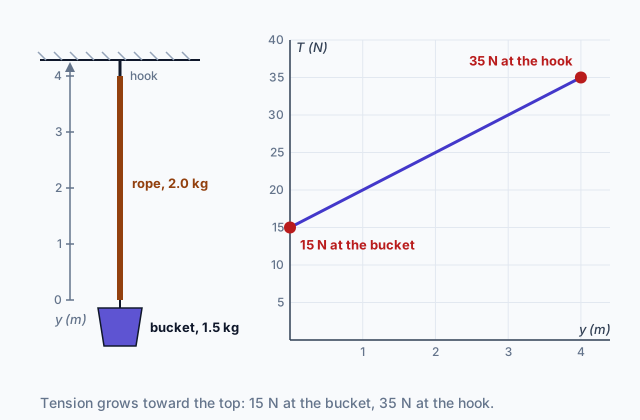
Take a uniform rope, 2.0 kg in mass and 4.0 m long, holding a 1.5 kg bucket. Measure up from the bottom of the rope and look at a thin slice from to . With the rope's mass per unit length, the slice's mass is . The rope above pulls it up with , the rope below pulls it down with , and Earth pulls it down with . The slice is at rest, so the up and down forces balance:
At the bottom the rope holds just the bucket, so N. Each meter adds N, and at the hook N. In a rope with mass, the tension is not the same at every point.
Quick check · Calculate
A uniform chain 2.0 m long, with a mass of 3.0 kg, hangs at rest from a hook in the ceiling. A 5.0 kg lamp hangs from its lower end. Take up as positive. What is the tension in the chain at its midpoint, 1.0 m below the hook?
2d. Ideal strings and ideal pulleys
Let the rope's mass shrink toward nothing and the slice equation becomes : the tension stops changing along the rope. That is the ideal string, a string with negligible mass that does not stretch when under tension. Its tension is the same at every point. That holds whether the string is at rest or speeding up, because a piece of string with negligible mass needs a negligible net force to move however it moves, so the pulls on its two ends match. Because it does not stretch, the objects tied to its two ends move the same distance along it.
An ideal pulley has negligible mass and turns on an axle through its center of mass with negligible friction. An ideal string over an ideal pulley has the same tension on both sides; the pulley only changes the direction of the pull. A pulley with a lot of mass, or an axle that drags, can leave the two sides with different tensions, and Unit 5 shows how much they differ.
Use these models when the question gives you permission: words such as light, massless, of negligible mass or frictionless. A heavy chain, a thick rope or a rusty pulley is not ideal.
Quick check · Sort it
Tap a card, then say whether the tension in that string, rope or chain is the same at every point along it.
Same at every point
Can differ from point to point
Part 3 Watch it done A cable that thickens toward the top
Watch each step, then do the last one yourself.
A cable 4.0 m long hangs at rest from a crane hook, with a 30 kg crate on its lower end. The cable is thicker near the top: measuring up from the bottom of the cable, its mass per unit length is , with in kg/m and in meters. Take up as positive. What is the tension in the cable at the hook?
Step 1 · Balance one slice
A slice from to has mass . The cable above pulls it up with , the cable below pulls it down with , and Earth pulls it down with . At rest these balance, so and .
Step 2 · Start from the bottom
At the cable holds only the crate, so N. Integrating the slice equation upward, , in newtons.
Why this step?
Why not multiply the density at the top by the cable's length?
The density changes along the cable, from 2.0 kg/m at the bottom to 4.0 kg/m at the top, so no one value of fits every meter. The integral adds up each slice's own mass, . Using the top value treats every meter as the thickest one.
Your step · Calculate
Finish it. What is the tension in the cable at the hook, m? Up is positive.
N
Part 4 Try it New situations
Try it · Rank it
Three ropes hang at rest from a ceiling, each with a block on its lower end. Rope P has negligible mass and holds a 4.0 kg block. Rope Q is uniform, has a mass of 1.0 kg and holds a 3.0 kg block. Rope R is uniform, has a mass of 2.0 kg and holds a 3.0 kg block. Rank the ropes by the tension at their midpoints.
Greatest first
Give each one a place, 1 for first. Give two the same place if they are equal.
Your ranking: none yet
Try it · Draw the forces
Block A, 2.0 kg, rests on top of block B, 3.0 kg, and block B rests on a level floor. Nothing moves. Build the free-body diagram of block B.
The dot is block B. One diagram that fits
Pick each force exerted on block B, then choose the way it points and how long its arrow is compared with the others. The arrows are drawn for you.
Try it · Decide and justify
A tugboat pushes a loaded barge from behind, and both speed up across a harbor. Take their direction of travel as positive. While they speed up, how does the size of the force the tug exerts on the barge compare with the size of the force the barge exerts on the tug?
Which reason supports your answer?
Part 5 Explain it Describe it, then derive it
Nothing you type leaves this page. Check your answer against the model and each scoring point.
Free response is 50% of the exam score. This one is shaped like Question 4, Qualitative/Quantitative Translation.
Free-response practice · Question 4 style
A uniform rope of mass and length hangs at rest from a hook in the ceiling, and a block of mass hangs from its lower end. Measure upward from the bottom of the rope, and take up as positive.
(a) Without writing any equations, describe how the tension in the rope changes from its bottom to its top, and explain why.
(b) On paper, draw a free-body diagram of a short slice of the rope between and . Label each force with the object that exerts it.
(c) Derive an expression for the tension in terms of , , , and physical constants, as appropriate.
(d) Explain how your expression in part (c) is consistent with your description in part (a), and state what it becomes if the rope's mass is negligible.
(e) The hook pulls up on the rope. Identify the third-law partner of that force and give its magnitude in terms of the given quantities.
Model answer
(a) The tension increases steadily from the bottom to the top. At the bottom the rope holds up only the block. Each point higher also holds up all the rope below it, so every bit of height adds the weight of one more bit of rope.
(b) Three straight arrows from the slice's dot: up, the pull of the rope above, ; down, the pull of the rope below, ; and down, the gravitational force exerted by Earth, . The two downward arrows are drawn side by side. Compare your diagram with that list.
(c) The slice is at rest, so , which gives . At the rope holds only the block, so . Then .
(d) The expression starts at at the bottom and rises linearly with , at the rope's weight per unit length, , as (a) describes. It reaches at the top. If is negligible, at every point, the single tension of an ideal string.
(e) The rope pulls down on the hook. That force has the same magnitude as the hook's pull on the rope, .
Score your own answer. This is a self-check, not a grade. Tick each point your answer makes.
Part 6 Check yourself A chain on a force sensor
The case questions use the sensor readings. Answer them from those.
A student hangs a force sensor from a stand, hangs a uniform chain from the sensor's hook, and hangs a 2.0 kg block from the chain's lower end. She repeats this with five pieces cut from the same chain, of different lengths , and records the sensor reading each time. Everything hangs at rest, and up is positive.
| (m) | Sensor reading (N) |
|---|---|
| 0.50 | 23.1 |
| 1.00 | 25.9 |
| 1.50 | 29.2 |
| 2.00 | 31.9 |
| 2.50 | 35.1 |
Case question 1 · Calculate
Using a straight line fit to the readings, what is the chain's mass per unit length?
Case question 2 · Multiple choice
With the 2.00 m piece of chain, about how large is the tension in the chain 0.50 m above the block?
Case question 3 · Multiple choice
With the 2.00 m piece of chain, the sensor's hook pulls up on the top of the chain with 31.9 N. Which force is the third-law partner of that pull?
The rest stand on their own and do not use the case.
Check yourself · Spot the error
Two skaters, A and B, stand at rest on smooth ice and push off each other. Friction is negligible, and B's direction of motion, to the right, is positive. A student reasons about the push. Tap the first line with a mistake.
Check yourself · Fill the statement
A cart on a level table is tied to a hanging block by a light string that does not stretch. The string runs over an ideal pulley at the table's edge, and the block speeds up as it falls. A force sensor in the string next to the cart reads 12 N.
The string pulls up on the hanging block with . The block pulls on the string with a force of the same size, directed .
Part 7 Keep it Bring back earlier ideas
This lesson stands on free-body diagrams and motion in two dimensions. Pulling them back up is what makes them last.
Bring it back · Multiple choice
A crate slides down a straight ramp tilted 30° above the horizontal, speeding up. Which choice of axes makes it simplest to turn the crate's free-body diagram into equations?
Bring it back · Calculate
A drone flies over a level field with position , with in meters and in seconds, where points east and points north. What is the drone's speed at s?
In three lines
- Every force has a third-law partner, , the same type of force acting on the other object, equal in size at every instant.
- Internal forces cancel in pairs, so only external forces can change how a system's center of mass moves.
- An ideal string, alone or over an ideal pulley, has one tension; in a rope with mass, and the tension grows toward the top.
Exam strategy for this topic
- Section I, Multiple Choice: 42 questions in 85 minutes.
- Section II, Free Response: 4 questions in 95 minutes.
- This lesson's Explain it is shaped like free-response question 4, Qualitative/Quantitative Translation.
- A four-function, scientific, or graphing calculator is allowed on both sections of the exam.
On a free-response question, name every force as one object on another, such as "the rope on the block". It makes the partner of each force easy to find, keeps the reaction force off the wrong free-body diagram, and shows a reader exactly which interaction you mean.
Questions students ask
If the two forces of a pair are equal and opposite, why does anything move?
Because they act on different objects. Each force can change the motion of the object it acts on, and the other force of the pair acts somewhere else. Forces cancel only when they act on the same object.
Does Newton's third law still hold when one object is much heavier or moving faster?
Yes. The two forces are equal in size at every instant of the interaction, whatever the masses and speeds. The lighter object usually changes its motion more, because the same size of force acts on less mass.
What makes a force internal?
Your choice of system. The push between two skaters is internal if the system is both skaters and external if the system is one skater. Internal forces cancel in pairs, so they cannot change the motion of the system's center of mass.
When is the tension the same everywhere in a rope?
When the rope can be modeled as an ideal string, with negligible mass and no stretch, and any pulley it runs over is ideal. A rope with mass, or a pulley with mass or axle friction, can have different tensions at different points.
Why do we need calculus for tension?
In a rope with mass the tension changes from point to point. Balancing the forces on a thin slice gives the rate of change, , and integrating it from a point where you know the tension gives the tension anywhere, even when changes along the rope.
Course alignment, for teachers
AP Physics C: Mechanics topic 2.3, Unit 2: Force and Translational Dynamics.
- Skill 1.A: Create diagrams, tables, charts, or schematics to represent physical situations.
- Skill 2.C: Compare physical quantities between two or more scenarios or at different times and/or locations within a single scenario.
- Skill 3.B: Apply an appropriate law, definition, theoretical relationship, or model to make a claim.
- Skill 3.C: Justify or support a claim using evidence from experimental data, physical representations, or physical principles or laws.
This lesson maps all 7 essential knowledge statements of the topic to the part that teaches each one: 7 are checked by a scored question. The map is in the lesson file.