Unit 2 · Topic 2.4 · about 30 minutes · 7 parts · 15 scored checks, 3 of them multiple choice
AP Physics C: Mechanics 2.4: Newton’s First Law
Unit 2: 20 to 25% of the multiple-choice section
What you'll be able to do
- Describe the conditions under which a system's velocity stays constant: find the net force on it as the vector sum of every force, check whether that sum is zero along each direction, and say which reference frames the first law holds in.
Key vocabulary
| Term | What it means | The exam trap |
|---|---|---|
| Net force | The vector sum of all forces exerted on a system, . | A diagram can show several large forces and still have a net force of zero, so the net force comes from the sum, never from the biggest arrow. |
| Translational equilibrium | The configuration of forces in which the net force exerted on a system is zero, . | The equation is a vector equation, so it stands for one equation per axis, and each must be checked. |
| Newton's first law | If the net force exerted on a system is zero, the velocity of that system remains constant. | The law is stated for a system, so choose the system before you list the forces exerted on it. |
| Inertial reference frame | A reference frame from which an observer would verify Newton's first law of motion. | The definition is a test made in the frame itself: watch an object with zero net force on it and see whether its velocity stays constant. |
 Tap to open the picture full size
Part 1 Think first The puck that keeps going
Commit to a guess first. Being wrong now makes the right idea stick better.
Predict first
A hockey player shoots a puck across smooth, level ice. Once it leaves the stick, friction and air resistance are small enough to ignore. While the puck slides, what keeps it moving forward?
In short. Newton's first law says that when the net force on a system, the vector sum of every force exerted on it, is zero, the system's velocity stays constant: the same speed in the same direction.
- Add forces as vectors, component by component. Translational equilibrium means , so the forces along each axis sum to zero.
- Forces can balance along one axis and not along another, and then the velocity changes only along the unbalanced direction.
- An inertial reference frame is one from which an observer would see the first law hold; a frame that speeds up, slows down or turns is not one.
Part 2 Learn it Four ideas, with a check after each
2a. Adding every force
A system usually has several forces exerted on it at once. The net force is their vector sum:
Add vectors by component, as in Topic 1.1: all the components together, then all the components.
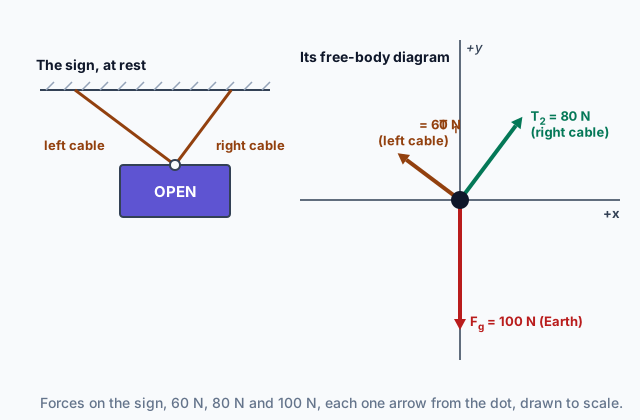
Take a sign hanging from two cables that meet at an eyelet on its top edge, so both cables pull on the sign itself (the diagram at the top of this page draws it). With to the right and up, the forces on it are N from the left cable, N from the right cable and N from Earth. Then
so the net force on the sign is zero. Adding the sizes, N, tells you nothing here. The cables pull partly sideways, in opposite directions, and only the components show how the forces combine.
Quick check · Calculate
A puck sits on a level air table, seen from above, with east and north. Its vertical forces balance, and three horizontal forces are exerted on it: N, N and N. What is the magnitude of the net force on the puck?
2b. Zero net force, constant velocity
When the net force on a system is zero, the system is in translational equilibrium:
It is a vector equation, so each component sums to zero on its own: and .
Newton's first law says what equilibrium does to motion: if the net force exerted on a system is zero, the system's velocity stays constant. At rest, it stays at rest. Moving, it keeps the same speed in the same direction. No force is needed to keep it going. Read the other way, an object whose velocity stays constant, watched from an inertial reference frame (see 2d, Frames where the law holds), has a net force of zero on it; Topic 2.5 shows why.
Constant velocity means at every instant. A cart at , in meters and seconds, has m/s throughout. A cart at has , which changes, so the forces on it cannot balance.
A velocity that passes through zero for an instant is still changing. So is the velocity of a car rounding a curve at a steady speed, because its direction turns.
Quick check · Sort it
Tap a card, then say whether the net force on the object is zero. Each one is watched from the ground.
Net force is zero
Net force is not zero
2c. Balanced one way, not the other
Equilibrium is checked one axis at a time, and the axes can disagree. The forces on a system can balance in one dimension and not in another. Then the velocity changes only in the direction of the unbalanced force, and the velocity component along the balanced axis stays constant.
Take a fan cart on a level track, with along the track and up, and friction negligible. Earth pulls it down and the track pushes it up with an equal force, so and stays zero: the cart neither sinks into the track nor lifts off it. Along the track the fan's push is the only force, so and changes.
So do not ask only whether an object is in equilibrium as a whole. Ask it of each axis. One component of the velocity can stay constant while the velocity as a whole changes, because another component is changing.
Quick check · Decide and justify
A puck slides east at 3.0 m/s across level, frictionless ice; take east as and north as . A steady wind then starts to push it north with a constant horizontal force, and nothing else horizontal is exerted on it. While the wind blows, what happens to the east component of the puck's velocity?
Which reason supports your answer?
2d. Frames where the law holds
Newton's first law does not hold for every observer. Sit in a bus that brakes hard, with a marble on the level floor that rolls with negligible friction. The marble rolls forward, speeding up relative to you, though nothing pushes it forward. From your seat its velocity changes with no net horizontal force on it, so the first law fails.
A friend on the sidewalk sees something simpler. The marble keeps moving forward at the bus's earlier velocity while the bus slows down under it. For her, zero net force goes with a constant velocity, and the first law holds.
An inertial reference frame is one from which an observer would verify Newton's first law. The sidewalk is one. The braking bus is not. A frame moving at a constant velocity relative to an inertial frame is inertial too, such as a train on a straight track at a steady speed. A frame that speeds up, slows down or turns is not. The ground is close enough to inertial for nearly every problem you will meet, and the laws of motion are applied from an inertial frame.
Quick check · Fill the statement
A jet speeds up from rest along a straight runway. A marble sits on a passenger's level tray and rolls with negligible friction.
As the jet speeds up, the marble rolls backward relative to the passenger, though nothing pushes it backward. In the jet's frame the first law , so that frame is . Seen from the ground, the marble's velocity while the jet speeds up under it.
Part 3 Watch it done A crate pulled at a steady speed
Watch each step, then do the last one yourself.
A worker pulls a crate across a level floor with a rope; take right as and up as . The rope exerts N on the crate, Earth exerts a 50 N gravitational force on it, and the floor exerts a normal force up and a friction force to the left. The crate's position is , with in meters and in seconds. Find the friction force and the normal force.
Step 1 · Check the velocity
m/s at every instant, and the crate stays on the floor, so . Both components are constant, so the crate is in translational equilibrium: , and each component of the net force is zero.
Why this step?
Why can the net force be zero when the crate is moving?
Moving at a constant velocity is what zero net force produces. The rope's forward pull does not have to beat the friction; if it did, the crate would speed up. Here the two cancel, and the crate keeps the 0.8 m/s it already has.
Step 2 · Sum the x components
, so N, to the left. The friction force equals the rope's horizontal component, not the rope's whole 30 N pull.
Your step · Calculate
Finish it. What is the size of the normal force the floor exerts on the crate? Up is positive.
N
Part 4 Try it New situations
Try it · Rank it
Three crates sit on level, frictionless floors, seen from above, and each has only these horizontal forces exerted on it. Crate A: 8 N east, 8 N west and 6 N north. Crate B: 6 N east and 8 N north. Crate C: 12 N east and 2 N west. Rank the crates by the magnitude of the net force on them.
Greatest first
Give each one a place, 1 for first. Give two the same place if they are equal.
Your ranking: none yet
Try it · Calculate
A metal ring lies on a level, frictionless table, seen from above, with east and north. Three horizontal strings hold it at rest. Two of them pull with N and N. What is the component of the third string's force?
Try it · Sketch the graph
A ball rolls off the edge of a level table at 2.0 m/s and falls for 0.50 s before it lands; take the direction it was rolling as , with at the table's edge. Air resistance is negligible. Sketch the shape of the graph of the ball's horizontal position against time while it falls.
One shape that fits
Drag a point up or down, or tap it and use the arrow keys. Only the shape is checked.
Part 5 Explain it Draw it, write it, sketch it
Nothing you type leaves this page. Check your answer against the model and each scoring point.
Free response is 50% of the exam score. This one is shaped like Question 2, Translation Between Representations.
Free-response practice · Question 2 style
A student pushes a sled across level snow at a constant velocity with a pole held at an angle below the horizontal; take right, the direction of motion, as and up as . The pole pushes on the sled with a force of size along the pole, and Earth's gravitational force on the sled is . The snow exerts a normal force and a friction force on the sled.
(a) On paper, draw a free-body diagram of the sled. Draw each force as a straight arrow starting on a dot, and label it.
(b) Derive expressions for and in terms of , and .
(c) The sled's position is , where and are positive constants. On paper, sketch the sled's velocity against time .
(d) A classmate says the normal force on the sled equals , because the sled does not move vertically. Use your answers to (b) and (c) to explain whether the classmate is right.
Model answer
(a) A dot with four arrows starting on it: straight down, straight up and longer than , down and to the right at angle below the horizontal, and to the left. The pole's push is one arrow, not split into components.
(b) The velocity is constant, so along each axis. Along : , so . Along : , so .
(c) , so the sketch is a horizontal line at the positive value , with the axes labeled and .
(d) The classmate is wrong. The flat graph in (c) shows the velocity is constant, so the forces balance along as well as . Along there are three forces, not two: the pole pushes partly downward, so (b) gives , more than . No vertical motion means the vertical forces add to zero, not that the normal force equals the gravitational force.
Score your own answer. This is a self-check, not a grade. Tick each point your answer makes.
Part 6 Check yourself A glider and a fan
The case questions use the sensor readings. Answer them from those.
A class tests the first law on a level air track; take the glider's direction of travel as positive. The air cushion makes friction negligible, and the vertical forces on the glider balance. A student pushes the glider and lets go before . At some moment during the run, a second student switches on a small fan mounted on the glider, which pushes it forward. A motion sensor records the glider's position:
| (s) | (m) |
|---|---|
| 0 | 0.501 |
| 0.5 | 0.699 |
| 1.0 | 0.902 |
| 1.5 | 1.099 |
| 2.0 | 1.298 |
| 2.5 | 1.502 |
| 3.0 | 1.700 |
| 3.5 | 2.001 |
| 4.0 | 2.498 |
Case question 1 · Multiple choice
Using the readings, during which interval was the net force on the glider zero?
Case question 2 · Calculate
Using the readings at and s, what was the glider's velocity over that interval? The direction of travel is positive.
Case question 3 · Multiple choice
A third student rides a cart that rolls beside the track at a steady 0.40 m/s in the positive direction, and she watches the glider from to s. Which statement about what she observes is correct?
The rest stand on their own and do not use the case.
Check yourself · Spot the error
An elevator rises at a steady 3 m/s; take up as positive. Its cable pulls up with tension , and Earth exerts an 8000 N gravitational force on it. A student finds . Tap the first line with a mistake.
Check yourself · Match
Tap a situation, then what happens to its velocity. Each one is watched from the ground.
Part 7 Keep it Bring back earlier ideas
This lesson stands on systems and interactions from Topics 2.1 and 2.3. Pulling them back up is what makes them last.
Bring it back · Multiple choice
A car tows a trailer along a straight, level road and is speeding up. How does the force the car exerts on the trailer compare with the force the trailer exerts on the car?
Bring it back · Calculate
A thin rod 2.0 m long has linear mass density , with in kilograms per meter and in meters measured from its left end. How far from the left end is the rod's center of mass?
In three lines
- The net force is the vector sum of every force on a system, found component by component with signs kept.
- Translational equilibrium is , and by Newton's first law a system in it keeps a constant velocity; forces can balance along one axis and not another, and only the unbalanced component of velocity changes.
- An inertial reference frame is one in which the first law can be verified; a frame that speeds up, slows down or turns is not one.
Exam strategy for this topic
- Section I, Multiple Choice: 42 questions in 85 minutes.
- Section II, Free Response: 4 questions in 95 minutes.
- This lesson's Explain it is shaped like free-response question 2, Translation Between Representations.
- A four-function, scientific, or graphing calculator is allowed on both sections of the exam.
On a free-response question that says an object moves at a constant velocity, write along each axis before anything else, then fill in the forces from your free-body diagram. A line such as shows the physics before the algebra.
Questions students ask
Does a moving object need a force to keep moving?
No. With zero net force its velocity stays constant, whatever that velocity is. Real objects slow down because friction or air resistance is a force against the motion, not because a forward force runs out.
Is an object at rest always in equilibrium?
Only if it stays at rest. A ball at the top of a straight-up throw is at rest for an instant, but its velocity is changing, so the net force on it is not zero.
What is the difference between translational equilibrium and the first law?
Translational equilibrium describes the forces: their vector sum is zero. The first law says what that does to the motion: the velocity stays constant.
Is the ground an inertial reference frame?
Not exactly, because Earth spins and orbits the Sun. The effects are small enough that the ground is treated as inertial in nearly every problem you will meet.
Course alignment, for teachers
AP Physics C: Mechanics topic 2.4, Unit 2: Force and Translational Dynamics.
- Skill 1.C: Create qualitative sketches of graphs that represent features of a model or the behavior of the physical system.
- Skill 2.B: Calculate or estimate an unknown quantity with units from known quantities, by selecting and following a logical computational pathway.
- Skill 2.C: Compare physical quantities between two or more scenarios or at different times and/or locations within a single scenario.
- Skill 3.C: Justify or support a claim using evidence from experimental data, physical representations, or physical principles or laws.
This lesson maps all 5 essential knowledge statements of the topic to the part that teaches each one: 5 are checked by a scored question. The map is in the lesson file.