Unit 2 · Topic 2.5 · about 30 minutes · 7 parts · 14 scored checks, 2 of them multiple choice, plus 1 from earlier lessons
AP Physics C: Mechanics 2.5: Newton’s Second Law
Unit 2: 20 to 25% of the multiple-choice section
What you'll be able to do
- Describe the conditions under which a system's velocity changes, using the net external force on the system and Newton's second law, .
Key vocabulary
| Term | What it means | The exam trap |
|---|---|---|
| Net force | The vector sum of all the forces exerted on a system, . | The net force is not one more force to draw on a free-body diagram; it is what the forces you drew add up to. |
| Unbalanced forces | A configuration of forces such that the net force exerted on a system is not equal to zero. | Add the forces with their directions before you decide. Comparing their sizes alone can mislead you. |
| Newton's second law | The acceleration of a system's center of mass has a magnitude proportional to the magnitude of the net force on the system and points in the same direction as that net force: . | A question that tells you only which way something moves has not yet told you which way the net force points. |
| System | The object or group of objects you choose to analyze; everything else is its environment. | Which forces count depends on the system you choose, so name the system before you add any forces. |
| Internal force | A force that one part of a system exerts on another part of the same system. | Being internal is not a property of the force itself: a string between two carts is internal to the pair but external to either cart alone. |
| Center of mass | The point of a system that moves as if all of the system's mass were there and every external force were exerted on it. | The center of mass is a point, not a piece of the system; it can sit in empty space between two objects. |
 Tap to open the picture full size
Part 1 Think first A steady push on ice
Commit to a guess first. Being wrong now makes the right idea stick better.
Predict first
A hockey puck sits on smooth ice, where friction is too small to matter. You hold your stick against it and push with the same steady force, never harder or softer. While you keep pushing, what does the puck do?
In short. Newton's second law says a system's center of mass accelerates in the direction of the net external force on the system, with , so a system's velocity changes only when the forces on it are unbalanced.
- Forces are unbalanced when their vector sum, the net force, is not zero; how fast or which way the system moves does not decide it.
- The size of the acceleration is proportional to the size of the net force and inversely proportional to the mass, and it points the same way as the net force.
- Only external forces count: forces between parts of a system cancel in pairs, and when the net force changes with time, divide by the mass and integrate.
Part 2 Learn it Four ideas, with a check after each
2a. Balanced or unbalanced
Every force on a system is a vector, so to find their combined effect you add them as vectors, directions and all. That sum is the net force:
In a tug of war, one team pulls the rope east with 300 N and the other pulls west with 260 N. Take east as positive: N, so the net force is 40 N east.
When the net force on a system is not zero, the forces are unbalanced. When it is zero, they are balanced. That is the whole test. You do not decide it from how fast the system moves, or from which way. A box can slide across a floor while its forces are balanced, and a ball can be at rest for an instant while its forces are not.
Forces can also balance along one axis and not another. Check each direction: add the components, then the components. If either sum is not zero, the forces are unbalanced.
Quick check · Sort it
Tap a card, then say whether the forces on the object are balanced or unbalanced.
Balanced
Unbalanced
2b. Newton's second law
Newton's second law says how unbalanced forces change motion. The acceleration of a system's center of mass has a magnitude proportional to the magnitude of the net force, and it points in the same direction as the net force:
A 1500 kg car with a net force of 3000 N forward accelerates at 2.0 m/s² forward. Double the net force and the acceleration doubles. Put the same net force on a 3000 kg truck and its acceleration is half as large.
The direction comes from the net force, not from the velocity. A car moving east while it brakes has a net force pointing west, so its acceleration points west too, and that is why it slows.
Because the law is a vector equation, it holds along each axis on its own: and . Find the components of the net force first, then divide each by the mass.
Quick check · Calculate
A 2.5 kg puck slides on frictionless, horizontal ice. Take east as and north as . Three horizontal forces are exerted on it: 8.0 N east, 2.0 N west and 8.0 N north, and its vertical forces cancel. What is the magnitude of the puck's acceleration?
2c. Systems: only external forces count
The second law is about a system, which can be one object or several. The forces that count are external forces, exerted on the system by things outside it. The forces parts of the system exert on each other are internal forces, and they come in Newton's third law pairs: equal in size and opposite in direction. Added together, each pair is zero, so internal forces never change the motion of the system's center of mass.
That gives the condition this topic is about: the velocity of a system's center of mass changes only if a nonzero net external force is exerted on the system.
Two skaters stand at rest on frictionless ice and push off each other. Each one speeds up, in opposite directions. The pushes are internal to the two-skater system, and gravity and the ice's normal force cancel, so the net external force is zero and the center of mass stays where it was.
The choice of system decides which forces are internal. Take an engine and the two train cars it pulls as the system. The couplings are internal, so all three accelerate together at the net external force, the track's push on the engine's driving wheels, divided by the total mass. Choose only the last car as the system, and the coupling force on it becomes external.
Quick check · Decide and justify
Two astronauts, 60 kg and 90 kg, float at rest beside each other in deep space, far from any planet or star. They push off each other and drift apart. While they push, does the velocity of the center of mass of the two-astronaut system change?
Which reason supports your answer?
2d. When the net force changes with time
The second law holds at every instant, so a net force that changes with time gives an acceleration that changes with time: . From there you integrate, as in Topic 1.2:
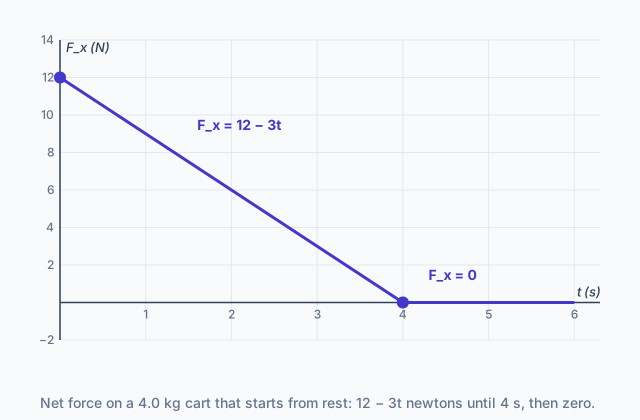
The graph at the top of this page shows the net force on a 4.0 kg cart that starts from rest: newtons for the first 4 s, then zero. Its acceleration is m/s², and
At 4 s that is m/s. Notice that the cart speeds up the whole time the force shrinks. A smaller positive net force still gives a positive acceleration, so the velocity still grows, only more slowly. After 4 s the net force is zero, and the cart keeps moving at 6 m/s.
A constant-acceleration equation such as does not fit here, because changes. When the force is a function of time, divide by the mass and integrate.
Quick check · Calculate
A 4.0 kg cart starts from rest on a level track with negligible friction. A motor pushes it so the net force on it is , with in newtons and in seconds. Take the direction of the push as positive. What is the cart's velocity at s?
Part 3 Watch it done A crate on a winch
Watch each step, then do the last one yourself.
A winch drags a 20 kg crate east across a level floor; take east as positive. The winch's pull is , with in newtons and in seconds. The crate starts from rest at and begins sliding at once, and while it slides the floor exerts a constant 20 N friction force on it, west. Its vertical forces cancel. What is the crate's velocity at s?
Step 1 · Add the forces
The horizontal forces are the pull, N, and friction, N. So N. The vertical forces cancel and add nothing.
Step 2 · Apply the second law
m/s². The acceleration starts at 0.5 m/s² and grows, so the crate gains speed faster and faster.
Why this step?
Why not divide the winch's pull by the mass?
The second law uses the net force, the sum of every force on the crate. Friction acts the whole time, and dividing the pull alone by 20 kg would give m/s², three times the true starting acceleration.
Your step · Calculate
Finish it. What is the crate's velocity at s? East is positive.
m/s
Part 4 Try it New situations
Try it · Rank it
Four carts move on level tracks with negligible friction. Cart A has a mass of 2.0 kg and a net force of 6.0 N on it; cart B, 4.0 kg and 12 N; cart C, 1.0 kg and 2.0 N; cart D, 3.0 kg and 15 N. Rank the carts by the magnitude of their acceleration.
Greatest first
Give each one a place, 1 for first. Give two the same place if they are equal.
Your ranking: none yet
Try it · Calculate
A student pulls a 1.5 kg cart along a level track with negligible friction, so that the net force on it is 6.0 N forward. She then sets a 0.50 kg block on the cart and pulls so that the net force is 9.0 N forward. By what factor does the acceleration change? Give the new acceleration divided by the old one.
Try it · Fill the statement
A cart rolls up a ramp with negligible friction and slows down as it goes. Take up the ramp as positive.
While the cart rolls up and slows, the net force on it points , which is the direction of the cart's .
Part 5 Explain it Design it, then find the mass from a graph
On the exam this is handwritten, so answer on paper first. Nothing you type here leaves this page. Then check your answer against the model and each scoring point.
Free response is 50% of the exam score. This one is shaped like Question 3, Experimental Design and Analysis.
Free-response practice · Question 3 style
A student wants to find the mass of a lab cart using Newton's second law. She has a level track with negligible friction, a force sensor with a handle that clips to the cart, a motion sensor, and the cart. Take the direction she pulls as positive.
(a) Describe a procedure she could use to collect data for a graph that gives . Say what she changes, what she measures and how, and one step that reduces experimental uncertainty.
(b) Her results are below. On paper, plot acceleration against net force, with a scale and units on each axis, and draw a best-fit line. Do this by hand before you open the model.
- Net force 0.20 N: acceleration 0.38 m/s²
- Net force 0.40 N: acceleration 0.81 m/s²
- Net force 0.60 N: acceleration 1.19 m/s²
- Net force 0.80 N: acceleration 1.62 m/s²
- Net force 1.00 N: acceleration 1.98 m/s²
(c) Use your best-fit line to calculate .
(d) She fixes a 0.25 kg block to the cart and repeats the experiment. Calculate the slope her new best-fit line should have.
Model answer
(a) Clip the force sensor to the cart and pull it along the track with a steady force, keeping the pull parallel to the track. Record the force sensor reading, which is the net force because friction is negligible and the vertical forces cancel. Use the motion sensor to record the cart's velocity against time and take the acceleration as the slope of that graph. Repeat with four or five different steady pulls. Repeat each pull a few times and average the accelerations. The slope gives the mass of everything the sensor accelerates, the cart plus the sensor, so measure the sensor's mass on a balance and subtract it to get .
(b) See the graph below: a labeled scale on each axis and one straight best-fit line through the points, not a line joining them.
(c) , so the slope of against is . From (0.20 N, 0.39 m/s²) and (1.00 N, 2.00 m/s²) on the line, the slope is kg⁻¹, so kg.
(d) The mass becomes kg, so the slope should be kg⁻¹, a less steep line.
Acceleration against net force, with the best-fit line
The line passes very near the origin and through (1.00 N, 2.00 m/s²).
Score your own answer. This is a self-check, not a grade. Tick each point your answer makes.
Part 6 Check yourself Two carts on a string
The case questions use the description and the readings. Answer them from those.
A student joins two carts with a light string on a level track with negligible friction. Cart A, 1.5 kg, is in front. Cart B, 0.50 kg, trails behind it on the string. She pulls cart A forward with a force sensor that reads a steady 4.0 N; take forward as positive. The carts start from rest, and a motion sensor records their velocity:
| (s) | (m/s) |
|---|---|
| 0 | 0.00 |
| 0.50 | 0.96 |
| 1.00 | 1.95 |
| 1.50 | 2.93 |
| 2.00 | 3.90 |
Case question 1 · Calculate
Take the two carts and the string as one system. What acceleration does Newton's second law predict for it? Forward is positive.
Case question 2 · Multiple choice
Which claim do the motion sensor readings support?
Case question 3 · Calculate
Now take cart B alone as the system, with the acceleration Newton's second law predicts for the pair. What force does the string exert on cart B? Forward is positive.
The rest stand on their own and do not use the case.
Check yourself · Spot the error
A rope lifts a 2.0 kg box that is moving upward, pulling up on it with 30 N. Take up as positive and use m/s². A student finds the box's acceleration. Tap the first line with a mistake.
Check yourself · Match
Each change is made to a cart on a level track with negligible friction. Tap a change, then what it does to the size of the cart's acceleration.
Part 7 Keep it Bring back earlier ideas
This lesson stands on Newton's first law and on integrating to get velocity. Pulling them back up is what makes them last.
Bring it back · Multiple choice
A hockey puck slides north across frictionless, horizontal ice. Take east as and north as . For a moment a stick held against it pushes it east with 0.5 N, while gravity, 1.7 N down, and the ice's normal force, 1.7 N up, act on it too. While the push lasts, what happens to the puck's velocity?
From 1.2 Displacement, Velocity, and Acceleration · Calculate
A cart on a straight track has velocity , with in meters per second and in seconds. At it is at m. Take the direction of increasing as positive. Where is the cart at s?
In three lines
- Forces are unbalanced when their vector sum, the net force on the system, is not zero, and only then does the system's velocity change.
- Newton's second law, , gives the acceleration of the center of mass: proportional to the net external force and in its direction.
- Internal forces cancel in pairs; when the net force changes with time, divide by the mass and integrate to find the velocity.
Exam strategy for this topic
- Section I, Multiple Choice: 42 questions in 85 minutes.
- Section II, Free Response: 4 questions in 95 minutes.
- This lesson's Explain it is shaped like free-response question 3, Experimental Design and Analysis.
- A four-function, scientific, or graphing calculator is allowed on both sections of the exam.
On a free-response question, show the second law as a sum before you put numbers in: name the system, write with each force as its own signed term, then substitute. When the force is given as a function of time, write the integral with its limits before you evaluate it.
Questions students ask
Is Newton's second law just F = ma?
Close, but the F is the net force, the vector sum of every external force on the system, and the a is the acceleration of the system's center of mass. Written as it says the acceleration is caused by the net force and points the same way.
Does a moving object need a net force to keep moving?
No. With a net force of zero the velocity stays constant, so a moving object keeps moving at the same speed in the same direction. A net force is needed to change the velocity, not to keep it.
What changes when the net force depends on time?
The second law still holds at each instant, so . Integrate that over time, adding the starting velocity, to get . The constant-acceleration equations only work when the net force is constant.
Why don't internal forces change how a system moves?
Each internal force has a third law partner, exerted by the other part, equal in size and opposite in direction. Each pair adds to zero, so only external forces are left in the net force on the system.
How can I measure a mass with Newton's second law?
Pull the object with several known net forces, measure each acceleration, and plot acceleration against net force. The slope of the best-fit line is one over the mass.
Course alignment, for teachers
AP Physics C: Mechanics topic 2.5, Unit 2: Force and Translational Dynamics.
- Skill 1.B: Create quantitative graphs with appropriate scales and units, including plotting data.
- Skill 2.B: Calculate or estimate an unknown quantity with units from known quantities, by selecting and following a logical computational pathway.
- Skill 2.D: Predict new values or factors of change of physical quantities using functional dependence between variables.
- Skill 3.A: Create experimental procedures that are appropriate for a given scientific question.
- Skill 3.C: Justify or support a claim using evidence from experimental data, physical representations, or physical principles or laws.
This lesson maps all 3 essential knowledge statements of the topic to the part that teaches each one: 3 are checked by a scored question. The map is in the lesson file.