Unit 2 · Topic 2.6 · about 30 minutes · 7 parts · 14 scored checks, 3 of them multiple choice, plus 2 from earlier lessons
AP Physics C: Mechanics 2.6: Gravitational Force
Unit 2: 20 to 25% of the multiple-choice section
What you'll be able to do
- Describe the gravitational interaction between two objects or systems with mass, with the law of universal gravitation and the gravitational field.
- Describe situations in which the gravitational force can be treated as constant.
- Describe when a system's apparent weight differs from the gravitational force exerted on it.
- Describe inertial mass and gravitational mass.
- Describe the gravitational force exerted on an object by a uniform sphere or a thin uniform spherical shell of mass.
Key vocabulary
| Term | What it means | The exam trap |
|---|---|---|
| Universal gravitation | Newton's law that any two masses attract each other with a force , where is the distance between their centers of mass. | is one constant for the whole universe, while is a field strength that changes from place to place, so the two cannot stand in for each other. |
| Gravitational field | The gravitational force a body would exert on a test object at a point, divided by the test object's mass, , in N/kg. | The field is set by the body making it and the place; the mass of the object you put there does not change it. |
| Weight | The gravitational force an astronomical body exerts on a small object near it, . | Weight is a force in newtons and mass is a quantity in kilograms, even though everyday speech uses one word for both. |
| Apparent weight | The magnitude of the normal force exerted on a system, which is what a scale reads. | Apparent weight is a magnitude, so it has no sign, even when you take up as positive to find it. |
| Inertial mass | The property that sets how strongly an object's motion resists change when it interacts with another object; the in Newton's second law. | Inertia is a property, not a force, so it never appears as an arrow on a free-body diagram. |
| Gravitational mass | The property that sets the size of the gravitational attraction between an object and other masses; the in . | That it equals inertial mass is a result of experiments, not part of either definition. |
| Equivalence principle | The principle that an observer in a noninertial reference frame cannot distinguish an object's apparent weight from the gravitational force a gravitational field exerts on it. | It is a statement about what can be measured from inside a frame; it does not say that gravity is not real. |
| Shell theorem | Newton's results for the net gravitational force a thin, uniform spherical shell of mass exerts on an object outside it or inside it. | A solid sphere is a set of nested shells, so sort its shells into those inside the object's distance from the center and those outside before you use the theorem. |
| Partial mass | The mass of a uniform sphere that lies within a distance of its center, . | It is a volume times a density, so it carries the cube of , not the square. |
 Tap to open the picture full size
Part 1 Think first Standing on Mars
Commit to a guess first. Being wrong now makes the right idea stick better.
Predict first
Mars has about one tenth of Earth's mass and about half of Earth's radius. Compared with the gravitational pull on you at Earth's surface, how strong is the pull on you at the surface of Mars?
In short. Any two masses attract each other with a force , and the gravitational field is that force per kilogram of the object being pulled, about 10 N/kg near Earth's surface.
- The distance runs between centers of mass, and the force on each object points along that line toward the other object.
- A scale reads the normal force, your apparent weight, which differs from the gravitational force on you whenever you accelerate up or down.
- Inertial mass and gravitational mass are equal, and a uniform sphere pulls on an outside object as if all its mass sat at its center.
Part 2 Learn it Four ideas, with a check after each
2a. Every mass pulls on every other mass
Any two objects with mass attract each other. Newton's law of universal gravitation gives the size of that pull:
Here N·m²/kg², a constant that is the same everywhere, and is the distance between the two objects' centers of mass, not between their surfaces. The force on each object can be taken to act at its own center of mass, and it points along the line joining the two centers, toward the other object. Gravity only ever attracts.
The force is proportional to each mass and inversely proportional to the square of the distance. Double one of the masses and the force doubles. Double the distance and the force falls to a quarter.
The pull is mutual. The force Earth exerts on you and the force you exert on Earth are a third-law pair from Topic 2.3: equal in size and opposite in direction. Earth's acceleration from your pull is tiny only because its mass is huge.
Quick check · Fill the statement
A 2000 kg asteroid and a 6000 kg asteroid drift in deep space, far from anything else, with their centers of mass 30 m apart.
The gravitational force the small asteroid exerts on the large one is the force the large one exerts on the small one. If the distance between their centers grew to 90 m, each force would become as large. If instead the small asteroid's mass doubled while they stayed 30 m apart, each force would become as large.
2b. The field, and weight
A field describes what a noncontact force would do to an object at each point in space. The gravitational field of a body of mass , at a point a distance from its center, is the force it would exert on a small test mass placed there, divided by :
Its unit is N/kg, and it points toward the body's center. The test mass cancels out, so the field belongs to the place, not to whatever you put there.
When gravity is the only force on an object, Newton's second law gives : its acceleration in m/s² is the same number as the field strength in N/kg where it is.
The gravitational force an astronomical body exerts on a small object near it is that object's weight, . Near Earth's surface, N/kg.
You can treat the field as constant when it barely changes over the motion. Differentiating gives , so a small rise changes the field by about , a fraction of . Climbing 100 m above a planet of radius 5000 km changes the field by 0.004%, far too little to matter.
Quick check · Calculate
A 500 kg probe coasts with its engines off, m above the surface of a planet with no air. The planet's mass is kg and its radius is m, and its gravity is the only force on the probe. Use N·m²/kg². What is the magnitude of the probe's acceleration?
2c. Apparent weight, and two kinds of mass
A bathroom scale does not measure the gravitational force on you. It measures how hard it pushes up on you, the normal force, and the magnitude of that normal force is your apparent weight.
Standing still, the normal force balances gravity, so the two are equal. While you accelerate, they are not. Ride an elevator that speeds up going upward at 3.0 m/s², taking up as positive: for a 50 kg rider, gives N, more than the 500 N gravitational force.
You appear weightless when nothing pushes on you: either no forces at all are exerted on you, or gravity is the only one. A diver who has left the board is weightless in this sense for the whole dive, though Earth still pulls on her with .
Mass plays two roles. Inertial mass is the in Newton's second law: how strongly an object resists a change in its motion. Gravitational mass is the in : how strongly it is attracted by other masses. Experiments find the two equal, which is why heavy and light objects fall with the same acceleration. It is also why the equivalence principle holds: an observer in an accelerating, noninertial frame cannot tell an object's apparent weight from the gravitational force a field exerts on it.
Quick check · Decide and justify
An astronaut floats beside her seat in a space station orbiting 400 km above Earth's surface. Earth's radius is 6400 km. Is the gravitational force Earth exerts on her zero?
Which reason supports your answer?
2d. Spheres and shells
A planet is not a point. To find its pull on a probe, split the planet into tiny pieces of mass , find the force each piece exerts on the probe, and add those forces as vectors, . For a uniform sphere the sum comes out simply, and Newton's shell theorem states the results. You use them; you do not need to prove them.
- Outside a thin, uniform spherical shell, the shell pulls on an object as if all its mass sat at its center.
- Inside a thin, uniform spherical shell, the forces from all its parts add to zero, wherever the object is.
A solid uniform sphere is a nest of thin shells. For an object outside it, every shell acts from the center, so the whole sphere does too, and is measured from the center. For an object inside it, at a distance from the center, the shells farther out than the object exert no net force. Only the partial mass, the part of the sphere within radius , pulls on it:
where is the sphere's density. Watch it done turns that partial mass into a force.
Quick check · Multiple choice
A hollow asteroid is modeled as a thin, uniform spherical shell with a mass of kg and a radius of 3.0 km. A 10 kg probe floats inside the hollow, 2.0 km from the shell's center and 1.0 km from the nearest point of the shell. Ignore every other body. Use N·m²/kg². What is the magnitude of the net gravitational force the shell exerts on the probe?
Part 3 Watch it done A probe deep inside a moon
Watch each step, then do the last one yourself.
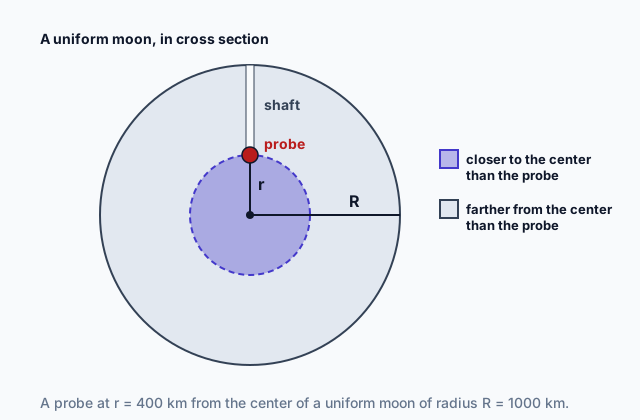
A small moon is a uniform sphere of mass kg and radius m. A 50 kg probe sits at the bottom of a shaft, m from the moon's center. Take the direction away from the center as positive. Use N·m²/kg². Find the gravitational force the moon exerts on the probe.
Step 1 · Find the density
The moon is uniform, so its density is its mass over its volume: .
Step 2 · Add up the shells inside the probe
A thin shell of radius and thickness has volume . Adding the shells from the center out to the probe, .
Why this step?
Why leave out the rock between the probe and the surface?
That rock is a set of thin shells, each with the probe inside it. By the shell theorem, the forces from all parts of each of those shells add to zero, so together they exert no net force on the probe.
Step 3 · Put the partial mass into the law
The partial mass pulls as if it sat at the center, a distance away, toward the center: . That is with , a constant for this moon and probe; the minus sign says the force points toward the center.
Your step · Calculate
Finish it. What is the magnitude of the gravitational force the moon exerts on the probe, m from the moon's center?
N
Part 4 Try it New situations
Try it · Rank it
A 60 kg rider stands on a scale in an elevator. Take up as positive and use N/kg. In case A the elevator moves up at a steady 3.0 m/s. In case B it moves up and speeds up at 2.0 m/s². In case C it moves down and speeds up at 2.0 m/s². In case D it moves down and slows down at 2.0 m/s². Rank the scale's reading in the four cases.
Greatest first
Give each one a place, 1 for first. Give two the same place if they are equal.
Your ranking: none yet
Try it · Calculate
Near Earth's surface the gravitational field is about 10 N/kg, and Earth's radius is m. A climber goes from sea level to a summit 3.2 km higher. Use to estimate how much weaker the field is at the summit than at sea level, as a positive number.
Try it · Sort it
Tap a card, then say which kind of mass the outcome depends on.
Inertial mass
Gravitational mass
Try it · Multiple choice
An astronaut wakes in a closed cabin with no windows. She holds a 2.0 kg wrench and a 0.020 kg pencil level with each other and lets go. Measured from the cabin, both fall side by side toward the floor at 10 m/s². What can she conclude from this alone?
Part 5 Explain it Derive it, then put numbers in
Nothing you type leaves this page. Check your answer against the model and each scoring point.
Free response is 50% of the exam score. This one is shaped like Question 1, Mathematical Routines.
Free-response practice · Question 1 style
A lander sets down on a planet with no air, of mass kg and radius m. An astronaut of mass kg stands on a scale bolted to the lander's floor. Take up as positive, and use N·m²/kg².
(a) Derive an expression for the magnitude of the gravitational force the planet exerts on the astronaut at the surface, in terms of , , and physical constants. Calculate its value.
(b) Just before touchdown, the lander moves down and slows down with an acceleration of magnitude . Derive an expression for the scale reading in terms of , , , and physical constants, and calculate it for m/s².
(c) The final descent starts 200 m above the surface. Using , estimate how much the field strength changes over those 200 m, and say whether treating the field as constant during the descent is reasonable.
(d) Earlier, with its engines off, the lander fell freely toward the planet. The astronaut says the scale read zero then because the planet's gravity had stopped acting on her. Explain what she has right and what she has wrong.
Model answer
(a) N, toward the planet's center. The field at the surface is N/kg.
(b) The forces on her are the normal force from the scale, up, and gravity, down. Moving down and slowing down means her acceleration points up, . So , which gives N.
(c) , so , which at the surface is N/kg per meter. Over 200 m the field changes by about N/kg, about 0.01% of 4.0 N/kg. That is negligible, so a constant field is reasonable for the descent.
(d) She is right that the scale read zero. The scale reads the normal force, and with gravity the only force on her and the lander, they fell together and the floor did not push on her. She is wrong that gravity stopped. The planet still pulled on her with , which is what made her and the lander accelerate toward it; gravity being the only force is what made her appear weightless.
Score your own answer. This is a self-check, not a grade. Tick each point your answer makes.
Part 6 Check yourself A lander at a small moon
The case questions use the lander's readings. Answer them from those.
A lander studies a small moon with no air, of radius m. At four heights above the surface, the lander holds still, releases a small test mass and measures its acceleration over the first meter of its fall. Toward the moon's center is positive. The readings:
| Height above the surface (m) | Measured acceleration (m/s²) |
|---|---|
| 0 (on the surface) | 1.51 |
| 0.95 | |
| 0.67 | |
| 0.37 |
Case question 1 · Calculate
Using the readings, predict the acceleration the lander would measure at a height of m above the surface. Toward the moon's center is positive.
Case question 2 · Multiple choice
Which value of the moon's mass do the readings support? Use N·m²/kg².
Case question 3 · Decide and justify
The lander holds still at m above the surface and releases a probe, which falls all the way to the surface. Toward the moon's center is positive. Can the probe's whole fall be modeled with one constant acceleration?
Which reason supports your answer?
The rest stand on their own and do not use the case.
Check yourself · Spot the error
Two uniform lead spheres, each 1000 kg with a radius of 0.30 m, sit on a lab bench with 0.40 m between their surfaces. Use N·m²/kg². A student finds the size of the gravitational force each exerts on the other. Tap the first line with a mistake.
Check yourself · Sketch the graph
A planet is a uniform sphere of radius 4000 km, and the gravitational field at its surface is 8.0 N/kg. Sketch the strength of the planet's field against distance from its center, from the center out to 8000 km. Points snap to the nearest 0.5 N/kg, so round any value that falls between grid lines.
One shape that fits
Drag a point up or down, or tap it and use the arrow keys. The shape is checked, and so are the values the question lets you work out.
Part 7 Keep it Bring back earlier ideas
This lesson stands on Newton's second and third laws from Topics 2.5 and 2.3. Pulling them back up is what makes them last.
From 2.5 Newton’s Second Law · Spot the error
A rope lifts a 2.0 kg box that is moving upward, pulling up on it with 30 N. Take up as positive and use m/s². A student finds the box's acceleration. Tap the first line with a mistake.
From 2.3 Newton’s Third Law · Calculate
An 80 kg astronaut and a 20 kg toolbox float together at rest in deep space, far from anything else. The astronaut shoves the toolbox away. During the shove, the toolbox's position measured from where it started is , with in meters and in seconds, for s. Take the direction the toolbox moves as positive. What is the astronaut's velocity at s?
In three lines
- Any two masses attract with , with between centers of mass, and the field is the force per kilogram; near Earth it is about 10 N/kg and nearly constant.
- A scale reads the normal force, your apparent weight, which equals only when you have no vertical acceleration; with gravity as the only force you appear weightless.
- Inertial and gravitational mass are equal; a uniform sphere pulls outside objects as a point at its center, and inside it only the partial mass pulls.
Exam strategy for this topic
- Section I, Multiple Choice: 42 questions in 85 minutes.
- Section II, Free Response: 4 questions in 95 minutes.
- This lesson's Explain it is shaped like free-response question 1, Mathematical Routines.
- A four-function, scientific, or graphing calculator is allowed on both sections of the exam.
When a free-response question asks for a gravitational force or field at some height, write as a sum, such as , and say what it is measured from before you substitute. For an object inside a uniform sphere, write the partial mass first, then put it into the law.
Questions students ask
What is the difference between and ?
N·m²/kg² is the universal gravitational constant, the same everywhere. is the gravitational field strength at a particular place, , which is about 10 N/kg near Earth's surface and different on the Moon or high above Earth.
Why don't I feel the pull of the person sitting next to me?
Because is so small. Two 70 kg people 1 m apart attract each other with about N, far less than the friction from your chair. Gravity only becomes large when at least one of the masses is enormous, like a planet.
Do I have to prove the shell theorem?
No. The course expects you to use its results for a thin uniform shell and a uniform sphere, not to derive them. You should be able to explain that a sphere's pull is the sum of the pulls of its small pieces.
When can I use N/kg?
Near Earth's surface, for motions over heights that are tiny compared with Earth's radius, the field barely changes and 10 N/kg works. Far from the surface, or on another body, find the field from .
Beyond the AP Exam
College Board sets this limit on what the AP Exam asks about this topic. Anything past it is not on the exam.
AP Physics C: Mechanics does not expect students to mathematically prove or derive Newton's shell theorem.
Course alignment, for teachers
AP Physics C: Mechanics topic 2.6, Unit 2: Force and Translational Dynamics.
- Skill 1.C: Create qualitative sketches of graphs that represent features of a model or the behavior of the physical system.
- Skill 2.A: Derive a symbolic expression from known quantities by selecting and following a logical mathematical pathway.
- Skill 2.D: Predict new values or factors of change of physical quantities using functional dependence between variables.
- Skill 3.B: Apply an appropriate law, definition, theoretical relationship, or model to make a claim.
This lesson maps all 24 essential knowledge statements of the topic to the part that teaches each one: 24 are checked by a scored question. The map is in the lesson file.