Unit 2 · Topic 2.7 · about 30 minutes · 7 parts · 13 scored checks, 2 of them multiple choice, plus 2 from earlier lessons
AP Physics C: Mechanics 2.7: Kinetic and Static Friction
Unit 2: 20 to 25% of the multiple-choice section
What you'll be able to do
- Describe kinetic friction between two surfaces: when it acts, which way it points on each surface, and how its size follows from the normal force and the materials in contact.
- Describe static friction between two surfaces: when it acts, how it takes the value and direction needed to prevent slipping, and the largest value it can reach.
Key vocabulary
| Term | What it means | The exam trap |
|---|---|---|
| Kinetic friction | The friction force between two surfaces in contact that move relative to each other. | Kinetic friction is a contact force, so it acts only where two surfaces touch; a ball in flight feels air resistance, not kinetic friction. |
| Static friction | The friction force that may act between two surfaces in contact that do not move relative to each other. | Static and kinetic friction never act between the same two surfaces at once: at any instant the surfaces either slide or they do not. |
| Coefficient of kinetic friction | A number with no unit, , that depends on the materials of the two surfaces and gives the size of kinetic friction as . | A coefficient of friction has no unit, so a value with newtons attached is a force, not a coefficient. |
| Coefficient of static friction | A number with no unit, , for a pair of surfaces; is the largest static friction force those surfaces can exert. | Coefficients above 1 do happen, for example for some rubbers on dry rough surfaces, so do not reject a value only because it is large. |
| Normal force | The component of the force a surface exerts on an object that is perpendicular to the surface; it points away from the surface. | The normal force and the object's weight are exerted by different things, the surface and Earth, so they are never a third-law pair, even when they are equal. |
| Slipping (sliding) | Two surfaces in contact moving relative to each other, one across the other. | The two words mean the same thing here, and neither is about speed: a very slow slide is still a slide. |
 Tap to open the picture full size
Part 1 Think first A box in a truck bed
Commit to a guess first. Being wrong now makes the right idea stick better.
Predict first
A box sits in the open bed of a pickup truck. The truck pulls away from a stop sign, speeding up, and the box does not slide; it speeds up along with the truck. While the truck speeds up, which way does the friction force from the truck bed on the box point?
In short. Friction is the force two touching surfaces exert on each other along their contact: kinetic friction, of size , when they slide across each other, and static friction, up to , when they do not.
- Kinetic friction on each surface points opposite that surface's motion relative to the other, and its size is the coefficient of kinetic friction times the normal force.
- Static friction takes whatever value and direction keep the surfaces from sliding, up to a largest value of .
- The normal force is the surface's perpendicular push, directed away from the surface, and it is found from the forces on the object, not assumed to equal the weight.
Part 2 Learn it Four ideas, with a check after each
2a. Kinetic friction between sliding surfaces
When two surfaces in contact slide across each other, each exerts a kinetic friction force on the other. Slide a book across a table and the table drags on the book's cover, and the book slows down.
The direction comes from relative motion. On each surface, kinetic friction points opposite the way that surface moves relative to the other one. The book slides east across the table, so the table's friction on the book points west. Seen from the book, the table slides west, so the book's friction on the table points east. Those two forces are a third-law pair.
Relative motion is what counts, even when both surfaces move. A crate on a flatbed truck that brakes hard can slide forward across the bed while the truck is still rolling forward. Friction on the crate points backward, against its slide over the bed.
How well two surfaces grip depends on what they are made of: rubber on dry concrete grips far better than steel on ice. That property of the pair of materials is the coefficient of kinetic friction, , a number with no unit, measured for each pair of surfaces.
Quick check · Draw the forces
A suitcase is set down on a level conveyor belt that moves east at a steady 0.8 m/s. At first the suitcase slides on the belt; a moment later it moves along with it. Seen from the side, with east to the right and up as up, build the suitcase's free-body diagram while it slides. The coefficient of kinetic friction between the suitcase and the belt is 0.30. Ignore the air. Choose each force's length compared with the others.
The dot is the suitcase. One diagram that fits
Pick each force exerted on the suitcase, then choose the way it points and how long its arrow is compared with the others. The arrows are drawn for you.
2b. How big kinetic friction is
The size of kinetic friction is the coefficient times the normal force:
The normal force is the part of a surface's push on an object that is perpendicular to the surface, and it points away from the surface. It measures how hard the two surfaces are pressed together, and it is not always the object's weight. Find it from the forces perpendicular to the surface.
A box that weighs 300 N slides across a level floor with . Alone, N and friction is 60 N. Press straight down on the box with an extra 100 N and the floor must push up with 400 N, so friction grows to 80 N. Lift on it instead, and and friction both shrink.
The area of contact does not appear in the equation, and it does not change the friction. A brick slid on its wide face or on its narrow end has the same normal force and the same materials touching, so it feels the same friction. Spreading the weight over more area presses each patch of surface more lightly, and the two effects cancel.
Quick check · Calculate
A child pulls a sled across level snow with a rope tilted 30° above the horizontal. The rope's tension is 120 N, Earth pulls down on the sled with 400 N, and the coefficient of kinetic friction between the sled and the snow is 0.15. The sled slides forward and speeds up. Take up as positive. What is the size of the kinetic friction force on the sled?
2c. Static friction: as much as it needs, up to a limit
When two surfaces touch but do not move relative to each other, static friction may act between them. Slipping and sliding both mean the surfaces move relative to each other; static friction is what keeps that from starting.
Static friction has no fixed size. It takes whatever value and direction prevent the surfaces from sliding, up to a limit:
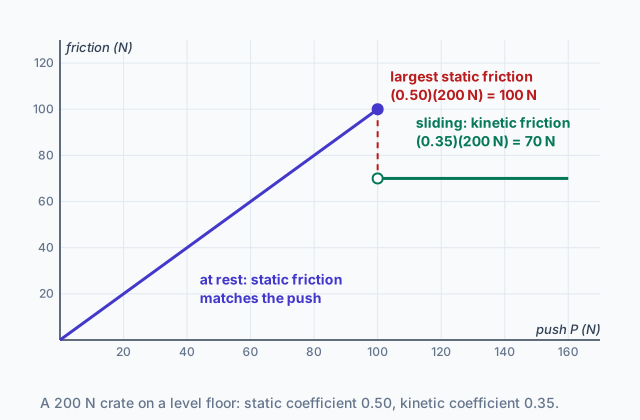
The graph at the top of this page is for a crate that weighs 200 N on a level floor with , pushed sideways harder and harder. Push with 30 N and static friction is 30 N the other way; push with 80 N and it is 80 N. The crate stays put and the net force on it stays zero. With no sideways push at all, static friction is zero, because there is nothing to balance.
The limit is N. A push above 100 N is more than static friction can match, so the crate starts to slide.
So is a ceiling, not the friction. Use it to decide whether something slips, or when an object is just on the point of slipping.
Quick check · Fill the statement
A worker pushes horizontally on a cabinet that weighs 500 N and sits at rest on a level floor. Between the cabinet and the floor, and . She pushes with 90 N, and the cabinet does not move.
The friction force on the cabinet is friction, and its size is . To start the cabinet sliding, she must push with more than .
2d. From sticking to sliding
For a given pair of surfaces, the coefficient of static friction is typically greater than the coefficient of kinetic friction. That is why a heavy crate is harder to start than to keep moving. In the graph, the crate's friction drops from 100 N to N the moment it starts to slide.
Once the surfaces slide, friction is fixed at ; it no longer adjusts to the push. Push the sliding crate with 120 N and friction stays 70 N, so the net force is 50 N.
When a push changes with time, use the two rules in turn. Before the slip, static friction balances the push and the acceleration is zero. The slip comes at the instant when the push reaches . After it, write
and integrate from the slip, when the velocity is still zero: .
Quick check · Decide and justify
A mover pushes horizontally on a dresser that weighs 600 N and sits at rest on a level floor, with and between them. Take the direction of her push as positive. She pushes harder and harder until the dresser just starts to slide, then keeps pushing with exactly the force she had at that instant, 270 N. What does the dresser do next?
Which reason supports your answer?
Part 3 Watch it done A trunk and a tightening rope
Watch each step, then do the last one yourself.
A 40 kg trunk sits at rest on a level floor, and Earth pulls down on it with 400 N. Between the trunk and the floor, and . Starting at , a horizontal rope pulls the trunk east with a tension that grows steadily, , with in newtons and in seconds. Take east as positive. What is the trunk's velocity at s?
Step 1 · Find when it starts to slide
The floor is level and the rope is horizontal, so N. Static friction can supply at most N. Until the tension reaches that, static friction matches it, pointing west, and the trunk stays put. at s.
Step 2 · Write the second law while it slides
From 4.0 s on, friction is kinetic: N, west. So , and , in m/s², for s. At 4.0 s that is 1.0 m/s².
Why this step?
Why does the acceleration jump from zero to 1.0 m/s² at 4.0 s, instead of growing from zero?
At the instant the trunk starts to slide, friction drops from the 200 N static limit to 160 N of kinetic friction, because is smaller than . The tension is still 200 N at that instant, so the net force jumps from zero to 40 N east.
Your step · Calculate
Finish it. The trunk's velocity is zero at s. What is its velocity at s? East is positive.
m/s
Part 4 Try it New situations
Try it · Rank it
Three crates sit on level floors, and each is pushed horizontally. Crate A: Earth pulls it down with 300 N, and ; it starts at rest and is pushed with 60 N. Crate B: Earth pulls it down with 100 N, and ; it is already sliding and is pushed along with 90 N. Crate C: Earth pulls it down with 200 N, and ; it starts at rest and is pushed with 70 N. Rank the crates by the size of the friction force the floor exerts on each.
Greatest first
Give each one a place, 1 for first. Give two the same place if they are equal.
Your ranking: none yet
Try it · Multiple choice
A student holds a book of mass flat against a vertical wall by pushing on it horizontally, straight into the wall, with a force of size . Between the book and the wall the coefficients of friction are and . Take up as positive. What is the smallest that keeps the book from sliding down?
Try it · Match
A wooden block slides across a level table while a horizontal string pulls it along. Tap a change, then what it does to the size of the kinetic friction force on the block.
Part 5 Explain it Design it, then find the coefficient from a graph
On the exam this is handwritten, so answer on paper first. Nothing you type here leaves this page. Then check your answer against the model and each scoring point.
Free response is 50% of the exam score. This one is shaped like Question 3, Experimental Design and Analysis.
Free-response practice · Question 3 style
A student wants to find the coefficient of kinetic friction between her sneaker and the gym floor. She has the sneaker, a force sensor with a hook, several small masses that fit inside the sneaker, and the level gym floor. Take the direction she pulls as positive.
(a) Describe a procedure she could use to collect data for a graph that gives . Say what she changes, what she measures and how, and one step that reduces experimental uncertainty.
(b) Her results are below. On paper, plot friction force against normal force, with a scale and units on each axis, and draw a best-fit line. Do this by hand before you open the model.
- Normal force 4.0 N: friction 1.9 N
- Normal force 8.0 N: friction 4.1 N
- Normal force 12.0 N: friction 5.9 N
- Normal force 16.0 N: friction 8.2 N
- Normal force 20.0 N: friction 9.9 N
(c) Use your best-fit line to calculate .
(d) Her partner repeats the experiment with the same sneaker on a freshly waxed floor, which is more slippery. Describe how the partner's best-fit line should compare with hers, and explain why.
Model answer
(a) Hang the sneaker from the force sensor to read its weight. On a level floor, with a horizontal pull and nothing else pushing up or down, the normal force equals that weight. Then hook the sensor to the sneaker and pull it horizontally across the floor at a slow, steady speed. At steady speed the net force is zero, so the sensor reading equals the kinetic friction. Add masses inside the sneaker, weigh it again, and repeat for four or five loads. Repeat each pull three times and average the readings, and keep the sensor level so it pulls only horizontally.
(b) See the graph below: a labeled scale on each axis and one straight best-fit line through the points, not a line joining them.
(c) , so the slope of friction against normal force is . From (4.0 N, 1.98 N) and (20.0 N, 10.02 N) on the line, the slope is , so , with no unit.
(d) The partner's line should be less steep, and it should still pass very near the origin. Its slope is the coefficient for rubber on a waxed floor, and a coefficient of friction depends on the materials of both surfaces in contact. Wax makes the floor more slippery, so the coefficient is smaller, and at each normal force the friction is smaller. With no normal force there is no friction on either floor.
Friction force against normal force, with the best-fit line
The line passes very near the origin and through (20.0 N, 10.02 N).
Score your own answer. This is a self-check, not a grade. Tick each point your answer makes.
Part 6 Check yourself Pulling a block with a force sensor
The case questions use the force sensor readings. Answer them from those.
A student lays a wooden block on a level board. Hanging the block from a force sensor shows that its weight is 20.0 N. She hooks the sensor to the block and pulls horizontally, gently at first and then harder, until the block starts to slide; then she keeps it sliding at a steady speed. The direction she pulls is positive. The sensor readings:
| (s) | Pull (N) | Block |
|---|---|---|
| 0 | 0.0 | at rest |
| 0.5 | 2.1 | at rest |
| 1.0 | 4.0 | at rest |
| 1.5 | 6.2 | at rest |
| 2.0 | 8.1 | starts to slide |
| 2.5 | 6.1 | sliding at a steady speed |
| 3.0 | 5.9 | sliding at a steady speed |
| 3.5 | 6.0 | sliding at a steady speed |
| 4.0 | 6.1 | sliding at a steady speed |
| 4.5 | 5.9 | sliding at a steady speed |
Case question 1 · Calculate
Using the readings, what is the coefficient of static friction between the block and the board?
Case question 2 · Calculate
Using the readings, what is the coefficient of kinetic friction between the block and the board?
Case question 3 · Multiple choice
The student turns the block onto one of its narrow faces, which touches the board with one third of the area, and repeats the same pull. What should she expect?
The rest stand on their own and do not use the case.
Check yourself · Sort it
Tap a card, then say which kind of friction, if any, the surface exerts on the object.
Static friction
Kinetic friction
No friction
Check yourself · Spot the error
A box sits at rest on a ramp tilted 30° above the horizontal. Earth pulls down on it with 50 N, and between the box and the ramp. A student finds the friction force on the box, taking up the ramp as positive along it and away from the ramp as positive across it. Tap the first line with a mistake.
Part 7 Keep it Bring back earlier ideas
This lesson stands on the normal force from Topic 2.6 and on integrating to get motion from Unit 1. Pulling them back up is what makes them last.
From 2.6 Gravitational Force · Rank it
A 60 kg rider stands on a scale in an elevator. Take up as positive and use N/kg. In case A the elevator moves up at a steady 3.0 m/s. In case B it moves up and speeds up at 2.0 m/s². In case C it moves down and speeds up at 2.0 m/s². In case D it moves down and slows down at 2.0 m/s². Rank the scale's reading in the four cases.
Greatest first
Give each one a place, 1 for first. Give two the same place if they are equal.
Your ranking: none yet
On paper. For the kicked ball in Watch it done, sketch its path with and axes labeled in meters. Mark its positions at , 1.5 s and 3.0 s. At each one, draw the velocity as an arrow, then draw its horizontal and vertical component arrows from the same point, labeled with their values. Use the same length for every 5 m/s. There is nothing to submit; check that your horizontal arrows are all the same length and that your vertical arrows shrink, vanish at the top and grow again pointing down.
From 1.5 Motion in Two or Three Dimensions · Calculate
A rover starts at the origin of a flat test field, with east as and north as . At its velocity is m/s, and its acceleration is , with in m/s² and in seconds. How far is the rover from its starting point at s?
In three lines
- Kinetic friction acts between sliding surfaces, opposite each surface's motion relative to the other, with size that does not depend on the area of contact.
- Static friction takes the value and direction that prevent slipping, up to , and is typically larger than .
- The normal force is perpendicular to the surface and away from it; find it from the forces, and when a push changes with time, integrate from the moment of slip.
Exam strategy for this topic
- Section I, Multiple Choice: 42 questions in 85 minutes.
- Section II, Free Response: 4 questions in 95 minutes.
- This lesson's Explain it is shaped like free-response question 3, Experimental Design and Analysis.
- A four-function, scientific, or graphing calculator is allowed on both sections of the exam.
On a free-response question, find the normal force from its own equation before you write any friction, and say which kind of friction acts and why. Write only for surfaces that slide; for surfaces that do not, find static friction from the other forces and compare it with .
Questions students ask
Why is the coefficient of static friction usually bigger than the kinetic one?
It is what is typically measured for a pair of surfaces, and you can feel it when a heavy box is harder to start than to keep moving. In this course you use the two coefficients as given; you do not need a model of why they differ.
Can a coefficient of friction be larger than 1?
Yes. It means the friction can be larger than the normal force. Some rubbers on dry, rough surfaces have coefficients near or above 1.
Is the normal force always equal to mg?
No. On a level surface it equals only when nothing else pushes or pulls perpendicular to the surface and the object does not speed up or slow down in that direction. An elevator speeding up is a level floor where is not . Write the forces perpendicular to the surface and solve for every time.
When do I use ?
To find the largest static friction, which tells you whether an object slips, or when a question says the object is just about to slip. Otherwise static friction is whatever value the other forces call for.
Which way does static friction point?
Opposite the way the surfaces would slide across each other if there were no friction. Find that direction first, from the other forces, and point static friction against it.
Course alignment, for teachers
AP Physics C: Mechanics topic 2.7, Unit 2: Force and Translational Dynamics.
- Skill 1.B: Create quantitative graphs with appropriate scales and units, including plotting data.
- Skill 2.A: Derive a symbolic expression from known quantities by selecting and following a logical mathematical pathway.
- Skill 2.B: Calculate or estimate an unknown quantity with units from known quantities, by selecting and following a logical computational pathway.
- Skill 3.A: Create experimental procedures that are appropriate for a given scientific question.
- Skill 3.B: Apply an appropriate law, definition, theoretical relationship, or model to make a claim.
This lesson maps all 11 essential knowledge statements of the topic to the part that teaches each one: 11 are checked by a scored question. The map is in the lesson file.