Unit 2 · Topic 2.8 · about 30 minutes · 7 parts · 14 scored checks, 2 of them multiple choice, plus 1 from earlier lessons
AP Physics C: Mechanics 2.8: Spring Forces
Unit 2: 20 to 25% of the multiple-choice section
What you'll be able to do
- Describe the force an ideal spring exerts on an object, its size from Hooke's law, , and its direction toward the equilibrium position, and tell an ideal spring from a nonideal one.
- Describe the equivalent spring constant of a set of springs exerting forces on one object, when the springs are all in series or all in parallel.
Key vocabulary
| Term | What it means | The exam trap |
|---|---|---|
| Ideal spring | A spring with negligible mass that exerts a force proportional to the change in its length as measured from its relaxed length. | Ideal is a model you choose; a real spring fits it only over some range of stretches, so check that range before you use it. |
| Nonideal spring | A spring that either has nonnegligible mass or exerts a force that is not proportional to the change in its length from its relaxed length. | Either reason on its own is enough to make a spring nonideal, so check both. |
| Spring constant | The constant in Hooke's law, the force per unit change in length, in newtons per meter, which says how stiff a spring is. | is in newtons per meter, so a change in length measured in centimeters has to be converted first. |
| Hooke's law | The force an ideal spring exerts on an object, , where is the change in the spring's length from its relaxed length. | The minus sign carries a direction, so the sign of your answer depends on which way you call positive. |
| Equilibrium position | The position at which the net force on the object is zero. For a spring on a level frictionless surface it is where the spring is relaxed; for a hanging object it is where the spring is stretched by . | Hooke's law measures the change in the spring's length from its relaxed length, which is the equilibrium position only when the spring is the only force along its line. |
| Equivalent spring constant | The constant of the single spring that would exert the same force on an object, for the same displacement, as a set of springs does. | It describes the whole set, so use it with the object's displacement, not with the change in length of any one spring. |
 Tap to open the picture full size
Part 1 Think first Two springs, end to end
Commit to a guess first. Being wrong now makes the right idea stick better.
Predict first
You hang a bag of apples from a light spring, and the spring stretches 6 cm. Then you hook a second spring, identical to the first, onto the bottom of the first one, end to end, and hang the same bag from the bottom of the pair. How far does the pair stretch in all?
In short. An ideal spring has negligible mass and exerts a force proportional to its change in length, , always directed toward the equilibrium position; several springs on one object act like one spring whose constant is the sum of theirs in parallel and the inverse of the sum of their inverses in series.
- Measure from the spring's relaxed length, and read the minus sign as a direction: the force points back toward the length where the spring is relaxed.
- In parallel, each spring changes length by the same amount and the forces add, so
- In series, each light spring carries the same force and the stretches add, so , which is smaller than the smallest constant in the set.
Part 2 Learn it Four ideas, with a check after each
2a. Ideal and nonideal springs
A spring has a relaxed length, the length it has when nothing stretches or squeezes it. What sets its force is the change in its length from there, : how far it has been stretched or compressed, not how long it is.
An ideal spring has negligible mass and exerts a force proportional to that change in length. Double the stretch and the force doubles. A spring that breaks either condition is nonideal: its own mass is not negligible, or its force is not proportional to its change in length.
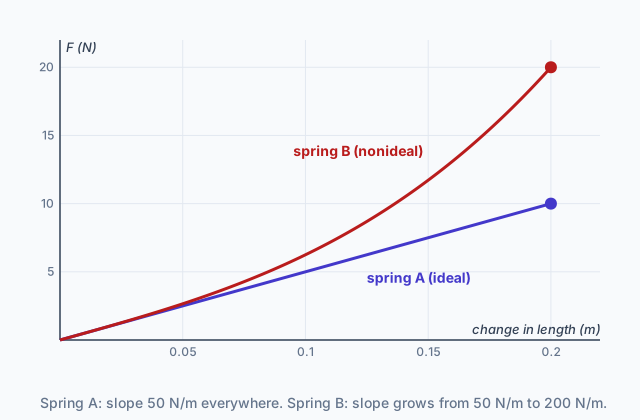
The graph at the top of this page shows both kinds. Spring A's force is , in newtons and meters, a straight line through the origin. Its slope, N/m, is the same at every stretch. Spring B's force is . Near the origin it matches A, but its slope, , climbs to 200 N/m at 0.20 m, so each extra centimeter of stretch takes more force than the last. Spring B is nonideal.
So a light spring is ideal over a range of stretches when a graph of its force against its change in length is a straight line through the origin there. Many real springs come close over a modest range and stop being ideal when stretched far.
Quick check · Sort it
Tap a card, then say whether the spring it describes is ideal or nonideal over the stretches given.
Ideal
Nonideal
2b. Hooke's law: size and direction
For an ideal spring, the force on the object at its end follows Hooke's law:
The spring constant , in N/m, is the spring's stiffness. is the change in the spring's length from its relaxed length: the displacement of the object on its end from the point where the spring is relaxed.
The minus sign is a direction. The force always points back toward that point: a stretched spring pulls the object back, and a compressed spring pushes it back out. When the spring is the only force along its line, as for a block on a level frictionless table, that point is the object's equilibrium position, where the net force on it is zero. A hanging object's equilibrium position is lower, where the spring is stretched by and pulls up as hard as gravity pulls down. Put where the spring is relaxed and the law reads . For a block on a level table, with N/m and right as positive, the force at m is N, to the left; at m it is N, to the right. Put in meters first.
The force depends on position, so the acceleration does too. With the spring the only horizontal force, the second law gives , which changes as the block moves. Constant-acceleration equations do not fit it.
Quick check · Calculate
A 0.60 kg cart sits on a level track with negligible friction. It is attached to an ideal spring with N/m whose other end is fixed to a wall on the left. Take right as positive, with where the spring is relaxed. The cart is pulled to m and released. What is the cart's acceleration at the moment it is released?
2c. Springs in parallel
Several springs that all exert forces on one object can act like a single spring. Its spring constant is the equivalent spring constant, : the constant of the one spring that would exert the same total force for the same displacement of the object.
Springs are in parallel when each one is attached to the object, so each one changes length by the same amount as the object moves. Take a platform resting on two springs side by side, 150 N/m and 250 N/m. Push the platform down 0.02 m and each spring compresses 0.02 m. The forces add:
So N/m. In general,
Parallel springs make a combination stiffer than any one of them, because every spring resists the same displacement at once.
Quick check · Fill the statement
A box hangs at rest from two light, ideal springs side by side. The springs have the same relaxed length, and both run from one ceiling bar to the same ring on top of the box. One spring has N/m and the other has N/m.
Both springs stretch by the amount. Together they act like one spring with , and the spring with N/m pulls up on the box with the larger force.
2d. Springs in series
Springs are in series when they are joined end to end, so the force passes from one spring through the next to reach the object. Treat each spring as ideal. With negligible mass, a spring cannot have a net force on it, so each one is pulled at both ends by the same force , the force on the object.
Each spring stretches by its own amount, and , and the object moves by the total:
The one equivalent spring would have , so
A 100 N/m spring and a 400 N/m spring in series give , so N/m. That is less than 100 N/m, and it always works out that way: the equivalent constant of springs in series is smaller than the smallest constant in the set, because each added spring adds stretch without adding force.
The rule also works backward. A uniform spring is its own pieces joined end to end, so each piece is stiffer than the whole spring.
This course asks for an equivalent spring constant only when the springs in a set are all in series or all in parallel, never a mix of the two.
Quick check · Decide and justify
A toy maker joins a 40 N/m spring and a 60 N/m spring end to end, hangs the 40 N/m spring from a hook and hangs a toy from the free end of the 60 N/m spring. Both springs are ideal. Is the pair stiffer than the 40 N/m spring would be on its own?
Which reason supports your answer?
Part 3 Watch it done A box on two springs in a row
Watch each step, then do the last one yourself.
A 3.0 kg box hangs at rest from two light, ideal springs joined end to end. The upper spring, N/m, hangs from a ceiling hook, and the lower spring, N/m, holds the box. Take down as positive and use m/s². How far below the position it would have with both springs relaxed does the box hang?
Step 1 · Find the force in each spring
The box is at rest, so the lower spring pulls up on it with a force equal to its weight, N. The lower spring has negligible mass, so the upper spring pulls up on it with the same 30 N. Each spring carries 30 N.
Step 2 · Find each spring's stretch
Upper spring: m. The lower spring carries the same 30 N, and it is stiffer, so it stretches less.
Why this step?
Why does each spring carry the whole 30 N, and not 15 N each?
In series, the springs do not share the load. The lower spring is the only thing holding up the box, and the upper spring is the only thing holding up the lower spring and the box. Because a light spring adds no weight and can have no net force on it, the upper spring must pull up with the same 30 N the box pulls down with.
Your step · Calculate
Finish it. How far below the position it would have with both springs relaxed does the box hang? Down is positive, and m/s². Give your answer in centimeters.
cm
Part 4 Try it New situations
Try it · Rank it
Four sets of light, ideal springs each hold one block. Set A is a single 30 N/m spring. Set B is two 40 N/m springs joined end to end. Set C is a 10 N/m spring and a 15 N/m spring side by side, both hooked to the block. Set D is a 60 N/m spring and a 120 N/m spring joined end to end. Rank the sets by their equivalent spring constant.
Greatest first
Give each one a place, 1 for first. Give two the same place if they are equal.
Your ranking: none yet
Try it · Calculate
One end of a light, ideal spring with N/m is fixed to a wall. At the spring is at its relaxed length, and a hand starts pulling its free end straight away from the wall at a steady 0.050 m/s. At what rate does the size of the spring's force on the hand grow?
Try it · Calculate
A 0.50 kg bag hangs at rest from a light, ideal spring and stretches it 6.0 cm. The spring is cut into two halves of equal length, and the same bag hangs at rest from one half. Take down as positive. How far does that half stretch?
On paper. Go back to the box hanging from two springs in Watch it done. Draw two free-body diagrams: one for the box, and one for the lower spring, treated as an object with negligible mass. Label each force with what exerts it and its size in newtons. Then use the second diagram to say why the upper spring must pull with the same force as the box. There is nothing to submit here; compare your reasoning with the why-step in Watch it done.
Part 5 Explain it Derive it, then put numbers in
On the exam this is handwritten, so answer on paper first. Nothing you type here leaves this page. Then check your answer against the model and each scoring point.
Free response is 50% of the exam score. This one is shaped like Question 1, Mathematical Routines.
Free-response practice · Question 1 style
A cart of mass sits on a level track with negligible friction between two walls. An ideal spring with constant joins the cart to the left wall, and an ideal spring with constant joins it to the right wall. With the cart at , both springs are at their relaxed lengths. Take right as positive. The cart is pulled right to and released.
(a) On paper, draw a free-body diagram of the cart at the moment it is released. Draw each force as an arrow starting on a dot, and label what exerts it.
(b) Derive an expression for the net force on the cart at , in terms of , and . Use it to write the equivalent spring constant of the two springs.
(c) The cart has kg, N/m, N/m and m. Calculate the cart's acceleration at the moment it is released.
(d) A classmate says the springs are in series because they sit in a line on either side of the cart, so . Explain what is wrong with the classmate's reasoning.
Model answer
(a) Four arrows from the dot. The gravitational force exerted by Earth points down, and the normal force exerted by the track points up, the same size. The force exerted by the left spring points left: that spring is stretched by , so it pulls the cart back toward the left wall. The force exerted by the right spring also points left: that spring is compressed by , so it pushes the cart away from the right wall.
(b) Each spring changes length by , and each force points toward equilibrium, so and . The vertical forces cancel, so . That has the form with .
(c) N/m, so N and m/s²: 8.0 m/s² to the left.
(d) In series, the force passes from one spring through the other, each spring carries the same force, and the stretches add. Here each spring is attached directly to the cart, each changes length by the cart's whole displacement , and both forces act on the cart in the same direction, so they add. That is the parallel case. The series formula would give 21 N/m and an acceleration of only 1.68 m/s².
Score your own answer. This is a self-check, not a grade. Tick each point your answer makes.
Part 6 Check yourself Measuring a spring
The case questions use the description and the readings. Answer them from those.
A student hangs a light spring from a clamp. Its relaxed length is 10.0 cm. She hangs slotted masses from its lower end, one load at a time, and measures the spring's length with a meter stick once the load hangs at rest. Take down as positive and use m/s². Her readings:
| Load (kg) | Spring length (cm) |
|---|---|
| 0.10 | 14.1 |
| 0.20 | 17.9 |
| 0.30 | 22.1 |
| 0.40 | 26.0 |
| 0.50 | 29.9 |
Case question 1 · Calculate
Using the readings, find the spring constant of the spring as the slope of the best-fit line of force against change in length. Use m/s².
Case question 2 · Multiple choice
Which claim about the spring, over this range of loads, do the readings support?
Case question 3 · Calculate
She hooks a second spring, with twice the first spring's constant, onto the bottom of the first one, end to end, and hangs the 0.30 kg load from the bottom of the pair. Using the readings, predict the total change in length of the pair once the load hangs at rest. Down is positive.
The rest stand on their own and do not use the case.
Check yourself · Spot the error
A block on a level, frictionless table is attached to an ideal spring with N/m whose other end is fixed to a wall on the left. Take right as positive, with where the spring is relaxed. The block is pushed toward the wall to m and held there. A student finds the spring's force on the block. Tap the first line with a mistake.
Check yourself · Match
Each set of light, ideal springs holds one object. Tap a set, then its equivalent spring constant.
Part 7 Keep it Bring back earlier ideas
This lesson uses Newton's second law, and an earlier idea from this unit is due for review. Pulling them back up is what makes them last.
Bring it back · Multiple choice
A 1.0 kg block rides on top of a 3.0 kg cart without sliding. The cart rolls on a level floor with negligible friction, and a rope pulls the cart forward with a steady 12 N. Take forward as positive. What horizontal force does the cart exert on the block?
From 2.1 Systems and Center of Mass · Calculate
A thin rod lies along the x axis from to m, with positive to the right. Its linear mass density is , with in kg/m and in meters. Where is the rod's center of mass?
In three lines
- An ideal spring has negligible mass and a force proportional to its change in length from its relaxed length; a spring that breaks either condition is nonideal.
- Hooke's law, , gives the force's size and its direction, always back toward the equilibrium position.
- Springs in parallel add their constants; springs in series add the inverses, giving less than the smallest constant in the set.
Exam strategy for this topic
- Section I, Multiple Choice: 42 questions in 85 minutes.
- Section II, Free Response: 4 questions in 95 minutes.
- This lesson's Explain it is shaped like free-response question 1, Mathematical Routines.
- A four-function, scientific, or graphing calculator is allowed on both sections of the exam.
On a free-response question, write Hooke's law with its sign and say which way is positive before you substitute. For a set of springs, say whether they are in series or in parallel and why, from what each spring carries or how far each one changes length, before you write .
Questions students ask
Why is there a minus sign in Hooke's law?
It says the force points opposite the spring's change in length. Stretch the spring and it pulls back; compress it and it pushes back out. The size of the force is .
Is any real spring ideal?
None exactly, but many come close over a modest range of stretches when their mass is small compared with what they hold. Plot force against change in length: a straight line through the origin over the range you use means the ideal model fits there.
How do I tell whether springs are in series or in parallel?
Ask what each spring does. If every spring is attached to the object and changes length by the object's displacement, they are in parallel, and their forces add. If the force has to pass from one spring through the next to reach the object, they are in series, and each carries the same force.
Do I need to handle springs that are partly in series and partly in parallel?
No. This course asks for an equivalent spring constant only when every spring in the set is in series or every one is in parallel.
What are the units of the spring constant?
Newtons per meter, N/m. A spring with N/m needs 200 N to stretch it 1 m, or 2 N to stretch it 1 cm.
Beyond the AP Exam
College Board sets this limit on what the AP Exam asks about this topic. Anything past it is not on the exam.
AP Physics C: Mechanics only expects students to find the effective spring constant of systems of springs that are arranged either in series or in parallel and does not expect students to find the effective spring constant of a system in which springs are arranged in both series and parallel.
Course alignment, for teachers
AP Physics C: Mechanics topic 2.8, Unit 2: Force and Translational Dynamics.
- Skill 1.A: Create diagrams, tables, charts, or schematics to represent physical situations.
- Skill 2.B: Calculate or estimate an unknown quantity with units from known quantities, by selecting and following a logical computational pathway.
- Skill 2.D: Predict new values or factors of change of physical quantities using functional dependence between variables.
- Skill 3.C: Justify or support a claim using evidence from experimental data, physical representations, or physical principles or laws.
This lesson maps all 7 essential knowledge statements of the topic to the part that teaches each one: 7 are checked by a scored question. The map is in the lesson file.