Unit 3 · Topic 3.2 · about 30 minutes · 7 parts · 13 scored checks, 1 of them multiple choice, plus 2 from earlier lessons
AP Physics C: Mechanics 3.2: Work
Unit 3: 15 to 25% of the multiple-choice section
What you'll be able to do
- Describe the work done on an object or system by a given force or collection of forces, whether the force is constant or changes along the path.
Key vocabulary
| Term | What it means | The exam trap |
|---|---|---|
| Work | The amount of energy transferred into or out of a system by a force exerted on that system over a distance. | Work belongs to one force acting on one system, so name both the force and the system before you find it. |
| Dot product | A product of two vectors that gives a scalar, , where is the angle between them. | The result is a scalar, so it has a sign but no direction; do not draw it as an arrow. |
| Work-energy theorem | The change in an object's kinetic energy equals the sum of the work done on it by all the forces exerted on it, the net work. | It needs the work of every force on the object, so list the forces before you add anything. |
| Conservative force | A force whose work on a system is path-independent and depends only on the system's initial and final configurations. | Conservative describes how a force's work depends on the path, not how large or small the force is. |
| Nonconservative force | A force whose work on a system is path-dependent; friction and air resistance are the most common. | A nonconservative force can do positive work too; the label is about the path, not about the sign. |
 Tap to open the picture full size
Part 1 Think first Carrying a backpack
Commit to a guess first. Being wrong now makes the right idea stick better.
Predict first
You carry a heavy backpack down a level hallway at a steady walking pace. The whole way, your shoulders push straight up on the pack to hold it. Does that upward push do work on the pack?
In short. Work is the energy a force transfers into or out of a system as it acts over a distance, , and the net work done on an object equals its change in kinetic energy.
- For a constant force, : only the component along the displacement counts, and the result is a scalar that may be positive, negative or zero.
- For a force that changes along the path, integrate it, or find the area under the graph of against displacement.
- A conservative force's work depends only on where the system starts and ends; a nonconservative force's work, such as friction's, depends on the path.
Part 2 Learn it Four ideas, with a check after each
2a. Work is energy moved by a force
Work is the amount of energy a force transfers into or out of a system when it is exerted on that system over a distance.
For a constant force and a straight displacement, work is the dot product of the force and the displacement. The dot product of two vectors is a scalar, , where is the angle between them. So
Here is the component of the force parallel to the displacement. Only that component changes the system's energy. Work is measured in joules, . A handle that pulls a wagon with 40 N at 60° above the ground, while the wagon rolls 10 m, does J of work on it.
Work is a scalar, but it has a sign. A force with a part along the motion does positive work and puts energy in. A force with a part against the motion does negative work and takes energy out. A force perpendicular to the motion does zero work: it can turn the object's motion without changing its kinetic energy.
Quick check · Sort it
Tap a card, then say what kind of work the force does on the object while it moves as described.
Positive work
Negative work
Zero work
2b. A force that changes along the way
When a force changes as the object moves, no single value of belongs in . Break the path into tiny displacements , find the work on each, and add them all. That sum is an integral taken over the path from point to point :
When the motion is along the -axis and the force is along that same line, this is . It is also the area under the curve of a graph of against displacement. Area above the axis counts as positive work, and area below it as negative work.
A stretched rubber cord pulls a cart forward with , in newtons with in meters, until the cord goes slack at m. Then
On the graph that is a triangle, J. Using the starting force, 30 N, for the whole 1.5 m would give 45 J, twice too much.
Quick check · Calculate
A launcher's arm pushes a puck along a straight, level track in the direction. While they touch, the arm's force on the puck is , with in newtons and in meters. The force falls to zero at m, where the puck leaves the arm. How much work does the arm do on the puck from to m?
2c. Net work changes kinetic energy
Add the work done by every force exerted on an object and you have the net work. The work-energy theorem says that net work equals the change in the object's kinetic energy, from Topic 3.1:
A 2.0 kg cart moving at 2.0 m/s has J. A 10 N push along its motion and 2.0 N of friction against it act over 1.5 m, so the net work is J. Then J and m/s.
That treats the cart as an object. If a system's center of mass and the point where a force is applied move the same distance, the system may be modeled as an object, and the only energy the force can change is its kinetic energy.
An external force can also change a system's configuration. Squeeze a foam ball between your palms: your hands move in while the ball's center stays put, and the work goes into changing its shape. The work a force does is always its parallel component times the displacement of the point where it is applied.
Quick check · Calculate
A 0.20 kg hockey puck slides east across rough, level ice at 8.0 m/s. The ice exerts a kinetic friction force of 0.30 N on it, and no other force has a part along its motion. How fast is the puck moving after it slides 15 m?
2d. When the path matters
For some forces, the work depends only on where the system starts and ends. These are conservative forces, such as the gravitational force and the force of an ideal spring. Lift a 2.0 kg book 1.0 m and gravity does J of work on it, whether you lift it straight up or in a zigzag. Carry it back down to where it started and gravity does J, so its total over the round trip is zero. The work done by a conservative force is path-independent, and it is zero whenever the system returns to its initial configuration.
That is what lets a conservative force have a potential energy, a stored energy that depends only on the configuration (Topic 3.3). Potential energies are associated only with conservative forces.
For a nonconservative force, the work is path-dependent. The most common ones are friction and air resistance. Kinetic friction points against the motion at every point, so the energy it dissipates is the friction force times the length of the path:
with the path length and . This course tracks only mechanical energy, but that energy does not vanish: friction turns it into thermal energy and sound.
Quick check · Decide and justify
A skier starts at the top of a hill and reaches the same lift station at the bottom by one of two runs: a short, steep, straight run or a long, winding run. Compare the work done on the skier by Earth's gravitational force on the two runs.
Which reason supports your answer?
Part 3 Watch it done Dragging a box with a tilted rope
Watch each step, then do the last one yourself.
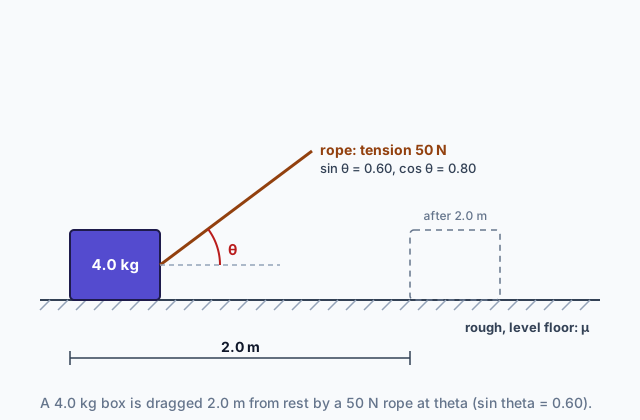
A worker drags a 4.0 kg box from rest across a level floor with a rope tilted above the horizontal at an angle , where and . The rope's tension is 50 N, the coefficient of kinetic friction between the box and the floor is , and m/s². How fast is the box moving after it has been dragged 2.0 m?
Step 1 · Find the normal force
The box does not accelerate vertically, so the vertical forces balance: . With N and N, N. The rope lifts part of the box's weight, so the floor pushes up with less than .
Step 2 · Find the work done by the rope
J, positive because the rope's pull has a part along the motion. Gravity and the normal force are perpendicular to the displacement, so each does zero work.
Why this step?
Why does the rope's 30 N upward part not appear in the rope's work?
Only the component parallel to the displacement transfers energy, and the box moves horizontally. The upward part still matters, though: it lowers the normal force, and so it lowers the friction force.
Your step · Calculate
Finish it. How fast is the box moving after it has been dragged 2.0 m from rest?
m/s
Part 4 Try it New situations
Try it · Decide and justify
A student crouches on a level floor and then jumps straight up. While she pushes off, the floor pushes up on her feet, and her feet stay in place on the floor until she leaves it. Does the floor's force on her do work on her during the push-off?
Which reason supports your answer?
Try it · Rank it
Four carts roll across the same level floor, each at its own speed, and each is stopped by a brake that exerts the same constant friction force on it. Cart A has a mass of 1.0 kg and moves at 2.0 m/s. Cart B has 2.0 kg and 2.0 m/s, cart C has 1.0 kg and 4.0 m/s, and cart D has 4.0 kg and 1.0 m/s. Rank the carts by the distance each rolls before it stops.
Longest first
Give each one a place, 1 for first. Give two the same place if they are equal.
Your ranking: none yet
Try it · Sketch the graph
A student pulls a cart along a level track, and her pull, along the cart's motion, grows in proportion to how far the cart has gone: , with in newtons and in meters. Sketch the total work her pull has done on the cart, from the start, against the cart's position from 0 to 4 m.
One shape that fits
Drag a point up or down, or tap it and use the arrow keys. Only the shape is checked.
On paper. A worker slides a crate down a rough ramp, pushing on it with a horizontal force toward the downhill side, and the crate speeds up. Draw the free-body diagram of the crate, each force as a straight arrow starting on the dot and labeled with what exerts it, and draw the crate's displacement as a separate arrow. Next to each force, write whether it does positive, negative or zero work on the crate, and why. Then check each sign against the angle between that force and the displacement: less than 90° gives positive work, more than 90° negative, and exactly 90° zero.
Part 5 Explain it Derive it, then interpret it
Nothing you type leaves this page. Check your answer against the model and each scoring point.
Free response is 50% of the exam score. This one is shaped like Question 1, Mathematical Routines.
Free-response practice · Question 1 style
A block of mass rests on a level floor at . A machine then pushes it in the direction with a horizontal force , which falls to zero at . The coefficient of kinetic friction between the block and the floor is , and the block keeps moving the whole way. Take as positive.
(a) Derive an expression for the work done by the machine on the block from to , in terms of and .
(b) Derive an expression for the work done by friction on the block over the same interval, in terms of , , and .
(c) Derive an expression for the block's speed at , in terms of , , , and .
(d) On paper, sketch the machine's force against from 0 to , and shade the region whose area equals your answer to (a).
(e) The normal force on the block is as large as the gravitational force on it. Explain why it still does no work on the block.
Model answer
(a) .
(b) The floor is level and nothing else pushes vertically, so and friction is , pointing in the direction. Then .
(c) Gravity and the normal force do no work, so the work-energy theorem gives , and .
(d) A straight line from at down to zero at , with the triangle under it shaded. Its area, , matches (a).
(e) The normal force points straight up and the block moves horizontally, so the angle between them is 90° and . The normal force has no component along the displacement, so it transfers no energy, however large it is.
Score your own answer. This is a self-check, not a grade. Tick each point your answer makes.
Part 6 Check yourself Pulling a cart through a force sensor
The case questions use the force readings. Answer them from those.
A student pulls a 0.50 kg cart from rest along a level track with negligible friction. She pulls through a force sensor held level along the track, so it reads the force on the cart in the direction the cart moves; take that direction as positive. A position sensor tracks the cart. The readings:
| (m) | (N) |
|---|---|
| 0 | 0.4 |
| 0.10 | 1.6 |
| 0.20 | 2.5 |
| 0.30 | 2.9 |
| 0.40 | 2.6 |
| 0.50 | 1.7 |
| 0.60 | 0.5 |
Case question 1 · Calculate
Estimate the work the student's pull does on the cart from to m as the area under the force readings plotted against position, joining neighboring readings with straight lines.
Case question 2 · Multiple choice
In a second run, the student starts the same cart from rest and pulls so that every force reading is twice as large as in the table, at the same positions. Compared with the first run, how fast is the cart moving at m?
Case question 3 · Decide and justify
Was the cart moving faster at m than at m?
Which reason supports your answer?
The rest stand on their own and do not use the case.
Check yourself · Sort it
Tap a card, then say whether a potential energy can be associated with the force.
Has a potential energy
Has no potential energy
Check yourself · Spot the error
A worker pulls a sled 40 m up a straight, snowy slope and then lets it slide 40 m back down to where it started. Kinetic friction on the sled is 25 N on the way up and on the way down. A student finds the total work done on the sled over the round trip by gravity and by friction. Tap the first line with a mistake.
Part 7 Keep it Bring back earlier ideas
This lesson builds on kinetic energy from the last topic and on the normal force from Unit 2, which sets the friction force in Watch it done. Pulling them back up is what makes them last.
On paper. For a 2.0 kg cart, make two sketches. First, sketch its kinetic energy against its velocity for velocities from m/s to m/s. Second, sketch its kinetic energy against the square of its speed, from 0 to 16 m²/s². Label each axis with its quantity and unit, and mark the kinetic energy at the largest value on each horizontal axis. Then write what the slope of the second graph equals, with its unit. There is nothing to submit here. When you have drawn both, compare: the first is a parabola that opens upward, symmetric about , from 16 J at m/s down to zero and back up to 16 J at m/s. The second is a straight line from the origin to 16 J at 16 m²/s², with slope kg, since J per m²/s² is kg.
From 3.1 Translational Kinetic Energy · Fill the statement
Two 1.5 kg carts roll toward each other on a level track; take east as positive. One moves east at 4.0 m/s and the other moves west at 4.0 m/s.
The sum of the two carts' velocities is , and the total kinetic energy of the two carts is .
A tilted surface with motion along it, then three blocks on level floors. For the skier, picture axes along the slope and across it before you choose directions.
From 2.2 Forces and Free-Body Diagrams · Rank it
Three identical 5.0 kg blocks sit on level floors, and none leaves its floor. A rope pulls block A with 20 N at 30° above the horizontal. A hand pushes block B with 20 N at 30° below the horizontal. A rope pulls block C with 20 N horizontally. Use m/s² and take up as positive. Rank the blocks by the normal force the floor exerts on each.
Greatest first
Give each one a place, 1 for first. Give two the same place if they are equal.
Your ranking: none yet
In three lines
- Work is the energy a force transfers into or out of a system: for a constant force, a scalar that can be positive, negative or zero.
- For a force that changes along the path, , the area under a graph of against displacement.
- The net work on an object equals its change in kinetic energy; a conservative force's work depends only on the start and end, while friction's depends on the path length.
Exam strategy for this topic
- Section I, Multiple Choice: 42 questions in 85 minutes.
- Section II, Free Response: 4 questions in 95 minutes.
- This lesson's Explain it is shaped like free-response question 1, Mathematical Routines.
- A four-function, scientific, or graphing calculator is allowed on both sections of the exam.
On a free-response question about work, write the definition you are using before any numbers: with the angle named, or with its limits. When a force is given as a function of position, that is your signal to integrate rather than multiply.
Questions students ask
Can work be negative even though it is a scalar?
Yes. A scalar has no direction, but it can have a sign. Negative work means the force takes energy out of the system, as friction does from a sliding box.
Why does a force that holds something up do no work?
Work counts only the part of a force along the displacement. If the object moves sideways, or does not move at all, a vertical force has no part along the motion and transfers no energy to the object.
When do I integrate instead of using Fd cos θ?
Whenever the force, or its angle to the motion, changes along the path. is the special case of the integral for a constant parallel component.
Is the work done by gravity on a round trip always zero?
Yes. Gravity is conservative, so its work depends only on the starting and ending positions, and on a round trip those are the same.
Where does the energy taken out by friction go?
Into thermal energy and sound, mostly in the surfaces that rub. This course asks you to track mechanical energy, so you account for friction by its negative work.
Beyond the AP Exam
College Board sets this limit on what the AP Exam asks about this topic. Anything past it is not on the exam.
AP Physics C: Mechanics only expects students to analyze the transfer of mechanical energy, although students should be aware that mechanical energy may be dissipated in the form of thermal energy or sound.
Course alignment, for teachers
AP Physics C: Mechanics topic 3.2, Unit 3: Work, Energy, and Power.
- Skill 1.A: Create diagrams, tables, charts, or schematics to represent physical situations.
- Skill 1.C: Create qualitative sketches of graphs that represent features of a model or the behavior of the physical system.
- Skill 2.A: Derive a symbolic expression from known quantities by selecting and following a logical mathematical pathway.
- Skill 2.D: Predict new values or factors of change of physical quantities using functional dependence between variables.
- Skill 3.B: Apply an appropriate law, definition, theoretical relationship, or model to make a claim.
This lesson maps all 17 essential knowledge statements of the topic to the part that teaches each one: 17 are checked by a scored question. The map is in the lesson file.