Unit 3 · Topic 3.3 · about 30 minutes · 7 parts · 13 scored checks, 1 of them multiple choice, plus 2 from earlier lessons
AP Physics C: Mechanics 3.3: Potential Energy
Unit 3: 15 to 25% of the multiple-choice section
What you'll be able to do
- Describe the potential energy of a system: when a system has it, how it follows from a conservative force by integrating, how the force follows from it by differentiating, what its graph says about equilibrium, and its form for springs, for gravity and for systems of several objects.
Key vocabulary
| Term | What it means | The exam trap |
|---|---|---|
| Potential energy | A scalar quantity associated with the positions of objects within a system, which the system has if its objects interact with each other only through conservative forces. | Potential energy is a scalar, so it has a size and a sign but no direction. |
| Conservative force | A force, such as gravity or an ideal spring's force, whose work on the objects of a system depends only on their starting and ending positions, so it can be described by a potential energy. | Whether a force is conservative depends on the kind of force, not on its size, so a small force can still be nonconservative and a large one can still be conservative. |
| Stable equilibrium | A location at which a small displacement in an object's position results in a force exerted on the object opposite to the direction of the small displacement, accelerating the object back toward the equilibrium position. | An object at rest is not necessarily at a stable equilibrium; the test is which way the force points after a small push. |
| Unstable equilibrium | A location at which a small displacement in an object's position results in a force exerted on the object in the same direction as the small displacement, accelerating the object away from the equilibrium position. | The net force there is still zero, so an object placed exactly at that location with no speed stays put until something disturbs it. |
| Elastic potential energy | The potential energy of an ideal spring system, , where is the distance the spring has been stretched or compressed from its equilibrium length. | A compressed spring stores energy just as a stretched one does, because is squared. |
| Gravitational potential energy | For two approximately spherical masses, , and for an object near a planet's surface the change . | The in the general form is the distance between the two centers, so a height measured from a planet's surface needs the planet's radius added before it goes in. |
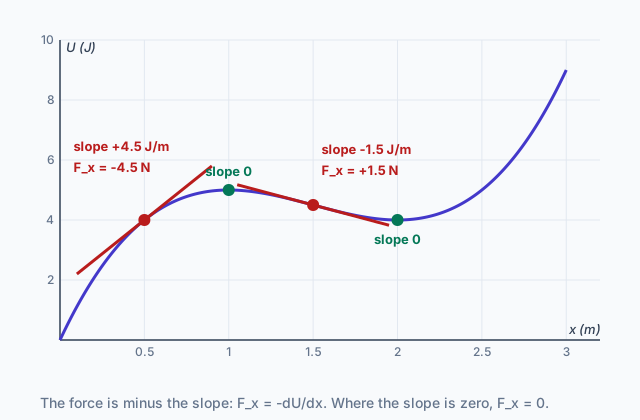 Tap to open the picture full size
Part 1 Think first Where the energy goes
Commit to a guess first. Being wrong now makes the right idea stick better.
Predict first
You lift a textbook from the floor onto a high shelf and leave it there. The work you did lifting it has not simply vanished. Where is that energy stored now?
In short. Potential energy is a scalar that belongs to a system of objects interacting through conservative forces; it changes by as the objects move, and in one dimension the force is .
- Only changes in potential energy are fixed by the physics, so you choose where to make a problem easier.
- The force points toward decreasing potential energy, so a local minimum of is a stable equilibrium and a local maximum is an unstable one.
- An ideal spring has , two spheres have , near a surface , and several objects add the energy of every pair.
Part 2 Learn it Four ideas, with a check after each
2a. Potential energy belongs to a system
Potential energy is not something one object carries. It belongs to a system of two or more objects, and the system has it when the objects inside interact only through conservative forces: gravity between a book and Earth, or the force between a cart and an ideal spring. Kinetic friction between a crate and a floor is not conservative, so that interaction has no potential energy.
Potential energy is a scalar. It has a size and a sign but no direction, and it depends only on the positions of the objects in the system. Carry the book back to the floor along any path and the book and Earth system returns to the same potential energy it started with.
Only changes in potential energy are fixed by the physics, so you choose where . Pick whatever position makes the analysis easiest: the floor, a tabletop, a spring at its relaxed length, or objects infinitely far apart. Moving the zero shifts every value of by the same amount, so the change between two positions does not depend on where you put it.
Quick check · Sort it
Tap a card, then say whether the system it describes has a potential energy.
Has potential energy
Has no potential energy
2b. From a force to a change in potential energy
A conservative force inside a system and the system's potential energy are tied together by an integral. As the objects move from position to position ,
In one dimension that is . The minus sign matters: when the conservative force points the way the objects move, it does positive work and the potential energy goes down.
An ideal spring. Measure from the relaxed length, so . With at ,
usually written , where is the stretch or compression. A compressed spring stores energy just as a stretched one does.
Near a planet's surface. With up as positive, the gravitational force on an object is , nearly constant, so . Raising the object raises the potential energy of the object and planet system.
When the force fits no standard form, such as a nonideal spring, integrate the function you are given.
Quick check · Calculate
A cart rolls into a nonideal bumper on a level track. Let be how far the bumper is compressed, in meters, so grows as the cart moves into it, and take the direction of increasing as positive. The bumper pushes on the cart with , with in newtons. By how much does the potential energy of the cart and bumper system change as the compression goes from to m?
2c. From potential energy back to the force
Run the integral backward and the potential energy gives you the force. In one dimension,
The conservative force is minus the slope of against position. Where rises toward , the force points toward ; where falls toward , the force points toward . Either way, the force points toward decreasing potential energy, and its size is set by how steep is, not by how large is.
The same idea works for gravity far from a surface, where the field is not constant. For two approximately spherical masses with centers apart, and at infinite separation,
This is negative at every finite separation and rises toward zero as the masses move apart. Its slope gives , where the minus sign means the force points toward smaller : the attraction of Topic 2.6.
A system of three or more objects has a potential energy for each pair. Add them all.
Quick check · Calculate
A small magnet moves along a straight track, the -axis, near magnets fixed beside the track. The potential energy of the system is , with in joules and in meters. Take the direction of increasing as positive. What is the -component of the conservative force on the small magnet at m?
2d. Reading a potential energy graph
Wherever a graph of against is flat, its slope is zero, so and the object is in equilibrium there. There are two kinds.
Stable equilibrium is a location at which a small displacement in an object's position results in a force opposite to the direction of the displacement, accelerating the object back toward the equilibrium position. Unstable equilibrium is a location at which a small displacement results in a force in the same direction as the displacement, accelerating the object away.
The shape of tells you which. At a local minimum, step a little to the right and rises, so the force points left, back toward the bottom: stable. At a local maximum, step right and falls, so the force points right, farther away: unstable. Think of a marble in a bowl, and a marble balanced on top of an upside-down bowl.
With a formula, find where , then find the sign of the force just to either side, or use the second derivative: if it is positive there, has a minimum; if negative, a maximum; if zero, check the force on each side. Away from equilibrium, the steeper the graph, the larger the force.
Quick check · Fill the statement
A particle moves along the -axis as part of a system whose potential energy is , with in joules and in meters. The particle has equilibrium positions at m and m. The direction points to the right.
At m, has a local . A small nudge to the right of m gives a force to the , so m is a equilibrium position. A small nudge to the right of m gives a force to the .
Part 3 Watch it done Lifting a probe a whole planet radius
Watch each step, then do the last one yourself.
A 1000 kg probe is carried from the surface of a planet to a point m from the planet's center. The planet is a uniform sphere of mass kg and radius m. Use N·m²/kg². By how much does the potential energy of the probe and planet system change?
Step 1 · Write the conservative force
Take the direction away from the planet's center as positive. Gravity pulls the probe toward the center with , and its size changes with . The final distance, m, is exactly .
Step 2 · Integrate it
. The same result comes from at each end: .
Why this step?
Why not use with the field at the surface?
That form assumes the field keeps its surface value the whole way up. Here the probe rises a full planet radius, and at twice the distance from the center the field is only a quarter as strong, so the constant-field form would overstate the change.
Your step · Calculate
Finish it. By how much does the potential energy of the probe and planet system change? Give your answer in units of J.
× 10^10 J
Part 4 Try it New situations
Try it · Decide and justify
A 2.0 kg box is lifted from the floor onto a shelf 1.5 m higher. Ana takes for the box and Earth system with the box on the floor. Ben takes with the box on the shelf. With the box on the shelf, do Ana and Ben find the same value of the system's gravitational potential energy?
Which reason supports your answer?
Try it · Calculate
Three uniform lead spheres sit along a straight line in deep space, far from anything else. Sphere A, 2000 kg, is at ; sphere B, 1000 kg, is at m; and sphere C, 2000 kg, is at m, each position measured to the center. Take when the spheres are infinitely far apart, and use N·m²/kg². What is the gravitational potential energy of the three-sphere system? Give your answer in units of J.
Try it · Rank it
Three satellites orbit the same planet, whose radius is . Satellite A, 100 kg, is from the planet's center; satellite B, 200 kg, is from it; satellite C, 100 kg, is also from it. Take at infinite separation. Rank the gravitational potential energies of the three satellite and planet systems. A less negative value counts as greater.
Greatest first
Give each one a place, 1 for first. Give two the same place if they are equal.
Your ranking: none yet
On paper. Show that the general form of gravitational potential energy turns into the near-surface form. Write for an object of mass raised from to above the center of a planet of mass , using . Then use , so that , and the field at the surface, , to show that . There is nothing to submit; you should end with the form you met for an object near a planet's surface.
Part 5 Explain it From a potential energy function to its force
Nothing you type leaves this page. Check your answer against the model and each scoring point.
Free response is 50% of the exam score. This one is shaped like Question 2, Translation Between Representations.
Free-response practice · Question 2 style
A particle moves along the -axis as part of a system in which only conservative forces act. The system's potential energy is , with in joules and in meters. Take the direction of increasing as positive.
(a) Derive an expression for the -component of the conservative force on the particle, .
(b) Determine every equilibrium position of the particle. For each one, state whether it is stable or unstable, and justify your answer using the direction of the force after a small displacement.
(c) On paper, sketch against and against on aligned axes for m m. Label each equilibrium position on both graphs.
(d) The particle is at m. Using the slope of the potential energy graph there, explain which way the force on the particle points.
Model answer
(a) , in newtons with in meters.
(b) where : at m, 0 and m. At , has a local maximum of 0 J. A small displacement to the right gives a force to the right, for example N, which pushes the particle farther away, so is unstable. At m, has local minima of J. Just right of m the force points left, for example N, back toward m. Just left of m the force points right, N, back toward m, so both are stable.
(c) The graph is a W: 0 at , minima of J at m, back through zero near m and up to 9 J at m. The graph crosses zero at m, 0 and m. It is positive between 0 and 2 m and below m, negative between m and 0 and above 2 m, and reaches N at m and N at m. Each zero of sits directly below a flat point of .
(d) At m, J/m, so decreases toward . A conservative force points toward decreasing potential energy, so the force points in the direction, with N.
Score your own answer. This is a self-check, not a grade. Tick each point your answer makes.
Part 6 Check yourself A glider near magnets
The case questions use the table of readings. Answer them from the table.
A glider moves along a level air track with negligible friction, near magnets fixed beside the track. Take the direction of increasing as positive. The potential energy of the glider and magnets system depends only on the glider's position , and a class finds it at nine positions from force sensor readings:
| (m) | (J) |
|---|---|
| 0.10 | 5.45 |
| 0.20 | 2.64 |
| 0.30 | 1.32 |
| 0.40 | 0.92 |
| 0.50 | 1.20 |
| 0.60 | 1.58 |
| 0.70 | 1.84 |
| 0.80 | 1.45 |
| 0.90 | 0.13 |
Case question 1 · Multiple choice
Near which position in the table is the glider in stable equilibrium?
Case question 2 · Calculate
Estimate the -component of the force on the glider at m, using the slope of between the readings at 0.40 m and 0.60 m.
Case question 3 · Decide and justify
The glider is held at m and released from rest. Which way does it start to move?
Which reason supports your answer?
The rest stand on their own and do not use the case.
Check yourself · Match
Match each system to the simplest correct expression for its potential energy or the change in it.
Check yourself · Spot the error
A box on a level, frictionless floor is attached to an ideal spring with N/m. The spring starts stretched 0.10 m from its relaxed length, and a student pulls the box until the stretch is 0.30 m. The student finds the change in the potential energy of the box and spring system. Tap the first line with a mistake.
Part 7 Keep it Bring back earlier ideas
This lesson stands on the work a force does, and a question from a few topics back keeps circular motion fresh for the energy of orbits later. Pulling them back up is what makes them last.
On paper. A worker slides a crate down a rough ramp, pushing on it with a horizontal force toward the downhill side, and the crate speeds up. Draw the free-body diagram of the crate, each force as a straight arrow starting on the dot and labeled with what exerts it, and draw the crate's displacement as a separate arrow. Next to each force, write whether it does positive, negative or zero work on the crate, and why. Then check each sign against the angle between that force and the displacement: less than 90° gives positive work, more than 90° negative, and exactly 90° zero.
From 3.2 Work · Rank it
Four carts roll across the same level floor, each at its own speed, and each is stopped by a brake that exerts the same constant friction force on it. Cart A has a mass of 1.0 kg and moves at 2.0 m/s. Cart B has 2.0 kg and 2.0 m/s, cart C has 1.0 kg and 4.0 m/s, and cart D has 4.0 kg and 1.0 m/s. Rank the carts by the distance each rolls before it stops.
Longest first
Give each one a place, 1 for first. Give two the same place if they are equal.
Your ranking: none yet
On paper. The car from Watch it done now rounds the same banked curve at 25 m/s, faster than the speed, about 19 m/s, at which the road would need no friction at all. Draw its free-body diagram: each force a straight arrow starting on the dot, labeled with what exerts it, and no centripetal force. Decide which way friction points along the slope at this speed. Then write the horizontal and vertical equations from your diagram and check that the signs agree with your choice. There is nothing to submit here.
From 2.10 Circular Motion · Rank it
Three children ride playground merry-go-rounds that turn at steady rates, counterclockwise seen from above. Ana sits 1.0 m from the center of a ride that turns once every 4.0 s. Ben sits 2.0 m from the center of the same ride. Cara sits 2.0 m from the center of a different ride that turns once every 8.0 s. Rank the children by the size of their centripetal acceleration.
Greatest first
Give each one a place, 1 for first. Give two the same place if they are equal.
Your ranking: none yet
In three lines
- Potential energy is a scalar that belongs to a system of objects interacting through conservative forces, and you choose where it is zero.
- It changes by , and the force is , pointing toward lower : minima are stable equilibria and maxima unstable.
- Springs store , two masses have , near a surface , and a larger system adds every pair.
Exam strategy for this topic
- Section I, Multiple Choice: 42 questions in 85 minutes.
- Section II, Free Response: 4 questions in 95 minutes.
- This lesson's Explain it is shaped like free-response question 2, Translation Between Representations.
- A four-function, scientific, or graphing calculator is allowed on both sections of the exam.
On a free-response question that gives a potential energy function or graph, write first, then the derivative, then its sign at the point you care about. When you classify an equilibrium, justify it with the direction of the force after a small displacement, not just with the words minimum or maximum.
Questions students ask
Does an object have potential energy, or does a system?
A system does. Potential energy depends on the positions of two or more objects that interact through conservative forces. We often say a lifted ball has potential energy, but the energy belongs to the ball and Earth together.
Why is gravitational potential energy negative?
Because the zero is chosen at infinite separation. Bringing two masses closer than that lowers the potential energy, so every finite separation gives a negative value. Only changes matter, so the negative sign is a result of the choice, not an error.
Where should I put the zero of potential energy?
Anywhere that makes the problem easier: the lowest point of the motion, a spring at its relaxed length, or infinite separation for gravity between planets. Every change in potential energy comes out the same whichever zero you pick.
When can I use instead of ?
When the object stays near a planet's surface, so the field is nearly constant over the motion. If the height changes by a sizable fraction of the planet's radius, use the general form at both positions and subtract.
How do I find the force from a potential energy graph?
Find the slope of the graph at the point and change its sign: . A steep graph means a large force, a flat graph means zero force, and the force always points toward lower potential energy.
Course alignment, for teachers
AP Physics C: Mechanics topic 3.3, Unit 3: Work, Energy, and Power.
- Skill 1.C: Create qualitative sketches of graphs that represent features of a model or the behavior of the physical system.
- Skill 2.A: Derive a symbolic expression from known quantities by selecting and following a logical mathematical pathway.
- Skill 2.B: Calculate or estimate an unknown quantity with units from known quantities, by selecting and following a logical computational pathway.
- Skill 3.B: Apply an appropriate law, definition, theoretical relationship, or model to make a claim.
This lesson maps all 15 essential knowledge statements of the topic to the part that teaches each one: 15 are checked by a scored question. The map is in the lesson file.