Unit 3 · Topic 3.4 · about 30 minutes · 7 parts · 12 scored checks, 1 of them multiple choice, plus 2 from earlier lessons
AP Physics C: Mechanics 3.4: Conservation of Energy
Unit 3: 15 to 25% of the multiple-choice section
What you'll be able to do
- Describe the energies present in a system.
- Describe the behavior of a system using conservation of mechanical energy principles.
- Describe how the selection of a system determines whether the energy of that system changes.
Key vocabulary
| Term | What it means | The exam trap |
|---|---|---|
| System | The object or objects you choose to keep track of; everything else is its surroundings. | The same event can look different for two choices of system, so name the system before you say what its energy does. |
| Mechanical energy | The sum of a system's kinetic and potential energies, . | Mechanical energy is a sum of scalars, so add the kinetic and potential energies as plain numbers, with no components or angles. |
| Conservation of energy | Energy is conserved in all interactions: any change to a type of energy within a system is balanced by an equivalent change of other types of energy within the system or by a transfer of energy between the system and its surroundings. | Before you say a system's total energy is constant, check whether anything outside it does work on it. |
| Energy transfer | If the total energy of a system changes, that change is equivalent to the energy transferred into or out of the system, often by work done on it from outside. | Count each force once: as work done from outside the system, or as potential energy inside it, never both. |
| Dissipated energy | Mechanical energy that nonconservative forces, such as kinetic friction, turn into thermal energy or sound. | Dissipated energy is not destroyed. It is still there as thermal energy or sound; it just no longer counts as mechanical energy. |
 Tap to open the picture full size
Part 1 Think first The bowling ball and the nose
Commit to a guess first. Being wrong now makes the right idea stick better.
Predict first
A teacher hangs a bowling ball from the ceiling on a long cable. She pulls the ball back until it just touches her nose, holds her head still and lets go without pushing. The ball swings across the room and back, and the air pushes on it a little the whole way. What happens when it comes back?
In short. Energy is conserved in all interactions, so a system's total energy changes only by the energy transferred into or out of it, and its mechanical energy, , stays constant when no work is done on it and nothing nonconservative acts inside it.
- A system of a single object can only have kinetic energy; objects that interact through conservative forces, or that change shape and spring back, can also have potential energy.
- Work done on a system by a force from outside it transfers energy in or out, so you can select a system whose total energy is constant.
- Friction and air resistance dissipate mechanical energy as thermal energy and sound, but the energy is still there: .
Part 2 Learn it Four ideas, with a check after each
2a. Which energies a system can have
Before you count energy, choose the system: the objects you are keeping track of. Everything else is its surroundings.
A system made of a single object can only have kinetic energy. Potential energy is not stored in one object. It belongs to objects that interact through conservative forces, such as a ball and Earth pulling on each other, or to something that can change its shape and spring back, such as a spring or a trampoline. A system like that may have both kinetic and potential energies.
The mechanical energy of a system is the sum of its kinetic and potential energies:
Take a 0.50 kg ball moving at 4.0 m/s, 2.0 m above the floor, with m/s². With the ball alone as the system, the only energy is J. With the ball and Earth as the system, and at the floor, there is also J, so J. Same ball, same instant: the system you choose decides which energies you count.
Quick check · Sort it
Tap a card, then say which energies the system it describes can have.
Kinetic energy only
Kinetic and potential energy
2b. Choosing a system, and watching its boundary
Energy is conserved in all interactions. It is never created or destroyed, so when one type of energy in a system changes, something balances it: an equal and opposite change in other types of energy inside the system, or a transfer of energy between the system and its surroundings.
The transfer you will meet most is work. When a force from outside the system does work on it, energy crosses the boundary, and the system's total energy changes by exactly that amount:
If no work is done on the system, its total energy stays constant. You can often select a system so that this is true, and that system is usually the easiest one to analyze.
A hand lifts a 2.0 kg book 1.5 m at a steady speed, with m/s². Take the book alone: the hand does J of work on it and Earth does J, so no net energy enters and its kinetic energy does not change. Take the book and Earth: only the hand is outside, it does J, and the system's gravitational potential energy rises by 30 J. Both choices are correct. Count Earth's pull once, either as work from outside or as potential energy inside, never both.
Quick check · Decide and justify
A 0.50 kg ball is dropped from rest and falls 3.0 m. Air resistance is negligible. Take the ball alone as the system. While the ball falls, what happens to the total energy of this system?
Which reason supports your answer?
2c. When mechanical energy stays constant
If no work is done on a system and nothing inside it is nonconservative, such as friction, the system's mechanical energy is constant. has the same value at every instant, so any kinetic energy gained is potential energy lost.
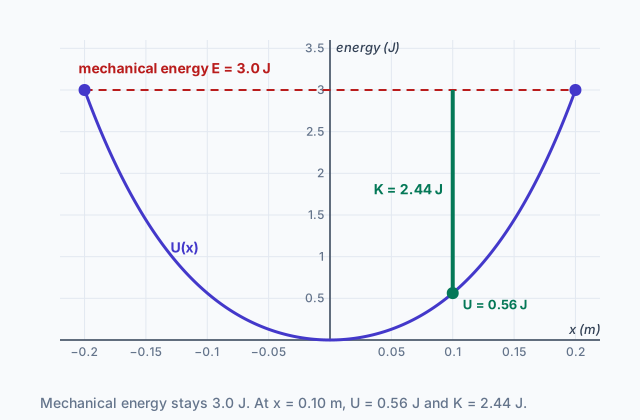
A 0.60 kg cart on a level, frictionless track is attached to a light spring that stiffens as it stretches. With measured from the spring's relaxed length and right as positive, the spring exerts N on the cart. As in Topic 3.3, the potential energy comes from the integral of the conservative force:
Take the cart and spring as the system. The wall holding the spring's far end does not move, so it does no work, and Earth's pull and the track's push are perpendicular to the motion. The cart is pulled to m and released from rest, so J, and it stays 3.0 J:
| (m) | (J) | (J) | speed (m/s) |
|---|---|---|---|
| 0.20 | 3.00 | 0 | 0 |
| 0.10 | 0.56 | 2.44 | 2.85 |
| 0 | 0 | 3.00 | 3.16 |
Each speed comes from . At the relaxed length all 3.0 J is kinetic, so m/s. Using with N/m would miss the term, a third of the energy here.
Quick check · Calculate
A 0.50 kg block on a level, frictionless table is attached to a light spring that stiffens as it stretches. With in meters measured from the spring's relaxed length and right as positive, the spring exerts N on the block, and the far end of the spring is fixed to a wall. The block is pulled to m and released from rest. How fast is it moving when it passes m?
2d. Energy carried in or out, and energy turned to heat
When kinetic friction or air resistance acts, mechanical energy is not constant. Nonconservative forces like these dissipate it as thermal energy and sound. Energy is still conserved: put both rubbing surfaces in the system, and the mechanical energy it loses shows up as thermal energy inside it. With work done from outside as well, the whole account is
The left side is every change inside the system. The right side is the energy transferred in by work from outside: positive work moves energy in, and negative work moves it out.
A horizontal rope pulls a 4.0 kg crate across a level floor from rest, with a pull that grows as the crate moves, , in newtons and meters. Kinetic friction on the crate is 6.0 N. Take the crate and floor as the system; the rope is outside. Over the first 2.0 m the rope's work is the integral of its pull,
Friction turns J into thermal energy, so J, and the crate ends at m/s.
Quick check · Calculate
A cable lifts a 10 kg box straight up from rest. Its pull on the box is , with in newtons and in meters measured upward from the starting point. Take the box and Earth as the system, use m/s² and ignore air resistance. How fast is the box moving when m?
Part 3 Watch it done A spring launch across a rough mat
Watch each step, then do the last one yourself.
A 2.0 kg block on a level floor is pressed against a light, ideal spring with N/m, compressing it 0.30 m, and released from rest. The floor under the spring is frictionless. Where the spring reaches its relaxed length, , the block slides onto a 1.0 m rubber mat whose roughness grows along it: , with in meters measured along the block's direction of motion. Use m/s². How fast is the block moving as it leaves the mat?
Step 1 · Choose the system
Take the block, the spring, the floor with its mat, and Earth. The wall holds the spring's far end still, so it does no work, and nothing else outside the system touches the block. So and .
Step 2 · Energy at the start
At release the block is at rest and the spring holds J. By the time the block reaches the mat the spring is relaxed, so all 36 J is kinetic.
Step 3 · Thermal energy on the mat
On a level floor the normal force is N, so the friction force is N, which grows along the mat. The thermal energy is the integral of that force over the distance: J.
Why this step?
Why not multiply the mat's roughest value, 0.40, by and by 1.0 m?
Because the friction force grows from 0 at the start of the mat to 8.0 N at its end. Using 8.0 N for the whole meter would charge the block for 8.0 J, twice what it actually loses. A force that changes with position does work equal to the area under its graph, which here is a triangle.
Your step · Calculate
Finish it. How fast is the block moving as it leaves the mat?
m/s
Part 4 Try it New situations
Try it · Rank it
Three identical balls are thrown, and air resistance is negligible; use m/s². Ball A is thrown straight up at 10 m/s from the edge of a roof 20 m above the ground and misses the roof on the way down. Ball B is thrown horizontally at 10 m/s from the same roof. Ball C is thrown straight down at 15 m/s from a balcony 10 m above the ground. Rank the balls by their speed just before they hit the ground.
Greatest first
Give each one a place, 1 for first. Give two the same place if they are equal.
Your ranking: none yet
Try it · Match
Each card names a system and what it does. Air resistance is negligible. Tap a system, then what happens to its energy.
On paper. A 0.50 kg cart is released from rest 0.80 m above the bottom of a track with negligible friction. Use m/s² and take at the bottom. Make a table of the cart-Earth system's , and at heights of 0.80, 0.60, 0.40, 0.20 and 0 m. Plot and against height on one set of axes, with scales and units on both. Then write a procedure to test whether the mechanical energy of a real cart-Earth system stays constant: what you would measure, with what equipment, how you would compare the results with your table, and what result would show that it does not stay constant. There is nothing to submit here.
Part 5 Explain it Derive it, then reason about it
On the exam this is handwritten, so answer on paper first. Nothing you type here leaves this page. Then check your answer against the model and each scoring point.
Free response is 50% of the exam score. This one is shaped like Question 1, Mathematical Routines.
Free-response practice · Question 1 style
A small block of mass is released from rest at height on a curved, frictionless ramp and slides down onto a level floor. Where the floor begins, at , it becomes rough, with , where is a positive constant and is the distance along the floor. Air resistance is negligible.
(a) Derive an expression for the block's speed at the bottom of the ramp, in terms of and physical constants.
(b) Derive an expression for the distance the block slides along the rough floor before it stops, in terms of and .
(c) A second block of mass is released from the same height. Is its stopping distance greater than, less than or equal to ? Justify your answer.
(d) Take the block, the ramp, the floor and Earth as the system. Describe what happens to the system's mechanical energy and to its total energy from release until the block stops.
Model answer
(a) For the block-Earth system on the frictionless ramp, no work is done from outside and nothing dissipates energy, so mechanical energy is constant: , and .
(b) On the level floor the normal force is , so the friction force is . All of the block's kinetic energy becomes thermal energy: . With , this gives , so .
(c) Equal. Doubling the mass doubles the energy at the bottom, , and also doubles the friction force at every point, , so the mass cancels and for both blocks.
(d) The mechanical energy falls from to zero, because friction inside the system converts it to thermal energy (and a little sound) in the block and the floor. Nothing outside the system does work on it, so its total energy stays constant the whole time.
Score your own answer. This is a self-check, not a grade. Tick each point your answer makes.
Part 6 Check yourself A cart down a ramp, timed by a photogate
The case questions use the description and the readings. Answer them from those.
A class tests energy conservation with a 0.50 kg cart on an inclined track. They release the cart from rest at five heights above a photogate at the bottom of the track, and the photogate records the cart's speed as it passes. Use m/s², and take the gravitational potential energy of the cart-Earth system as zero at the photogate. The cart's wheels are light, so take its kinetic energy as .
| (m) | (m/s) |
|---|---|
| 0.10 | 1.37 |
| 0.20 | 1.92 |
| 0.30 | 2.37 |
| 0.40 | 2.72 |
| 0.50 | 3.05 |
Case question 1 · Calculate
Using the reading for m, what is the change in the mechanical energy of the cart-Earth system from release to the photogate? Give the change as the value at the photogate minus the value at release.
Case question 2 · Multiple choice
Which claim about the mechanical energy of the cart-Earth system, from release to the photogate, do the readings support?
The rest stand on their own and do not use the case.
Check yourself · Spot the error
A 2.0 kg box starts from rest at the top of a ramp 3.0 m long and 1.8 m high and slides to the bottom. Kinetic friction exerts 4.0 N on it, air resistance is negligible, and m/s². A student finds the box's speed at the bottom. Tap the first line with a mistake.
Check yourself · Fill the statement
A bungee jumper steps off a bridge. Take the jumper, the cord and Earth as the system, and treat the cord as ideal.
As the cord stretches, it stores energy. If air resistance is negligible, then at the lowest point, where the jumper is momentarily at rest, the system's mechanical energy is its value on the bridge. If air resistance is included, with the air outside the system, the system's total energy during the fall.
Check yourself · Sketch the graph
A 0.50 kg ball is thrown straight up from the ground at 8.0 m/s. Air resistance is negligible; use m/s². Sketch the ball's kinetic energy against its height, from the ground up to 3.2 m, the top of its flight. Points snap to the nearest 1 J.
One shape that fits
Drag a point up or down, or tap it and use the arrow keys. The shape is checked, and so are the values the question lets you work out.
Part 7 Keep it Bring back earlier ideas
This lesson stands on kinetic energy from Topic 3.1 and potential energy from Topic 3.3. Pulling them back up is what makes them last.
From 3.3 Potential Energy · Spot the error
A box on a level, frictionless floor is attached to an ideal spring with N/m. The spring starts stretched 0.10 m from its relaxed length, and a student pulls the box until the stretch is 0.30 m. The student finds the change in the potential energy of the box and spring system. Tap the first line with a mistake.
From 3.1 Translational Kinetic Energy · Calculate
A 2.0 kg cart moves along a straight track; take right as positive. Its position is , with in meters and in seconds. What is the cart's kinetic energy at s?
In three lines
- Choose the system first: a single object has only kinetic energy, and objects that interact through conservative forces, or that change shape and spring back, can also have potential energy.
- Energy is conserved in all interactions, so a system's total energy changes only by the energy transferred in or out by work from outside: .
- Mechanical energy, , is constant when no work is done on the system and nothing nonconservative acts inside it; friction and air resistance dissipate it as thermal energy and sound.
Exam strategy for this topic
- Section I, Multiple Choice: 42 questions in 85 minutes.
- Section II, Free Response: 4 questions in 95 minutes.
- This lesson's Explain it is shaped like free-response question 1, Mathematical Routines.
- A four-function, scientific, or graphing calculator is allowed on both sections of the exam.
On a free-response question, name the system before you write any energy equation, and say whether anything outside it does work on it. Then write the energy equation in symbols, with any varying force's work or any thermal energy as an integral, before you substitute numbers.
Questions students ask
If energy is always conserved, how can a system's energy change?
Conservation is about all the energy involved, not about the system you pick. A system's energy changes when energy crosses its boundary, usually as work done by a force from outside it. Put everything that exerts a force on it inside the system and its total energy is constant.
Why can't a single object have potential energy?
Potential energy describes how interacting objects are arranged, such as how far a ball is from Earth, or how far a spring is stretched. With only one object in the system there is nothing for it to interact with, so the only energy it can have is kinetic.
When can I use conservation of mechanical energy?
When no work is done on your system from outside and nothing nonconservative, such as friction, acts inside it. If one of those fails, write instead.
Where does the calculus come in?
In two places: the work done by a force that changes with position, , and the potential energy of a conservative force that is not an ideal spring, . Friction that changes along a surface needs the same integral to find the thermal energy.
Does it matter where I put the zero of potential energy?
No. Only changes in potential energy enter the energy equation, so any zero works as long as you use the same one throughout a problem. Pick the one that makes the numbers simplest, often the lowest point of the motion.
Course alignment, for teachers
AP Physics C: Mechanics topic 3.4, Unit 3: Work, Energy, and Power.
- Skill 1.B: Create quantitative graphs with appropriate scales and units, including plotting data.
- Skill 2.A: Derive a symbolic expression from known quantities by selecting and following a logical mathematical pathway.
- Skill 2.C: Compare physical quantities between two or more scenarios or at different times and/or locations within a single scenario.
- Skill 3.A: Create experimental procedures that are appropriate for a given scientific question.
- Skill 3.C: Justify or support a claim using evidence from experimental data, physical representations, or physical principles or laws.
This lesson maps all 9 essential knowledge statements of the topic to the part that teaches each one: 9 are checked by a scored question. The map is in the lesson file.