Unit 3 · Topic 3.5 · about 30 minutes · 7 parts · 12 scored checks, 0 of them multiple choice, plus 2 from earlier lessons
AP Physics C: Mechanics 3.5: Power
Unit 3: 15 to 25% of the multiple-choice section
What you'll be able to do
- Describe the transfer of energy into, out of or within a system in terms of power: as an average, or , and at an instant, or .
Key vocabulary
| Term | What it means | The exam trap |
|---|---|---|
| Power | The rate at which energy changes with respect to time, either by transfer into or out of a system or by conversion from one type to another within a system. Its unit is the watt, one joule per second. | Power is not a kind of energy and never appears as a bar in an energy accounting; it describes how fast those amounts change. |
| Average power | The amount of energy transferred or converted, divided by the time it took for that transfer or conversion, ; equally, the total work done divided by the time during which it was done, . | An average over an interval uses the whole change and the whole time, so it can differ from the power at any single instant in that interval. |
| Instantaneous power | The power at one instant, the derivative of the work done by a force, ; for a constant force on a moving object it is . | The angle in is easy to take from the wrong pair of directions in a picture, so find the two arrows it belongs to before you take a cosine. |
 Tap to open the picture full size
Part 1 Think first Two ways up the stairs
Commit to a guess first. Being wrong now makes the right idea stick better.
Predict first
Two friends with the same mass climb the same flight of stairs, starting from rest at the bottom and stopping at the top. One runs up in 4 s. The other walks up in 12 s. How does the increase in gravitational potential energy of the runner and Earth compare with the increase for the walker and Earth?
In short. Power is the rate at which energy changes, by transfer into or out of a system or by conversion within it; on average , and at an instant , which for a constant force on a moving object is .
- Power is measured in watts, and one watt is one joule per second.
- Average power divides a whole energy change, or a whole work, by the whole time; instantaneous power is the slope of work against time, and the area under power against time is the work.
- Only the part of a force along the velocity delivers power: , which is negative when the force has a part against the motion and zero when the force is perpendicular to it.
Part 2 Learn it Four ideas, with a check after each
2a. Power is a rate
Energy accounting tells you how much a system's energy changes. Power tells you how fast:
> Power is the rate at which energy changes with respect to time, either by transfer into or out of a system or by conversion from one type to another within a system.
So there are two ways power shows up, and which one you see depends on where you draw the system's boundary. A rope pulling a sled is outside a sled system, so the rope transfers energy into the system. A spring pushing a cart is outside a cart system but inside a cart-and-spring system: in the first it transfers energy in, in the second it converts elastic energy into kinetic energy without anything crossing the boundary.
The unit of power is the watt, one joule per second: . A 60 W rate means 60 J every second, whatever kind of energy it is.
Quick check · Sort it
Tap a card, then say whether the energy change it describes crosses the system's boundary or happens by conversion inside the system.
Crosses the boundary
Converted inside the system
2b. Average power: the whole change over the whole time
Average power is the amount of energy transferred or converted, divided by the time that took:
Work is the change in a system's energy caused by a force, so the same idea can be written with work. Average power is the total work done divided by the time during which it was done:
Suppose a crane lifts a 250 kg pallet of bricks 12 m at a steady speed in 20 s. The kinetic energy does not change, and the gravitational potential energy of the bricks and Earth rises by J. The crane's average power is W.
Keep the time in seconds. A rate in joules per minute is a real rate, but it is not a watt.
Quick check · Calculate
An elevator motor lifts a 600 kg elevator car 24 m straight up at a constant speed in 16 s. Ignore friction and any counterweight. What average power does the motor deliver to the car?
2c. Instantaneous power is a derivative
An average hides how the rate changes along the way. The instantaneous power delivered to an object by a force is the derivative of the work that force has done:
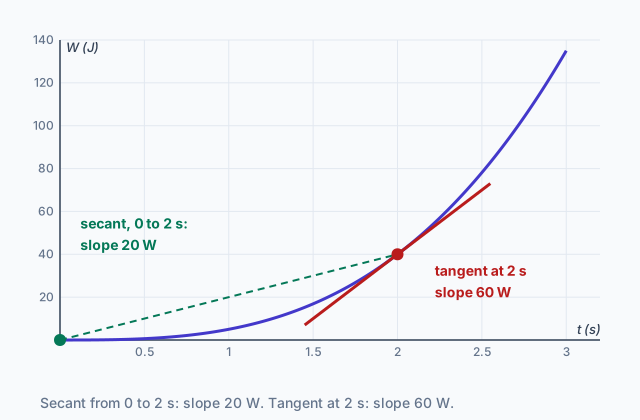
Take a winch whose cable has done joules of work on a load after seconds. Over the first 2 s it does 40 J, so its average power is W, the slope of the secant from 0 to 2 s on a graph of against . At the instant s, W, the slope of the tangent there. The winch is speeding up its delivery, so the power at the end of the interval is larger than the average over it.
The relationship also runs backward. If you know the power as a function of time, the work done from to is the integral, the area under a graph of power against time:
Quick check · Calculate
A winch reels in a cable tied to a crate. The work the cable has done on the crate is , with in joules and in seconds. What power does the cable deliver to the crate at s?
2d. The power a force delivers: Fv cos θ
For a constant force on an object that moves a small distance , the work is , where is the angle between the force and the direction of motion. Divide by , and is the speed :
Only the component of the force parallel to the velocity delivers power. A dog pulling a wagon at 2.0 m/s with a 50 N leash angled 37° above the horizontal, where , delivers W, not 100 W.
The angle also sets the sign:
- Between 0° and 90°, the force has a part along the motion, and is positive: energy goes into the object.
- At 90°, the force is perpendicular to the velocity, and .
- Between 90° and 180°, the force has a part against the motion, and is negative: energy leaves the object. Friction slowing a sliding box delivers negative power.
The power can change even when the force does not. A constant force on an object that speeds up delivers more power every second, because grows.
Quick check · Decide and justify
A rope pulls a sled across level snow at a constant speed of 1.5 m/s. The rope's tension is 40 N, at 30° above the horizontal. Is the power the rope delivers to the sled less than, equal to or greater than 60 W?
Which reason supports your answer?
Part 3 Watch it done A car pulling away
Watch each step, then do the last one yourself.
A 1200 kg car starts from rest on a level road; take its direction of motion as positive. The net horizontal force on it is a constant 3000 N forward, and drag is negligible. The force stays the same until the power it delivers to the car reaches 60 kW. What average power does the force deliver from the start until that moment?
Step 1 · Find the velocity
m/s², constant, so m/s.
Step 2 · Find the power and the time
The force points along the velocity, so and watts. It reaches 60,000 W when s, when the car moves at m/s.
Why this step?
Why does the power grow when the force does not change?
The power a force delivers is . The force and the angle stay the same, but the car keeps speeding up, so each second the same force moves the car farther and does more work.
Your step · Calculate
Finish it. What average power does the force deliver to the car from to s?
W
Part 4 Try it New situations
Try it · Rank it
Three electric motors each lift a load straight up at a constant speed. Motor A lifts a 200 N load 3.0 m in 2.0 s. Motor B lifts a 100 N load 6.0 m in 2.0 s. Motor C lifts a 300 N load 2.0 m in 4.0 s. Rank the motors by the average power each delivers to its load.
Greatest first
Give each one a place, 1 for first. Give two the same place if they are equal.
Your ranking: none yet
Try it · Calculate
A winch is switched on, and the power it delivers to a crate rises steadily: , with in watts and in seconds, for s. How much work does the winch do on the crate in the first 5.0 s?
On paper. A rope parallel to a ramp drags a crate up the ramp at a steady speed, and kinetic friction acts on the crate. Draw the crate as a dot, with an arrow for each force on it (the rope's pull, gravity, the normal force and friction) and a separate arrow for its velocity. Next to each force, write whether it delivers positive, negative or zero power to the crate, and why, from the angle between that force and the velocity. Then check your work: the rope's pull lies along the velocity, so its power is positive; the normal force is perpendicular to the velocity, so its power is zero; friction points opposite the velocity, so its power is negative; and gravity points more than 90° from the velocity, which runs up the slope, so its power is negative too. At a steady speed the four powers add to zero.
Part 5 Explain it Reason first, then derive
Nothing you type leaves this page. Check your answer against the model and each scoring point.
Free response is 50% of the exam score. This one is shaped like Question 4, Qualitative/Quantitative Translation.
Free-response practice · Question 4 style
A motor at the top of a ramp winds in a cable that pulls a cart of mass up the ramp at a constant speed . The ramp is inclined at an angle above the horizontal, the cable is parallel to the ramp, and friction is negligible.
(a) A student says that pulling the cart up at twice the speed takes twice the power, even though the cart gains the same gravitational potential energy either way. Without deriving an equation, explain whether the student is right.
(b) Derive an expression for the power the motor delivers to the cart, in terms of , , and physical constants as appropriate.
(c) Explain how your expression from part (b) agrees or disagrees with your reasoning in part (a).
(d) For kg, and m/s, calculate the power the motor delivers.
Model answer
(a) The student is right. The cart gains the same energy on the way up at either speed, because the gain depends on its mass and the height of the ramp. At twice the speed it covers the ramp in half the time, and power is energy per unit time, so the same energy in half the time is twice the power.
(b) At constant speed the net force on the cart is zero, so the cable's tension balances the component of gravity along the ramp: . The tension points along the velocity, so the angle between them is 0 and .
(c) The expression is proportional to with , and unchanged, so doubling doubles , which agrees with part (a). The force the motor needs does not depend on the speed; the power does, because the same force moves the cart farther each second.
(d) W.
Score your own answer. This is a self-check, not a grade. Tick each point your answer makes.
Part 6 Check yourself A winch on a track
The case questions use the readings in the table. Answer them from those.
A winch at the end of a level track winds in a cable that pulls a cart along the track, starting from rest at ; take the cart's direction of travel as positive. The cable stays parallel to the track. A sensor in the winch records the power the cable delivers to the cart, and a speed sensor records the cart's speed. Some of the readings:
| (s) | (W) | (m/s) |
|---|---|---|
| 0 | 0 | 0 |
| 1.0 | 296 | 1.98 |
| 2.0 | 604 | 4.03 |
| 3.0 | 897 | 5.97 |
| 4.0 | 1203 | 8.02 |
Case question 1 · Calculate
Estimate the work the cable does on the cart from to s, as the area under the power readings found with the trapezoid rule, one trapezoid for each 1.0 s step.
Case question 2 · Calculate
Using the readings at s, what is the size of the force the cable exerts on the cart?
The rest stand on their own and do not use the case.
Check yourself · Spot the error
A 2.0 kg box slides down a frictionless ramp inclined at 30° above the horizontal. At one instant it moves at 3.0 m/s down the ramp. A student finds the power the gravitational force delivers to the box at that instant, using m/s². Tap the first line with a mistake.
Check yourself · Match
A 50 N force acts on a cart moving at 4.0 m/s. Tap each direction of the force, then the power it delivers to the cart at that instant.
Check yourself · Fill the statement
A motor delivers a steady 1500 W for 2.0 min.
In 2.0 min the motor transfers of energy. A second motor transfers the same energy in 4.0 min, so its average power is .
Part 7 Keep it Bring back earlier ideas
Power is the rate at which work is done, so this lesson leans on energy conservation and on work from earlier in this unit. Pulling them back up is what makes them last.
On paper. A 0.50 kg cart is released from rest 0.80 m above the bottom of a track with negligible friction. Use m/s² and take at the bottom. Make a table of the cart-Earth system's , and at heights of 0.80, 0.60, 0.40, 0.20 and 0 m. Plot and against height on one set of axes, with scales and units on both. Then write a procedure to test whether the mechanical energy of a real cart-Earth system stays constant: what you would measure, with what equipment, how you would compare the results with your table, and what result would show that it does not stay constant. There is nothing to submit here.
From 3.4 Conservation of Energy · Rank it
Three identical balls are thrown, and air resistance is negligible; use m/s². Ball A is thrown straight up at 10 m/s from the edge of a roof 20 m above the ground and misses the roof on the way down. Ball B is thrown horizontally at 10 m/s from the same roof. Ball C is thrown straight down at 15 m/s from a balcony 10 m above the ground. Rank the balls by their speed just before they hit the ground.
Greatest first
Give each one a place, 1 for first. Give two the same place if they are equal.
Your ranking: none yet
From 3.2 Work · Decide and justify
A skier starts at the top of a hill and reaches the same lift station at the bottom by one of two runs: a short, steep, straight run or a long, winding run. Compare the work done on the skier by Earth's gravitational force on the two runs.
Which reason supports your answer?
In three lines
- Power is the rate at which energy is transferred into or out of a system or converted within it, in watts, joules per second.
- Average power is ; instantaneous power is , and integrating power over time gives the work.
- A force delivers : positive along the motion, zero perpendicular to it and negative against it.
Exam strategy for this topic
- Section I, Multiple Choice: 42 questions in 85 minutes.
- Section II, Free Response: 4 questions in 95 minutes.
- This lesson's Explain it is shaped like free-response question 4, Qualitative/Quantitative Translation.
- A four-function, scientific, or graphing calculator is allowed on both sections of the exam.
When a free-response question gives work, energy or a force as a function of time, write the definition before the numbers: or , then the substitution, then the result in watts. When it asks for an average, say which energy change or work you are dividing and over which time.
Questions students ask
What is the difference between power and energy?
Energy is an amount, in joules. Power is how fast that amount changes, in joules per second, which is watts. A small motor and a large one can lift the same load to the same height and give it the same energy; the large one just does it in less time.
Is a kilowatt-hour a unit of power?
No. It is a unit of energy: one kilowatt for one hour, which is 3.6 million joules. Electric bills charge for energy, so they count kilowatt-hours.
Can power be negative?
Yes. When a force has a component against an object's velocity, is negative and so is . The force is taking energy out of the object, as friction does to a sliding box.
When do I use the derivative and when do I divide?
Divide a total work or energy change by the total time for an average power. Use , or at that instant, for the power at one moment. The average equals the instantaneous value at every moment only when the power stays constant; otherwise the instantaneous power is above the average at some moments and below it at others.
Course alignment, for teachers
AP Physics C: Mechanics topic 3.5, Unit 3: Work, Energy, and Power.
- Skill 1.A: Create diagrams, tables, charts, or schematics to represent physical situations.
- Skill 2.B: Calculate or estimate an unknown quantity with units from known quantities, by selecting and following a logical computational pathway.
- Skill 2.C: Compare physical quantities between two or more scenarios or at different times and/or locations within a single scenario.
- Skill 3.B: Apply an appropriate law, definition, theoretical relationship, or model to make a claim.
This lesson maps all 5 essential knowledge statements of the topic to the part that teaches each one: 5 are checked by a scored question. The map is in the lesson file.