Unit 4 · Topic 4.1 · about 30 minutes · 7 parts · 12 scored checks, 2 of them multiple choice, plus 2 from earlier lessons
AP Physics C: Mechanics 4.1: Linear Momentum
Unit 4: 10 to 20% of the multiple-choice section
What you'll be able to do
- Describe the linear momentum of an object or a system: calculate it from a mass and a velocity or a position function, give its direction, and decide when the collision or explosion model fits an interaction.
Key vocabulary
| Term | What it means | The exam trap |
|---|---|---|
| Linear momentum | Linear momentum is defined by the equation , the product of an object's mass and its velocity. | Its unit is the kilogram meter per second, kg·m/s, so a momentum is never written in joules or newtons. |
| Collision | A model for an interaction where the forces exerted between the involved objects in the system are much larger than the net external force exerted on those objects during the interaction. | It is a model you choose, not a kind of event, so decide whether it fits before you use it. |
| Explosion | A model for an interaction in which forces internal to the system move objects within that system apart. | Whether a force is internal depends on the system you chose, so name the system before you call an interaction an explosion. |
| Object model | A model that ignores an object's size, shape and internal configuration and treats it as a single point with properties such as mass. | The model keeps the mass, so a point in this model still carries momentum; it is not the same as ignoring the object. |
 Tap to open the picture full size
Part 1 Think first A car or a baseball
Commit to a guess first. Being wrong now makes the right idea stick better.
Predict first
A 1200 kg car rolls toward you at 1.0 m/s on a level parking lot, and a 0.15 kg baseball flies toward you at 40 m/s. You must bring each one to rest. Which one takes more total push from you?
In short. Linear momentum is an object's mass times its velocity, , a vector that points the same direction as the velocity; momentum is used to analyze collisions and explosions, which are models of interactions.
- Find momentum from the velocity at that instant; when you have a position function, differentiate it first, .
- Give each momentum a sign or components, and add them as vectors to get a system's momentum.
- Use the collision model when the forces between objects are much larger than the net external force during the interaction, and the explosion model when internal forces push objects apart.
Part 2 Learn it Four ideas, with a check after each
2a. Mass times velocity
The linear momentum of an object is its mass times its velocity:
Its unit is the kilogram meter per second, kg·m/s. A 1200 kg car at 1.0 m/s has a momentum of 1200 kg·m/s; a 0.15 kg baseball at 40 m/s has 6 kg·m/s. Neither the mass nor the speed alone tells you which is larger.
In Physics C the velocity often comes from a position function. Since ,
So differentiate the position, then multiply by the mass. A 4.0 kg cart at , in meters and seconds, has , and at s its momentum is kg·m/s.
The position itself never goes into the momentum. A cart parked 50 m from the origin has a large position and zero momentum.
Quick check · Calculate
A 0.50 kg cart moves along a straight track; take the direction of increasing as positive. Its position is , with in meters and in seconds. What is the cart's momentum at s?
2b. A vector, pointing where the velocity points
Mass is a positive scalar, so multiplying a velocity by it changes the length of the vector but never its direction. Momentum is a vector, and it points the same direction as the velocity.
In one dimension that direction is a sign. Choose a positive direction and keep it: a 2.0 kg cart moving left at 3.0 m/s, with right positive, has kg·m/s.
The momentum of a system is the vector sum of the momenta of the objects in it. Add with the signs kept. A 2.0 kg cart moving right at 3.0 m/s and a 1.0 kg cart moving left at 6.0 m/s have momenta of and kg·m/s, so the two-cart system has zero momentum, even though both carts are moving.
In two dimensions, add components:
then find the size and direction from the components, as you did for any vector in Topic 1.1. Adding the sizes of momenta that point different ways gives a number with no meaning.
Quick check · Multiple choice
On a level, frictionless air table, puck A (0.20 kg) slides east at 3.0 m/s and puck B (0.40 kg) slides north at 2.0 m/s. What is the size of the momentum of the two-puck system?
2c. Collisions and explosions are models
Momentum can be used to analyze collisions and explosions. Each is a model, a simplified picture you choose because it fits the interaction.
A collision is a model for an interaction in which the forces the objects exert on each other are much larger than the net external force on them while they interact. When two billiard balls hit, each pushes on the other with hundreds of newtons for about a millisecond, while the net outside force on each, mostly friction from the cloth, is a fraction of a newton. During that brief contact, the outside force hardly matters.
Because a collision is analyzed only from its initial and final states, each object in it can be treated with the object model. The balls squash slightly while they touch, but you describe each one just before and just after, as a point with its mass and its velocity.
An explosion is a model for an interaction in which forces inside the system push its objects apart. Nothing has to burn: the push can come from a spring, a muscle or a chemical reaction, as long as it comes from inside the system you chose. An interaction that starts with the objects together and pushes them apart is modeled as an explosion, even though its internal forces also dwarf any external force.
Quick check · Sort it
Tap a card, then say which model fits the interaction it describes.
Collision
Explosion
2d. Momentum over time, and how it scales
Because and the mass of a cart or a ball does not change, a graph of momentum against time has exactly the shape of the velocity graph, with every value multiplied by and the axis in kg·m/s. Where the velocity crosses zero, so does the momentum. Where the velocity graph bends, the momentum graph bends the same way.
The same equation predicts factors of change. Momentum is proportional to mass at a fixed velocity and proportional to velocity at a fixed mass:
- double the mass at the same velocity, and the momentum doubles;
- triple the speed in the same direction, and the momentum triples;
- reverse the velocity at the same speed, and the momentum has the same size but points the other way.
Kinetic energy from Topic 3.1, , depends on the same two quantities but not in the same way, because the speed is squared. So two objects can share a momentum and still have different kinetic energies, and an object's kinetic energy can stay the same while its momentum changes.
Quick check · Sketch the graph
A 0.50 kg fan cart starts from rest on a straight, level track, and its fan is turned up steadily; take forward as positive. Its position is , with in meters and in seconds. Sketch its momentum against time from 0 to 4 s. The first point is fixed at 0.
One shape that fits
Drag a point up or down, or tap it and use the arrow keys. The shape is checked, and so are the values the question lets you work out.
Part 3 Watch it done Two fan carts on one track
Watch each step, then do the last one yourself.
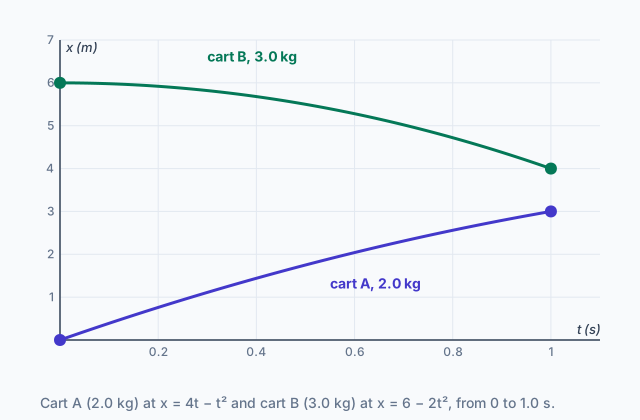
Two fan carts move along one straight, level track; take right as positive. Cart A, 2.0 kg, has position , and cart B, 3.0 kg, has position , with positions in meters and in seconds. What is the momentum of the two-cart system at s, before the carts meet?
Step 1 · Cart A's velocity and momentum
, which is m/s at 1.0 s. So kg·m/s: cart A moves right.
Why this step?
Why not divide cart A's position at 1.0 s, 3 m, by 1.0 s?
That gives the average velocity from 0 to 1.0 s, 3 m/s, not the velocity at 1.0 s. Cart A is slowing down, so its velocity at 1.0 s is less than its average over the first second. Momentum at an instant uses the velocity at that instant, the derivative.
Step 2 · Cart B's velocity
, which is m/s at 1.0 s. Cart B moves left, toward cart A.
Your step · Calculate
Finish it. What is the momentum of the two-cart system at s? Right is positive.
kg·m/s
Part 4 Try it New situations
Try it · Match
A cart moving along a straight track has momentum . Tap each change, then the cart's new momentum.
Try it · Calculate
A 0.15 kg baseball and a 6.0 kg bowling ball have momenta of the same size. How many times the bowling ball's kinetic energy is the baseball's kinetic energy?
Part 5 Explain it From a position function to a momentum graph
Nothing you type leaves this page. Check your answer against the model and each scoring point.
Free response is 50% of the exam score. This one is shaped like Question 2, Translation Between Representations.
Free-response practice · Question 2 style
A 2.0 kg cart moves along a straight track; take right as positive. Its position is , with in meters and in seconds, from to s.
(a) Derive an expression for the cart's momentum .
(b) On paper, sketch against from 0 to 4 s. Label the momentum at , 2 and 4 s.
(c) Explain how the slope of your sketch and the time where it crosses zero are consistent with your expression in part (a) and with the cart's motion.
(d) A classmate says that because the cart's speed at s equals its speed at , its momentum at 4 s equals its momentum at 0. Explain why the classmate is wrong.
Model answer
(a) , so , in kg·m/s.
(b) A straight line from kg·m/s at , through 0 at 2 s, to kg·m/s at 4 s, with the vertical axis in kg·m/s. Compare your sketch with that line and those three values.
(c) The expression is linear in with slope kg·m/s each second, so the sketch is a straight line falling at that rate. It crosses zero at 2 s, where : the cart stops there for an instant and turns around, moving right before 2 s and left after.
(d) Momentum is a vector in the direction of the velocity. At 0 the velocity is m/s and at 4 s it is m/s, so the momentum changes from to kg·m/s: the same size, pointing the opposite way.
Score your own answer. This is a self-check, not a grade. Tick each point your answer makes.
Part 6 Check yourself Gliders on an air track
The case questions use the description and the readings. Answer them from those.
On a level air track, glider A moves right toward glider B, which moves left; take right as positive. Each glider has a spring bumper on the end facing the other, and the bumpers compress while the gliders touch. The air cushion supports each glider's weight, and the only other outside force on a glider is a small friction force from the air. A force sensor in glider B's bumper records the force between the gliders.
| Quantity | Glider A | Glider B |
|---|---|---|
| Mass (kg) | 0.30 | 0.20 |
| Velocity just before contact (m/s) | +0.60 | −0.40 |
| Largest force between the gliders (N) | 12 | 12 |
| Friction force from the air (N) | under 0.01 | under 0.01 |
| Time in contact (s) | 0.030 | 0.030 |
Case question 1 · Calculate
What is the momentum of the two-glider system just before contact? Right is positive.
Case question 2 · Decide and justify
Can the 0.030 s contact between the gliders be analyzed with the collision model?
Which reason supports your answer?
Case question 3 · Multiple choice
The bumpers compress while the gliders touch, so each glider changes shape during the contact. Why may each glider still be treated as a single point with mass in this analysis?
The rest stand on their own and do not use the case.
Check yourself · Spot the error
A 0.50 kg ball is thrown straight up; take up as positive. Its height is , with in meters and in seconds. A student finds its momentum at s. Tap the first line with a mistake.
Check yourself · Fill the statement
A 60 kg skater and a 40 kg skater stand together at rest on smooth ice, then push off each other; take east as positive. Just afterward, the 40 kg skater glides west at 3.0 m/s.
The push is modeled as . Just afterward, the 40 kg skater's momentum is .
Part 7 Keep it Bring back earlier ideas
Momentum describes motion the way kinetic energy did in Unit 3, so power and potential energy from that unit are due for review. Pulling them back up is what makes them last.
On paper. A rope parallel to a ramp drags a crate up the ramp at a steady speed, and kinetic friction acts on the crate. Draw the crate as a dot, with an arrow for each force on it (the rope's pull, gravity, the normal force and friction) and a separate arrow for its velocity. Next to each force, write whether it delivers positive, negative or zero power to the crate, and why, from the angle between that force and the velocity. Then check your work: the rope's pull lies along the velocity, so its power is positive; the normal force is perpendicular to the velocity, so its power is zero; friction points opposite the velocity, so its power is negative; and gravity points more than 90° from the velocity, which runs up the slope, so its power is negative too. At a steady speed the four powers add to zero.
From 3.5 Power · Rank it
Three electric motors each lift a load straight up at a constant speed. Motor A lifts a 200 N load 3.0 m in 2.0 s. Motor B lifts a 100 N load 6.0 m in 2.0 s. Motor C lifts a 300 N load 2.0 m in 4.0 s. Rank the motors by the average power each delivers to its load.
Greatest first
Give each one a place, 1 for first. Give two the same place if they are equal.
Your ranking: none yet
From 3.4 Conservation of Energy · Spot the error
A 2.0 kg box starts from rest at the top of a ramp 3.0 m long and 1.8 m high and slides to the bottom. Kinetic friction exerts 4.0 N on it, air resistance is negligible, and m/s². A student finds the box's speed at the bottom. Tap the first line with a mistake.
In three lines
- Linear momentum is mass times velocity, , in kg·m/s; from a position function, .
- Momentum is a vector in the direction of the velocity, and a system's momentum is the vector sum of its objects' momenta.
- A collision is a model where the forces between objects dwarf the net external force, analyzed only before and after; an explosion is a model where internal forces push objects apart.
Exam strategy for this topic
- Section I, Multiple Choice: 42 questions in 85 minutes.
- Section II, Free Response: 4 questions in 95 minutes.
- This lesson's Explain it is shaped like free-response question 2, Translation Between Representations.
- A four-function, scientific, or graphing calculator is allowed on both sections of the exam.
When a question asks for a momentum, state your positive direction before you write a number, and carry the sign of every velocity into its momentum. For a system, write each object's momentum first, then add them as vectors, so a grader can see the direction of each one.
Questions students ask
Is momentum the same thing as kinetic energy?
No. Momentum, , is a vector in kg·m/s; kinetic energy, , is a scalar in joules. An object that reverses at the same speed keeps its kinetic energy but its momentum points the other way.
Why does momentum have a direction when mass does not?
Mass is a positive scalar, so multiplying the velocity by it stretches the vector without turning it. The momentum keeps the velocity's direction.
Can a system have zero momentum while its parts move?
Yes. Two carts with momenta of and kg·m/s make a system with zero momentum. Add the momenta as vectors, not their sizes.
Does a collision have to be a crash?
No. The collision model fits any interaction in which the forces between the objects are much larger than the net external force on them during it, from colliding atoms to two billiard balls.
How can I treat a golf ball as a point if it flattens against the club?
A collision is analyzed only from its initial and final states, and at those instants the golf ball moves as a whole. The object model sets aside what happens to its shape in between.
Course alignment, for teachers
AP Physics C: Mechanics topic 4.1, Unit 4: Linear Momentum.
- Skill 1.C: Create qualitative sketches of graphs that represent features of a model or the behavior of the physical system.
- Skill 2.B: Calculate or estimate an unknown quantity with units from known quantities, by selecting and following a logical computational pathway.
- Skill 2.D: Predict new values or factors of change of physical quantities using functional dependence between variables.
- Skill 3.B: Apply an appropriate law, definition, theoretical relationship, or model to make a claim.
This lesson maps all 6 essential knowledge statements of the topic to the part that teaches each one: 6 are checked by a scored question. The map is in the lesson file.