Unit 4 · Topic 4.2 · about 30 minutes · 7 parts · 12 scored checks, 1 of them multiple choice, plus 2 from earlier lessons
AP Physics C: Mechanics 4.2: Change in Momentum and Impulse
Unit 4: 10 to 20% of the multiple-choice section
What you'll be able to do
- Describe the impulse delivered to an object or system, from a force function, from the area under a force-time graph, or from the slope of a momentum-time graph.
- Describe how the impulse exerted on an object or system equals its change in momentum, and use that to find a velocity, a force or a time, including for a system whose mass changes at constant velocity.
Key vocabulary
| Term | What it means | The exam trap |
|---|---|---|
| Change in momentum | The difference between a system's final momentum and its initial momentum, . | The order of the subtraction matters: final minus initial. Reversing it flips the sign, and in one dimension the sign is the direction. |
| Impulse | The integral of a force exerted on an object or system over a time interval, . | Impulse has the same unit as momentum, N·s or kg·m/s, but it is delivered over an interval; it is not something an object has. |
| Impulse-momentum theorem | The impulse exerted on an object is equal to the object's change in momentum, . | The theorem uses the impulse of the net force. One force's impulse equals the change in momentum only when every other force is negligible during the interval. |
| Net external force | The sum of the forces from outside a system, equal to the rate of change of the system's momentum, . | Forces between parts of the same system do not count. They cannot change the system's total momentum. |
 Tap to open the picture full size
Part 1 Think first Two eggs, two landings
Commit to a guess first. Being wrong now makes the right idea stick better.
Predict first
You drop two identical eggs from the same height. One lands on a thick pillow and stops. The other lands on a concrete floor and stops. Compare how much each egg's momentum changes while it is being stopped.
In short. Impulse is the integral of a force over a time interval, , and the impulse-momentum theorem says it equals the change in momentum, .
- Change in momentum is final minus initial, , with directions kept as signs in one dimension.
- Impulse is the area under a graph of net force against time, and the net force is the slope of a graph of momentum against time, .
- With constant mass, , Newton's second law; with constant velocity and changing mass, .
Part 2 Learn it Four ideas, with a check after each
2a. Change in momentum, and the impulse that causes it
An object's momentum is , a vector pointing the way it moves. The change in momentum is the difference between its final momentum and its initial momentum:
In one dimension, pick a positive direction and give each momentum its sign before you subtract. A 0.50 kg ball moving at m/s that comes back at m/s has kg·m/s. That is larger than either momentum, because the ball had to be stopped and then sent back.
What changes an object's momentum is impulse, a force exerted over a time interval. The impulse-momentum theorem says the impulse exerted on an object equals its change in momentum:
Impulse is a vector with the same direction as the net force. The unit is the newton second, N·s, which is the same as kg·m/s.
Quick check · Calculate
A 0.16 kg hockey puck slides east at 20 m/s. A player's stick hits it, and it slides away west at 30 m/s. Friction from the ice is negligible. Take east as positive. What impulse does the stick exert on the puck?
2b. When the force changes: an integral, or an area
In a real hit the force is never steady. It rises from zero, peaks and falls back in a few milliseconds. Impulse handles that by adding up the force over the interval. It is defined as the integral of the force over time:
When the force is given as a function of time, integrate it. When it is given as a graph, the impulse delivered by a net external force is the area under the graph of that force against time, with area below the time axis counting as negative.
For example, suppose a bat's push on a ball rises steadily from 0 to 3000 N in 0.4 ms and then falls steadily back to 0 in 0.6 ms. The graph is a triangle with a base of 1.0 ms, so N·s.
Multiplying the peak force by the whole contact time treats the force as if it stayed at its peak, and that overstates the impulse.
Quick check · Calculate
A tennis racket hits a ball. The racket's force on the ball rises steadily from 0 to 400 N in 1.0 ms, stays at 400 N for 2.0 ms, then falls steadily back to 0 in 2.0 ms. Every other force on the ball is negligible during the hit. What is the size of the impulse the racket delivers to the ball?
2c. Net force is the rate of change of momentum
Run the impulse idea over a very short interval and you get the force at an instant. The rate of change of a system's momentum equals the net external force on it:
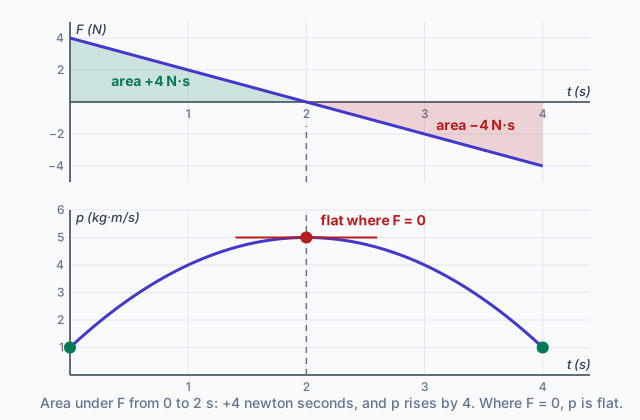
So on a graph of momentum against time, the slope at any instant is the net force. Take a cart whose net force falls steadily from N to N over 4 s, starting with kg·m/s. Its momentum is . While the force is positive the momentum graph climbs, most steeply at the start. At 2 s the force is zero and the momentum graph is flat, at its top value of 5 kg·m/s. After that the force is negative and the graph falls. The area under the force graph from 0 to 2 s, N·s, is exactly the rise in momentum.
When the mass stays constant, , so
Newton's second law is what the impulse-momentum theorem becomes for a system whose mass does not change.
Quick check · Fill the statement
A 2.0 kg cart moves along a straight track. Its momentum is , with in kg·m/s and in seconds. Take the direction of increasing as positive.
At s, the net force on the cart is , and the cart's acceleration is .
2d. Constant velocity, changing mass
The theorem also covers a system whose velocity stays the same while its mass changes. Write and hold constant:
A railroad hopper car is pulled at a steady 1.5 m/s while grain pours straight down into it at 400 kg/s. Take the car and the grain inside it as the system. The car's speed never changes, but every second another 400 kg of grain has to be brought from rest up to 1.5 m/s, so the system's momentum grows. That takes a horizontal net external force of N, in the direction the car moves. (Stopping the grain's fall takes a vertical force as well; here only the horizontal motion matters.)
So constant velocity does not mean zero net force when the mass is changing. It means zero net force only when the mass stays the same.
Quick check · Calculate
Sand falls straight down onto a level conveyor belt at 15 kg/s. The belt moves at a constant 2.0 m/s. Take the belt and the sand on it as the system, and ignore friction in the rollers. What is the size of the horizontal net external force on the system?
Part 3 Watch it done A soccer ball, kicked back
Watch each step, then do the last one yourself.
A 0.40 kg soccer ball rolls toward a player at 6.0 m/s, and she kicks it straight back the way it came. Take the direction of the kick, away from the player, as positive. While her foot touches the ball, from to s, the force on the ball is , with in newtons and in seconds. Every other force on the ball is negligible during the kick. What is the ball's velocity just after the kick?
Step 1 · Integrate the force
N·s, in the positive direction.
Step 2 · Write the momentum before
The ball rolls toward the player, against the positive direction, so kg·m/s. The impulse-momentum theorem then says .
Why this step?
Why not multiply the largest force by 0.010 s?
The force is at its largest, 1200 N at 0.005 s, for only an instant. It starts and ends at zero, so the area under its graph is less than a rectangle 1200 N tall and 0.010 s wide. The integral adds up the force the ball actually feels at every instant.
Your step · Calculate
Finish it. What is the ball's velocity just after the kick? Away from the player is positive.
m/s
Part 4 Try it New situations
Try it · Rank it
Three 0.20 kg balls each hit a wall head-on. Ball A is coated in clay; it arrives at 10 m/s and sticks. Ball B arrives at 10 m/s and bounces straight back at 10 m/s. Ball C arrives at 15 m/s and bounces straight back at 5 m/s. Rank the balls by the size of the impulse the wall exerts on each.
Greatest first
Give each one a place, 1 for first. Give two the same place if they are equal.
Your ranking: none yet
Try it · Calculate
A 1500 kg car moves at 20 m/s along a straight, level road; take its direction of motion as positive. The driver presses the brake pedal harder and harder, so the net force on the car is , with in newtons and in seconds measured from when braking starts. How long after braking starts does the car come to rest?
On paper. For the braking car in the last question, sketch against and against on aligned axes, from the moment braking starts until the car stops. Label the momentum at the start. There is nothing to submit here. Check your sketch against one rule: the slope of the momentum graph at each instant equals the height of the force graph at that instant, so the momentum graph should leave the start with a flat slope and get steeper as the force grows.
On paper. A 2.0 kg fan cart on a level track with negligible friction is moving left at 3.0 m/s at ; take right as positive. Its fan runs from to s, and while it runs the net force on the cart is , with in newtons and in seconds. Derive an expression for the cart's momentum for s, then sketch and against on aligned axes from 0 to 6.0 s. There is nothing to submit here. Then compare: integrating the force and adding the starting momentum, kg·m/s, gives kg·m/s, which reaches kg·m/s at 4.0 s. The momentum graph should be steepest at 2.0 s, where the force peaks, and level from 4.0 s on, once the fan is off.
Part 5 Explain it Design it, then test the theorem with data
On the exam this is handwritten, so answer on paper first. Nothing you type here leaves this page. Then check your answer against the model and each scoring point.
Free response is 50% of the exam score. This one is shaped like Question 3, Experimental Design and Analysis.
Free-response practice · Question 3 style
A lab group wants to test the impulse-momentum theorem with a cart. They have a level track on which friction is negligible, a cart with a force sensor mounted on it, a string they can tie to the sensor's hook, and a motion sensor at one end of the track. The cart and its sensor have a total mass of 0.80 kg. Take the direction of the pull as positive.
(a) Describe a procedure the group could use to test whether the impulse delivered to the cart equals the cart's change in momentum. Say what they change, what they measure and with what, and one step that reduces experimental uncertainty.
(b) Describe how they would find the impulse and the change in momentum from the data of one trial.
(c) Their results are below. In every trial the cart moves at +0.20 m/s just before the pull. On paper, find each change in momentum, then plot change in momentum against impulse, with a scale and units on each axis, and draw a best-fit line. Do this by hand before you open the model.
- Impulse 0.16 N·s: velocity just after the pull +0.41 m/s
- Impulse 0.32 N·s: velocity just after the pull +0.59 m/s
- Impulse 0.48 N·s: velocity just after the pull +0.81 m/s
- Impulse 0.64 N·s: velocity just after the pull +0.99 m/s
- Impulse 0.80 N·s: velocity just after the pull +1.21 m/s
(d) Use your best-fit line to calculate its slope, and explain whether the data support the impulse-momentum theorem.
Model answer
(a) Tie the string to the force sensor's hook and start the cart rolling slowly along the track. Give the string a short pull, keeping it horizontal and along the track. The force sensor records the force many times a second during the pull, and the motion sensor records the cart's velocity just before and just after it. Change how hard the pull is from trial to trial, for five or more trials. Zero the force sensor with the string slack before each trial, and repeat each pull strength three times and average.
(b) The impulse is the area under the force sensor's graph of force against time for the pull, from the software's integral or by adding trapezoids between neighboring readings. With friction negligible, the string's pull is the net force, so its impulse is the one the theorem uses. The change in momentum is , with kg and the two velocities from the motion sensor, each with its sign.
(c) The changes in momentum are , then 0.312, 0.488, 0.632 and 0.808 kg·m/s. See the graph below: a labeled scale on each axis and one straight best-fit line through the points, not a line joining them.
(d) From two points on the line, (0.16 N·s, 0.162 kg·m/s) and (0.80 N·s, 0.802 kg·m/s), the slope is , with no unit, since a N·s is a kg·m/s. The line also passes very near the origin. A slope of 1 through the origin means the change in momentum equaled the impulse in every trial, within the scatter of the data, so the data support the theorem.
Change in momentum against impulse, with the best-fit line
The line passes very near the origin and through (0.80 N·s, 0.802 kg·m/s).
Score your own answer. This is a self-check, not a grade. Tick each point your answer makes.
Part 6 Check yourself A cart hits a foam pad
The case questions use the force readings. Answer them from those.
A 0.50 kg cart rolls along a level track toward a force sensor with a thick foam pad on its face. A motion sensor shows the cart moving toward the force sensor at 1.8 m/s just before it touches the pad. The cart squashes the pad, stops, and rolls slowly back. The force sensor records the size of the force the pad exerts on the cart every 0.020 s; every other horizontal force on the cart is negligible.
| (s) | Force (N) |
|---|---|
| 0 | 0 |
| 0.020 | 4.2 |
| 0.040 | 7.4 |
| 0.060 | 8.6 |
| 0.080 | 8.4 |
| 0.100 | 7.6 |
| 0.120 | 6.3 |
| 0.140 | 4.8 |
| 0.160 | 3.2 |
| 0.180 | 1.7 |
| 0.200 | 0.6 |
| 0.220 | 0 |
Case question 1 · Calculate
Estimate the size of the impulse the pad delivers to the cart from to s, as the area under the force readings found with the trapezoid rule, one trapezoid between each pair of neighboring readings.
Case question 2 · Multiple choice
At which of these times is the cart's momentum changing at the greatest rate?
Case question 3 · Decide and justify
Take the direction toward the force sensor as positive; the cart first moves toward it and then rolls back. Over the whole collision, which way does the change in the cart's momentum point?
Which reason supports your answer?
The rest stand on their own and do not use the case.
Check yourself · Sort it
Tap a card, then say whether the net external force on the system it describes is zero.
Zero
Not zero
Check yourself · Spot the error
A cart's momentum is , with in kg·m/s and in seconds; the cart moves in the direction, which is positive. A student finds the net force on the cart at s. Tap the first line with a mistake.
Part 7 Keep it Bring back earlier ideas
Impulse changes momentum, the quantity from the last topic, and it is an area under a force graph the way work in Unit 3 was an area under a power graph. Pulling both back up is what makes them last.
From 4.1 Linear Momentum · Match
A cart moving along a straight track has momentum . Tap each change, then the cart's new momentum.
On paper. A rope parallel to a ramp drags a crate up the ramp at a steady speed, and kinetic friction acts on the crate. Draw the crate as a dot, with an arrow for each force on it (the rope's pull, gravity, the normal force and friction) and a separate arrow for its velocity. Next to each force, write whether it delivers positive, negative or zero power to the crate, and why, from the angle between that force and the velocity. Then check your work: the rope's pull lies along the velocity, so its power is positive; the normal force is perpendicular to the velocity, so its power is zero; friction points opposite the velocity, so its power is negative; and gravity points more than 90° from the velocity, which runs up the slope, so its power is negative too. At a steady speed the four powers add to zero.
From 3.5 Power · Calculate
A winch is switched on, and the power it delivers to a crate rises steadily: , with in watts and in seconds, for s. How much work does the winch do on the crate in the first 5.0 s?
In three lines
- Change in momentum is final minus initial, , and it equals the impulse, , which points the way the net force does.
- Impulse is the area under a net force against time graph; the net force is the slope of a momentum against time graph.
- For constant mass, ; for constant velocity with changing mass, .
Exam strategy for this topic
- Section I, Multiple Choice: 42 questions in 85 minutes.
- Section II, Free Response: 4 questions in 95 minutes.
- This lesson's Explain it is shaped like free-response question 3, Experimental Design and Analysis.
- A four-function, scientific, or graphing calculator is allowed on both sections of the exam.
On a free-response question, write the theorem before the numbers: , with the limits on the integral and a sign on every momentum, then the substitution, then the result in N·s or kg·m/s. When a force graph is given, say that the impulse is the area under it and show how you found the area.
Questions students ask
Are N·s and kg·m/s really the same unit?
Yes. A newton is a kg·m/s², so a newton second is a kg·m/s. Use N·s when you are talking about an impulse and kg·m/s for a momentum, but they can be added and compared directly.
Why does an airbag or a soft landing reduce the force?
Stopping you takes the same change in momentum either way. An airbag spreads that change over a longer time, and since the impulse is the area under the force graph, a longer interval needs a smaller force to give the same area.
When can I use the impulse of just one force?
When the other forces are negligible during the interval, as in a short, hard hit where a bat's or a wall's push is far larger than the object's weight or friction. Otherwise add up the impulses of every force, or integrate the net force.
How is this different from Newton's second law?
It is the same law in a more general form. becomes when the mass is constant. Written with momentum it also covers systems whose mass changes, and in its integrated form it handles forces that change quickly during a collision.
How do I find the impulse from data instead of a function?
Find the area under the force readings against time. The trapezoid rule, the average of each pair of neighboring readings times the time between them, added up, is a good estimate when the readings are close together.
Course alignment, for teachers
AP Physics C: Mechanics topic 4.2, Unit 4: Linear Momentum.
- Skill 1.C: Create qualitative sketches of graphs that represent features of a model or the behavior of the physical system.
- Skill 2.A: Derive a symbolic expression from known quantities by selecting and following a logical mathematical pathway.
- Skill 2.C: Compare physical quantities between two or more scenarios or at different times and/or locations within a single scenario.
- Skill 3.C: Justify or support a claim using evidence from experimental data, physical representations, or physical principles or laws.
This lesson maps all 10 essential knowledge statements of the topic to the part that teaches each one: 10 are checked by a scored question. The map is in the lesson file.