Unit 4 · Topic 4.3 · about 30 minutes · 7 parts · 12 scored checks, 2 of them multiple choice, plus 2 from earlier lessons
AP Physics C: Mechanics 4.3: Conservation of Linear Momentum
Unit 4: 10 to 20% of the multiple-choice section
What you'll be able to do
- Describe the behavior of a system using conservation of linear momentum: its total momentum, its center-of-mass velocity, and the velocities of its parts immediately before and after a collision or explosion.
- Describe how the selection of a system determines whether the momentum of that system changes.
Key vocabulary
| Term | What it means | The exam trap |
|---|---|---|
| Total momentum of a system | The sum of the momenta of the system's constituent parts, . | It is a vector sum, so two parts moving in opposite directions partly cancel. |
| Center-of-mass velocity | For a collection of objects, , the one velocity that describes the collection as a system. | It weights each velocity by its object's mass, so it is not the plain average of the velocities. |
| Internal force | A force that one object in the selected system exerts on another object in the same system. | An internal force can change one part's momentum a great deal; it just cannot change the system's total. |
| External force | A force exerted on an object in the system by something outside the system. | Whether a force is external depends on where you draw the boundary, not on the force itself. |
| Conservation of linear momentum | Momentum is conserved in all interactions. If the net external force on the selected system is zero, the total momentum of the system is constant. | Conserved does not mean every object, or every system, keeps its momentum; a system's momentum changes when momentum is transferred across its boundary. |
 Tap to open the picture full size
Part 1 Think first The backpack throw
Commit to a guess first. Being wrong now makes the right idea stick better.
Predict first
You stand still on a skateboard on a smooth, level floor, holding a heavy backpack. You throw the backpack straight ahead. What happens to you just after the throw?
In short. A system's total momentum is the sum of its parts' momenta, and its center of mass moves at . Forces inside the system cancel in pairs, so only a net external force, through its impulse, can change the total.
- Add momenta as vectors, signs or components kept, and divide the total by the total mass for the center-of-mass velocity.
- Two objects exert equal and opposite impulses on each other, so whatever momentum one gains, the other loses: momentum is conserved in all interactions.
- Draw the system first. With zero net external force its total momentum is constant; otherwise the change equals the external impulse. In a brief collision or explosion, total momentum just before equals total momentum just after.
Part 2 Learn it Four ideas, with a check after each
2a. One system, one total momentum
The total momentum of a system is the sum of the momenta of its parts:
It is a vector sum, so in one dimension every momentum keeps its sign.
A collection of moving objects can be described as one system with one velocity, the velocity of its center of mass:
It is the derivative of the center-of-mass position from Topic 2.1, .
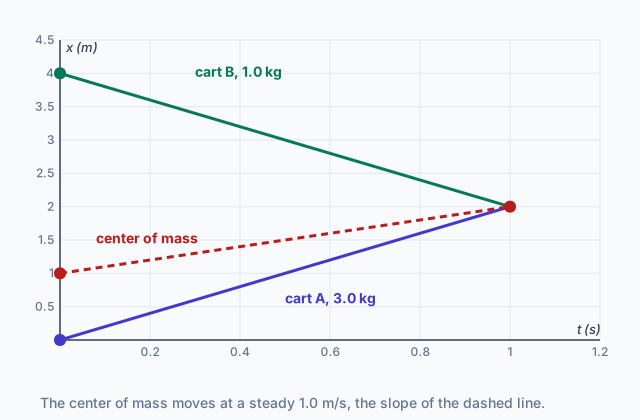
Take two carts on a level track, with right as positive. Cart A, 3.0 kg, moves at m/s, and cart B, 1.0 kg, moves toward it at m/s. The total momentum is kg·m/s, and the total mass is 4.0 kg, so m/s. The carts have the same speed, but the heavier one counts three times as much, so the center of mass drifts right.
Quick check · Calculate
Three gliders move along a straight, level air track; take right as positive. Glider P, 1.0 kg, moves to the right at 1.2 m/s. Glider Q, 0.50 kg, moves to the left at 2.0 m/s. Glider R, 0.50 kg, moves to the right at 0.40 m/s. What is the velocity of the center of mass of the three gliders?
2b. Forces inside a system cancel
When object A pushes on object B, Newton's third law says B pushes back on A with a force of the same size in the opposite direction, at every instant, for exactly the same time. Integrate each force over the contact time and the impulses match too:
The impulse exerted by one object on a second object is equal and opposite to the impulse exerted by the second object on the first. When those are the only forces with a real impulse, each impulse is that object's change in momentum, so .
So with no net external force, any change to the momentum of one object in a system is balanced by an equal and opposite change somewhere else in it. That holds however the force rises and falls during contact, and whether the objects bounce, stick or crumple. Momentum is conserved in all interactions: it moves from object to object, or across a system's boundary, but none is created or destroyed. If a bat gives a ball N·s, the ball gives the bat N·s.
Quick check · Decide and justify
A 2000 kg pickup truck moving east collides head-on with a 1000 kg car moving west. How does the size of the truck's change in momentum during the collision compare with the size of the car's?
Which reason supports your answer?
2c. Where you draw the system
Whether a system's momentum changes depends on where you draw its boundary. Forces between objects inside the system are internal, and their impulses cancel in pairs. Forces from anything outside are external, and only they can change the total. If the total momentum of a system changes, that change equals the impulse exerted on the system:
If the net external force on the selected system is zero, the total momentum of the system is constant, and so is the velocity of its center of mass. If the net external force is nonzero, momentum is transferred between the system and its environment.
Take a person jumping straight up from a floor. For the person alone, the floor's push and Earth's gravity are external and do not balance during the jump, so the person's momentum changes: momentum crosses the boundary. For the person and Earth together, both forces are internal. Earth gains a downward momentum equal to the person's upward momentum, too small a velocity change to notice, and the total stays constant. A system can always be selected so that its total momentum is constant.
Quick check · Sort it
Tap a card, then say what happens to the total momentum of the system it names.
Stays constant
Changes
2d. Just before and just after
Conservation of momentum is most useful in collisions and explosions. The objects push on each other with large internal forces for a very short time. External forces such as friction usually still act, but over that short time their impulse is tiny compared with the momenta involved. So the total momentum immediately after equals the total immediately before:
An explosion runs the same way: internal forces push the pieces apart, and the pieces' total momentum just after equals the momentum of the whole just before. A 4.0 kg rifle at rest fires a 0.010 kg bullet at m/s. The total was zero before, so and m/s: the rifle recoils.
Write every velocity with its sign, set the two totals equal and solve for the unknown. The equation holds only just before and just after; over the following seconds, friction has time to deliver a real impulse.
Quick check · Calculate
A 5.0 kg toy rocket sled moves to the right at 2.0 m/s along a level track with negligible friction. A small charge splits it in two, and immediately afterward the 2.0 kg rear piece moves to the left at 3.0 m/s. Take right as positive. What is the velocity of the 3.0 kg front piece immediately after the split?
Part 3 Watch it done A crash at an icy corner
Watch each step, then do the last one yourself.
A 1200 kg car moving east at 20 m/s and an 1800 kg truck moving north at 10 m/s collide at an icy intersection and lock together. Take east as and north as . Find the velocity of the wreck immediately after the collision.
Step 1 · Choose the system
Take the car and the truck as one system. The forces they exert on each other are internal. Friction from the icy road is external, but it is small, and over the fraction of a second the crash lasts its impulse is tiny, so the total momentum just after equals the total just before.
Step 2 · Add the momenta by component
kg·m/s and kg·m/s. The wreck carries both components, and it is one object of 3000 kg, so its velocity is the center-of-mass velocity .
Why this step?
Why not add 24 000 and 18 000?
Momentum is a vector, and these two point at right angles. Each component is conserved on its own: east-west momentum stays east-west and north-south stays north-south. The size of the total comes from the two components at right angles, not from adding their sizes.
Your step · Calculate
Finish it. What is the speed of the wreck immediately after the collision?
m/s
Part 4 Try it New situations
Try it · Rank it
Three people stand at rest on smooth ice, where friction is negligible, each holding a ball. Each throws the ball horizontally. Ana, 60 kg, throws a 2.0 kg ball at 9.0 m/s. Ben, 50 kg, throws a 1.0 kg ball at 15 m/s. Cy, 80 kg, throws a 4.0 kg ball at 5.0 m/s. Each person's mass does not include the ball, and every speed is measured relative to the ice. Rank the people by the speed at which each slides backward just after the throw.
Greatest first
Give each one a place, 1 for first. Give two the same place if they are equal.
Your ranking: none yet
Try it · Calculate
A 3.0 kg cart and a 1.0 kg cart are tied together with a loose string on a level track with negligible friction, and both start at rest. A fan exerts a net external force on the two-cart system of , with in newtons and in seconds, in the positive direction, for s. As the carts move, the string goes slack and taut several times. What is the velocity of the system's center of mass at s?
On paper. Cart A, 0.50 kg, rolls at m/s along a level track with negligible friction into cart B, 0.25 kg, at rest. The carts touch for 0.05 s, starting at s. Afterward cart A moves at m/s and cart B at m/s.
- Draw the two carts with a dashed boundary around both. Draw each force on each cart as an arrow and label it internal or external to the two-cart system.
- On one set of axes from to s, with scales and units, plot cart A's momentum, cart B's momentum and their total. Treat each cart's momentum as changing steadily while they touch.
- Describe how you would use two carts and motion sensors in your lab to test whether the total momentum of the two carts stays constant in a collision: what you would measure, how you would keep external impulses small, and what result would support the claim.
There is nothing to submit here. Your total line should stay level, at the value it has before the carts touch.
Part 5 Explain it Reason first, then derive
Nothing you type leaves this page. Check your answer against the model and each scoring point.
Free response is 50% of the exam score. This one is shaped like Question 4, Qualitative/Quantitative Translation.
Free-response practice · Question 4 style
Two blocks, of mass and , sit on a level surface with a compressed spring of negligible mass between them. They are held at rest and then released, and the spring pushes them apart. Take right as positive. The block of mass leaves the spring moving left at speed .
(a) Friction is negligible. Without deriving an equation, describe the motion of the center of mass of the two blocks and the spring while the spring pushes the blocks apart. Justify your answer.
(b) Derive an expression for the velocity of the block of mass after it leaves the spring, in terms of .
(c) Use your result from part (b) to show whether it agrees with your claim in part (a).
(d) Now suppose the surface is rough, with the same coefficient of kinetic friction under both blocks. While both blocks slide after leaving the spring, is the total momentum of the two blocks constant? Justify your answer, and state the direction of any net external force.
Model answer
(a) The center of mass stays at rest. The spring's pushes on the blocks are internal to the system, and gravity and the surface's upward push balance, so the net external force is zero. The system's center-of-mass velocity is then constant, and it started at zero.
(b) The total momentum is zero before release and stays zero, so , which gives , to the right.
(c) , so the center of mass is still at rest, as claimed in part (a). The heavier block moves a third as fast in the opposite direction.
(d) No. The surface is outside the system, so the friction forces are external. The block of mass moves left, so friction on it is to the right; the block of mass moves right, so friction on it is to the left. The net external force is to the left, so the system's total momentum changes, gaining leftward momentum: momentum is transferred between the blocks and the surface.
Score your own answer. This is a self-check, not a grade. Tick each point your answer makes.
Part 6 Check yourself Two carts and a motion sensor
The case questions use the sensor readings. Answer them from those.
A class sends two carts toward each other along a level track; take right as positive. Cart A, 0.60 kg, starts on the left moving right, and cart B, 0.40 kg, starts on the right moving left. Each cart has a thick foam bumper, which squashes and springs back only weakly. The bumpers meet at about s and touch for less than 0.05 s. Motion sensors at both ends of the track record each cart's velocity. Some of the readings:
| (s) | (m/s) | (m/s) |
|---|---|---|
| 0.0 | 0.84 | −0.54 |
| 0.2 | 0.82 | −0.52 |
| 0.4 | 0.80 | −0.50 |
| 0.6 | 0.08 | 0.55 |
| 0.8 | 0.06 | 0.53 |
| 1.0 | 0.04 | 0.51 |
Case question 1 · Calculate
Using the readings at s, what is the total momentum of the two carts? Right is positive.
Case question 2 · Multiple choice
Compare the changes in momentum of the two carts from s to s. Which statement do the readings and the physics of the collision support?
Case question 3 · Multiple choice
The class works out the total momentum of the two carts from every row of readings and finds that it gets smaller from each row to the next. Which explanation is best?
The rest stand on their own and do not use the case.
Check yourself · Spot the error
Cart A, 1.0 kg, moves right at 4.0 m/s toward cart B, 2.0 kg, which moves left at 1.0 m/s. Just after they collide, cart A moves left at 2.0 m/s. Take right as positive. A student finds cart B's velocity just after the collision. Tap the first line with a mistake.
Check yourself · Fill the statement
A firework shell is moving straight up when it bursts into many fragments. Air resistance is negligible.
Immediately after the burst, the total momentum of the fragments is the momentum of the shell immediately before it, because the forces that blow the shell apart are to the system of fragments. In the seconds after the burst, the total momentum of the fragments , because Earth's gravitational force on them is .
Part 7 Keep it Bring back earlier ideas
Momentum is conserved because the impulses two objects give each other cancel, so the last topic is the base for this one, and work from Unit 3 is due for review. Pulling them back up is what makes them last.
On paper. For the braking car in the last question, sketch against and against on aligned axes, from the moment braking starts until the car stops. Label the momentum at the start. There is nothing to submit here. Check your sketch against one rule: the slope of the momentum graph at each instant equals the height of the force graph at that instant, so the momentum graph should leave the start with a flat slope and get steeper as the force grows.
On paper. A 2.0 kg fan cart on a level track with negligible friction is moving left at 3.0 m/s at ; take right as positive. Its fan runs from to s, and while it runs the net force on the cart is , with in newtons and in seconds. Derive an expression for the cart's momentum for s, then sketch and against on aligned axes from 0 to 6.0 s. There is nothing to submit here. Then compare: integrating the force and adding the starting momentum, kg·m/s, gives kg·m/s, which reaches kg·m/s at 4.0 s. The momentum graph should be steepest at 2.0 s, where the force peaks, and level from 4.0 s on, once the fan is off.
From 4.2 Change in Momentum and Impulse · Rank it
Three 0.20 kg balls each hit a wall head-on. Ball A is coated in clay; it arrives at 10 m/s and sticks. Ball B arrives at 10 m/s and bounces straight back at 10 m/s. Ball C arrives at 15 m/s and bounces straight back at 5 m/s. Rank the balls by the size of the impulse the wall exerts on each.
Greatest first
Give each one a place, 1 for first. Give two the same place if they are equal.
Your ranking: none yet
On paper. A rope parallel to a ramp drags a crate up the ramp at a steady speed, and kinetic friction acts on the crate. Draw the crate as a dot, with an arrow for each force on it (the rope's pull, gravity, the normal force and friction) and a separate arrow for its velocity. Next to each force, write whether it delivers positive, negative or zero power to the crate, and why, from the angle between that force and the velocity. Then check your work: the rope's pull lies along the velocity, so its power is positive; the normal force is perpendicular to the velocity, so its power is zero; friction points opposite the velocity, so its power is negative; and gravity points more than 90° from the velocity, which runs up the slope, so its power is negative too. At a steady speed the four powers add to zero.
From 3.5 Power · Calculate
A winch is switched on, and the power it delivers to a crate rises steadily: , with in watts and in seconds, for s. How much work does the winch do on the crate in the first 5.0 s?
In three lines
- A system's total momentum is the vector sum of its parts' momenta, and its center of mass moves at .
- Two objects exert equal and opposite impulses on each other, so internal forces move momentum around a system but never change its total.
- With zero net external force a system's momentum is constant; otherwise its change equals the external impulse. Just before and just after a collision or explosion, the totals are equal.
Exam strategy for this topic
- Section I, Multiple Choice: 42 questions in 85 minutes.
- Section II, Free Response: 4 questions in 95 minutes.
- This lesson's Explain it is shaped like free-response question 4, Qualitative/Quantitative Translation.
- A four-function, scientific, or graphing calculator is allowed on both sections of the exam.
On a free-response question, name the system before you write an equation, and say why its momentum is or is not constant: list the external forces, or say why their impulse is negligible during a brief collision. Then write the total momentum just before and just after with every velocity's sign, or by components in two dimensions, and solve.
Questions students ask
Is momentum conserved when two objects stick together or get dented?
Yes. The forces between them are internal, so their total momentum just after equals the total just before. What is not kept in those collisions is kinetic energy, which Topic 4.4 takes up.
If momentum is always conserved, why does a ball rolling on grass slow down and stop?
The ball alone is not a system with zero net external force: friction from the grass is external, so momentum moves from the ball to the ground and Earth. Take the ball and Earth together and the total is constant, though Earth's share is far too small to notice.
Why do problems say "immediately before" and "immediately after"?
External forces such as friction still act during a collision, but only for a tiny time, so their impulse is negligible. A few seconds later they have delivered a real impulse, and the total momentum is no longer what it was.
How do I handle a collision in two dimensions?
Conserve each component separately. Add the -momenta just before and set them equal to the -momenta just after, then do the same for . Combine components at the end to get a speed and a direction.
What does the center-of-mass velocity tell me about a collision?
With no net external force, it is the same just before and just after, however violent the collision. If the objects stick together, the combined object moves at exactly that velocity.
Beyond the AP Exam
College Board sets this limit on what the AP Exam asks about this topic. Anything past it is not on the exam.
AP Physics C: Mechanics only expects students to quantitatively analyze collisions and interactions in one or two dimensions. Three-dimensional collisions may be analyzed qualitatively.
Course alignment, for teachers
AP Physics C: Mechanics topic 4.3, Unit 4: Linear Momentum.
- Skill 1.A: Create diagrams, tables, charts, or schematics to represent physical situations.
- Skill 1.B: Create quantitative graphs with appropriate scales and units, including plotting data.
- Skill 2.C: Compare physical quantities between two or more scenarios or at different times and/or locations within a single scenario.
- Skill 3.A: Create experimental procedures that are appropriate for a given scientific question.
- Skill 3.B: Apply an appropriate law, definition, theoretical relationship, or model to make a claim.
This lesson maps all 12 essential knowledge statements of the topic to the part that teaches each one: 12 are checked by a scored question. The map is in the lesson file.