Unit 4 · Topic 4.4 · about 30 minutes · 7 parts · 12 scored checks, 2 of them multiple choice, plus 2 from earlier lessons
AP Physics C: Mechanics 4.4: Elastic and Inelastic Collisions
Unit 4: 10 to 20% of the multiple-choice section
What you'll be able to do
- Describe whether an interaction between objects is elastic or inelastic, from the system's total kinetic energy before and after it, and what becomes of the kinetic energy that is not restored.
Key vocabulary
| Term | What it means | The exam trap |
|---|---|---|
| Elastic collision | A collision in which the initial kinetic energy of the system is equal to the final kinetic energy of the system. | The definition compares the system before and after the collision; it says nothing about the moments of contact in between. |
| Inelastic collision | A collision in which the total kinetic energy of the system decreases. | A collision can lose kinetic energy even when nothing looks dented and the objects bounce apart. |
| Perfectly inelastic collision | A collision in which the objects stick together and move with the same velocity after the collision. | The joined objects still carry the system's total momentum, so their shared velocity comes from momentum conservation. |
 Tap to open the picture full size
Part 1 Think first Two carts, one bump
Commit to a guess first. Being wrong now makes the right idea stick better.
Predict first
On a level track, a cart rolling at 2 m/s bumps into an identical cart at rest. Their bumpers are springy, and afterward the two carts together have exactly as much kinetic energy as before. What does the cart that was rolling do?
In short. A collision is elastic when the system's total kinetic energy after equals its total before, inelastic when that total decreases, and perfectly inelastic when the objects stick together and move off with the same velocity.
- Compare totals for the whole system, before and after. In an elastic collision each object's own kinetic energy can still change.
- In an inelastic collision, nonconservative forces transform some kinetic energy into other forms, such as internal energy and sound; it is not restored as kinetic energy.
- Momentum tells you the velocities, but it cannot tell you the type: total momentum is the same before and after every collision with no net external force.
Part 2 Learn it Four ideas, with a check after each
2a. Elastic: the total comes back
In a collision, the objects exert large forces on each other for a short time. If no net external force acts on the system, its total momentum is the same just before and just after, as in Topic 4.3. Kinetic energy is a separate question, and the answer sorts collisions into types.
An elastic collision is one in which the initial kinetic energy of the system is equal to the final kinetic energy of the system:
where the primes mark values just after the collision. The comparison is between totals. In an elastic collision the final kinetic energies of each of the objects within the system may be different from their initial kinetic energies.
Suppose a 2.0 kg cart moving at 3.0 m/s hits a 1.0 kg cart at rest, and afterward they move the same way at 1.0 m/s and 4.0 m/s. Before, the system has J. After, it has J. The collision is elastic, even though the first cart went from 9.0 J to 1.0 J and the second from 0 to 8.0 J.
Quick check · Decide and justify
On a level air track, take right as positive. A 0.50 kg glider moving right at 0.60 m/s hits a 0.25 kg glider at rest. Afterward the 0.50 kg glider moves right at 0.20 m/s and the 0.25 kg glider moves right at 0.80 m/s. Was the collision elastic or inelastic?
Which reason supports your answer?
2b. Inelastic: some of it does not come back
An inelastic collision is one in which the total kinetic energy of the system decreases:
Energy is not destroyed. In an inelastic collision, some of the initial kinetic energy is not restored to kinetic energy but is transformed by nonconservative forces into other forms of energy. When a fender crumples or a ball of clay flattens, the forces that bend the material and rub its parts against each other turn kinetic energy into internal energy, which shows up as a slightly warmer object, and into sound.
The amount transformed is the decrease in the system's kinetic energy, , using every object in the system both times.
Most real collisions are at least a little inelastic. Two pool balls click when they hit, and that click is kinetic energy leaving as sound. Steel balls and gliders with magnetic bumpers come close to elastic, because almost nothing deforms permanently.
Quick check · Calculate
On a level track, a 1.2 kg cart moving east at 2.0 m/s hits a 0.80 kg cart at rest. Afterward both carts move east: the 1.2 kg cart at 0.60 m/s and the 0.80 kg cart at 2.1 m/s. How much kinetic energy did nonconservative forces transform into other forms during the collision?
2c. Perfectly inelastic: stuck together
In a perfectly inelastic collision, the objects stick together and move with the same velocity after the collision. A dart that sticks in a target, two train cars whose couplers latch, and a ball of clay that lands on a cart are all perfectly inelastic.
Because the objects share one final velocity , momentum conservation alone finds it:
Give each velocity its sign. A 4.0 kg cart moving east at 2.0 m/s that sticks to a 1.0 kg cart at rest gives, with east positive, , so m/s. The system's kinetic energy goes from 8.0 J to J, so this collision, like every perfectly inelastic one, is also inelastic.
Sticking together does not mean stopping. The joined objects move off with whatever velocity the total momentum gives them; they come to rest only if the total momentum was zero.
Quick check · Calculate
On a level track, take east as positive. A 0.30 kg cart moving east at 1.5 m/s and a 0.20 kg cart moving west at 1.0 m/s collide and stick together. What is their velocity just after the collision?
2d. Reading a collision from the force
During contact, each object pushes on the other with equal and opposite forces. A force sensor can record one of them against time, and its integral is the impulse, that object's change in momentum (Topic 4.2):
Say the force on a 2.0 kg cart at rest is , in newtons, for the 0.050 s of contact. Then N·s, so the cart leaves at 2.0 m/s, and the other object gets N·s. With every velocity after the collision known, compare the kinetic energy totals.
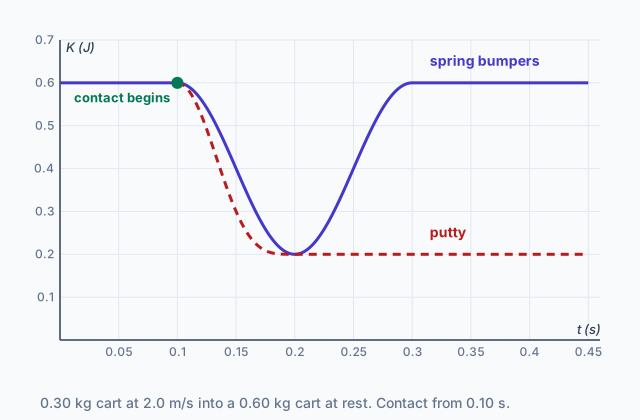
While springy bumpers are squeezed, the system's kinetic energy drops, because some of it is stored as elastic potential energy. If the bumpers push all of it back out as the objects separate, the total comes back and the collision is elastic. If friction inside the material, or bending that stays bent, keeps part of it, the collision is inelastic. So classify a collision from the moments before and after it, never from the middle of the contact.
Quick check · Spot the error
On a level track, take right as positive. A 0.40 kg cart moving right at 1.5 m/s hits a 0.60 kg cart at rest. During the 0.10 s of contact, the force on the 0.40 kg cart is , in newtons, with in seconds. A student classifies the collision. Tap the first line with a mistake.
Part 3 Watch it done Two pucks on the ice
Watch each step, then do the last one yourself.
On level ice, take east as positive. A 0.20 kg puck sliding east at 4.0 m/s strikes a 0.60 kg puck at rest. During the 0.020 s of contact, the force the first puck exerts on the second points east and is , in newtons, with in seconds. Friction from the ice is negligible during the contact. Is the collision elastic?
Step 1 · Integrate the force
The impulse on the 0.60 kg puck is N·s, east. It started at rest, so it leaves at m/s.
Step 2 · Use the equal and opposite impulse
The second puck pushes back on the first with an impulse of N·s, so m/s. The first puck bounces back west. Check: total momentum is kg·m/s before and kg·m/s after.
Why this step?
Why not decide from the momentum check in the second step?
Because it would come out the same for any collision of these pucks with no net external force, elastic or not. The momentum check only confirms the velocities. The type is decided by kinetic energy.
Your step · Calculate
Finish it. What is the total kinetic energy of the two pucks just after the collision?
J
Part 4 Try it New situations
Try it · Rank it
Two 2.0 kg carts are on a level track. In each of three trials, one cart rolls east at 3.0 m/s into the other, which is at rest. Afterward, in trial A the first cart stops and the second moves east at 3.0 m/s. In trial B the carts stick together and move east at 1.5 m/s. In trial C the first cart moves east at 1.0 m/s and the second moves east at 2.0 m/s. Rank the trials by the kinetic energy transformed into other forms during the collision.
Greatest first
Give each one a place, 1 for first. Give two the same place if they are equal.
Your ranking: none yet
Try it · Calculate
A lump of clay of mass slides at speed across frictionless ice and sticks to a block of mass at rest. If the clay slid at instead, by what factor would the kinetic energy transformed into other forms change?
On paper. Take trial B from the ranking. Sketch the two carts just before and just after the collision, with a velocity arrow on every moving cart labeled with its value, and an arrow showing which way is positive. Then draw two energy bar charts for the system of both carts, one for just before and one for just after: a bar for kinetic energy and a bar for the other forms the missing kinetic energy became, with heights to scale. Check your bars against the energies in the ranking's feedback; the two charts should have the same total height.
Part 5 Explain it Derive it, then put numbers in
On the exam this is handwritten, so answer on paper first. Nothing you type here leaves this page. Then check your answer against the model and each scoring point.
Free response is 50% of the exam score. This one is shaped like Question 1, Mathematical Routines.
Free-response practice · Question 1 style
A lump of clay of mass slides at speed across a level, frictionless surface and sticks to a block of mass that is at rest.
(a) Derive an expression for the speed of the clay and block just after the collision, in terms of , and .
(b) Derive an expression for the fraction of the clay's initial kinetic energy that is transformed into other forms in the collision, in terms of and .
(c) For kg, kg and m/s, calculate the speed just after the collision and the kinetic energy transformed into other forms.
(d) On paper, sketch the fraction from part (b) against for a fixed , from to . Label its values at , and . Then use your sketch to explain what happens to the kinetic energy when the block is much more massive than the clay.
Model answer
(a) The clay and block form a system with no net external force along the surface, so momentum is conserved, and after the collision they share one velocity: , so .
(b) The kinetic energy after is , which is of the initial . The fraction transformed is .
(c) m/s. The initial kinetic energy is J and the final is J, so 2.0 J is transformed, the fraction .
(d) The curve starts at 0 when , rises steeply, passes 0.5 at and 0.8 at , and levels off toward 1, reaching about 0.91 at . So when the block is much more massive than the clay, the pair moves off very slowly and nearly all of the clay's kinetic energy is transformed into other forms, mostly internal energy of the squashed clay.
Score your own answer. This is a self-check, not a grade. Tick each point your answer makes.
Part 6 Check yourself Gliders with three kinds of bumper
The case questions use the glider readings. Answer them from those.
A class collides two gliders on a level air track, where friction is negligible; take right as positive. Glider A has a mass of 0.400 kg and glider B a mass of 0.200 kg. The class fits the gliders with a different kind of bumper for each trial, and motion sensors record each glider's velocity just before and just after the collision. In Trials 3 and 4 the gliders stuck together.
| Trial | Bumpers | A before | B before | A after | B after |
|---|---|---|---|---|---|
| 1 | Magnets | +0.602 | 0 | +0.198 | +0.799 |
| 2 | Rubber | +0.598 | 0 | +0.281 | +0.632 |
| 3 | Hook-and-loop pads | +0.605 | 0 | +0.401 | +0.401 |
| 4 | Hook-and-loop pads | +0.500 | −0.300 | +0.234 | +0.234 |
Case question 1 · Calculate
Using the Trial 4 readings, how much kinetic energy was transformed into other forms in the collision? Give your answer in millijoules.
Case question 2 · Multiple choice
Which statement about the kinetic energy of each glider in Trial 1 do the readings support?
Case question 3 · Multiple choice
In Trial 2 the gliders have less total kinetic energy after the collision than before. What happened to the kinetic energy that is missing?
The rest stand on their own and do not use the case.
Check yourself · Sort it
Tap a card, then say which kind of collision it describes. Every track is level, and east is positive.
Elastic
Inelastic, objects separate
Perfectly inelastic
Check yourself · Fill the statement
A loaded freight car rolls along a level track into an empty freight car at rest, and their couplers latch.
Just after the collision the two cars move with , so the collision is . The kinetic energy that is not restored was transformed by forces into other forms of energy.
Part 7 Keep it Bring back earlier ideas
Every collision here kept its momentum, from Topic 4.3, and kinetic energy and momentum are tied together, from Topic 4.1. Pulling them back up is what makes them last.
From 4.3 Conservation of Linear Momentum · Calculate
A 5.0 kg toy rocket sled moves to the right at 2.0 m/s along a level track with negligible friction. A small charge splits it in two, and immediately afterward the 2.0 kg rear piece moves to the left at 3.0 m/s. Take right as positive. What is the velocity of the 3.0 kg front piece immediately after the split?
From 4.1 Linear Momentum · Calculate
A 0.15 kg baseball and a 6.0 kg bowling ball have momenta of the same size. How many times the bowling ball's kinetic energy is the baseball's kinetic energy?
In three lines
- Elastic: the system's total kinetic energy after equals its total before, though each object's share can change.
- Inelastic: the total kinetic energy decreases, because nonconservative forces transform some of it into other forms that are not restored.
- Perfectly inelastic: the objects stick together and share one velocity, which momentum conservation finds.
Exam strategy for this topic
- Section I, Multiple Choice: 42 questions in 85 minutes.
- Section II, Free Response: 4 questions in 95 minutes.
- This lesson's Explain it is shaped like free-response question 1, Mathematical Routines.
- A four-function, scientific, or graphing calculator is allowed on both sections of the exam.
When a question asks whether a collision is elastic, show the system's total kinetic energy before and after, with every object in both sums, and state the comparison. Writing that momentum is conserved does not answer it. When the force during contact is given as a function of time, integrate it for the impulse before you find any velocity.
Questions students ask
Is momentum conserved in an inelastic collision?
Yes. With no net external force on the system, the total momentum is the same before and after every collision, elastic, inelastic or perfectly inelastic. Only the kinetic energy tells the types apart.
Where does the kinetic energy go in an inelastic collision?
Nonconservative forces, such as the ones that bend metal or flatten clay, transform it into other forms, mostly internal energy and sound. The total energy is still conserved.
Can a collision be exactly elastic?
Collisions between atoms can be. Everyday collisions are at least slightly inelastic, but gliders with magnetic bumpers or hard steel balls come close enough that physics problems often treat them as elastic.
Does perfectly inelastic mean the objects stop?
No. They stick together and move with one shared velocity, which is zero only if the system's total momentum was zero.
Course alignment, for teachers
AP Physics C: Mechanics topic 4.4, Unit 4: Linear Momentum.
- Skill 1.A: Create diagrams, tables, charts, or schematics to represent physical situations.
- Skill 2.B: Calculate or estimate an unknown quantity with units from known quantities, by selecting and following a logical computational pathway.
- Skill 2.D: Predict new values or factors of change of physical quantities using functional dependence between variables.
- Skill 3.C: Justify or support a claim using evidence from experimental data, physical representations, or physical principles or laws.
This lesson maps all 5 essential knowledge statements of the topic to the part that teaches each one: 5 are checked by a scored question. The map is in the lesson file.