Unit 5 · Topic 5.1 · about 30 minutes · 7 parts · 12 scored checks, 2 of them multiple choice, plus 2 from earlier lessons
AP Physics C: Mechanics 5.1: Rotational Kinematics
Unit 5: 10 to 15% of the multiple-choice section
What you'll be able to do
- Describe how a rigid system rotates over time using angular displacement, angular velocity and angular acceleration, moving between them by differentiating and integrating and by reading their graphs.
Key vocabulary
| Term | What it means | The exam trap |
|---|---|---|
| Rigid system | A system that holds its shape but in which different points move in different directions as it rotates, so it cannot be modeled as a single object. | Rigid describes the shape, not the motion: the parts of a rigid system are still moving, in different directions. |
| Axis of rotation | The line about which a rigid system turns. | The same rotation looks clockwise from one side of the axis and counterclockwise from the other, so a sense means nothing until you say where you are looking from. |
| Center of mass | The point that moves as if the whole mass of the system were concentrated there. | Tracking only the center of mass throws away the turning, so check what the question asks about before choosing it. |
| Angular displacement | The angle, in radians, through which a point on a rigid system rotates about a specified axis, . | An angle counted in revolutions or degrees has to be converted to radians before it is combined with an angular velocity in rad/s. |
| Angular velocity | The rate at which angular position changes with time, , in rad/s. | A negative angular velocity does not mean slow turning; it means turning in the sense you chose as negative. |
| Angular acceleration | The rate at which angular velocity changes with time, , in rad/s². | The sign of the angular acceleration alone does not say whether a spin is speeding up or slowing down. |
 Tap to open the picture full size
Part 1 Think first Two riders, one turn
Commit to a guess first. Being wrong now makes the right idea stick better.
Predict first
Maya sits at the outer edge of a playground merry-go-round and Leo sits halfway to the center. A parent pushes it through exactly one full turn. Who turned through the bigger angle about the center?
In short. Rotational kinematics describes a turning rigid system with its angular displacement in radians, its angular velocity and its angular acceleration , which are related exactly as position, velocity and acceleration are along a line.
- Every point on a rigid system turns through the same angle about the axis, so one , one and one describe the whole system; pick clockwise or counterclockwise, seen from a stated side, as positive.
- Differentiate to go from to to , and integrate, with a known starting value, to go back; the slope of each graph is the next quantity and the area under it is a change in the one before.
- With a constant , use , and ; with a changing , integrate.
Part 2 Learn it Four ideas, with a check after each
2a. A rigid system and the angle it turns through
A spinning wheel cannot be shrunk to a single point. A rigid system is one that holds its shape but whose points move in different directions as it rotates, so it cannot be modeled as an object. What its points do share is the angle they turn through about the axis of rotation.
Angular displacement is that angle, measured in radians:
One full turn is rad, so two and a half turns is rad. Work in radians: angular displacement is defined in radians, and the link to distance along a circle in the next topic holds only in radians.
In this course a rotation has a sense rather than an arrow. Choose clockwise or counterclockwise as positive; the other sense is negative. Say which side you are looking from: a wheel turning clockwise seen from one side turns counterclockwise seen from the other. With counterclockwise positive, a half turn clockwise is rad.
If the turning does not matter, the motion of the center of mass may describe the system well enough to treat it as a single object. Earth spins once a day, but for its yearly trip around the Sun you can treat it as a single object.
Quick check · Fill the statement
A bicycle sits upside down on a repair stand. Take counterclockwise, as seen from the chain side, as positive. A mechanic turns the front wheel through 3 full revolutions, clockwise as seen from the chain side.
The wheel is modeled as a . Its angular displacement is , and a spot on the rim and a spot near the hub turn through .
2b. Angular velocity and angular acceleration are derivatives
Angular velocity is the rate at which angular position changes, and angular acceleration is the rate at which angular velocity changes:
Their units are rad/s and rad/s², and each carries the sign of the sense you chose as positive. Over an interval, the average angular velocity is , which uses only the two ends.
Suppose a turntable's angle is , with in radians, in seconds and counterclockwise seen from above positive. Then and rad/s². At s, rad/s and rad/s²: opposite signs, so the turntable is slowing down. At s, rad/s and rad/s²: the same sign, so it is speeding up, now turning clockwise.
That is the same test as along a line: the same signs mean speeding up, opposite signs mean slowing down. Because every point on a rigid system turns through the same angle in the same time, they all share one and one at each instant.
Quick check · Calculate
A drill bit's angular position is , with in radians and in seconds. Take counterclockwise, as seen from behind the drill, as positive. What is the bit's angular acceleration at s?
2c. The same mathematics as motion along a line
Angular displacement, angular velocity and angular acceleration about one axis relate to each other exactly as position, velocity and acceleration do in one dimension. Swap for , for and for , and every relationship carries over, integration included:
When is constant, those integrals give three equations:
A potter's wheel turning at 2.0 rad/s counterclockwise, seen from above and taken as positive, speeds up at a constant 0.50 rad/s² for 6.0 s. It ends at rad/s, after turning rad.
The third equation has no time in it, so reach for it when the question gives no time and asks for none. All three hold only while stays constant.
Quick check · Calculate
A grinding wheel spins counterclockwise, as seen from the front, at 40 rad/s when its motor is switched off. Take counterclockwise as positive. It then slows with a constant angular acceleration of magnitude 5.0 rad/s². Through what angular displacement does it turn before it stops?
2d. Reading rotation graphs
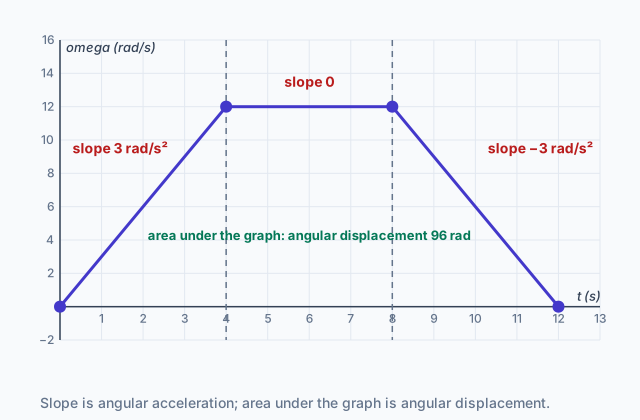
A ceiling fan, with counterclockwise seen from below positive, spins up at 3 rad/s² for 4 s to 12 rad/s, runs steadily for 4 s, then spins down at 3 rad/s² to rest (the graph at the top of this page). Graphs of , and against time are linked the same way motion graphs along a line are:
- The slope of the graph at an instant is , and the slope of the graph is . The fan's line rises at 3 rad/s² while it spins up, is level while it turns steadily, and falls at rad/s² while it spins down.
- The area between the graph and the time axis over an interval is the angular displacement, . For the fan that area is 96 rad, about 15 turns. The area under an graph is the change in .
- Area below the time axis counts as negative, because the system is turning the negative way there.
On a graph, a curve that bends upward means is growing, so is positive; a curve that bends downward means is negative.
Quick check · Decide and justify
A wheel's angular velocity, with counterclockwise as seen from the front positive, falls along a straight line on its graph from rad/s at to rad/s at s. What is the sign of the wheel's angular displacement from to s?
Which reason supports your answer?
Part 3 Watch it done A wind turbine in a gust
Watch each step, then do the last one yourself.
A wind turbine's rotor turns at 2.0 rad/s, counterclockwise as seen from upwind, when a gust arrives; take counterclockwise as positive. During the gust its angular acceleration is , with in rad/s² and in seconds, for s. Through what angle does the rotor turn in those 6 s?
Step 1 · Integrate the angular acceleration
, with rad/s as the constant. Check: differentiating gives back .
Step 2 · Read the angular velocity
At s, rad/s. The angular acceleration falls from 2 rad/s² to 0 over the gust but stays positive, so the rotor speeds up the whole time and turns fastest at the end.
Why this step?
Why not use with rad/s²?
That equation holds only for a constant angular acceleration, and this one shrinks to zero by 6 s. Using the starting value for the whole gust gives 48 rad, too much, because the rotor never keeps gaining speed that fast. The angular displacement is the integral of .
Your step · Calculate
Finish it. Through what angle does the rotor turn from to s? Counterclockwise, as seen from upwind, is positive.
rad
Part 4 Try it New situations
Try it · Rank it
Three wheels turn on fixed axles, each with a constant angular acceleration. For all three, counterclockwise as seen from the front is positive. Wheel A starts at 2 rad/s with rad/s². Wheel B starts from rest with rad/s². Wheel C starts at 6 rad/s with rad/s². Rank the wheels by angular displacement from to s.
Greatest first
Give each one a place, 1 for first. Give two the same place if they are equal.
Your ranking: none yet
Try it · Sort it
Tap a card, then say which model fits the question asked about it.
Single object
Rigid system
On paper. A turntable starts from rest and speeds up with a constant angular acceleration of 2 rad/s², counterclockwise seen from above taken as positive, for 3 s; then it turns at a steady angular velocity for 2 s more. Sketch three graphs stacked with their time axes lined up, from 0 to 5 s: , and against , with at the start. Label and at 3 s and 5 s, and check that each slope and each area agrees with the graph beside it. There is nothing to submit. Check your three graphs against each other: the slope of the angular position graph should match the angular velocity graph, and the area under each graph should match the change in the one before it.
Part 5 Explain it Derive it, then put numbers in
Nothing you type leaves this page. Check your answer against the model and each scoring point.
Free response is 50% of the exam score. This one is shaped like Question 1, Mathematical Routines.
Free-response practice · Question 1 style
A flywheel in a lab turns on a fixed vertical axle; take counterclockwise, as seen from above, as positive. Its angular velocity is , with in rad/s and in seconds, for s, and its angular position is at .
(a) Derive an expression for the flywheel's angular position .
(b) Calculate the flywheel's angular acceleration at s.
(c) Calculate the flywheel's angular displacement and its average angular velocity from to s.
(d) On paper, sketch against from 0 to 4 s. Label the angular velocity at , 2 and 4 s.
(e) Is the flywheel speeding up or slowing down at s? Justify your answer using your results.
Model answer
(a) , since .
(b) , so rad/s², clockwise.
(c) rad, so rad counterclockwise and rad/s.
(d) A parabola opening downward: 0 at , a peak of 12 rad/s at 2 s, and back to 0 at 4 s, never below the axis. Compare your sketch with that shape and those three labeled values.
(e) Slowing down. At 3 s, rad/s while rad/s². They have opposite signs, so the angular acceleration acts against the turning and the flywheel's spin is getting slower.
Score your own answer. This is a self-check, not a grade. Tick each point your answer makes.
Part 6 Check yourself A wheel on video
The case questions use the video readings. Answer them from those.
A student films a bicycle wheel on a stand while a motor spins it up, and video software tracks a reflective dot on the rim. Take counterclockwise, as seen by the camera, as positive. The software gives the wheel's angular position each second, in radians.
| (s) | (rad) |
|---|---|
| 0 | 0 |
| 1.0 | 2.6 |
| 2.0 | 6.4 |
| 3.0 | 11.4 |
| 4.0 | 17.6 |
| 5.0 | 25.0 |
Case question 1 · Multiple choice
Using the readings, what is the wheel's average angular velocity from s to s? Counterclockwise, as seen by the camera, is positive.
Case question 2 · Calculate
The software fits the readings with , with in radians and in seconds. Using that fit, what is the wheel's angular velocity at s? Counterclockwise, as seen by the camera, is positive.
Case question 3 · Multiple choice
From the readings alone, can the student treat the wheel's angular acceleration as constant during the run, so that the constant angular acceleration equations apply?
The rest stand on their own and do not use the case.
Check yourself · Sketch the graph
A wheel turns counterclockwise, as seen from the front, at 10 rad/s at , and slows with a constant angular acceleration of rad/s², with counterclockwise positive. It is still turning counterclockwise at s. Sketch the shape of its angular position against from 0 to 4 s, with at : drag the points so the curve rises or falls, and bends or runs straight, the way does.
One shape that fits
Drag a point up or down, or tap it and use the arrow keys. Only the shape is checked.
Check yourself · Spot the error
A fan starts from rest and speeds up with a constant angular acceleration of 3.0 rad/s² for 4.0 s; counterclockwise, as seen from below, is positive. A student finds how many revolutions it makes. Tap the first line with a mistake.
Part 7 Keep it Bring back earlier ideas
This lesson stands on Topic 1.2: comparing the signs of a velocity and an acceleration, and integrating a velocity with a starting value. Pulling them back up is what makes them last.
From 1.2 Displacement, Velocity, and Acceleration · Decide and justify
A cart moves along a track with its position given by , with in meters and in seconds. Take the direction of increasing as positive. At s, is the cart speeding up or slowing down?
Which reason supports your answer?
From 1.2 Displacement, Velocity, and Acceleration · Calculate
A cart on a straight track has velocity , with in meters per second and in seconds. At it is at m. Take the direction of increasing as positive. Where is the cart at s?
In three lines
- Angular displacement is in radians, shared by every point on a rigid system, with clockwise or counterclockwise, seen from a stated side, chosen as positive.
- Angular velocity and angular acceleration are derivatives, and ; slopes and areas link their graphs just as they link motion graphs along a line.
- Use the three constant angular acceleration equations only when is constant, and integrate when it changes.
Exam strategy for this topic
- Section I, Multiple Choice: 42 questions in 85 minutes.
- Section II, Free Response: 4 questions in 95 minutes.
- This lesson's Explain it is shaped like free-response question 1, Mathematical Routines.
- A four-function, scientific, or graphing calculator is allowed on both sections of the exam.
On a free-response question, say which sense is positive, and from which side you are looking, before the first number. Then write the derivative or the integral before you substitute. When the angular acceleration is given as a function of time, that is your signal to integrate rather than reach for a constant angular acceleration equation.
Questions students ask
Why do rotation problems use radians instead of degrees?
Angular displacement is defined in radians, and the link to distance along a circle in the next topic holds only in radians. Keep every angle quantity in one unit, and convert first: one revolution is rad and is rad.
Do I need to give the direction of the angular velocity as a vector?
No. In this course a rotation's direction is described only as clockwise or counterclockwise about a given axis, with one sense chosen as positive. You still keep the sign in every equation.
When can I treat a spinning thing as a single object?
When its turning does not matter to the question. Earth spins every day, but for its yearly path around the Sun the motion of its center of mass is enough.
Can I use the constant-acceleration equations for rotation?
Yes, with , and in place of , and , but only while the angular acceleration is constant. If it changes with time, integrate.
How do I find an angular displacement from a graph of angular velocity?
Find the area between the graph and the time axis over the interval. Area above the axis counts positive and area below counts negative, so a wheel that turns one way and then back can have a small or zero angular displacement.
Beyond the AP Exam
College Board sets this limit on what the AP Exam asks about this topic. Anything past it is not on the exam.
AP Physics C: Mechanics expects students to be able to mathematically manipulate the magnitudes of angular displacement, angular velocity, and angular acceleration using vector conventions. However, the directions of said vectors will not be assessed on the exam. Descriptions of the directions of rotational kinematics quantities for a point or rigid body are limited to clockwise and counterclockwise with respect to a given axis of rotation.
Course alignment, for teachers
AP Physics C: Mechanics topic 5.1, Unit 5: Torque and Rotational Dynamics.
- Skill 1.C: Create qualitative sketches of graphs that represent features of a model or the behavior of the physical system.
- Skill 2.B: Calculate or estimate an unknown quantity with units from known quantities, by selecting and following a logical computational pathway.
- Skill 2.D: Predict new values or factors of change of physical quantities using functional dependence between variables.
- Skill 3.B: Apply an appropriate law, definition, theoretical relationship, or model to make a claim.
This lesson maps all 9 essential knowledge statements of the topic to the part that teaches each one: 9 are checked by a scored question. The map is in the lesson file.