Unit 5 · Topic 5.2 · about 30 minutes · 7 parts · 12 scored checks, 2 of them multiple choice, plus 2 from earlier lessons
AP Physics C: Mechanics 5.2: Connecting Linear and Rotational Motion
Unit 5: 10 to 15% of the multiple-choice section
What you'll be able to do
- Describe the linear motion of a point on a rotating rigid system from the rotation of the system, using its distance from the axis, and work back from a point's linear motion to the rotation.
Key vocabulary
| Term | What it means | The exam trap |
|---|---|---|
| Axis of rotation | The fixed line a system turns about; a point's distance is measured from it. | Measure from the axis to the point itself; a wheel's diameter or a distance along the rim is a different length. |
| Angular displacement | The angle through which a rotating system turns about its axis. | Revolutions, degrees and radians all measure it, and only one of them can go straight into the equations of this topic. |
| Linear distance | The distance a point travels along its circular path as the system turns, . | It is a length along the arc, not the straight-line gap between where the point started and where it ended. |
| Angular velocity | The rate at which the angle changes, , in rad/s. | A turning rate is not a speed along the path; check which one a question asks for before comparing points. |
| Linear velocity | The velocity of a point along its circular path, tangent to the circle, with size . | uses the angular velocity at that instant; the angle turned so far belongs in a different equation. |
| Angular acceleration | The rate at which the angular velocity changes, , in rad/s². | A large does not mean a large ; is about how changes. |
| Tangential acceleration | The component of a point's acceleration along its path, , which changes how fast the point moves. | It is only the part along the path; a point moving in a circle also accelerates toward the axis, and that part is a different quantity. |
| Rigid system | A system whose shape and size do not change, so the distance between any two of its points stays fixed as it moves. | Rigid does not mean still: a rigid wheel can spin and speed up. What it cannot do is bend or stretch. |
 Tap to open the picture full size
Part 1 Think first Two riders, one merry-go-round
Commit to a guess first. Being wrong now makes the right idea stick better.
Predict first
Maya rides at the outer edge of a spinning merry-go-round. Her little brother sits halfway between her and the center. Over one minute, who goes around more times?
In short. A point a distance from a fixed axis moves along a circle, so its linear motion follows from the rotation: , and , with angles in radians.
- Measure angles in radians: one revolution is rad, and is the distance from the axis, not the diameter.
- Differentiate with fixed to get and the tangential component .
- Every point of a rigid system shares one and one ; speed and tangential acceleration grow in proportion to .
Part 2 Learn it Four ideas, with a check after each
2a. From an angle to a distance along the arc
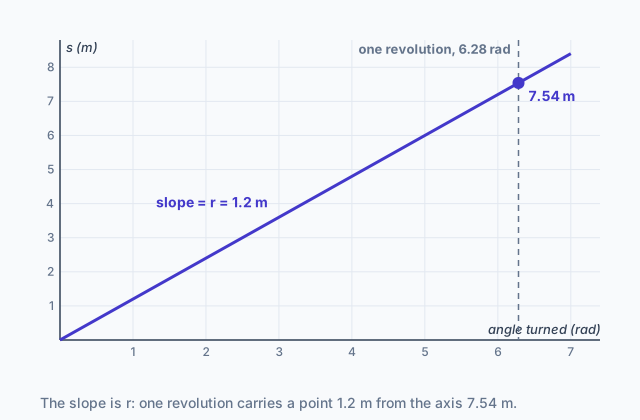
Pick a point on a rotating object, a distance from the fixed axis of rotation. As the object turns through an angular displacement , the point moves along an arc of its circle. The linear distance it travels is
This works only with in radians, because that is what a radian is: the arc length divided by the radius, . The radian has no physical unit of its own, so meters times radians comes out in meters.
One full revolution sweeps the whole circumference, , so one revolution is rad, about 6.28 rad, and 360° is the same angle. Convert revolutions or degrees before you multiply.
A bike wheel of radius 0.35 m that turns 4 revolutions turns through rad, so a pebble stuck in its tire travels m around the wheel. Note that is measured from the axis to the point, so for a pebble on the tire it is the wheel's radius, not its diameter.
Quick check · Calculate
A boat winch pulls in a rope by winding it onto a drum of radius 0.20 m. The rope does not slip and winds on in a single layer, so the radius stays 0.20 m. While the boat is pulled in, the drum turns through 15.0 revolutions. What length of rope is wound onto the drum?
2b. Differentiate to get the speed
If you measure from a fixed starting line, the point's position along its circle, measured from that line, is . For a point on a rigid object turning about a fixed axis, does not change, so differentiating with respect to time pulls out as a constant:
Here is the angular velocity in rad/s, and is the point's linear velocity, which points along its circle, tangent to the path. Its direction keeps turning, but its size is the point's speed.
A fan blade turning at 20 rad/s carries a point 0.50 m from the axis at m/s. If the angle is given as a function of time, differentiate it first: uses the angular velocity at that instant, not the angle.
Quick check · Calculate
A ceiling fan starts up with its blade angle given by , with in radians and in seconds, for s. Counterclockwise, as seen from below, is positive. What is the speed of a point on a blade 0.60 m from the axis at s?
2c. Differentiate again for the tangential acceleration
Differentiate once more, with still constant:
where is the angular acceleration in rad/s². The result is the tangential component of acceleration, : the part of the point's acceleration that lies along its path and changes how fast it moves. A point moving in a circle also has an acceleration component toward the axis, because the direction of its velocity keeps turning. gives only the tangential part.
The linear and angular quantities line up in matching pairs:
Each linear quantity is times the matching angular one, so pick the matching pair. A grinding wheel with rad/s² gives a rim point 0.20 m out a tangential acceleration of m/s², whatever its angular velocity is at that moment.
Quick check · Spot the error
A grinding wheel speeds up with angular velocity , with in rad/s and in seconds; counterclockwise, as seen from the front, is positive. A student finds the tangential acceleration of a point on the rim, 0.10 m from the axis, at s. Tap the first line with a mistake.
2d. Every point of a rigid system turns together
A rigid system keeps its shape: the distance between any two of its points never changes. Draw a line from the axis through two points on a rigid wheel. As the wheel turns, the line stays straight, so both points sweep the same angle in every interval.
That makes the angular quantities shared: all points of a rigid system have the same angular velocity and the same angular acceleration at every instant. The linear quantities are not shared. They are times the angular ones, so they grow in proportion to distance from the axis:
| Quantity | Same for every point? |
|---|---|
| , , | Yes |
| , , | No, proportional to |
The link runs both ways. Measure one point's linear motion and its distance from the axis, and you know the rotation of the whole system: a point 0.20 m from the axis moving at 3.0 m/s means the system turns at 15 rad/s, and then every other point's speed follows.
Quick check · Decide and justify
A potter's wheel speeds up, turning counterclockwise as seen from above. One clay chip sticks to it 0.10 m from the axis and another 0.30 m from the axis. A student says the outer chip has three times the angular acceleration of the inner chip. Is the student right?
Which reason supports your answer?
Part 3 Watch it done A winch lifts a crate
Watch each step, then do the last one yourself.
A construction winch lifts a crate with a cable wound on a drum of radius 0.25 m. The cable does not slip or stretch. Starting from rest at , the drum's angular velocity is , with in rad/s and in seconds, Seen from the drum's right end, the drum turns counterclockwise to lift the crate; counterclockwise is positive. Find the crate's speed and acceleration at s, and how far it rises in the first 5.0 s.
Step 1 · Link the crate to the drum
The cable leaves the drum at its surface, 0.25 m from the axis, and moves with that surface. So the crate's speed is the rim speed, , and its acceleration is the rim's tangential acceleration, .
Step 2 · Speed and acceleration at 5.0 s
At s, rad/s, so m/s upward. The angular acceleration is rad/s², the same at every instant, so m/s² upward.
Why this step?
Why does the crate move with the rim and not with some other point of the drum?
Every bit of cable that winds on was moving with the drum's surface as it touched it, and the cable does not stretch, so the crate moves as far as a rim point travels along its arc. A point inside the drum, closer to the axis, travels a shorter arc for the same angle and has nothing to do with the cable.
Your step · Calculate
Finish it. How far does the crate rise from to s? Up is positive.
m
Part 4 Try it New situations
Try it · Rank it
A bicycle chain runs without slipping around a front chainring of radius 0.10 m and a rear sprocket of radius 0.040 m. The rear wheel is rigidly fixed to the rear sprocket and turns with it. While the rider pedals, rank the three by the magnitude of angular velocity.
Greatest first
Give each one a place, 1 for first. Give two the same place if they are equal.
Your ranking: none yet
Try it · Calculate
A bicycle is clamped on an indoor trainer, so its rear wheel spins in place. The rider turns the 0.10 m chainring at 6.0 rad/s, and the chain drives the 0.040 m rear sprocket without slipping. The rear wheel, fixed to the sprocket, has radius 0.34 m. What is the speed of a point on the outer edge of the rear tire?
On paper. Draw the chainring and the rear sprocket as two circles joined by the chain, and mark the chain speed at the top of each. Then derive, in symbols, the speed of the rear tire's edge in terms of the chainring's angular velocity , the chainring radius , the sprocket radius and the wheel radius . Then substitute the trainer question's numbers into your expression and check that it gives the same speed you found there. There is nothing to submit here; compare your expression with the chain of steps in that question's explanation.
Part 5 Explain it Make a claim, derive it, then test it
Nothing you type leaves this page. Check your answer against the model and each scoring point.
Free response is 50% of the exam score. This one is shaped like Question 4, Qualitative/Quantitative Translation.
Free-response practice · Question 4 style
A turntable starts from rest and turns counterclockwise, as seen from above, with a constant angular acceleration of magnitude ; counterclockwise is positive. Two small coins ride on it without sliding: coin 1 at distance from the axis and coin 2 at distance .
(a) Is the magnitude of the tangential acceleration of coin 2 greater than, less than or equal to that of coin 1? Justify your claim.
(b) At some instant, coin 2 reaches a speed . Derive an expression for the distance coin 2 has traveled along its circle from the start until then, in terms of , and .
(c) Use your expression from part (b) to predict the distance coin 1 travels in that same time. Explain whether your prediction agrees with your claim in part (a).
Model answer
(a) Greater: twice as large. The turntable is a rigid system, so both coins have the same angular acceleration, . Each coin's tangential acceleration is , so coin 2's is and coin 1's is .
(b) From rest, and . Coin 2 has , so it reaches when , at . Then , and .
(c) Coin 1 turns through the same in the same time, so , half of coin 2's distance. This agrees with (a): each coin starts from rest with a constant tangential acceleration, so it travels , and coin 2's doubled over the same time doubles its distance.
Score your own answer. This is a self-check, not a grade. Tick each point your answer makes.
Part 6 Check yourself A spool on a fixed axle
The case questions use the readings and the fit. Answer them from those.
A class winds a string around a spool of radius 0.025 m that turns on a fixed horizontal axle. A mass hangs from the free end of the string, and when it is released the string unwinds without slipping. A rotary motion sensor on the axle records the angle the spool has turned. Seen from the front, the spool turns clockwise as the string unwinds; clockwise is positive. The software fits the readings with , with in radians and in seconds. Some of the readings:
| (s) | (rad) |
|---|---|
| 0 | 0 |
| 0.50 | 1.02 |
| 1.00 | 3.97 |
| 1.50 | 9.04 |
| 2.00 | 15.98 |
Case question 1 · Calculate
Using the fit, what length of string unwinds from the spool between and s?
Case question 2 · Multiple choice
Using the fit, what is the magnitude of the hanging mass's acceleration while it falls?
Case question 3 · Multiple choice
A paint dot on the spool's flat face sits 0.010 m from the axle, while the string leaves the rim 0.025 m from the axle. At s, how does the dot's motion compare with that of a point on the rim?
The rest stand on their own and do not use the case.
Check yourself · Sort it
A rigid wheel speeds up as it turns about a fixed axle. Tap a card, then say whether the quantity is the same for every point on the wheel or depends on the point's distance from the axle.
Same for every point
Depends on distance from the axle
Check yourself · Fill the statement
A wheel turns through 2.5 revolutions about a fixed axle.
The equation gives a distance only when is in , because an angle in that unit is an arc length divided by . The wheel's angular displacement is .
Part 7 Keep it Bring back earlier ideas
This lesson stands on angular velocity from Topic 5.1, found by differentiating an angle function, and on the derivatives of motion from Topic 1.2: and are those same derivatives scaled by . Pulling them back up is what makes them last.
From 5.1 Rotational Kinematics · Calculate
A drill bit's angular position is , with in radians and in seconds. Take counterclockwise, as seen from behind the drill, as positive. What is the bit's angular acceleration at s?
A physics class sends a fan cart along a level track while one student turns the fan up steadily; take the cart's direction of travel as positive. A motion sensor records the cart's position, and the software fits the readings with , with in meters and in seconds. Some of the readings:
| (s) | (m) |
|---|---|
| 0 | 0 |
| 1.0 | 1.200 |
| 2.0 | 3.600 |
| 2.9 | 7.778 |
| 3.0 | 8.400 |
| 3.1 | 9.058 |
| 4.0 | 16.800 |
From 1.2 Displacement, Velocity, and Acceleration · Calculate
Using the software's fit, what is the cart's instantaneous acceleration at s? The direction of travel is positive.
In three lines
- A point at distance from a fixed axis travels along its arc, with in radians.
- Differentiating with fixed gives and the tangential component .
- Every point of a rigid system shares and ; its linear quantities scale with .
Exam strategy for this topic
- Section I, Multiple Choice: 42 questions in 85 minutes.
- Section II, Free Response: 4 questions in 95 minutes.
- This lesson's Explain it is shaped like free-response question 4, Qualitative/Quantitative Translation.
- A four-function, scientific, or graphing calculator is allowed on both sections of the exam.
When a free-response part links a rotation to a point's motion, write the link first, such as with named as that point's distance from the axis, then substitute. Convert any revolutions to radians in a written step, and when a part asks you to compare two points on one object, say outright that they share and because the object is rigid.
Questions students ask
Why do the equations need radians?
A radian is defined as an arc length divided by a radius, so is that definition rearranged. In degrees or revolutions you would need an extra conversion factor in every equation.
Where does a radian go in the units?
A radian is a ratio of two lengths, so it has no physical unit. Meters times radians is meters, and meters times rad/s is m/s.
Is the tangential acceleration the whole acceleration of the point?
No. A point moving in a circle also has an acceleration component toward the axis, because its velocity keeps changing direction. is only the part along the path, and it is zero whenever is not changing.
Do two points on one wheel really have the same angular velocity?
Yes, if the wheel is rigid. A line from the axis through both points stays straight as the wheel turns, so both sweep the same angle in the same time. Their speeds differ, in proportion to their distances from the axis.
How does a rope or a chain fit in?
A rope or chain that does not slip moves with the surface it touches, so its speed equals for that wheel. Two wheels joined by one chain share a rim speed, not an angular velocity.
Beyond the AP Exam
College Board sets this limit on what the AP Exam asks about this topic. Anything past it is not on the exam.
AP Physics C: Mechanics expects students to be able to mathematically manipulate the magnitudes of angular displacement, angular velocity, and angular acceleration using vector conventions. However, the directions of the vectors will not be assessed on the exam. Descriptions of the directions of rotational kinematics quantities for a point or rigid body are limited to clockwise and counterclockwise with respect to a given axis of rotation.
Course alignment, for teachers
AP Physics C: Mechanics topic 5.2, Unit 5: Torque and Rotational Dynamics.
- Skill 1.C: Create qualitative sketches of graphs that represent features of a model or the behavior of the physical system.
- Skill 2.A: Derive a symbolic expression from known quantities by selecting and following a logical mathematical pathway.
- Skill 2.C: Compare physical quantities between two or more scenarios or at different times and/or locations within a single scenario.
- Skill 3.B: Apply an appropriate law, definition, theoretical relationship, or model to make a claim.
This lesson maps all 3 essential knowledge statements of the topic to the part that teaches each one: 3 are checked by a scored question. The map is in the lesson file.