Unit 6 · Topic 6.2 · about 30 minutes · 7 parts · 12 scored checks, 2 of them multiple choice, plus 2 from earlier lessons
AP Physics C: Mechanics 6.2: Torque and Work
Unit 6: 10 to 15% of the multiple-choice section
What you'll be able to do
- Describe the work done on a rigid system by one torque or by several torques, from a constant torque, from a torque that changes with angle, or from a graph of torque against angular position.
Key vocabulary
| Term | What it means | The exam trap |
|---|---|---|
| Torque | The rotational effect of a force about an axis, with the angle between and , measured in newton-meters. | A torque depends on where and in which direction a force is exerted, not on the size of the force alone. |
| Work | Energy transferred into or out of a system by a force or by a torque. | Work is a scalar, so its sign is not a direction in space; read it as energy in or energy out. |
| Angular position | The angle that locates a rotating object from a chosen reference line, in radians, with a chosen sense as positive. | A graph of torque against angular position is not a graph against time, and the area under each means something different. |
| Angular displacement | The change in angular position, , signed by the chosen positive sense. | Its sign comes from the chosen positive sense of rotation, not from which way a torque on the object points. |
| Rigid system | A system whose parts keep fixed distances from one another, so the whole system turns as one unit. | Every point of a rigid system turns through the same angular displacement, but points farther from the axis travel farther along their arcs. |
 Tap to open the picture full size
Part 1 Think first The lid that will not budge
Commit to a guess first. Being wrong now makes the right idea stick better.
Predict first
A jar lid is stuck fast. You grip it and twist as hard as you can for ten seconds, and the lid never moves. Your hand exerts a large torque on the lid the whole time. Does that torque do work on the lid?
In short. The work a torque does on a rigid system is : a torque moves energy into or out of the system only while the system turns through an angle, and on a graph of torque against angular position that work is the area under the curve.
- A torque on an object that does not turn transfers no energy to it, however large the torque is or however long it is held.
- For a constant torque with in radians; when the torque and the rotation have opposite senses the work is negative and energy leaves the system.
- For a torque that changes with angle, integrate over the angular displacement, or find the signed area under the graph of against , counting area below the axis as negative.
Part 2 Learn it Four ideas, with a check after each
2a. A torque moves energy only through a turn
In Topic 3.2 a force did work when its point of application moved along the force. The rotational version: a torque on a rigid system transfers energy into or out of it only if the system turns through an angular displacement while the torque is exerted.
Pick a positive sense of rotation, such as counterclockwise as seen from the front. Then:
- Torque and rotation in the same sense: the work is positive and energy goes in, as when a drill's motor speeds up its bit.
- Opposite senses: the work is negative and energy comes out, as when a brake slows a spinning wheel.
- No rotation: no work, however large the torque.
Where the energy goes depends on the system. For a rigid system turning about a fixed axis, add the work done by every torque on it. That net work equals the change in its rotational kinetic energy. This is the work-energy theorem of Topic 3.2, with the rotational kinetic energy of Topic 6.1:
So a torque that does positive work on a wheel and is the only one doing work speeds the wheel up.
Quick check · Sort it
Tap a card, then say whether the torque named does positive, negative or zero work on the object while it is exerted.
Positive work
Negative work
Zero work
2b. A constant torque: torque times angle, in radians
For a torque that keeps the same value while the system turns, the torque comes out of the integral:
Two habits keep the number right.
Use radians. One revolution is rad. The work comes from how far the force's point of application moves along its arc, , and that equation holds only with in radians. An angle in revolutions or degrees gives the wrong arc length, so the wrong work.
Use one sign convention for both. Give and their signs from the same positive sense. A spindle turned 3.0 rev counterclockwise by a counterclockwise torque of 0.50 N·m, with counterclockwise positive, has rad, so J. A friction torque of N·m on the same spindle over the same turn does J.
When several torques act, find each one's work with its sign and add them. With both of those torques on the spindle, the net work is J.
Quick check · Calculate
An electric motor exerts a constant torque of 0.40 N·m on a grinding wheel, counterclockwise as seen from the front, while the wheel turns 25 revolutions counterclockwise. Take counterclockwise as seen from the front as positive. How much work does the motor's torque do on the wheel?
2c. Work is the area under the torque graph
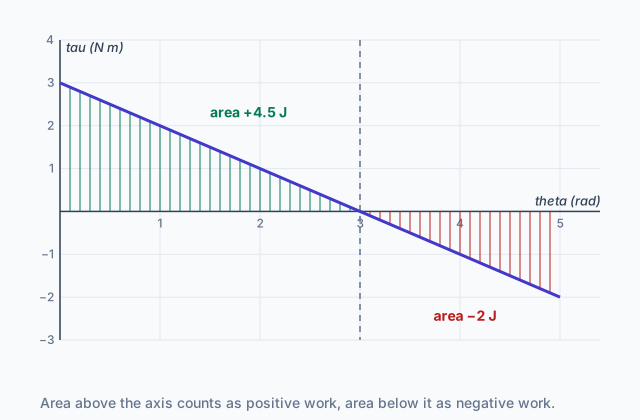
The graph below, the same one as at the top of this page, shows the torque a twisted spring exerts on a dial, , with in newton-meters, in radians and counterclockwise positive. The dial turns counterclockwise from 0 to 5 rad.
Tap to open the picture full sizeWork is the integral of torque over angular position, so on a graph of against it is the area between the curve and the -axis:
- From 0 to 3 rad the line is above the axis. The triangle's area is J, energy into the dial.
- From 3 to 5 rad the line is below the axis. The triangle there counts as J, energy back out.
- Over the whole turn, J.
Area below the axis is negative work, so it subtracts. When a graph is made of straight pieces, split the area into rectangles and triangles. The work over an interval depends on the whole area, not on the torque at one angle, so a graph that reaches a bigger torque can still enclose less area.
Quick check · Rank it
Three motors each turn a shaft from to rad, counterclockwise as seen from the motor, which is the positive sense, and every torque is counterclockwise. Motor A's torque is a constant 3.0 N·m. Motor B's torque rises steadily from 0 at 0 rad to 5.0 N·m at 2.0 rad. Motor C's torque falls steadily from 7.0 N·m at 0 rad to 0 at 2.0 rad. Rank the motors by the work each torque does on its shaft.
Most work first
Give each one a place, 1 for first. Give two the same place if they are equal.
Your ranking: none yet
2d. A torque that changes with angle
When the torque changes as the system turns, the integral has to be done:
Write as a function of , find its antiderivative and evaluate it at both limits. A motorized valve whose torque grows as it opens, with in newton-meters and in radians, turning in the sense of its torque from 0 to 3.0 rad, has work done on it
Multiplying the final torque, 7.0 N·m, by 3.0 rad gives 21 J, which is too much: the torque was smaller for most of the turn. The product is the work only when the torque is constant.
When the lower limit is not zero, evaluate the antiderivative there too and subtract it. Leaving it out counts the turn from 0 that never happened in the interval.
Quick check · Calculate
A controller makes a motor's torque on a winch drum grow as the drum turns: , with in newton-meters and in radians, both positive in the drum's counterclockwise sense as seen from the motor. How much work does the motor's torque do on the drum as the drum turns from rad to rad?
Part 3 Watch it done A motor spins up a flywheel
Watch each step, then do the last one yourself.
A flywheel with rotational inertia 0.24 kg·m² sits at rest on a frictionless axle. A motor exerts a torque on it, with in newton-meters and in radians, counterclockwise as seen from the motor, which is the positive sense, until the flywheel has turned 4.0 rad counterclockwise. No other torque does work on the flywheel. What is its angular velocity at 4.0 rad?
Step 1 · Integrate the torque over the turn
J. The torque falls from 4.0 N·m to 2.0 N·m but stays counterclockwise, so the work is positive.
Step 2 · Link the work to kinetic energy
The motor's torque is the only one doing work, so , because the flywheel starts at rest.
Why this step?
Why not use and a constant angular acceleration equation?
The torque falls as the flywheel turns, so the angular acceleration falls too, and an equation that assumes a constant would give the wrong answer. Work over the angle handles a torque that depends on angle directly, and it never needs the time.
Your step · Calculate
Finish it. What is the flywheel's angular velocity at rad? Counterclockwise as seen from the motor is positive.
rad/s
Part 4 Try it New situations
Try it · Spot the error
A programmed motor exerts a torque on a turntable of +6.0 N·m from to 2.0 rad and then −4.0 N·m from 2.0 rad to 5.0 rad. Counterclockwise as seen from above is positive, and the turntable turns counterclockwise the whole time. A student finds the work the motor's torque does from 0 to 5.0 rad. Tap the first line with a mistake.
Try it · Multiple choice
A motor's constant torque does work on a turntable while the turntable turns 2 revolutions in the sense of the torque. A second motor exerts a constant torque half as large on an identical turntable while it turns 6 revolutions in the sense of that torque. How much work does the second motor's torque do?
On paper. A door closer exerts a torque on a door in the closing sense, which you take as positive. Measure the door's angle as how far it has swung shut, from 0 when it is wide open to 1.5 rad when it latches. The closer's torque falls steadily from 6.0 N·m at to 1.0 N·m at rad. Plot the torque against with scales and units on both axes, and shade the region that stands for the work the closer does as the door swings shut. Then describe how you could measure the closer's torque at several angles in your lab: what you would pull with and read, where on the door and in which direction you would pull, and how you would turn each reading into a torque. There is nothing to submit here.
Part 5 Explain it Derive, then calculate
Nothing you type leaves this page. Check your answer against the model and each scoring point.
Free response is 50% of the exam score. This one is shaped like Question 1, Mathematical Routines.
Free-response practice · Question 1 style
A flywheel with rotational inertia turns on a fixed, frictionless axle and starts at rest. A motor exerts a torque on it that falls steadily with angular position, , from to , and then disconnects. Take the sense of the motor's torque as positive.
(a) Derive an expression for the work the motor's torque does on the flywheel from to , in terms of and .
(b) On paper, sketch against from 0 to . Label the values where the line meets each axis, and shade the region whose area equals the work in part (a).
(c) Derive an expression for the flywheel's angular speed at , in terms of , and .
(d) For N·m, rad and kg·m², calculate the work and .
(e) After the motor disconnects, a brake exerts a constant torque of magnitude 1.5 N·m opposite to the rotation until the flywheel stops. Calculate the work the brake's torque does and the angle through which the flywheel turns while it stops.
Model answer
(a) .
(b) A straight line from on the -axis down to zero at on the -axis, with the triangle under it shaded. Compare your sketch with that shape and those two labels; the triangle's area, , is the answer to part (a).
(c) The motor's torque is the only one doing work and the flywheel starts at rest, so , which gives .
(d) J, and rad/s.
(e) The flywheel loses all 12 J of its kinetic energy, so the brake's torque does J. The brake's torque is N·m, so rad.
Score your own answer. This is a self-check, not a grade. Tick each point your answer makes.
Part 6 Check yourself A flywheel turned by a crank
The case questions use the crank readings. Answer them from those.
A student turns a heavy flywheel by a hand crank on a fixed axle with negligible friction. The flywheel starts at rest. A torque sensor in the crank and an angle sensor on the axle record the student's torque on the flywheel as it turns; counterclockwise as seen from the crank side is positive, and the flywheel turns counterclockwise the whole time. Between readings the torque changes steadily, so the graph of torque against angular position is a set of straight pieces joining the readings.
| (rad) | (N·m) |
|---|---|
| 0 | 0 |
| 1.0 | 2.0 |
| 2.0 | 4.0 |
| 3.0 | 4.0 |
| 4.0 | 4.0 |
| 5.0 | 2.0 |
| 6.0 | 0 |
Case question 1 · Calculate
Using the readings, how much work does the student's torque do on the flywheel from to rad? Counterclockwise as seen from the crank side is positive.
Case question 2 · Decide and justify
Does the student's torque do more work on the flywheel from to 2.0 rad, or from to 6.0 rad?
Which reason supports your answer?
Case question 3 · Multiple choice
The student's torque is the only torque doing work on the flywheel. What is the flywheel's rotational kinetic energy when it reaches rad?
The rest stand on their own and do not use the case.
Check yourself · Match
Each torque below is constant and is exerted on a wheel that turns on a fixed axle. Counterclockwise as seen from the front is positive. Tap a situation, then the total work the torques named do on the wheel.
Check yourself · Fill the statement
A twisted spring exerts a torque on a dial, where is a positive constant and is measured from the spring's relaxed position, with counterclockwise positive. A hand turns the dial counterclockwise from to .
To find the work the spring's torque does on the dial, you with respect to from 0 to . The spring's torque and the dial's turning have senses, so that work is . On a graph of against , the work is the signed between 0 and .
Part 7 Keep it Bring back earlier ideas
This lesson stands on rotational kinetic energy from Topic 6.1, where the work a torque does ends up, and on integrating a function over an interval from Topic 1.2. Pulling them back up is what makes them last.
From 6.1 Rotational Kinetic Energy · Calculate
A bench grinder's wheel has a rotational inertia of 0.040 kg·m² about its axle and turns at 50 revolutions per second. What is its rotational kinetic energy?
From 1.2 Displacement, Velocity, and Acceleration · Calculate
A cart on a straight track has velocity , with in meters per second and in seconds. At it is at m. Take the direction of increasing as positive. Where is the cart at s?
In three lines
- A torque does work on a rigid system only while the system turns through an angle: positive when the torque and the rotation share a sense, negative when they are opposite.
- The work is , which is with in radians only when the torque is constant.
- On a graph of torque against angular position the work is the signed area under the curve, and the net work of all torques on a rigid system equals its change in rotational kinetic energy.
Exam strategy for this topic
- Section I, Multiple Choice: 42 questions in 85 minutes.
- Section II, Free Response: 4 questions in 95 minutes.
- This lesson's Explain it is shaped like free-response question 1, Mathematical Routines.
- A four-function, scientific, or graphing calculator is allowed on both sections of the exam.
When a question gives the torque as a function of angle, or a graph of torque against angular position, that is your signal to integrate over or find the area, not to multiply one torque value by the angle. On a free-response question, state your positive sense, write the integral with its limits before any numbers, and keep the sign of every torque.
Questions students ask
Is a newton-meter of torque the same thing as a joule?
No. Both are built from newtons times meters, but torque is a twisting effect at one instant and work is energy transferred over a turn. Torque is written in N·m and work in J to keep them apart.
Why does the angle have to be in radians?
The work comes from the arc length the force's point of application moves, , and that equation is true only with in radians. An angle in revolutions or degrees gives the wrong arc length, so the wrong work.
Can a torque do negative work?
Yes. When a torque points opposite to the way the system turns, as a brake does on a spinning wheel, it takes energy out of the system and its work is negative.
How is work by a torque related to work by a force?
They are the same energy transfer described two ways. A force applied at a distance from the axis moves its point of application along an arc of length , so the force's work, , is the torque's work, .
What if several torques act on the same system?
Find the work each torque does with its own sign and add them. For a rigid system turning about a fixed axis, that net work equals the change in its rotational kinetic energy.
Course alignment, for teachers
AP Physics C: Mechanics topic 6.2, Unit 6: Energy and Momentum of Rotating Systems.
- Skill 1.A: Create diagrams, tables, charts, or schematics to represent physical situations.
- Skill 2.A: Derive a symbolic expression from known quantities by selecting and following a logical mathematical pathway.
- Skill 2.C: Compare physical quantities between two or more scenarios or at different times and/or locations within a single scenario.
- Skill 3.B: Apply an appropriate law, definition, theoretical relationship, or model to make a claim.
This lesson maps all 3 essential knowledge statements of the topic to the part that teaches each one: 3 are checked by a scored question. The map is in the lesson file.