Unit 6 · Topic 6.3 · about 30 minutes · 7 parts · 12 scored checks, 1 of them multiple choice, plus 2 from earlier lessons
AP Physics C: Mechanics 6.3: Angular Momentum and Angular Impulse
Unit 6: 10 to 15% of the multiple-choice section
What you'll be able to do
- Describe the angular momentum of a spinning object or rigid system about an axis, and of a moving object about a point.
- Describe the angular impulse a torque delivers over a time interval, from a function of time or from the area under a torque graph.
- Relate the change in an object's or rigid system's angular momentum to the angular impulse it receives.
Key vocabulary
| Term | What it means | The exam trap |
|---|---|---|
| Rigid system | A system whose parts keep their distances from one another, so it turns as one body with a single angular velocity. | A system that changes shape is not rigid, so its rotational inertia about an axis can change while it turns. |
| Angular momentum of a rigid system | For a rigid system turning about a specific axis, the magnitude , the rotational inertia about that axis times the angular velocity, in kg·m²/s. | A rotational inertia belongs to one axis, so name the axis before you choose a formula for . |
| Angular momentum of an object about a point | , with magnitude , where runs from the chosen point to the object and is the angle between and the velocity. | Its value depends on the reference point, so a number for means nothing until the point is named. |
| Angular impulse | The product of a torque and the time interval during which it is exerted, in general , in N·m·s; it has the direction of the torque. | Multiply a torque by a time only when the torque is constant over that time. |
| Change in angular momentum | , the final angular momentum minus the initial angular momentum. | Give each value its sign for the stated positive sense before subtracting. |
| Rotational impulse-momentum theorem | The angular impulse delivered to an object or rigid system equals its change in angular momentum, . | The torque in the integral is the net torque, every torque added with its sign, not one of several torques. |
| Net torque | The sum of all the external torques on a system about one axis, which equals the rate of change of its angular momentum, . | Add torques about the same axis, each with its sign, before you use the sum. |
 Tap to open the picture full size
Part 1 Think first A puck and a post
Commit to a guess first. Being wrong now makes the right idea stick better.
Predict first
A hockey puck slides in a straight line across the ice at a steady speed. Its path passes 2 m from a post frozen into the ice, and it never circles the post. Does the puck have angular momentum about the post?
In short. Angular momentum is for a rigid system about an axis and for an object about a point; a torque exerted over time delivers an angular impulse, , and the angular impulse from the net torque equals the change in angular momentum.
- The axis or reference point is part of the answer: a different axis changes , and a different point changes the perpendicular distance .
- Angular impulse is the area under a graph of torque against time, and it has the direction of the torque that delivers it.
- , and is the slope of a graph of angular momentum against time; with constant it is .
Part 2 Learn it Four ideas, with a check after each
2a. A spinning body's angular momentum
A spinning object carries angular momentum. For a rigid system turning about a specific axis, its magnitude is
where is the rotational inertia about that axis and is the angular velocity. The unit is kg·m²/s. A flywheel with kg·m² turning at 12 rad/s has kg·m²/s.
The axis is part of the answer. Rotational inertia depends on how the mass is spread around the axis, so the same object turning at the same has a different about a different axis. A door swinging on its hinges and the same door spun about a vertical line through its middle are two different problems. Before you multiply, name the axis and use the rotational inertia about that axis.
The sign of carries the sense of rotation. State which sense, clockwise or counterclockwise as seen from a stated side, is positive; a wheel turning the other way then has a negative . This is the rotational partner of linear momentum, : rotational inertia takes the place of mass, and angular velocity takes the place of velocity.
Quick check · Calculate
A thin uniform rod of mass 1.2 kg and length 1.0 m spins at 6.0 rad/s counterclockwise, as seen from above, about a vertical axle through one end. Its rotational inertia is about its center and about an end. Take counterclockwise as positive. What is the rod's angular momentum about the axle?
2b. A moving object's angular momentum about a point
An object does not have to spin to have angular momentum about a point. For an object with momentum at position , measured from a chosen point,
Its magnitude is , where is the angle between and the velocity. In this course you give its direction as clockwise or counterclockwise about the point.
The product is the perpendicular distance from the point to the object's line of motion. Picture a 60 kg skater gliding at 5.0 m/s in a straight line that passes 2.0 m from a pole. Far from the pole, is large but is small; at closest approach m and . Either way m, so about the pole kg·m²/s for as long as her velocity does not change.
So the measured depends on four things: the distance from the reference point, the mass, the speed, and the angle between and the velocity. Change the reference point and changes. About a point on her path, is 0 or 180°, and .
Quick check · Decide and justify
A 0.50 kg puck slides at a steady 4.0 m/s in a straight line on frictionless ice. At its closest point, its path passes 3.0 m from a post. Compare the puck's angular momentum about the post at an instant when it is 5.0 m from the post with its angular momentum at closest approach.
Which reason supports your answer?
2c. Angular impulse adds up a torque over time
A torque exerted over a time interval delivers an angular impulse:
For a constant torque this is just : 3.0 N·m for 2.0 s delivers 6.0 N·m·s. When the torque changes, integrate. An integral is an area, so the angular impulse is the area under the curve of a graph of torque against time.
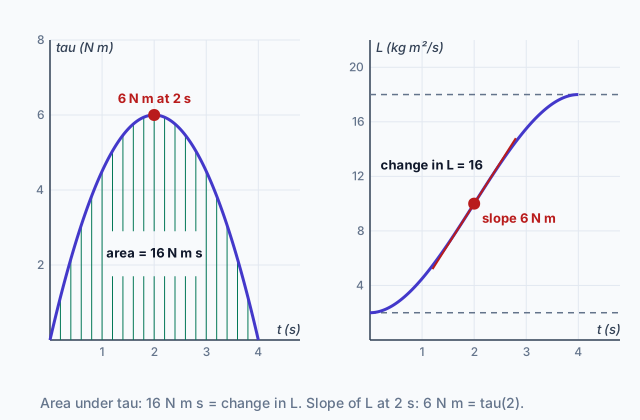
The left graph at the top of this page shows a torque , in N·m with in seconds, exerted for 4 s. It peaks at 6 N·m, but it is that large for only an instant, so the angular impulse is not . It is
the hatched area.
Angular impulse has the same direction as the torque that delivers it. With counterclockwise positive, a clockwise torque delivers a negative angular impulse, and area below the time axis counts as negative. The unit N·m·s is the same as kg·m²/s, the unit of angular momentum, and the next idea shows why that is no accident.
Quick check · Calculate
A motor exerts a counterclockwise torque on a turntable, with in N·m and in seconds, from to s. Counterclockwise, as seen from above, is positive. What angular impulse does the torque deliver over that interval?
2d. Angular impulse changes angular momentum
Angular impulse is what changes angular momentum. The rotational form of the impulse-momentum theorem says the angular impulse from the net external torque equals the change in angular momentum:
It comes straight from Newton's second law in rotational form. For a rigid system whose rotational inertia stays constant,
and integrating over time gives the theorem. Read as a graph, says the net torque is the slope of the angular momentum graph. On the right at the top of the page, the wheel's rises from 2 to 18 kg·m²/s, a change of 16 that matches the 16 N·m·s of area on the left, and its slope at 2 s is 6 N·m, the torque at 2 s.
To use the theorem, find with its sign, add the angular impulse with its sign, then divide by for the new angular velocity. A wheel at kg·m²/s that receives N·m·s ends at kg·m²/s: still turning counterclockwise, but more slowly.
Quick check · Fill the statement
A wheel turns counterclockwise on a fixed axle; counterclockwise, as seen from the front, is positive.
The rule follows from only when the wheel's stays constant. While a net torque points opposite to the wheel's spin, the size of its angular momentum . Because an angular impulse equals a change in angular momentum, the unit N·m·s is the same as .
Part 3 Watch it done A potter's wheel speeds up
Watch each step, then do the last one yourself.
A potter's wheel with its clay has a rotational inertia of 0.40 kg·m² about its axle, and that value stays constant. The wheel turns counterclockwise, as seen from above, at 6.0 rad/s; take counterclockwise as positive. Starting at , a motor exerts a counterclockwise net torque , with in N·m and in seconds, until s. What is the wheel's angular velocity at s?
Step 1 · Find the angular impulse
N·m·s, counterclockwise, the same sense as the torque.
Step 2 · Find the starting angular momentum
kg·m²/s, counterclockwise, so positive.
Why this step?
Why not find and use ?
That equation needs a constant angular acceleration, and this torque grows from 0 to 4.0 N·m over the 2.0 s. Using one value of the torque for the whole interval treats the wheel as if it felt that torque all along. The angular impulse integral adds up the torque at every instant.
Your step · Calculate
Finish it. What is the potter's wheel's angular velocity at s? Counterclockwise is positive.
rad/s
Part 4 Try it New situations
Try it · Rank it
Three objects move about a vertical axis through point O, all counterclockwise as seen from above. Disk A, centered on the axis, has rotational inertia 0.50 kg·m² about it and spins at 8.0 rad/s. Ball B, of mass 2.0 kg, slides at a steady 3.0 m/s in a straight line that passes 0.50 m from O at its closest. Hoop C, centered on the axis, has rotational inertia 2.0 kg·m² about it and spins at 2.0 rad/s. Rank them by the size of their angular momentum about the axis.
Greatest first
Give each one a place, 1 for first. Give two the same place if they are equal.
Your ranking: none yet
Try it · Calculate
A grinding wheel has a rotational inertia of 0.20 kg·m² about its axle and turns counterclockwise, as seen from the front, at 15 rad/s. Take counterclockwise as positive. Its reversible motor then exerts a constant net torque of 1.5 N·m clockwise for 3.0 s. What is the wheel's angular velocity at the end of the 3.0 s?
On paper. Sketch the potter's wheel's angular momentum against time, from the worked example in Watch it done, from to s, with a label and a unit on each axis. Mark its starting value, and say where the graph is steepest and which quantity sets how steep it is. There is nothing to submit. Compare: starts at 2.4 kg·m²/s with zero slope and curves upward the whole time, steepest at 2.0 s, where its slope is the net torque then, 4.0 N·m. The graph at the top of the page has a different shape because its torque rises and then falls.
Part 5 Explain it Draw it, derive it, graph it, connect them
Nothing you type leaves this page. Check your answer against the model and each scoring point.
Free response is 50% of the exam score. This one is shaped like Question 2, Translation Between Representations.
Free-response practice · Question 2 style
A playground merry-go-round has a rotational inertia of 120 kg·m² about its central axle, and friction at the axle is negligible. It starts at rest. Starting at , a student pushes on its rim, at radius m from the axle, always perpendicular to the radius, with a force that grows as , where N/s. She pushes counterclockwise, as seen from above, which is positive, and lets go at s.
(a) On paper, draw a top view of the merry-go-round at an instant while she pushes. Show the axle, the radius to the point of the push, the force and the positive sense of rotation.
(b) Derive an expression for the merry-go-round's angular momentum while she pushes, in terms of , and . Then calculate its angular velocity at .
(c) On paper, sketch two graphs on aligned time axes from to s: the net torque on the merry-go-round against time, and its angular momentum against time. Label the value of each just before she lets go at s.
(d) Justify why your graphs in part (c) agree with your expression in part (b), using the slope of one graph and the area under the other.
Model answer
(a) A circle with a dot at its center for the axle, a line from the axle to the rim labeled m, a force arrow at the rim perpendicular to that line, pointing counterclockwise, and a curved arrow marking counterclockwise as positive. Compare your drawing with that list.
(b) The torque is , counterclockwise. Since , . At , kg·m²/s, so rad/s, counterclockwise.
(c) Torque: a straight line from 0 up to N·m at 3.0 s, then a drop to zero that stays at zero until 6.0 s. Angular momentum: a curve from 0, bending upward, to 270 kg·m²/s at 3.0 s, then a level line at 270 kg·m²/s until 6.0 s. Compare your sketches with those shapes and the two labeled values.
(d) The net torque is the slope of the angular momentum graph: matches the torque line, which is why gets steeper as the torque grows and goes level once the torque is zero. The angular impulse is the area under the torque graph, a triangle of N·m·s, which equals the change in angular momentum, 270 kg·m²/s, from part (b).
Score your own answer. This is a self-check, not a grade. Tick each point your answer makes.
Part 6 Check yourself A flywheel on a test stand
The case questions use the readings in the table. Answer them from those.
An engineering class tests a flywheel with a rotational inertia of 0.50 kg·m² about its axle, which stays constant. A motor and a brake act on it at different times, and a sensor records its angular velocity; counterclockwise, as seen from above, is positive. The readings:
| (s) | (rad/s) |
|---|---|
| 0 | 20 |
| 2.0 | 28 |
| 4.0 | 36 |
| 6.0 | 36 |
| 8.0 | 30 |
Case question 1 · Calculate
The net torque on the flywheel is constant from to s. Using the readings, what is that net torque? Counterclockwise is positive.
Case question 2 · Multiple choice
What net angular impulse is delivered to the flywheel from s to s?
Case question 3 · Sort it
Take the net torque on the flywheel as steady within each interval. Tap a card, then say which way the net torque points during that interval. Counterclockwise is positive.
Counterclockwise
Zero
Clockwise
The rest stand on their own and do not use the case.
Check yourself · Match
Each torque below is the only torque on a wheel, and counterclockwise is positive. Match each torque history to the angular impulse it delivers.
Check yourself · Spot the error
A 0.30 kg puck slides at a steady 4.0 m/s in a straight line on frictionless ice, and its path passes 0.50 m from a point O at its closest. A student finds the puck's angular momentum about O at an instant when it is 1.3 m from O. Tap the first line with a mistake.
Part 7 Keep it Bring back earlier ideas
This lesson stands on Topic 6.2, which integrates a torque over an angle for work, and on Topic 1.2, which warns against constant-rate equations for a changing rate. Here the torque is integrated over time instead. Pulling those ideas back up is what makes them last.
From 6.2 Torque and Work · Calculate
A controller makes a motor's torque on a winch drum grow as the drum turns: , with in newton-meters and in radians, both positive in the drum's counterclockwise sense as seen from the motor. How much work does the motor's torque do on the drum as the drum turns from rad to rad?
From 1.2 Displacement, Velocity, and Acceleration · Spot the error
A cart starts from rest and has acceleration , with in m/s² and in seconds. A student finds its velocity at s. Tap the first line with a mistake.
In three lines
- A rigid system turning about an axis has about that axis; an object has about a point, set by the perpendicular distance to its line of motion.
- Angular impulse is , the area under a torque graph, and it points the way the torque does.
- The angular impulse from the net torque equals , and the net torque is the slope of a graph of against .
Exam strategy for this topic
- Section I, Multiple Choice: 42 questions in 85 minutes.
- Section II, Free Response: 4 questions in 95 minutes.
- This lesson's Explain it is shaped like free-response question 2, Translation Between Representations.
- A four-function, scientific, or graphing calculator is allowed on both sections of the exam.
On a free-response question, state your positive sense, clockwise or counterclockwise and seen from where, before the first equation. Then write with its limits before any numbers. A torque given as a function of time or as a graph is your signal to integrate or find an area, not to multiply one value of the torque by the time.
Questions students ask
Can something moving in a straight line really have angular momentum?
Yes, about any point that is not on its line of motion. Its angular momentum about that point is times the perpendicular distance from the point to the line, and it stays constant while the velocity does.
Is angular impulse the same thing as impulse?
They are partners. Impulse, , changes linear momentum; angular impulse, , changes angular momentum. The same push can deliver both, and its angular impulse also depends on where and at what angle the push is applied.
Why are N·m·s and kg·m²/s the same unit?
A newton is a kg·m/s², so N·m·s is (kg·m/s²)(m)(s), which is kg·m²/s. The match is a quick check that an angular impulse can equal a change in angular momentum.
When can I use instead of ?
When the rotational inertia stays constant, as for a rigid wheel on a fixed axle. If the system changes shape, as in Topic 6.4, its rotational inertia changes, and only still holds.
How do I give the direction of an angular impulse?
It has the direction of the torque that delivers it. In this course that means clockwise or counterclockwise about the axis, so state which sense is positive and give the angular impulse that sign.
Course alignment, for teachers
AP Physics C: Mechanics topic 6.3, Unit 6: Energy and Momentum of Rotating Systems.
- Skill 1.C: Create qualitative sketches of graphs that represent features of a model or the behavior of the physical system.
- Skill 2.A: Derive a symbolic expression from known quantities by selecting and following a logical mathematical pathway.
- Skill 2.C: Compare physical quantities between two or more scenarios or at different times and/or locations within a single scenario.
- Skill 3.C: Justify or support a claim using evidence from experimental data, physical representations, or physical principles or laws.
This lesson maps all 13 essential knowledge statements of the topic to the part that teaches each one: 13 are checked by a scored question. The map is in the lesson file.