Unit 6 · Topic 6.4 · about 30 minutes · 7 parts · 12 scored checks, 1 of them multiple choice, plus 2 from earlier lessons
AP Physics C: Mechanics 6.4: Conservation of Angular Momentum
Unit 6: 10 to 15% of the multiple-choice section
What you'll be able to do
- Describe the behavior of a system, including one that changes shape, by adding up its parts' angular momenta and using conservation of angular momentum.
- Describe how the system you choose decides whether its angular momentum changes, and find any change from the angular impulse its surroundings exert.
Key vocabulary
| Term | What it means | The exam trap |
|---|---|---|
| Total angular momentum | The sum of the angular momenta of all the parts of a system about one rotational axis, . | Each part's angular momentum carries a sense, clockwise or counterclockwise, so give it its sign before you add. |
| Angular impulse | The integral of a torque over the time it is exerted, , which is when the torque is constant; the net external angular impulse on a system equals its change in angular momentum. | An angular impulse depends on how long a torque acts as well as on how large it is, so a torque by itself is not an angular impulse. |
| System and surroundings | The system is the object or group of objects you choose to analyze; everything else is its surroundings. | Name the system before you write an equation: whether a torque counts as internal or external is only settled once you have. |
| Nonrigid system | A system whose parts can move relative to one another, so its shape and its rotational inertia can change. | A system built from rigid pieces, such as two disks that can slip on each other, is still nonrigid while those pieces move relative to each other. |
| Net external torque | The sum of the torques, about a chosen axis, that objects outside the system exert on it. | Large outside forces can still add up to zero net torque about the axis, so judge the torques about that axis, not the sizes of the forces. |
| Conservation of angular momentum | The law that angular momentum is conserved in all interactions, the same way linear momentum is. | The law is stated about one axis at a time, so an angular momentum found about one axis says nothing about the total about a different axis. |
 Tap to open the picture full size
Part 1 Think first Walking in on a merry-go-round
Commit to a guess first. Being wrong now makes the right idea stick better.
Predict first
A child stands near the outer edge of a playground merry-go-round that is turning on its own; nobody is pushing it, and its bearing has almost no friction. She walks straight in toward the center. While she walks in, what happens to how fast the merry-go-round turns?
In short. A system's total angular momentum is the sum of its parts' angular momenta about one axis, and it changes only by the angular impulse its surroundings exert, so with zero net external torque it stays constant.
- Add every part's angular momentum about the same axis, giving clockwise and counterclockwise opposite signs.
- Torques that two parts of a system exert on each other deliver equal and opposite angular impulses and cancel; only an external torque changes the total, by .
- A nonrigid system can change its angular speed by moving mass toward or away from the axis, , while its kinetic energy is free to change.
Part 2 Learn it Four ideas, with a check after each
2a. A system's total is the sum of its parts
Topic 6.3 gave each object its own angular momentum about an axis: for a rigid body turning about it, and in size for an object moving in a straight line, where is the perpendicular distance from the axis to its path.
The total angular momentum of a system about an axis is the sum of its parts' angular momenta about that same axis:
Pick a positive sense first, such as counterclockwise as seen from above, and give each part its sign. A turntable with kg·m² turning counterclockwise at 10 rad/s has kg·m²/s. A 0.50 kg beanbag sliding past it at 2.0 m/s, on a path 0.40 m from the axis and moving clockwise about it, has kg·m²/s. The total is kg·m²/s. The beanbag is not turning, but it still has angular momentum about the axis.
Quick check · Calculate
A platform on a vertical axle has rotational inertia 0.40 kg·m² and turns counterclockwise, as seen from overhead, at 5.0 rad/s. Meanwhile a 0.25 kg puck slides across the floor in a straight line at 4.0 m/s. Its path passes 0.80 m from the axle, and it moves clockwise about the axle as seen from overhead. Take counterclockwise as positive. What is the total angular momentum of the platform and puck about the axle?
2b. Torques inside a system cancel
When two parts of a system push or pull on each other, Newton's third law makes the two forces equal and opposite along the same line. Their torques about an axis are then equal in size and opposite in sense, and they last exactly as long, so the angular impulses they deliver, , are equal and opposite. Whatever one part gains, the other loses.
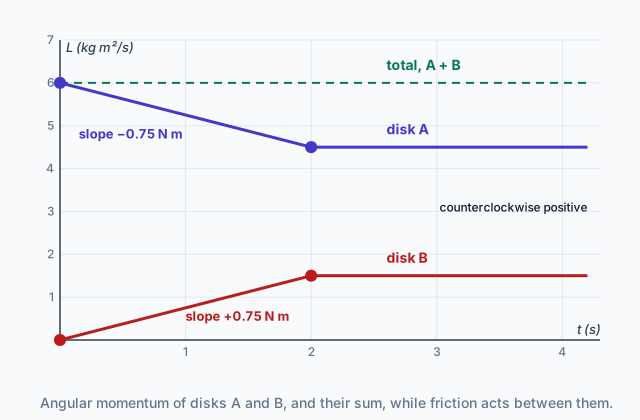
The graph at the top of the page shows this for two disks on one axle. Friction between them takes angular momentum from disk A at 0.75 N·m and gives it to disk B at the same rate, and the total stays at 6.0 kg·m²/s.
So a system's total can change only through an interaction with its surroundings, and the change equals the angular impulse they exert:
For each part on its own, the other part's torque counts: it changes that part's angular momentum by its angular impulse.
Quick check · Calculate
Disks P and Q turn on one frictionless vertical axle. Disk P has rotational inertia 0.20 kg·m² and disk Q has 0.50 kg·m². A clutch between them engages for 0.40 s, and during that time it exerts a torque of 1.5 N·m on disk Q, counterclockwise as seen from above. Take counterclockwise as positive. By how much does disk P's angular velocity change during those 0.40 s?
2c. The system you choose decides
Angular momentum is conserved in every interaction: it is never created or destroyed, only passed from one object to another. Whether a particular system keeps its total depends on what you put inside it.
- If the net external torque on the system is zero, its total angular momentum is constant.
- If the net external torque is not zero, angular momentum moves between the system and its surroundings.
Drop a lump of clay onto a spinning turntable with a frictionless bearing. For the turntable alone, the clay's friction is an outside torque, and the turntable's angular momentum falls. For turntable and clay together, that friction is internal, so the pair's total stays the same. If the bearing had friction, even the pair's total would fall, and that angular momentum would go into the base and Earth.
So choose the system that makes the torque you do not know internal. Then you can write without knowing it.
Quick check · Sort it
Tap a card, then say whether the angular momentum of the system named on it, about its axle, stays constant or changes. Every axle bearing here is frictionless.
Stays constant
Changes
2d. A system that changes shape
A rigid system can change its angular speed only through an external torque. A nonrigid system, one whose parts can move relative to each other, can also change it by moving mass toward or away from the axis. That changes its rotational inertia, and with no external torque the angular momentum stays the same:
A diver leaves the board stretched out, turning at 1.5 rad/s about her center of mass with kg·m². Gravity acts at her center of mass, so it exerts no torque about it. She pulls into a tuck, kg·m², and her angular speed becomes rad/s.
Her kinetic energy is not conserved. It goes from J to J, because her muscles do work pulling her body in. In a shape change, conserve angular momentum, never kinetic energy.
Quick check · Decide and justify
A satellite far from any planet or star spins counterclockwise, as seen from one end of its spin axis, with no thrusters firing. A motor slowly extends two long booms straight out from its sides, moving mass away from the spin axis. While the booms extend, what happens to the satellite's angular speed?
Which reason supports your answer?
Part 3 Watch it done A child jumps onto a merry-go-round
Watch each step, then do the last one yourself.
A merry-go-round of radius 2.0 m and rotational inertia 300 kg·m² sits at rest on a frictionless vertical axle. A 25 kg child runs at 4.0 m/s along a straight line tangent to its rim and jumps on at the rim, where she stays. Take counterclockwise, as seen from above, as positive; the child is moving counterclockwise about the axle. Treat the child as a point. What is the merry-go-round's angular velocity just after she lands?
Step 1 · Choose the system
Take the child and the merry-go-round together. Outside the system are Earth's gravity, which points along the axle, and the axle itself, which pushes through the axis and is frictionless. Neither exerts a torque about the axle, so the system's angular momentum about it is the same before and after she lands.
Why this step?
Why include the child instead of studying the merry-go-round alone?
For the merry-go-round alone, the child's feet exert a friction torque on it as she lands, and nobody knows how large it is or for how long. With both in the system that torque is internal: its angular impulse on the merry-go-round is equal and opposite to the one on the child, so it drops out of the total.
Step 2 · Angular momentum before
The merry-go-round is at rest, so its . The child moves along a line tangent to the rim, so m and kg·m²/s. The total is kg·m²/s.
Step 3 · Rotational inertia after
Now the child turns with the merry-go-round at the rim: kg·m².
Your step · Calculate
Finish it. What is the merry-go-round's angular velocity just after the child lands? Counterclockwise, as seen from above, is positive.
rad/s
Part 4 Try it New situations
Try it · Rank it
Three identical platforms, each of radius 1.2 m with rotational inertia 4.0 kg·m², turn counterclockwise, as seen from above, at 6.0 rad/s on frictionless vertical axles. A sandbag is dropped straight down from rest onto each and stays where it lands: on platform A a 2.0 kg bag lands 0.50 m from the axle, on B a 4.0 kg bag lands 0.25 m from the axle, and on C a 1.0 kg bag lands 1.0 m from the axle. Treat each bag as a point. Rank the platforms by angular speed after the bags land.
Greatest first
Give each one a place, 1 for first. Give two the same place if they are equal.
Your ranking: none yet
Try it · Calculate
A potter's wheel and the clay on it, together a rigid system with rotational inertia 0.80 kg·m², turn counterclockwise, as seen from above, at 12 rad/s. The motor is switched off, and the potter presses wet hands against the spinning clay, exerting a friction torque of 2.4 N·m in the clockwise sense for 1.5 s. Ignore friction in the bearing. Take counterclockwise as positive. What is the wheel's angular velocity at the end of the 1.5 s?
On paper. You have a stool that turns on a low-friction bearing, two hand weights, a meterstick and a phone with a gyroscope app that can be taped to the stool. Write a procedure to test whether a rider's angular momentum stays constant as she pulls the weights in toward her chest: what you would measure in each arm position and with what, how you would find her rotational inertia in each position, and which outside torque you would try to keep small, and how. There is nothing to submit here; compare your plan with the stool readings in Check yourself.
Part 5 Explain it Claim, derive, then check the claim
Nothing you type leaves this page. Check your answer against the model and each scoring point.
Free response is 50% of the exam score. This one is shaped like Question 4, Qualitative/Quantitative Translation.
Free-response practice · Question 4 style
A disk with rotational inertia spins freely, counterclockwise as seen from above, with angular speed on a frictionless vertical axle. A ring with rotational inertia , not rotating, is dropped onto the disk so that it is centered on the axle. Friction between the ring and the disk brings them to a common angular speed .
(a) Is the total kinetic energy of the disk and ring after they reach greater than, less than or equal to their total kinetic energy before the ring was dropped? Justify your claim using physical principles, without deriving or calculating anything.
(b) Derive an expression for in terms of , and .
(c) Derive an expression for the ratio of the final to the initial total kinetic energy, in terms of and . Justify whether your result agrees with your claim in part (a).
Model answer
(a) Less. While the ring slips on the disk, kinetic friction between the two surfaces turns some of the system's kinetic energy into thermal energy. That friction is internal, so it does not change the system's angular momentum, but it does lower its kinetic energy.
(b) Take the disk and ring as the system. Gravity and the axle exert no torque about the axle, and the friction torques between disk and ring are equal and opposite, so angular momentum is conserved: , which gives .
(c) and , so . For any ring with the denominator is larger than the numerator, so the ratio is less than 1 and the kinetic energy decreases. This agrees with part (a).
Score your own answer. This is a self-check, not a grade. Tick each point your answer makes.
Part 6 Check yourself A spin on a stool
The case questions use the stool readings. Answer them from those.
A student sits on a stool whose seat turns on a low-friction vertical bearing above a fixed stand, holding a weight in each hand with her arms stretched out. A classmate starts her turning counterclockwise, as seen from above, which is positive, and lets go at . A phone taped to the seat records her angular speed. Over the first 2.0 s she pulls the weights in to her chest, and then she holds them there. The class found the rotational inertia of the student, weights and seat in each arm position beforehand.
| (s) | Arms | (kg·m²) | (rad/s) |
|---|---|---|---|
| 0 | Out | 4.0 | 1.50 |
| 1.0 | Halfway | 3.0 | 1.93 |
| 2.0 | In | 2.0 | 2.80 |
| 8.0 | In | 2.0 | 2.20 |
Case question 1 · Multiple choice
In the first three rows, while she pulls her arms in, which quantity for the student, weights and seat stays most nearly the same?
Case question 2 · Calculate
Using the readings, what is the average net external torque on the student, weights and seat between s and s? Counterclockwise, as seen from above, is positive.
Case question 3 · Decide and justify
Between s and s, did anything outside the student, weights and seat gain angular momentum?
Which reason supports your answer?
The rest stand on their own and do not use the case.
Check yourself · Spot the error
A figure skater spins at 2.0 rad/s with her arms out, where her rotational inertia is 3.6 kg·m². She pulls her arms in, and her rotational inertia becomes 1.2 kg·m². The ice exerts a negligible torque about her spin axis. A student finds her final angular speed. Tap the first line with a mistake.
Check yourself · Match
Match each condition on a chosen system to what it means for the system's angular momentum about an axis.
Part 7 Keep it Bring back earlier ideas
This lesson stands on finding a change with its sign kept, from Topic 1.2, and on angular impulse changing a wheel's angular momentum, from Topic 6.3. Pulling them back up is what makes them last.
From 1.2 Displacement, Velocity, and Acceleration · Calculate
A tennis ball flies toward a wall at 30 m/s and bounces straight back at 20 m/s. It touches the wall for 0.010 s. Take the direction toward the wall as positive. What is the ball's average acceleration while it touches the wall?
On paper. Sketch the potter's wheel's angular momentum against time, from the worked example in Watch it done, from to s, with a label and a unit on each axis. Mark its starting value, and say where the graph is steepest and which quantity sets how steep it is. There is nothing to submit. Compare: starts at 2.4 kg·m²/s with zero slope and curves upward the whole time, steepest at 2.0 s, where its slope is the net torque then, 4.0 N·m. The graph at the top of the page has a different shape because its torque rises and then falls.
From 6.3 Angular Momentum and Angular Impulse · Calculate
A grinding wheel has a rotational inertia of 0.20 kg·m² about its axle and turns counterclockwise, as seen from the front, at 15 rad/s. Take counterclockwise as positive. Its reversible motor then exerts a constant net torque of 1.5 N·m clockwise for 3.0 s. What is the wheel's angular velocity at the end of the 3.0 s?
In three lines
- A system's total angular momentum is the sum of its parts' about one axis, each with the sign of its sense.
- Torques between parts cancel in equal and opposite angular impulses, so only an external torque changes the total, by .
- With zero net external torque, , even when a nonrigid system changes shape and its kinetic energy changes.
Exam strategy for this topic
- Section I, Multiple Choice: 42 questions in 85 minutes.
- Section II, Free Response: 4 questions in 95 minutes.
- This lesson's Explain it is shaped like free-response question 4, Qualitative/Quantitative Translation.
- A four-function, scientific, or graphing calculator is allowed on both sections of the exam.
When a free-response part asks you to justify that something stays the same, name the system first, then say which outside objects exert forces on it and why their torques about the axis are zero or not. That sentence is the justification. Then write the angular momentum before and after with every part included, and only after that put in numbers.
Questions students ask
Can angular momentum be conserved when kinetic energy is not?
Yes, and it often is. When parts slip and stick, friction turns kinetic energy into thermal energy, and when a system changes shape, the parts do work on each other. Neither changes the total angular momentum, which only an outside torque can change.
How does a spinning skater speed up with no torque on her?
She is a nonrigid system. Pulling her arms in lowers her rotational inertia, and since nothing outside exerts a torque about her spin axis, stays the same, so rises. Her muscles supply the extra kinetic energy.
Does gravity spoil conservation of angular momentum?
It depends on the axis. About a vertical axle, gravity points along the axis and exerts no torque about it. About a diver's center of mass, gravity acts at that point and exerts no torque either. About other axes it can exert a torque, so check the axis you chose.
What makes a torque internal or external?
Only the system you chose. A torque between two objects that are both in the system is internal and cancels with its third-law partner. If one of them is outside, the torque on the system is external and can change its angular momentum.
How is this like conservation of linear momentum?
It is the same pattern. Internal forces cancel in pairs, so only a net external force changes a system's linear momentum; internal torques cancel in pairs, so only a net external torque changes its angular momentum.
Course alignment, for teachers
AP Physics C: Mechanics topic 6.4, Unit 6: Energy and Momentum of Rotating Systems.
- Skill 1.C: Create qualitative sketches of graphs that represent features of a model or the behavior of the physical system.
- Skill 2.B: Calculate or estimate an unknown quantity with units from known quantities, by selecting and following a logical computational pathway.
- Skill 3.B: Apply an appropriate law, definition, theoretical relationship, or model to make a claim.
- Skill 3.C: Justify or support a claim using evidence from experimental data, physical representations, or physical principles or laws.
This lesson maps all 9 essential knowledge statements of the topic to the part that teaches each one: 9 are checked by a scored question. The map is in the lesson file.