Unit 6 · Topic 6.5 · about 30 minutes · 7 parts · 12 scored checks, 1 of them multiple choice, plus 2 from earlier lessons
AP Physics C: Mechanics 6.5: Rolling
Unit 6: 10 to 15% of the multiple-choice section
What you'll be able to do
- Describe the kinetic energy of an object that moves along and spins at the same time, as the sum of its translational and rotational kinetic energies.
- Describe the motion of an object that rolls without slipping, relating its center's displacement, velocity and acceleration to its rotation.
- Describe the motion of an object that rolls while slipping, and explain why kinetic friction then dissipates energy.
Key vocabulary
| Term | What it means | The exam trap |
|---|---|---|
| Translational kinetic energy | The kinetic energy of a system's center-of-mass motion, . | Use the speed of the center of mass, not the speed of some point on the rim. |
| Rotational kinetic energy | The kinetic energy of a system's rotation about its center of mass, . | Use the rotational inertia about the axis through the center of mass, not about the contact point or the rim. |
| Total kinetic energy | The sum of a system's translational and rotational kinetic energies, . | Both terms are scalars, so add them as numbers; there are no directions to combine. |
| Rolling without slipping | Rolling in which the contact point does not slide on the surface, so the center's motion and the rotation are tied by , and . | Use the radius from the center to the point that touches the surface; for an object rolling on a narrow axle, that is the axle's radius, not the outer radius. |
| Slipping | Motion in which a rotating object's contact point slides along the surface, so its center's motion and its rotation cannot be directly related. | While slipping, the center's velocity and the angular velocity are each still well defined; you find them from separate equations instead of from each other. |
| Kinetic friction | The friction force between two surfaces that slide relative to each other. | Kinetic friction is a different force from static friction, which acts where surfaces do not slide and can take any size up to its maximum. |
| Dissipated energy | Mechanical energy of a system turned into internal energy, such as the warming of two surfaces that rub. | Dissipated energy is not destroyed; it becomes internal energy, so the total energy of a large enough system is still conserved. |
 Tap to open the picture full size
Part 1 Think first A ball and an ice cube race
Commit to a guess first. Being wrong now makes the right idea stick better.
Predict first
A rubber ball and an ice cube of the same mass are released from rest at the top of the same ramp. The ball rolls down without slipping. The ice cube slides down with almost no friction. Which is moving faster at the bottom?
In short. A rolling object's total kinetic energy is the sum of its translational and rotational kinetic energies, ; while it rolls without slipping its center's motion is tied to its spin by , and once it slips that tie breaks.
- , two scalars added as numbers.
- Rolling without slipping: , and , and in the ideal case the friction at the contact dissipates no energy.
- Slipping: the center's motion and the spin are found separately, and kinetic friction at the sliding contact dissipates energy.
Part 2 Learn it Four ideas, with a check after each
6a. Two kinds of kinetic energy
A bowling ball rolling down a lane does two things at once: its center of mass moves along the lane, and the ball spins about that center. Each motion carries kinetic energy.
The translational kinetic energy is the energy of the center of mass's motion, as if all the mass moved with it: . The rotational kinetic energy is the energy of the spin about the center of mass: , where is the rotational inertia about an axis through the center of mass. The total kinetic energy is their sum:
Take a solid disk, , of mass 4.0 kg and radius 0.10 m, moving at 2.0 m/s while it spins at 30 rad/s. Then J, kg·m² and J, so J.
Both parts are scalars, so they add as numbers, with no directions to combine. The sum does not need the object to be rolling on anything: a disk tossed through the air has both kinds too.
Quick check · Calculate
A uniform solid disk, with , of mass 0.50 kg and radius 0.20 m is tossed through the air. Its center of mass moves at 4.0 m/s while the disk spins about its center at 20 rad/s. What is the disk's total kinetic energy?
6b. Rolling without slipping ties the spin to the center
When a wheel rolls without slipping, the part of its rim touching the ground never slides. Each time the wheel turns through an angle , a length of rim is laid down along the ground, and the center moves forward by exactly that length. Here is the distance from the center to the point that touches the ground.
Since is constant, differentiate with respect to time, once and then again, using and :
These need matching signs: take the direction the center moves as positive, and the sense the wheel turns while rolling that way, clockwise or counterclockwise as you see it, as the positive sense.
A bicycle wheel of radius 0.35 m rolling at 7.0 m/s spins at rad/s. Because the spin is now fixed by the speed, a rolling object's kinetic energy depends on alone:
Quick check · Fill the statement
A wheel of radius 0.25 m rolls without slipping along a straight, level path. Take the direction its center moves as positive, and the sense the wheel turns while rolling that way (clockwise, seen with the wheel moving to your right) as the positive sense.
When its center moves 2.0 m, the wheel turns through . When its center moves at 5.0 m/s, the wheel spins at . When its center's acceleration is 1.5 m/s², its angular acceleration is .
6c. Friction that takes no energy
A ball rolls down a ramp, rather than sliding, because friction acts on it. The friction at the contact point exerts a torque about the center that makes the ball spin faster as it speeds up. Gravity and the normal force exert no torque about the center, so without friction the ball would slide down without spinning up.
Yet in the ideal case this friction dissipates no energy. While the ball rolls without slipping, the point touching the ramp is at rest relative to the ramp at each instant: its forward velocity from the center's motion, , and its backward velocity from the spin, , cancel there. A friction force whose point of application does not slide along the surface turns no mechanical energy into internal energy. This is static friction, and all it does is move energy between the translational and rotational kinetic energy.
So for an object that starts from rest and rolls without slipping down a height , with no other losses,
Real tires and floors squash a little, which causes a small resistance called rolling friction. This course leaves rolling friction out, so treat every rolling object here as ideal.
Quick check · Decide and justify
A solid rubber ball rolls without slipping down a rough wooden ramp. Ignore air resistance. Is the mechanical energy of the ball-Earth system constant as the ball rolls down?
Which reason supports your answer?
6d. When the contact point slides
An object slips when its contact point slides along the surface. Then the center's motion and the spin are no longer tied: , and do not hold, and you find and from separate equations, Newton's second law for the center and its rotational form for the spin.
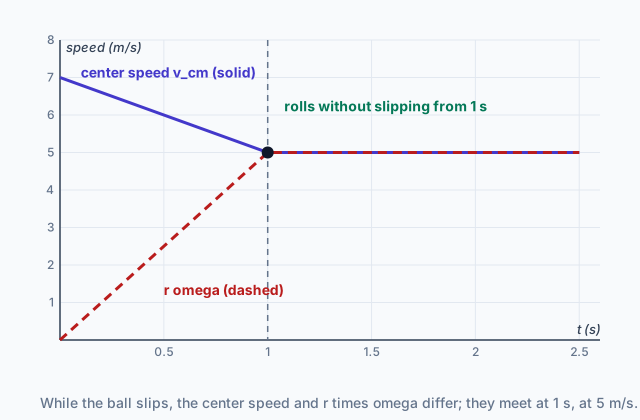
The graph at the top of this page follows a solid ball launched along a level floor at 7 m/s with no spin, with a coefficient of kinetic friction of 0.2 and m/s². While it slips, kinetic friction slows its center (the solid line) and spins it up (the dashed line, ). The two lines differ, so knowing one does not tell you the other. They meet at 1 s, and from then on the ball rolls without slipping.
During the slipping, the contact point moves relative to the floor, so the point of application of the kinetic friction slides along the surface. That friction dissipates energy: some mechanical energy becomes internal energy of the ball and the floor, and the system's mechanical energy decreases. Whenever a rotating object's rim rubs along a surface, energy goes this way.
Quick check · Sort it
Tap a card, then say whether the object is rolling without slipping or slipping.
Rolling without slipping
Slipping
Part 3 Watch it done A cylinder rolls down a ramp
Watch each step, then do the last one yourself.
A uniform solid cylinder, , of mass 3.0 kg and radius 0.10 m is released from rest at the top of a ramp and rolls without slipping to the bottom, 1.2 m lower. Ignore air resistance and take m/s². How fast is its center moving at the bottom?
Step 1 · Choose the system and the energy
Take the cylinder and Earth as the system. The ramp's static friction acts at a contact point that does not slide, so it dissipates no energy, and the mechanical energy is constant: .
Step 2 · Tie the spin to the center
Rolling without slipping gives , so . Then , the mass cancels, and . The radius canceled too.
Why this step?
Why doesn't the friction take any energy, when it is a real force acting on the cylinder?
Energy is dissipated only where a force's point of application slides along a surface, and the cylinder's contact point is at rest on the ramp at each instant. The friction slows how fast the center speeds up and makes the spin speed up by matching amounts, so it moves energy from translational to rotational kinetic energy without removing any.
Your step · Calculate
Finish it. Calculate the speed of the cylinder's center at the bottom of the ramp, 1.2 m below where it started. Use m/s².
m/s
Part 4 Try it New situations
Try it · Rank it
Four objects are released from rest at the top of the same ramp, one at a time, and each rolls without slipping to the bottom. A is a hoop () of mass 2.0 kg and radius 0.10 m. B is a solid sphere () of mass 0.50 kg and radius 0.050 m. C is a solid disk () of mass 1.0 kg and radius 0.20 m. D is a solid sphere of mass 3.0 kg and radius 0.15 m. Ignore air resistance. Rank the objects by the speed of their centers at the bottom.
Fastest first
Give each one a place, 1 for first. Give two the same place if they are equal.
Your ranking: none yet
Try it · Calculate
A bowling ball, a uniform solid sphere () of mass 6.0 kg and radius 0.11 m, rolls without slipping down a level lane at 5.0 m/s. What is its total kinetic energy?
On paper. Draw a force diagram for a solid ball rolling without slipping down a ramp, with each force drawn where it is exerted and labeled with what exerts it. Then describe how you could find out, in your lab, whether a soup can rolls without slipping down a ramp, using a meterstick and a strip of tape on the can's rim: what you would measure, how many times, and what result would show the can slipping. There is nothing to submit here.
Part 5 Explain it Derive it, then put numbers in
Nothing you type leaves this page. Check your answer against the model and each scoring point.
Free response is 50% of the exam score. This one is shaped like Question 1, Mathematical Routines.
Free-response practice · Question 1 style
A uniform solid cylinder, , of mass and radius rolls without slipping across a level floor at speed and then rolls without slipping up a rough ramp. Ignore air resistance and rolling friction, and take m/s².
(a) On paper, draw a force diagram of the cylinder while it rolls up the ramp, with each force drawn where it is exerted.
(b) Derive an expression for the greatest height that the cylinder's center rises above its height on the level floor, in terms of and .
(c) Calculate for m/s.
(d) The rough ramp is replaced by a frictionless ramp of the same shape, and the cylinder arrives at it the same way, at 3.0 m/s and rolling. Calculate how high the cylinder's center rises above its height on the level floor now, and explain why the answer differs from part (c).
Model answer
(a) Three forces: the gravitational force , downward at the center; the normal force, perpendicular to the ramp at the contact point; and static friction, along the ramp and pointing up the slope, at the contact point. Friction points up the slope even though the cylinder moves up: the spin must slow along with the center, and only an up-slope force at the contact point exerts a torque about the center that slows it. Compare your diagram with those three forces, their directions and where each one starts.
(b) Friction at a contact point that does not slide dissipates no energy, so . With and , the left side is , so .
(c) m.
(d) On the frictionless ramp no force exerts a torque about the center, so stays while the center slows: the cylinder slips, and its spin is no longer tied to its center's motion. Its rotational kinetic energy, , stays as it was, and only the translational part becomes gravitational potential energy: , so m. On the rough ramp friction let the spin's energy be turned into height as well, so the cylinder rose higher.
Score your own answer. This is a self-check, not a grade. Tick each point your answer makes.
Part 6 Check yourself A toy car's drive wheel
The case questions use the tracking readings. Answer them from those.
A student drives a small toy car straight across the floor, from a rubber mat onto smooth tile partway through the run. Video taken from the car's right side shows the car moving to the right, with its drive wheel, of radius 0.050 m, turning clockwise; take the car's direction of travel as positive and clockwise as the positive sense. Tracking software reads the position of the wheel's center and the angle the wheel has turned:
| (s) | (m) | (rad) |
|---|---|---|
| 0 | 0 | 0 |
| 0.5 | 0.20 | 4.0 |
| 1.0 | 0.50 | 10.0 |
| 1.5 | 0.85 | 22.0 |
| 2.0 | 1.25 | 36.0 |
Case question 1 · Multiple choice
Using the readings, over which interval does the drive wheel first slip on the floor?
Case question 2 · Calculate
Using the readings at 1.5 s and 2.0 s, what average angular velocity would rolling without slipping require of the drive wheel, given how far the car's center moved over that interval? Clockwise is positive.
Case question 3 · Decide and justify
From 1.5 s to 2.0 s, is energy dissipated at the contact between the drive wheel and the tile?
Which reason supports your answer?
The rest stand on their own and do not use the case.
Check yourself · Spot the error
A hoop, with , of mass 2.0 kg and radius 0.50 m rolls without slipping at 4.0 m/s. A student finds its total kinetic energy. Tap the first line with a mistake.
Check yourself · Match
Tap a situation, then the statement that describes its friction and energy.
Part 7 Keep it Bring back earlier ideas
This lesson stands on Topic 1.2, where differentiating a displacement gives a velocity, as the rolling relations do, and on Topic 6.4, where a spinning system was described by its rotational inertia and angular velocity.
From 1.2 Displacement, Velocity, and Acceleration · Sort it
Tap a card, then say which operation finds what it asks for.
Differentiate
Integrate
From 6.4 Conservation of Angular Momentum · Spot the error
A figure skater spins at 2.0 rad/s with her arms out, where her rotational inertia is 3.6 kg·m². She pulls her arms in, and her rotational inertia becomes 1.2 kg·m². The ice exerts a negligible torque about her spin axis. A student finds her final angular speed. Tap the first line with a mistake.
In three lines
- A rolling object's total kinetic energy is .
- Rolling without slipping ties the center to the spin, , , , and its static friction dissipates no energy.
- Slipping breaks that tie, and kinetic friction at the sliding contact dissipates energy.
Exam strategy for this topic
- Section I, Multiple Choice: 42 questions in 85 minutes.
- Section II, Free Response: 4 questions in 95 minutes.
- This lesson's Explain it is shaped like free-response question 1, Mathematical Routines.
- A four-function, scientific, or graphing calculator is allowed on both sections of the exam.
On a rolling question, decide first whether the object slips, and say so in your answer. If it does not, write and use energy conservation with both kinetic energy terms. If it does, treat the center and the spin with separate equations, and account for the energy kinetic friction dissipates.
Questions students ask
Why does a rolling object need friction at all, if the friction takes no energy?
Friction is what makes the spin change. On a ramp it exerts the torque about the center that speeds the spin up as the object speeds up. Without it the object would slide down without spinning up.
Is the friction on a rolling wheel static or kinetic?
Static, as long as the wheel rolls without slipping, because the contact point is not sliding. It becomes kinetic friction once the contact point slides, as in a skid or a wheel spinning on ice.
Which radius goes in ?
The distance from the center to the point that touches the surface. For a wheel on a road that is the wheel's radius; for a spool rolling on its narrow axle, it is the axle's radius.
Can an object have rotational kinetic energy while its center is at rest?
Yes. A bicycle wheel spinning on a stand has a center at rest, so its translational kinetic energy is zero, but it has rotational kinetic energy from its spin.
What is rolling friction, and do I need it?
Rolling friction is the small resistance that comes from a tire or floor squashing as an object rolls. It is beyond the scope of AP Physics C: Mechanics, so treat rolling without slipping as losing no energy.
Beyond the AP Exam
College Board sets this limit on what the AP Exam asks about this topic. Anything past it is not on the exam.
Rolling friction is beyond the scope of AP Physics C: Mechanics.
Course alignment, for teachers
AP Physics C: Mechanics topic 6.5, Unit 6: Energy and Momentum of Rotating Systems.
- Skill 1.B: Create quantitative graphs with appropriate scales and units, including plotting data.
- Skill 2.A: Derive a symbolic expression from known quantities by selecting and following a logical mathematical pathway.
- Skill 2.D: Predict new values or factors of change of physical quantities using functional dependence between variables.
- Skill 3.A: Create experimental procedures that are appropriate for a given scientific question.
- Skill 3.B: Apply an appropriate law, definition, theoretical relationship, or model to make a claim.
This lesson maps all 5 essential knowledge statements of the topic to the part that teaches each one: 5 are checked by a scored question. The map is in the lesson file.