Unit 6 · Topic 6.6 · about 30 minutes · 7 parts · 12 scored checks, 2 of them multiple choice, plus 2 from earlier lessons
AP Physics C: Mechanics 6.6: Motion of Orbiting Satellites
Unit 6: 10 to 15% of the multiple-choice section
What you'll be able to do
- Describe the motion of a satellite and a central object that interact only through gravity, using conservation of energy and angular momentum to say what stays constant and what changes, and finding the energy of an orbit and the speed needed to escape.
Key vocabulary
| Term | What it means | The exam trap |
|---|---|---|
| Satellite | An object that orbits a central object because of their gravitational attraction, with a mass negligible next to the central object's. | The word names a role, not a kind of object: a moon, a planet or a spacecraft can each be the satellite in a system. |
| Central object | The massive body a satellite orbits, such as a planet or a star. | Orbit equations need one particular distance between the two bodies; check which one a question gives before you substitute. |
| Circular orbit | An orbit in which the distance between the satellite and the central object's center stays the same all the way around. | Results derived for a circular orbit depend on that fixed distance, so check that the orbit really is circular before you use them. |
| Elliptical orbit | A closed orbit in which the distance between the satellite and the central object's center changes around the path. | Equations derived for circular orbits, such as , do not hold at each point of an ellipse. |
| Gravitational potential energy | The energy of a satellite and central object system due to their separation, , defined to be zero when they are infinitely far apart. | Because the zero sits at infinite separation, the sign of is part of the answer; carry it through every step and every comparison. |
| Total mechanical energy | The sum of the satellite's kinetic energy and the system's gravitational potential energy, . | It belongs to the system, so count the potential energy of the pair once, not once for each body. |
| Angular momentum | For a satellite about the central object's center, the product of its distance, its mass and the part of its velocity perpendicular to the line from the center. | holds only where the velocity is perpendicular to the line from the center; elsewhere on an ellipse only part of the velocity counts. |
| Escape velocity | The speed a satellite needs at a given distance from the central object so that the mechanical energy of the satellite and central object system is zero. | It depends on where the satellite starts: the value from a planet's surface is not the value from a high orbit. |
 Tap to open the picture full size
Part 1 Think first Braking into a faster orbit
Commit to a guess first. Being wrong now makes the right idea stick better.
Predict first
A spacecraft moves in a circular orbit around Earth. It fires its thrusters against its direction of motion twice, half an orbit apart, losing some energy each time, and ends up in a smaller circular orbit. In the smaller orbit, how does its speed compare with its speed before?
In short. When gravity is the only force, the system's total mechanical energy and the satellite's angular momentum stay constant; with , a circular orbit has and , and escape takes the speed that makes , .
- When the satellite's mass is negligible next to the central object's, treat the central object as fixed; in a circular orbit , , and are all constant.
- In an elliptical orbit only and stay constant: rises toward zero as the satellite moves away, and falls by the same amount.
- is zero at infinite separation, so a bound satellite has negative ; escape velocity, , brings up to exactly zero.
Part 2 Learn it Four ideas, with a check after each
2a. Two bodies, one of them almost still
A satellite is an object that orbits a far more massive central object: a moon around a planet, a spacecraft around Earth, a planet around a star. The two pull on each other with forces of equal size, but the central object's mass is so much larger that its acceleration is tiny. When the satellite's mass is negligible next to the central object's, the central object's motion is negligible too, and you treat it as fixed at the center of the orbit.
With gravity as the only force, two conservation laws constrain the motion:
- The system's total mechanical energy, , is constant, because gravity is a conservative force acting inside the satellite and central object system.
- The satellite's angular momentum about the central object's center is constant, because the gravitational force on it points along the line to that center and so exerts no torque about it.
In a circular orbit the distance between the centers never changes. The potential energy depends only on , so is constant; then is constant, so the speed is constant, and so is .
Quick check · Sort it
A small weather satellite moves in a circular orbit around Earth, and gravity is the only force on it. Tap a card, then say whether the quantity stays the same or changes as the satellite goes around.
Stays the same
Changes
2b. Potential energy that is zero far away
For a satellite of mass and a central object of mass , the system's gravitational potential energy is
where is the distance between their centers. The zero is defined at infinite separation. Bringing the two closer lowers the energy, so at any finite distance is negative, and it rises toward zero as grows.
In a circular orbit, gravity alone supplies the centripetal acceleration:
Compare that with : the kinetic energy is half its size, with the opposite sign. So
A satellite and planet with GJ in a circular orbit have GJ and GJ. The negative total means the satellite is bound: it does not have the energy to get infinitely far away. Measure from the center of the central object, never from its surface.
Quick check · Calculate
A 400 kg satellite moves in a circular orbit m above the surface of the invented planet Tolla, whose mass is kg and whose radius is m. Use N·m²/kg², with the potential energy zero at infinite separation. What is the total mechanical energy of the satellite and Tolla system, in megajoules?
2c. Ellipses trade kinetic for potential energy
In an elliptical orbit the distance changes around the path, so changes. With only gravity acting, the system's total and the satellite's angular momentum still stay constant, so any change in comes with an equal and opposite change in :
- As the satellite moves outward, rises toward zero and falls by the same amount.
- As it falls back inward, drops and grows.
At the closest and farthest points the velocity is perpendicular to the line from the center, so at those two points , and conservation of angular momentum gives
A comet whose farthest distance is 3 times its closest distance moves 3 times as fast at its closest point as at its farthest. The circular-orbit results, a constant speed and , do not hold point by point on an ellipse. Use conservation of and of between two points instead.
Quick check · Decide and justify
A probe moves in an elliptical orbit around a planet with its engine off, and gravity from the planet is the only force on it. Right now it is moving from its closest point toward its farthest point. During this part of the orbit, what happens to the probe's kinetic energy?
Which reason supports your answer?
2d. The speed that never comes back
Launch a probe straight away from an airless planet, and let gravity be the only force on it. stays fixed, and far away approaches zero. So the sign of decides what happens:
- If , the probe can never get infinitely far: it stops at some distance and falls back.
- If , it slows the whole way, and its speed approaches zero as its distance grows without limit.
- If , it still has speed left however far it goes.
The escape velocity is the speed that makes the mechanical energy of the satellite and central object system exactly zero. Starting at a distance from the center,
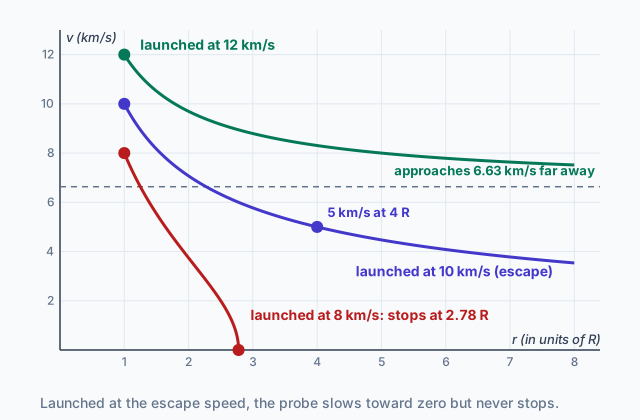
The graph at the top of this page shows three probes leaving the invented planet Oru, whose escape speed from its surface is 10 km/s. The probe launched at 8 km/s stops at 2.78 planet radii and falls back; the one launched at exactly 10 km/s is still slowing at 8 radii and never stops.
Quick check · Multiple choice
Two probes, one of 500 kg and one of 2000 kg, sit side by side on the surface of the same airless moon. Each is to be launched straight up with the least speed that lets it escape, with the moon's gravity the only force on it after launch. How do their launch speeds compare?
Part 3 Watch it done Raising a satellite to a higher orbit
Watch each step, then do the last one yourself.
A 1200 kg satellite moves in a circular orbit of radius m around the invented planet Tolla, whose mass is kg. Its engines move it to a circular orbit of radius m. Use N·m²/kg², with zero at infinite separation. How much mechanical energy must the engines add to the satellite and Tolla system? Ignore the mass of the fuel burned.
Step 1 · Write the energy of a circular orbit
Gravity alone supplies the centripetal acceleration in each circular orbit, so and . The energy the engines add is the change in the system's total, .
Step 2 · The starting orbit
J, or MJ. The satellite's kinetic energy there is MJ and MJ.
Why this step?
The engines add energy, yet the satellite ends up moving more slowly. Why?
In any circular orbit . Raising the orbit brings up toward zero, so must fall by the same amount. The potential energy rises by twice that amount: it takes all the energy the engines add, and all the kinetic energy the satellite loses.
Your step · Calculate
Finish it. How much mechanical energy must the engines add to the satellite and Tolla system, in megajoules?
MJ
Part 4 Try it New situations
Try it · Rank it
Three satellites move in circular orbits around the same planet, of mass , each with gravity from the planet as the only force on it. Satellite A has mass and orbit radius . Satellite B has mass and orbit radius . Satellite C has mass and orbit radius . With zero at infinite separation, rank the three satellite and planet systems by total mechanical energy.
Greatest first
Give each one a place, 1 for first. Give two the same place if they are equal.
Your ranking: none yet
Try it · Calculate
The invented airless moon Brin has a mass of kg and a radius of m. Use N·m²/kg². What is the escape speed from Brin's surface?
On paper. Sketch three graphs on one set of axes, against time for one trip around a circular orbit: the satellite's kinetic energy, the system's gravitational potential energy and the system's total energy, with a zero line and a label on each. Then make a second set of axes for a probe in an elliptical orbit, starting at its closest point and running for one full orbit, and sketch the same three. Mark which graphs are flat and which are not. There is nothing to submit here; compare your sketches with Learn it.
Part 5 Explain it Is the orbit's energy constant?
On the exam this is handwritten, so answer on paper first. Nothing you type here leaves this page. Then check your answer against the model and each scoring point.
Free response is 50% of the exam score. This one is shaped like Question 3, Experimental Design and Analysis.
Free-response practice · Question 3 style
Kesh is an invented planet. A space agency publishes a public tracking archive for each probe it has in orbit around Kesh: every ten minutes, the probe's distance from Kesh's center and its speed , both measured by radio. Each probe's mass is negligible next to Kesh's, its engine is off, and gravity from Kesh is the only force on it.
(a) A student wants to use the archive for one probe on an elliptical orbit to test whether the mechanical energy of the probe and Kesh system stays constant around the orbit, without knowing Kesh's mass. Describe a procedure: which entries the student should take from the archive, how many, and from what part of the orbit.
(b) Describe how the student could analyze those entries with a graph to decide whether the energy is constant, and what feature of the graph would show it.
The student then takes these entries for a 500 kg probe on an elliptical orbit around Kesh:
- m, m/s
- m, m/s
- m, m/s
- m, m/s
- m, m/s
(c) Indicate quantities that could be graphed to yield a straight line whose slope and vertical intercept could be used to determine the mass of Kesh and the total mechanical energy of the system, and explain why that graph is a straight line.
(d) On paper, plot the data for those quantities, with a scale and units on each axis, and draw a best-fit line extended to the vertical axis. Do this by hand before you open the model.
(e) Use your best-fit line to calculate the mass of Kesh and the total mechanical energy of the probe and Kesh system, and explain what the sign of that energy says about the probe's motion. Use N·m²/kg².
Model answer
(a) Take entries from one full trip around the orbit, at least eight or ten of them, spread from the closest point to the farthest point so they cover the widest range of . Record and for each. Entries from a second trip at the same distances are a check on the first.
(b) If the mechanical energy is constant, at every entry, so . Plot on the vertical axis against on the horizontal axis. If the points fall on one straight line, within their uncertainty, the energy is constant; points that curve away from a line, or entries at the same with different speeds, would show it is not.
(c) against , for the reason in (b): the slope is and the vertical intercept is . The values of , in m⁻¹, are 1.67, 1.25, 1.00, 0.833 and 0.667, and of , in m²/s², are 7.48, 5.03, 3.48, 2.51 and 1.51.
(d) See the graph below: a scale and units on each axis and one straight best-fit line through the five points, extended to cross the vertical axis below zero.
(e) From and on the line, the slope is m³/s², so kg. The line crosses the vertical axis at about m²/s², so J. The total is negative, so the probe is bound: it does not have the energy to reach infinite separation, and it stays on its closed orbit.
Speed squared against one over the distance for one probe, with the best-fit line
The line passes through (0.70, 1.71) and (1.60, 7.09) and crosses the vertical axis near −2.5.
Score your own answer. This is a self-check, not a grade. Tick each point your answer makes.
Part 6 Check yourself A probe on a stretched orbit
The case questions use the tracking data. Answer them from those.
A 200 kg probe moves in an elliptical orbit around the invented planet Tolla, of mass kg and radius m, with its engine off. Gravity from Tolla is the only force on it, and is zero at infinite separation. Use N·m²/kg². At the closest and farthest points, the probe's velocity is perpendicular to the line from Tolla's center to the probe. Tracking gives:
| Point in the orbit | Distance from Tolla's center (m) | Speed (m/s) |
|---|---|---|
| Closest point | ||
| Farthest point | not tracked |
Case question 1 · Calculate
Using the tracking data, what is the probe's speed at its farthest point?
Case question 2 · Multiple choice
Compare the probe at its farthest point with the probe at its closest point. Which statement about the probe's kinetic energy , the system's potential energy and the system's total mechanical energy is correct?
Case question 3 · Calculate
At its closest point the probe fires its engine briefly to escape from Tolla, so that afterward its speed approaches zero as its distance from Tolla grows without limit. Using the tracking data, what is the least mechanical energy the engine must add to the probe and Tolla system, in megajoules? Ignore the mass of the fuel burned.
The rest stand on their own and do not use the case.
Check yourself · Sketch the graph
A 1000 kg satellite and the invented planet Tolla, of radius m, form a system whose gravitational potential energy is zero at infinite separation. When the satellite sits on Tolla's surface, the system's gravitational potential energy is −80 GJ. Sketch the system's gravitational potential energy against the satellite's distance from Tolla's center, from 1 to 5 planet radii. The first point is fixed at −80 GJ.
One shape that fits
Drag a point up or down, or tap it and use the arrow keys. Only the shape is checked.
Check yourself · Spot the error
A student derives the total mechanical energy of a satellite of mass in a circular orbit of radius around a planet of mass , with zero at infinite separation. Tap the first line with a mistake.
Part 7 Keep it Bring back earlier ideas
Orbits stand on adding up kinetic energy from Topic 6.5 and on velocity as a vector whose direction can change from Topic 1.2. Pulling those back up is what makes them last.
On paper. Draw a force diagram for a solid ball rolling without slipping down a ramp, with each force drawn where it is exerted and labeled with what exerts it. Then describe how you could find out, in your lab, whether a soup can rolls without slipping down a ramp, using a meterstick and a strip of tape on the can's rim: what you would measure, how many times, and what result would show the can slipping. There is nothing to submit here.
From 6.5 Rolling · Calculate
A bowling ball, a uniform solid sphere () of mass 6.0 kg and radius 0.11 m, rolls without slipping down a level lane at 5.0 m/s. What is its total kinetic energy?
From 1.2 Displacement, Velocity, and Acceleration · Calculate
A tennis ball flies toward a wall at 30 m/s and bounces straight back at 20 m/s. It touches the wall for 0.010 s. Take the direction toward the wall as positive. What is the ball's average acceleration while it touches the wall?
In three lines
- With gravity as the only force, a satellite's angular momentum and the system's total energy are constant; in a circular orbit and are constant too, and on an ellipse they trade off.
- is zero at infinite separation, and in a circular orbit , so .
- Escape velocity makes : , with measured from the central object's center.
Exam strategy for this topic
- Section I, Multiple Choice: 42 questions in 85 minutes.
- Section II, Free Response: 4 questions in 95 minutes.
- This lesson's Explain it is shaped like free-response question 3, Experimental Design and Analysis.
- A four-function, scientific, or graphing calculator is allowed on both sections of the exam.
Before you put in any numbers on an orbit question, write with its sign and measured from the center. For a circular orbit, start from Newton's second law with gravity as the only force; for escape, set at the starting point; on an ellipse, use conservation of energy and of angular momentum between two points.
Questions students ask
Why is gravitational potential energy negative?
Because its zero is defined at infinite separation. Gravity pulls the two bodies together, so bringing them closer lowers the energy below that zero. Only differences in are physical; the negative sign records that a bound pair has less energy than a pair infinitely far apart.
Does Earth really stay still while the Moon or a satellite orbits it?
Not exactly. Both bodies pull on each other with forces of equal size, and both move. When the satellite's mass is negligible next to the central object's, the central object's motion is negligible, and the model treats it as fixed. For two bodies of similar mass, both visibly move.
Do I need Kepler's laws for this topic?
The course does not expect Kepler's first or second laws. The relation between period and radius for a circular orbit, , comes from Topic 2.10 and Newton's second law. On an ellipse, conservation of energy and of angular momentum do the work here.
What happens if a probe leaves faster than the escape speed?
Its total mechanical energy is positive, so it still has kinetic energy however far it gets. Its speed falls toward a value above zero instead of toward zero, as the top curve on the graph at the top of this page shows.
Where do I measure from?
From the center of the central object to the center of the satellite, in every equation here: , the total energy, angular momentum and escape velocity. Add the planet's radius to any height above its surface.
Course alignment, for teachers
AP Physics C: Mechanics topic 6.6, Unit 6: Energy and Momentum of Rotating Systems.
- Skill 1.C: Create qualitative sketches of graphs that represent features of a model or the behavior of the physical system.
- Skill 2.A: Derive a symbolic expression from known quantities by selecting and following a logical mathematical pathway.
- Skill 3.C: Justify or support a claim using evidence from experimental data, physical representations, or physical principles or laws.
This lesson maps all 9 essential knowledge statements of the topic to the part that teaches each one: 9 are checked by a scored question. The map is in the lesson file.