Unit 7 · Topic 7.1 · about 30 minutes · 7 parts · 12 scored checks, 2 of them multiple choice, plus 2 from earlier lessons
AP Physics C: Mechanics 7.1: Defining Simple Harmonic Motion (SHM)
Unit 7: 10 to 15% of the multiple-choice section
What you'll be able to do
- Describe simple harmonic motion: tell it apart from other periodic motion, locate the equilibrium position where the net force is zero, and show that the restoring force is proportional to the displacement from that position, .
Key vocabulary
| Term | What it means | The exam trap |
|---|---|---|
| Periodic motion | Motion that repeats itself in equal time intervals; the time for one full cycle is the period. | One full cycle ends back at the same place moving the same way, so two visits to the same point can be only half a cycle apart. |
| Simple harmonic motion (SHM) | A special case of periodic motion, in which the magnitude of the restoring force on an object is proportional to its displacement from its equilibrium position, . | The condition is about the size of the restoring force at each displacement, so check how the force changes as the displacement changes, not only which way it points. |
| Restoring force | A force exerted in the direction opposite to an object's displacement from an equilibrium position. | Restoring describes only the direction of the force; on its own it says nothing about how the size of the force depends on the displacement. |
| Equilibrium position | A location at which the net force exerted on an object or system is zero. | Equilibrium is a statement about the net force; check what it does and does not say about each force separately. |
| Displacement from equilibrium | , the object's position minus its equilibrium position, with a sign for its direction. | Measure it from the equilibrium position, which is not always the origin of the axis or the place where a spring is relaxed. |
| Spring constant | The constant in , in N/m: the size of the restoring force for each meter of displacement. | is a positive number; the minus sign in , not , carries the direction. |
 Tap to open the picture full size
Part 1 Think first A ball and a block, both bouncing
Commit to a guess first. Being wrong now makes the right idea stick better.
Predict first
You dribble a basketball in place so it bounces to the same height every 0.6 s. Next to you, a block hanging from a spring bobs up and down about its resting point, also once every 0.6 s. Ignore air resistance. While the ball is in the air, compare the force on it at 80 cm above the floor with the force on it at 5 cm. Then compare the net force on the block at 4 cm from its resting point with the net force at 1 cm. Which is true?
In short. Simple harmonic motion is periodic motion in which the restoring force on an object is proportional to the object's displacement from its equilibrium position: .
- Periodic motion repeats in equal time intervals, and simple harmonic motion is the special case with a particular force law.
- The equilibrium position is where the net force on the object is zero; a restoring force points opposite to the displacement from it, back toward it.
- The motion is simple harmonic when the size of that force is proportional to the displacement, so with one positive constant at every displacement.
Part 2 Learn it Four ideas, with a check after each
2a. Periodic motion, and one special case
Periodic motion is motion that repeats itself in equal time intervals. A buoy bobbing on steady waves, a heartbeat and a ball dribbled in place are all periodic. The time for one full cycle is the period, : the time for the object to come back to the same position, moving the same way.
To measure a period, time many cycles and divide. A metronome's arm that completes 20 full cycles in 15 s has s. Timing many cycles makes your reaction time a small part of the total.
Simple harmonic motion (SHM) is a special case of periodic motion. Every simple harmonic motion is periodic, but many periodic motions are not simple harmonic. You cannot tell which from how regular the motion looks. What decides it is the force that pulls the object back, and the next three ideas build that test.
Quick check · Fill the statement
A toy hanging from a springy cord is pulled down once and let go. Left alone, it bobs through 12 full up-and-down cycles in 30 s.
Motion that repeats in equal time intervals is called motion. The toy's period is . Whether its motion is also simple harmonic depends on .
2b. Equilibrium, and the force that pulls back
An equilibrium position is a location at which the net force on an object or system is zero. That is a statement about the sum of the forces, not about any single one.
For a glider on a level, frictionless air track tied to a spring, the spring is the only force along the track, so the equilibrium position is where the spring is relaxed. For an object hanging from a spring, it is not. A 2.0 N ornament on a spring with N/m hangs at rest where the spring pulls up with 2.0 N, so the spring is stretched m there. Its weight and the spring's pull add to zero.
Measure the object's displacement from equilibrium from that position: , with its sign.
A restoring force is a force exerted in the direction opposite to that displacement. Pull the object to the positive side of equilibrium and the net force points negative; push it to the negative side and the net force points positive. Its direction depends on where the object is, so at a given position it is the same on the way out and on the way back.
Quick check · Decide and justify
A block hangs from a spring and bobs up and down about its equilibrium position. Take up as positive. At one instant the block is 2.0 cm above its equilibrium position and moving upward, and the spring is still stretched beyond its relaxed length. Which way is the net force on the block at that instant?
Which reason supports your answer?
2c. Proportional to the displacement
SHM results when the magnitude of the restoring force is proportional to the object's displacement from equilibrium:
Here is a positive constant in N/m, the spring constant for a spring, and the minus sign makes the force point opposite to . Proportional means the same at every displacement: double the displacement and the force doubles. With N/m, a displacement of m gives N, and a displacement of m gives N.
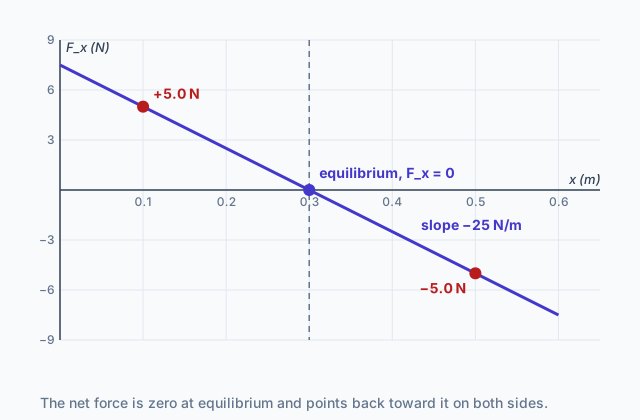
On a graph of against position, this force law is a straight line that crosses zero at the equilibrium position and has slope . For a glider whose equilibrium is 0.30 m from the end of its track and whose spring has N/m, the line passes through 0 N at 0.30 m and falls 25 N for every meter to the right, as in the graph at the top of the page.
Newton's second law turns the force law into a statement about acceleration. Since and ,
so in SHM the acceleration is also proportional to the displacement and opposite to it.
Quick check · Calculate
A glider on a level, frictionless air track is tied to a spring. Positions are measured from the left end of the track, with right as positive, and the glider's equilibrium position is m. When the glider is at m, the net force on it is N. What is the net force on it when it is at m?
2d. Testing a force law for SHM
To decide whether a force law gives SHM, take three steps. Find the equilibrium position, where the net force is zero. Rewrite the net force in terms of the displacement from that position. Then check that it has the form with one positive . In calculus terms, the slope must be the same negative number everywhere, and then .
Take a block of weight hanging from a spring, with up as positive and measured upward from the spring's relaxed end. The spring is stretched by , so the net force is . It is zero at , below the relaxed end, and rewriting gives . The weight moves the equilibrium position down, but the net force about the new equilibrium is still proportional to the displacement, with the spring's own . The hanging block moves in SHM.
Some restoring forces fail the test. A force , with a positive constant, always points back toward , but its slope, , changes with , so doubling the displacement multiplies the force by 8. The motion it gives is periodic but not simple harmonic. A force that pushes away from a point, such as , is not a restoring force at all, so it gives no oscillation.
Quick check · Multiple choice
A small cart moves along a straight, frictionless track, with in meters measured from the track's midpoint and the net force on the cart in newtons; the direction of increasing is positive. Which net force law makes the cart's motion simple harmonic?
Part 3 Watch it done A glider's position, tested for SHM
Watch each step, then do the last one yourself.
A 0.20 kg glider rides on a level, frictionless air track; right is positive. A motion sensor fits its displacement from equilibrium with , with in meters, in seconds and the angle in radians. Show that the net force on the glider is a restoring force proportional to its displacement, and find the constant in .
Step 1 · Differentiate twice
m/s, and m/s². Each derivative of brings out a factor of 5.0.
Step 2 · Compare the acceleration with the displacement
Since , the acceleration is , in m/s² with in meters, at every instant. The acceleration is proportional to the displacement and points the opposite way.
Why this step?
Why bring in Newton's second law instead of stopping at the acceleration?
Simple harmonic motion is defined by the force: the restoring force has to be proportional to the displacement. Newton's second law, , turns the acceleration the sensor gives you into the net force, and only then can you read off , which has units of N/m, not of 1/s².
Your step · Calculate
Finish it. What is the constant in for the net force on the 0.20 kg glider? Right is positive.
N/m
Part 4 Try it New situations
Try it · Rank it
Three gliders on level, frictionless air tracks are each tied to a spring, with right as positive on every track. Glider A's spring has N/m and the glider is 0.10 m to the right of its equilibrium position. Glider B's spring has N/m and the glider is 0.05 m to the left of its equilibrium position. Glider C's spring has N/m and the glider is 0.30 m to the right of its equilibrium position. Rank the gliders by the size of the restoring force on each.
Largest first
Give each one a place, 1 for first. Give two the same place if they are equal.
Your ranking: none yet
Try it · Calculate
A cart on a level, frictionless track sits between two springs: one on its left with N/m and one on its right with N/m, each attached to the cart and to a wall. Both springs are relaxed when the cart is at its equilibrium position. Right is positive. The cart is pulled 0.040 m to the right of equilibrium and held there. What is the net force the springs exert on the cart?
On paper. A block on a level, frictionless surface is tied to a spring with N/m. On one set of axes, sketch the net force on the block against its displacement from equilibrium, from m to m, with right as positive. Label the force at both ends and the slope. On the same axes, as a dashed curve, sketch a restoring force that would give periodic motion that is not simple harmonic. There is nothing to submit here. To compare: the solid graph is a straight line through the origin with slope N/m, at N at m and N at m. The dashed curve should stay on the opposite side of zero from the displacement on both sides, but it should not be a single straight line through the origin; a curve like , or a force of constant size that flips sign at 0, both work.
Part 5 Explain it Make a claim, derive it, then predict
Nothing you type leaves this page. Check your answer against the model and each scoring point.
Free response is 50% of the exam score. This one is shaped like Question 4, Qualitative/Quantitative Translation.
Free-response practice · Question 4 style
A block of mass hangs at rest from a light, ideal vertical spring with spring constant . The block is pulled down a short distance and released, and it moves up and down. Ignore air resistance. Take up as positive, and let be the block's displacement from the position where it hung at rest.
(a) A student claims: "Where the block hung at rest, the spring exerted no force on it, because the block was at equilibrium." Is the student right? Justify your claim.
(b) Derive an expression for the net force on the block in terms of and .
(c) The block is replaced by one of mass on the same spring. Predict how the position where the new block hangs at rest compares with the first one, and whether your expression from part (b) changes for the new block. Justify your prediction using your derivation.
Model answer
(a) No. Equilibrium means the net force on the block is zero, not that each force is zero. The block's weight pulls down, so the spring must pull up with a force of size . The spring is stretched by at that position.
(b) At displacement , the spring is stretched by , so it pulls up with . Adding the weight, , because .
(c) The new block hangs at rest where the spring is stretched , twice as far below the relaxed length as the first block. Repeating part (b) with gives again, with now measured from the new rest position. The extra weight changes where the equilibrium position is, not how the net force depends on the displacement from it, so the expression is unchanged and the motion is still simple harmonic with the same .
Score your own answer. This is a self-check, not a grade. Tick each point your answer makes.
Part 6 Check yourself A spring and a rubber band
The case questions use the force sensor readings. Answer them from those.
A physics class holds a cart on a level, frictionless air track in place two ways: first with a spring tied from the cart to a wall, then with a rubber band stretched between two posts, one at each end of the track, with the cart tied to its middle so both halves stay taut. Each time the class finds the cart's equilibrium position, where the net force on it is zero. A student then pulls the cart to the right by measured amounts, and a force sensor reads the net horizontal force on the cart at each displacement. Right is positive.
| (cm) | Spring: (N) | Rubber band: (N) |
|---|---|---|
| 0 | 0 | 0 |
| 2.0 | −0.60 | −0.50 |
| 4.0 | −1.20 | −0.80 |
| 6.0 | −1.80 | −1.00 |
| 8.0 | −2.40 | −1.10 |
Case question 1 · Calculate
Using the readings, what is the spring constant of the spring, in N/m?
Case question 2 · Multiple choice
With the spring attached, the student pulls the cart to cm and releases it. What is the net force on the cart the first time it passes cm, moving left? Assume the spring obeys the same force law when it is compressed. Right is positive.
Case question 3 · Fill the statement
From cm to cm, the cart's displacement grows by a factor of 4. Use the readings.
Over that change, the size of the spring's force grows by a factor of , and the size of the rubber band's force grows by a factor of . So the exerts a net force proportional to the displacement.
The rest stand on their own and do not use the case.
Check yourself · Sort it
Each card describes an object moving back and forth with no friction or air resistance. Tap a card, then say whether the motion is simple harmonic or periodic but not simple harmonic.
Simple harmonic
Periodic, not simple harmonic
Check yourself · Spot the error
A 4.0 N lamp hangs from a spring with N/m. It is pulled down so it is 0.030 m below its equilibrium position, then released. Up is positive. A student finds the net force on the lamp just after release. Tap the first line with a mistake.
Part 7 Keep it Bring back earlier ideas
This lesson stands on two earlier ideas: from Topic 5.6, a zero net torque leaves an angular velocity unchanged while an unbalanced one changes it, and from Topic 5.5, an object is in translational equilibrium exactly when the net force on it is zero, which is how this lesson defines the equilibrium position.
From 5.6 Newton’s Second Law in Rotational Form · Sort it
Each card describes the torques on a rigid system that turns about a fixed axis. Tap a card, then say whether the system's angular velocity is changing or constant.
Angular velocity changing
Angular velocity constant
From 5.5 Rotational Equilibrium and Newton’s First Law in Rotational Form · Match
Match each situation with the equilibrium it is in. Ignore air resistance.
In three lines
- Periodic motion repeats in equal time intervals; simple harmonic motion is the special case set apart by its force law.
- The equilibrium position is where the net force is zero, and a restoring force points opposite to the displacement from it.
- The motion is simple harmonic when that force is proportional to the displacement, with one positive .
Exam strategy for this topic
- Section I, Multiple Choice: 42 questions in 85 minutes.
- Section II, Free Response: 4 questions in 95 minutes.
- This lesson's Explain it is shaped like free-response question 4, Qualitative/Quantitative Translation.
- A four-function, scientific, or graphing calculator is allowed on both sections of the exam.
When a question asks whether a motion is simple harmonic, write the net force as a function of the displacement from equilibrium before you decide. Find the equilibrium from a zero net force, then show the force has the form of a negative constant times that displacement. A motion that only looks regular is not evidence on its own.
Questions students ask
Is every motion that repeats simple harmonic motion?
No. Any motion that repeats in equal time intervals is periodic. It is simple harmonic only when the restoring force is proportional to the displacement from equilibrium, . A puck bouncing between two walls repeats, but it is not simple harmonic.
Does simple harmonic motion need a spring?
No. A spring is the usual example, but any net force of the form gives it. The force can be a sum, such as a spring's pull and an object's weight, or the pull of two springs at once.
Is the equilibrium position always where the spring is relaxed?
Only when the spring is the only force along the motion. For an object hanging from a spring, the equilibrium position is where the spring's upward pull equals the object's weight, so the spring is stretched there.
Why is there a minus sign in ?
The constant is positive, so the minus sign makes the force point opposite to the displacement. That is what makes it a restoring force: to the left when the object is to the right of equilibrium, and to the right when it is to the left.
How do I find from data?
Plot the net force against the displacement from equilibrium. If the points lie on a straight line through the origin, the motion it gives is simple harmonic, and is the size of the slope, in N/m.
Course alignment, for teachers
AP Physics C: Mechanics topic 7.1, Unit 7: Oscillations.
- Skill 1.A: Create diagrams, tables, charts, or schematics to represent physical situations.
- Skill 2.C: Compare physical quantities between two or more scenarios or at different times and/or locations within a single scenario.
- Skill 3.B: Apply an appropriate law, definition, theoretical relationship, or model to make a claim.
- Skill 3.C: Justify or support a claim using evidence from experimental data, physical representations, or physical principles or laws.
This lesson maps all 4 essential knowledge statements of the topic to the part that teaches each one: 4 are checked by a scored question. The map is in the lesson file.