Unit 7 · Topic 7.2 · about 30 minutes · 7 parts · 12 scored checks, 2 of them multiple choice, plus 2 from earlier lessons
AP Physics C: Mechanics 7.2: Frequency and Period of SHM
Unit 7: 10 to 15% of the multiple-choice section
What you'll be able to do
- Describe the period and frequency of an object in simple harmonic motion, relate both to its angular frequency, and find them for an object on an ideal spring and for a simple pendulum swinging through a small angle.
Key vocabulary
| Term | What it means | The exam trap |
|---|---|---|
| Simple harmonic motion (SHM) | Periodic motion produced by a restoring force whose size is proportional to the object's displacement from its equilibrium position. | Not every motion that repeats is SHM: a ball bouncing on a floor repeats, but the force on it is not proportional to its displacement. |
| Period | The time for one full cycle of a repeating motion, in seconds. | One cycle ends back at the starting position moving the same way, so a swing from one side to the other is only half a cycle. |
| Frequency | The number of full cycles an oscillator completes each second, in hertz (Hz), where 1 Hz is one cycle per second. | A frequency is a rate, so a count of cycles has to be divided by the time those cycles took. |
| Angular frequency | The rate , in rad/s, at which the angle inside the cosine or sine that describes SHM advances; one full cycle is rad of that angle. | It shares the symbol and the unit rad/s with angular velocity, but it describes how often a motion repeats, not how fast something spins. |
| Object-ideal-spring oscillator | An object attached to a spring of negligible mass that exerts a force , oscillating about its equilibrium position. | The period is the square root of a ratio of and ; check that its units come out in seconds, because the ratio placed upside down gives a rate instead. |
| Simple pendulum | An object small enough to model as a point, hanging from a light string of length and swinging about a fixed pivot under gravity. | The length runs from the pivot to the center of the bob, not to its bottom and not just along the string. |
| Small-angle approximation | Replacing with when the angle is small, which turns a pendulum's restoring force into one proportional to its displacement. | It works only with in radians; in degrees, and are not close at all. |
 Tap to open the picture full size
Part 1 Think first Two riders, one swing
Commit to a guess first. Being wrong now makes the right idea stick better.
Predict first
A child and an adult take turns on the same playground swing, each sitting still and swinging gently through a small arc with nobody pushing. Treat each rider as a small weight at the end of the chains. Whose back-and-forth takes longer?
In short. The period of simple harmonic motion is the time for one full cycle, related to the angular frequency and the frequency by ; an object on an ideal spring has and a simple pendulum at a small angle has .
- Frequency is cycles per second and angular frequency is times it, in rad/s; the period is the reciprocal of the frequency.
- More mass or a weaker spring lengthens a spring oscillator's period; a longer string or a weaker gravitational field lengthens a pendulum's, and the bob's mass does not matter.
- Both periods go as a square root, so a factor of 4 in one quantity changes the period by a factor of 2, and neither depends on the amplitude while the pendulum's angle is small.
Part 2 Learn it Four ideas, with a check after each
2a. Period, frequency and angular frequency
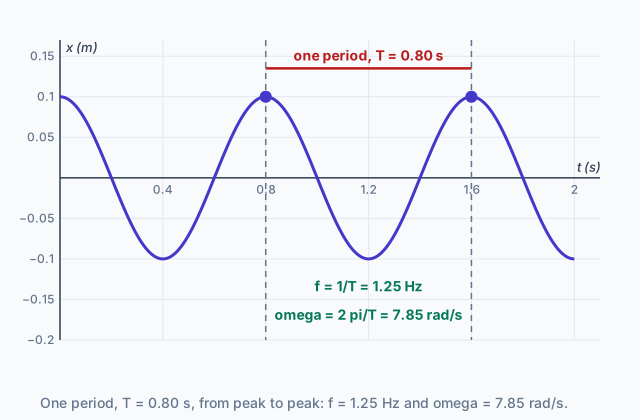
An oscillator repeats itself. Its period is the time for one full cycle: from a starting position, through equilibrium to the far side, and back to the start moving the same way as before. Its frequency is the number of cycles each second, in hertz, where 1 Hz is one cycle per second.
Simple harmonic motion follows a cosine or a sine, such as , where the angle is in radians. One full cycle carries that angle through rad, so the angular frequency , in rad/s, satisfies :
So : the angular frequency is the frequency multiplied by , never equal to it.
A buoy bobs on calm water, with its resting level as equilibrium and up as positive. It makes 15 full cycles in 60 s. Its period is s, its frequency is Hz, and its angular frequency is rad/s.
Timing many cycles and dividing beats timing one. Your reaction time adds the same error to the start and stop of the stopwatch whether you time 1 cycle or 15, so dividing by 15 shrinks it fifteenfold.
Quick check · Fill the statement
A cart attached to a spring rolls back and forth about its equilibrium position on a level track. It completes 20 full cycles in 8.0 s.
The cart's period is , its frequency is , and its angular frequency is .
2b. The period of an object on a spring
Topic 7.1 showed that an ideal spring exerts a restoring force on an object, with measured from equilibrium. Newton's second law then reads
Simple harmonic motion obeys , which Topic 7.3 takes up. Matching the two gives , so , and the period of an object on an ideal spring is
Read the fraction physically. More mass means the same spring force produces a smaller acceleration, so each cycle takes longer: is on top. A stiffer spring, larger , pulls harder at the same stretch and hurries the object back, so each cycle is shorter: is on the bottom.
A 0.50 kg glider on a level, frictionless air track is attached to a spring with N/m. Then rad/s and s.
Quick check · Calculate
A 2.0 kg block on a level, frictionless table is attached to a horizontal ideal spring with spring constant 50 N/m. The block is pulled 0.10 m to the right of its equilibrium position, with right as positive, and released. What is the period of its oscillation?
2c. The period of a simple pendulum
A simple pendulum is a bob small enough to treat as a point, on a light string of length measured from the pivot to the bob's center. Pull it aside through an angle , in radians, and the part of gravity along its arc, , pulls it back toward the bottom. The bob's distance along the arc from the bottom is .
For a small angle, , so the restoring force is close to . That has the spring's form, with in place of . Put it into and the mass cancels:
A heavier bob feels a larger pull back, but it also needs a larger force for the same acceleration, and the two grow together. Only the length and the gravitational field set the period.
A pendulum 2.5 m long with m/s² swinging through a small angle has s.
The formula is an approximation. At 15° the real period is only about 0.4% longer than , but the gap grows as the swing widens, because falls further below and the real restoring force is weaker than the approximation assumes.
Quick check · Decide and justify
A pendulum clock ticks once per swing and keeps perfect time in a cool room. Its pendulum is a small, heavy bob on a light brass rod, so treat it as a simple pendulum swinging through a small angle. On a hot day the rod lengthens slightly. On the hot day, does the clock run slow or fast?
Which reason supports your answer?
2d. Predicting a change in period
Both formulas put the period under a square root, so a change in one quantity changes the period by the square root of that factor. Write the new period over the old one and everything that stays the same cancels:
Make a pendulum 9 times as long and its period triples, since . Carry it to the Moon, where is about 1.6 m/s², and its period grows by .
Just as useful is what is missing. Neither formula has the amplitude in it, so pulling an object on an ideal spring farther before release does not change its period, and neither does a wider swing of a pendulum, as long as the angle stays small. A pendulum's period also has no mass in it.
A check on any answer: a heavier object on a spring, a weaker spring, a longer pendulum and a weaker gravitational field all mean a longer period.
Quick check · Match
A block on a horizontal ideal spring oscillates with a period of 1.2 s. Each row makes one change and keeps everything else the same. Tap a change, then the new period.
Part 3 Watch it done A bird feeder on a spring
Watch each step, then do the last one yourself.
A 0.40 kg bird feeder hangs at rest from a vertical ideal spring, which it stretches 0.10 m beyond the spring's unstretched length. Take the feeder's rest position as equilibrium and up as positive. A gust of wind sets it bouncing up and down. Use m/s². What is the frequency of the bounce?
Step 1 · Find the spring constant
At rest the net force on the feeder is zero, so the spring's upward force balances its weight: . Then N/m.
Step 2 · Check that the spring formula applies
Measured from the rest position, the feeder is an object on an ideal spring with kg and N/m, so applies with these values, as it would on a level track.
Why this step?
Why can gravity be left out of the period, when it is pulling on the feeder the whole time?
Gravity is the same at every position, so all it does is move the equilibrium down by 0.10 m. Displace the feeder by from that new equilibrium and the spring's force changes by while gravity does not change, so the net force is , exactly as for a spring on a level track.
Your step · Calculate
Finish it. Use with kg and N/m to find the frequency of the bounce.
Hz
Notice that here, so : the period of any object hanging from an ideal spring can be read from how far it stretches the spring at rest.
Part 4 Try it New situations
Try it · Rank it
Four oscillators each oscillate about their equilibrium positions with small amplitudes near Earth's surface. A is a 0.50 kg block on a horizontal spring with N/m. B is a 2.0 kg block on a horizontal spring with N/m. C is a 2.0 kg block on a horizontal spring with N/m. D is a simple pendulum 1.0 m long swinging through a small angle. Rank the oscillators by period.
Longest first
Give each one a place, 1 for first. Give two the same place if they are equal.
Your ranking: none yet
Try it · Calculate
A student wants a simple pendulum whose period is 2.0 s when it swings through a small angle near Earth's surface, where m/s². How long should the pendulum be, from the pivot to the center of the bob?
On paper. Draw axes of period against mass , from 0 to 1.0 kg, for one ideal spring whose spring constant does not change. Sketch the shape the formula gives, labeling both axes with their quantities and units. Then draw a second set of axes, against , and sketch that shape too. Note which of the two graphs is a straight line, and what its slope stands for. There is nothing to submit here; you will use this idea in Explain it.
Part 5 Explain it Design it, then plot it on paper
On the exam this is handwritten, so answer on paper first. Nothing you type here leaves this page. Then check your answer against the model and each scoring point.
Free response is 50% of the exam score. This one is shaped like Question 3, Experimental Design and Analysis.
Free-response practice · Question 3 style
A lab group has a ring stand with a clamp, light string, a set of small brass bobs, a meterstick, a protractor and a stopwatch.
(a) The group wants to know how the period of a simple pendulum depends on its length. Describe a procedure they could use. Say what they change, what they keep the same, what they measure and with what, and one step that reduces experimental uncertainty.
(b) Describe how they could analyze the data from (a) to answer the question: what they would graph so that the result is a straight line, and how they could find from that graph.
(c) A second group hangs different masses from one vertical spring, starts each bouncing with a small amplitude, and times 10 full cycles:
- = 0.100 kg: 10 cycles in 4.78 s
- = 0.200 kg: 10 cycles in 6.50 s
- = 0.300 kg: 10 cycles in 7.90 s
- = 0.400 kg: 10 cycles in 9.04 s
- = 0.500 kg: 10 cycles in 10.10 s
On paper, plot a graph of quantities that should give a straight line, with a scale and units on each axis, and draw a best-fit line. Do this by hand before you open the model.
(d) Use your best-fit line to calculate the spring constant .
(e) The model predicts a line through the origin. Explain what the line's small positive vertical intercept suggests about the real spring.
Model answer
(a) Tie a bob to the string and hang it from the clamp. Measure the length from the pivot to the center of the bob with the meterstick. Pull the bob aside to 10° with the protractor, release it, and time 10 full cycles with the stopwatch; divide by 10 for the period. Repeat for five lengths from 0.20 m to 1.00 m, keeping the same bob and the same small release angle. Time each length three times and average.
(b) For a small angle, , so . Graph against . A straight line through the origin shows the period grows as the square root of the length, and its slope is , so .
(c) Since , plot against . The periods are 0.478, 0.650, 0.790, 0.904 and 1.010 s, so is 0.228, 0.423, 0.624, 0.817 and 1.020 s². See the graph below: one straight best-fit line through the points, not a line joining them.
(d) The slope is . From two points on the line, and , the slope is s²/kg, so N/m.
(e) With no mass hung, the ideal model says nothing oscillates, so . The intercept of about 0.03 s² means something still oscillates: the real spring has mass of its own, and its moving coils add to the mass being accelerated, about the same as 0.015 kg more on the end (roughly a third of the spring's mass).
Square of the period against hanging mass, with the best-fit line
The line crosses the vertical axis near 0.029 s² and passes through (0.500, 1.018).
Score your own answer. This is a self-check, not a grade. Tick each point your answer makes.
Part 6 Check yourself Three timings in one lab
The case questions use the setups and timings in the table. Answer them from those.
A physics class times three oscillators with a stopwatch, counting 20 full cycles for each. The pendulums swing about the bottom of their arcs. The glider slides on a level, frictionless air track, attached to one horizontal ideal spring fixed to the end of the track, about its equilibrium position.
| Trial | Oscillator | Setup | Time for 20 cycles (s) |
|---|---|---|---|
| P | Simple pendulum | 0.50 m long, 0.10 kg bob, released at 5° | 28.1 |
| R | Simple pendulum | 0.50 m long, 0.10 kg bob, released at 60° | 30.2 |
| S | Glider on a spring | 0.25 kg glider, pulled 0.050 m to the right of equilibrium, with right positive, and released | 12.6 |
Case question 1 · Multiple choice
What is the frequency of the pendulum in trial P?
Case question 2 · Calculate
Using trial S, what is the spring constant of the glider's spring?
Case question 3 · Multiple choice
Trials P and R use the same pendulum, but R takes longer for its 20 cycles. Which statement best explains the difference?
The rest stand on their own and do not use the case.
Check yourself · Sort it
Each card makes one change to an oscillator and keeps everything else the same. Tap a card, then say what happens to the period.
Longer period
Shorter period
Same period
Check yourself · Spot the error
A 0.20 kg block on a horizontal ideal spring oscillates at 5.0 Hz. A student finds the spring constant. Tap the first line with a mistake.
Part 7 Keep it Bring back earlier ideas
This lesson stands on Topic 7.1's restoring force , which Newton's second law turns into , and on Topic 5.1's angular velocity, which shares the symbol and the unit rad/s with angular frequency. Pulling them back up is what makes them last.
From 7.1 Defining Simple Harmonic Motion (SHM) · Calculate
A glider on a level, frictionless air track is tied to a spring. Positions are measured from the left end of the track, with right as positive, and the glider's equilibrium position is m. When the glider is at m, the net force on it is N. What is the net force on it when it is at m?
From 5.1 Rotational Kinematics · Calculate
A drill bit's angular position is , with in radians and in seconds. Take counterclockwise, as seen from behind the drill, as positive. What is the bit's angular acceleration at s?
In three lines
- The period is the time for one cycle and the frequency is cycles per second: , so .
- An object on an ideal spring has , and a simple pendulum at a small angle has , with no mass in it.
- A change in one quantity changes the period by the square root of its factor, and the amplitude is in neither formula.
Exam strategy for this topic
- Section I, Multiple Choice: 42 questions in 85 minutes.
- Section II, Free Response: 4 questions in 95 minutes.
- This lesson's Explain it is shaped like free-response question 3, Experimental Design and Analysis.
- A four-function, scientific, or graphing calculator is allowed on both sections of the exam.
When a lab question asks for a graph that gives a straight line, square the period formula before you choose the axes: and . Say what the slope stands for, find it from two points on your best-fit line rather than from two data points, and solve for or with units. Whenever you use , write that the angle is small.
Questions students ask
Is angular frequency the same as angular velocity?
No. Both are written and measured in rad/s, but angular velocity is how fast an object turns, while angular frequency is how fast the angle inside the cosine of SHM advances. A block on a spring has an angular frequency even though nothing about it spins.
Why does mass matter for a spring but not for a pendulum?
A spring's force depends only on the stretch, so a heavier object gets the same force and a smaller acceleration. Gravity's pull on a pendulum bob grows with its mass, exactly as fast as the force needed to accelerate it, so the mass cancels.
How small does the angle have to be for the pendulum formula?
There is no sharp cutoff. At 15° the real period is only about 0.4% longer than , but at 60° it is about 7% longer. In a lab, keep release angles around 10° or less and say that you used the small-angle approximation.
Does a spring hung vertically have a different period from one lying flat?
No. Gravity only moves the equilibrium position down. Measured from that new equilibrium, the net force is still times the displacement, so holds either way.
Why time ten cycles instead of one?
Starting and stopping a stopwatch adds about the same reaction-time error to any timing. Spread over ten cycles, that error is ten times smaller in each period.
Course alignment, for teachers
AP Physics C: Mechanics topic 7.2, Unit 7: Oscillations.
- Skill 1.C: Create qualitative sketches of graphs that represent features of a model or the behavior of the physical system.
- Skill 2.A: Derive a symbolic expression from known quantities by selecting and following a logical mathematical pathway.
- Skill 2.D: Predict new values or factors of change of physical quantities using functional dependence between variables.
- Skill 3.B: Apply an appropriate law, definition, theoretical relationship, or model to make a claim.
This lesson maps all 3 essential knowledge statements of the topic to the part that teaches each one: 3 are checked by a scored question. The map is in the lesson file.