Unit 7 · Topic 7.3 · about 30 minutes · 7 parts · 12 scored checks, 2 of them multiple choice, plus 2 from earlier lessons
AP Physics C: Mechanics 7.3: Representing and Analyzing SHM
Unit 7: 10 to 15% of the multiple-choice section
What you'll be able to do
- Describe the displacement, velocity and acceleration of an object in simple harmonic motion, from its position function, from its graphs or from measured data.
Key vocabulary
| Term | What it means | The exam trap |
|---|---|---|
| Simple harmonic motion (SHM) | Periodic motion in which the restoring force, and so the acceleration, is proportional to the displacement from equilibrium and opposite to it. | Not every repeating motion is SHM: a ball bouncing on the floor repeats, but the force on it is not proportional to its displacement. |
| Equilibrium position | The position at which the net force on the oscillating object is zero; SHM displacements are measured from it. | A sensor or a ruler may put its zero somewhere else, so subtract the equilibrium reading before you treat a reading as a displacement. |
| Amplitude | The largest displacement from the equilibrium position, in . | On a graph, read it as a peak's height above the equilibrium line, which is not the line when positions are measured from somewhere other than equilibrium. |
| Frequency | The number of complete cycles per second, , in hertz. | A frequency in hertz and an angular frequency in radians per second are different numbers for the same motion, so check which one an equation calls for. |
| Angular frequency | The rate at which the argument of the cosine grows, , in radians per second. | is not a speed of the object; the object's speed changes all through the cycle while stays fixed. |
| Phase constant | The angle in , in radians, that sets where in its cycle the object is at . | With in radians, must be in radians too, and your calculator must be in radian mode when you evaluate the function. |
| Second-order differential equation | An equation that relates a function to its second derivative, here , from Newton's second law with a restoring force. | Its solution is a whole function, , not one number; you are expected to know that solution, not to prove it. |
| Natural frequency | The frequency at which a system oscillates when it is displaced from its equilibrium position and let go. | It belongs to the system, its masses and springs, not to whatever is pushing on it. |
| Resonance | The growth in amplitude that occurs when a sinusoidal external force is exerted at the natural frequency of an oscillating system. | Resonance is about timing, so name both frequencies, the driving one and the natural one, before deciding whether it happens. |
 Tap to open the picture full size
Part 1 Think first Pull it farther
Commit to a guess first. Being wrong now makes the right idea stick better.
Predict first
A teacher attaches a block to a spring on a level air track, where friction is negligible. She pulls the block 2 cm from where it rests, lets go, and times 10 full oscillations. Then she pulls it 4 cm, lets go, and times 10 more. How do the two times compare?
In short. In simple harmonic motion the displacement from equilibrium is , the solution of ; its derivatives give the velocity and an acceleration , with largest values and .
- At equilibrium the speed is greatest and the acceleration is zero; at a turning point the velocity is zero and the acceleration is largest, pointing back toward equilibrium.
- The period, , is set by the system, so changing the amplitude does not change it.
- A sinusoidal external force at the system's natural frequency produces resonance, which increases the amplitude.
Part 2 Learn it Four ideas, with a check after each
3a. The equation, and the function that solves it
In Topic 7.1 an ideal spring exerted a restoring force , with measured from the equilibrium position. Newton's second law, with , turns that force into an equation about the motion:
with for a block on a spring. This is a second-order differential equation: it ties the position to its own second derivative. Any system whose acceleration is proportional to its displacement and opposite to it obeys it, and that is how you identify SHM.
The position as a function of time is its solution, which you are expected to know but not to prove:
Here is the amplitude, the largest displacement from equilibrium, and is the angular frequency in rad/s. The phase constant , in radians, says where in the cycle the object is at .
Two starts are common. Released from rest at , an object has , so . Passing through equilibrium at moving in the direction, it has , which is the cosine with .
Quick check · Fill the statement
A glider on a spring rests at its equilibrium position, , with right positive. A student pulls it 0.05 m to the right and releases it from rest at . It then completes 4 full cycles in 2.0 s.
The glider's amplitude is , its frequency is , and its position as a function of time is .
3b. Velocity and acceleration from the position
Velocity and acceleration come from the position function by differentiating, with the chain rule on the cosine:
Comparing with , the acceleration is times the position at the same instant:
So the acceleration always points toward equilibrium, and its size grows with the distance from equilibrium.
A sine or cosine is never larger than 1 in size, so the largest speed and the largest size of the acceleration are
For a block with m and rad/s, m/s and m/s². When that block is at m, its acceleration is m/s², pointing back toward equilibrium.
Quick check · Calculate
A block oscillates on a horizontal spring with angular frequency 6.0 rad/s and amplitude 0.050 m about its equilibrium position at , with right positive. At one instant the block is 0.030 m to the left of equilibrium. What is its acceleration at that instant?
3c. Zeros, peaks and the period
The position, velocity and acceleration graphs are sinusoids with the same period, each a quarter cycle from the next. Their zeros and extremes line up like this:
| Place in the cycle | |||
|---|---|---|---|
| Turning point on the right | 0 | ||
| Passing equilibrium, moving left | 0 | 0 | |
| Turning point on the left | 0 | ||
| Passing equilibrium, moving right | 0 | 0 |
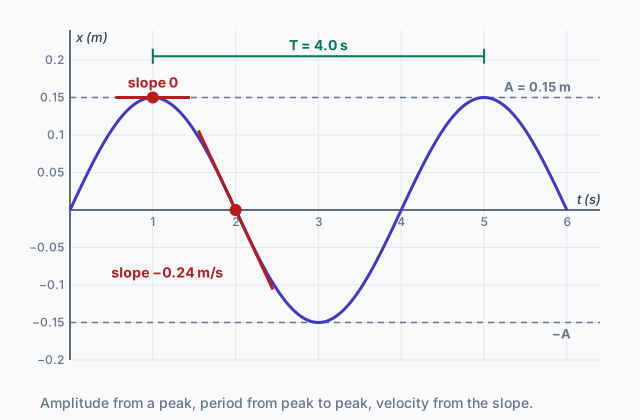
On a graph of against the velocity is the slope: zero at every peak and trough, steepest where the curve crosses equilibrium, as the graph at the top of the page shows. Read as a peak's height above the equilibrium line, and from one peak to the next.
The period is , and comes from the system itself, for a block on a spring. The amplitude appears nowhere in it. Pull the block twice as far and it has twice as far to go, but doubles too, so each cycle takes the same time.
Quick check · Decide and justify
A glider on a horizontal spring has position , with in meters, in seconds and the angle in radians. Its equilibrium position is , and right is positive. At s, what is the size of the glider's acceleration?
Which reason supports your answer?
3d. Natural frequency and resonance
Every oscillating system has a natural frequency: the frequency at which it oscillates when it is displaced from its equilibrium position and let go. For a block on a spring that is .
Now let a sinusoidal external force push on the system. When the force is exerted at the natural frequency, each push arrives at the same point of every cycle and adds to the motion, and the amplitude builds up. That is resonance: it occurs when an external force is exerted at the natural frequency of an oscillating system, and it increases the amplitude of the motion.
Pushing a child on a swing works this way. You push once per swing, at the swing's own frequency, and each push adds a little. Push at some other frequency and your pushes drift out of step with the swing: some help and some oppose, and the swing never gets high.
Engineers design around it. A footbridge whose natural frequency is close to the rate at which people step can sway badly under a crowd, and a glass driven by a loud sound at its natural frequency can crack.
Quick check · Multiple choice
A 0.50 kg cart on a level track is attached to one end of a spring with spring constant 200 N/m. A motor moves the spring's other end back and forth sinusoidally, at a frequency a student can set. At which driving frequency does the cart's amplitude grow largest?
Part 3 Watch it done A block passing through equilibrium
Watch each step, then do the last one yourself.
A 0.40 kg block on a level, frictionless surface is attached to a spring with spring constant 160 N/m. Its equilibrium position is , and right is positive. At the block passes through equilibrium moving right at 1.2 m/s. Write the block's position as a function of time, and find its largest acceleration.
Step 1 · Find the angular frequency
For a block on a spring, rad/s.
Step 2 · Find the amplitude
At equilibrium the block moves at its largest speed, so m/s and m.
Why this step?
Why is 1.2 m/s the largest speed, and not just the speed at ?
At equilibrium , so : the velocity has stopped growing and has not yet begun to shrink. On the way in toward equilibrium the spring speeds the block up, and on the way out it slows the block down, so the speed peaks at equilibrium.
Step 3 · Choose the phase
At , and the block moves in the direction, which the sine gives: m, the same as m.
Your step · Calculate
Finish it. What is the largest size of the block's acceleration? Right is positive.
m/s²
Part 4 Try it New situations
Try it · Sketch the graph
A block on a horizontal spring oscillates with a period of 2.0 s about its equilibrium position, , with right positive. It is released from rest at cm at . Sketch the shape of its velocity against from 0 to 0.50 s: drag the points so the curve rises or falls, and bends or runs straight, the way does.
One shape that fits
Drag a point up or down, or tap it and use the arrow keys. Only the shape is checked.
Try it · Calculate
A glider on a level air track oscillates about its equilibrium position, , with right positive. Its position is , with in meters, in seconds and the angle in radians. What is the glider's velocity at ?
On paper. This time the glider starts on the left, at , not at as in the items above. It is released from rest there at , with right positive. Sketch its position, velocity and acceleration against time for one full period on three sets of axes stacked one above the other, so the same instant lines up on all three. Mark , , and on each time axis, and label each graph's largest value in terms of and . There is nothing to submit here; once you open the Explain it model, check that each of your three graphs is that model's graph turned upside down.
Part 5 Explain it Draw it, derive it, graph it
On the exam this is handwritten, so answer on paper first. Nothing you type here leaves this page. Then check your answer against the model and each scoring point.
Free response is 50% of the exam score. This one is shaped like Question 2, Translation Between Representations.
Free-response practice · Question 2 style
A glider of mass on a level, frictionless air track is attached to a spring with spring constant , whose other end is fixed. The glider's equilibrium position is , and right is positive. The glider is pulled to and released from rest at .
(a) On paper, draw a free-body diagram of the glider at the instant it is released. Draw each force as an arrow starting on a dot, and label it.
(b) Starting from Newton's second law, derive the differential equation for the glider's position . Then write in terms of , , and .
(c) Derive expressions for the glider's largest speed and the largest size of its acceleration, in terms of , and .
(d) On paper, sketch graphs of , and against from to , one above the other with their time axes lined up. Label the time axis at , , and , and label each graph's largest value.
(e) The glider is now pulled to and released from rest. Predict whether the period, the largest speed and the largest acceleration each increase, decrease or stay the same, and justify each prediction using your answers to (b) and (c).
Model answer
(a) A dot with three arrows: a downward gravitational force exerted by Earth, an upward normal force exerted by the track, the same length, and a spring force of size pointing left, toward equilibrium.
(b) The spring exerts , so Newton's second law gives , or . That is with . Released from rest at , the glider has , so .
(c) , whose largest size is . Then , so .
(d) Position: a cosine from , zero at , at , zero at and at . Velocity: zero at the start, at , zero at , at and zero at . Acceleration: at the start, zero at , at , zero at and at . Compare your sketches with those values: the velocity is zero wherever the position has a peak or a trough, and the acceleration has the opposite sign to the position at every instant.
(e) The period stays the same: , and from (b) has no amplitude in it. The largest speed and the largest acceleration both double, because both expressions in (c) are proportional to the amplitude. In (d) the zeros and peaks stay at the same times; only the heights double.
Score your own answer. This is a self-check, not a grade. Tick each point your answer makes.
Part 6 Check yourself A glider and a motion sensor
The case questions use the sensor readings. Answer them from those.
A glider on a level air track is attached to a spring. Its equilibrium position is , and the direction away from the motion sensor is positive. The sensor's software is set to read zero at the equilibrium position. A student pulls the glider to cm and releases it from rest at . The sensor's readings over the next 0.80 s:
| (s) | (cm) |
|---|---|
| 0 | 6.00 |
| 0.10 | 4.24 |
| 0.20 | 0.00 |
| 0.30 | −4.24 |
| 0.40 | −6.00 |
| 0.50 | −4.24 |
| 0.60 | 0.00 |
| 0.70 | 4.24 |
| 0.80 | 6.00 |
Case question 1 · Calculate
Read the amplitude and the period from the readings, and use them with the SHM model to calculate the glider's largest speed.
Case question 2 · Multiple choice
Using the readings, which describes the glider's motion at s? The direction away from the sensor is positive.
Case question 3 · Rank it
Using the readings, rank the instants s, s, s and s by the size of the glider's acceleration.
Greatest first
Give each one a place, 1 for first. Give two the same place if they are equal.
Your ranking: none yet
The rest stand on their own and do not use the case.
Check yourself · Put it in order
A block of mass on a level, frictionless surface is attached to a spring with spring constant , and is measured from the equilibrium position. Put the steps in order to get the differential equation for and write its solution.
Check yourself · Spot the error
A 0.20 kg glider on a spring with spring constant 20 N/m oscillates with an amplitude of 0.05 m. A student predicts what happens when the amplitude is doubled to 0.10 m. Tap the first line with a mistake.
Part 7 Keep it Bring back earlier ideas
This lesson stands on Topic 7.2, where period, frequency and angular frequency are tied together by , and on Topic 1.2: velocity and acceleration are derivatives of position, and an object speeds up only when its velocity and acceleration point the same way. Pulling them back up is what makes them last.
From 1.2 Displacement, Velocity, and Acceleration · Decide and justify
A cart moves along a track with its position given by , with in meters and in seconds. Take the direction of increasing as positive. At s, is the cart speeding up or slowing down?
Which reason supports your answer?
From 7.2 Frequency and Period of SHM · Fill the statement
A cart attached to a spring rolls back and forth about its equilibrium position on a level track. It completes 20 full cycles in 8.0 s.
The cart's period is , its frequency is , and its angular frequency is .
In three lines
- In SHM, is the solution of , which Newton's second law gives for a restoring force proportional to displacement.
- Differentiating gives and , so at equilibrium and at the turning points.
- The period does not depend on the amplitude, and a sinusoidal force at the natural frequency produces resonance, which increases the amplitude.
Exam strategy for this topic
- Section I, Multiple Choice: 42 questions in 85 minutes.
- Section II, Free Response: 4 questions in 95 minutes.
- This lesson's Explain it is shaped like free-response question 2, Translation Between Representations.
- A four-function, scientific, or graphing calculator is allowed on both sections of the exam.
When a free-response part asks for a velocity or an acceleration in SHM, write the derivative of before any numbers, and say which way is positive. When a part asks you to sketch or compare graphs, line up the instants: the velocity is zero where the position has a peak or a trough, and the acceleration has the opposite sign to the position. State the solution of the differential equation when you need it; you are not asked to prove it.
Questions students ask
Do I have to prove that solves the differential equation?
No. The course expects you to know that solution and to recognize SHM from its equation, not to prove the solution is correct. You do need to differentiate the solution to find the velocity and the acceleration.
Should I use sine or cosine?
Either, since they differ only by a phase constant. A cosine with fits an object released from rest at ; a sine fits one passing through equilibrium in the positive direction at . Pick the one whose value and direction at match the start.
Why must the angle be in radians?
Because is in radians per second, is in radians, and the derivatives and are only right in radians. Set your calculator to radian mode.
What is the difference between and ?
counts cycles per second, in hertz, and counts radians per second. The relations , and all use .
Is resonance always a problem?
No. A swing, a musical instrument and a radio tuner use it on purpose. It is a problem when something that should stay still, such as a bridge or a machine mount, is driven at its natural frequency.
Beyond the AP Exam
College Board sets this limit on what the AP Exam asks about this topic. Anything past it is not on the exam.
AP Physics C: Mechanics only expects students to know the solution to the second-order differential equation that describes SHM, as well as be able to identify SHM. AP Physics C: Mechanics does not expect students to mathematically prove that the solution is correct.
Course alignment, for teachers
AP Physics C: Mechanics topic 7.3, Unit 7: Oscillations.
- Skill 1.C: Create qualitative sketches of graphs that represent features of a model or the behavior of the physical system.
- Skill 2.A: Derive a symbolic expression from known quantities by selecting and following a logical mathematical pathway.
- Skill 2.C: Compare physical quantities between two or more scenarios or at different times and/or locations within a single scenario.
- Skill 3.B: Apply an appropriate law, definition, theoretical relationship, or model to make a claim.
This lesson maps all 13 essential knowledge statements of the topic to the part that teaches each one: 13 are checked by a scored question. The map is in the lesson file.