Unit 1 · Topic 1.1 · about 30 minutes · 7 parts · 12 scored checks, 3 of them multiple choice
AP Psychology 1.1: Interaction of Heredity and Environment
Unit 1: 15 to 25% of the multiple-choice section
 Tap to open the picture full size
Part 1 Think first A family of readers
Guess before you learn. A wrong guess still makes the answer stick.
Predict first
Marisol is 15 and finishes a novel most weeks. Her mother reads every night, and her grandfather wrote for a newspaper for thirty years. You want to find out whether a love of reading runs in families because of what parents pass on at birth or because of the home they make. Which group of people would tell you the most?
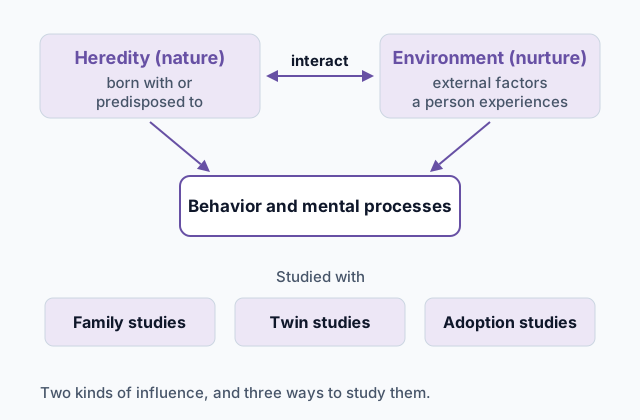
In short. Heredity and environment work together to shape behavior and mental processes, and psychologists study their influence by comparing people who share more or less of each.
- Heredity, or nature, is what a person is predisposed to by the biological parents; environment, or nurture, is what a person experiences, such as family life and school.
- The evolutionary perspective explains some behavior through natural selection, and eugenics misused that idea to discriminate against people.
- Family, twin and adoption studies compare relatives who share different amounts of heredity and environment, so they show links rather than proving causes.
Part 2 Learn it Four short ideas, each checked as you go
2a. Nature and nurture
Why does one child stay calm through a thunderstorm while her brother hides under the bed? Psychologists sort the possible answers into two kinds of influence.
Heredity, or nature, is the set of characteristics a person is born with or predisposed to, passed down from the biological parents. It shapes physical traits such as height, and it also shapes behavior and mental processes, such as how quickly a toddler warms up to a stranger. A predisposition is a tendency, a push in one direction. It makes a trait more likely without making it certain.
Environment, or nurture, is the set of external factors a person experiences. Family interactions are among the biggest: how parents talk to a child, whether an older sister teases, whether the family eats together. Education is another, and so are friends, neighborhood, culture and nutrition.
To sort an influence, ask where it came from. Did it come with the person from the biological parents, or did it come from outside, from something the person lived through?
One trap: a trait that runs in a family is not automatically nature. Families pass on their heredity, but they also pass on their habits, their home and their way of talking.
Quick check · Sort it
Tap an influence, then tap the kind it is.
Heredity (nature)
Environment (nurture)
2b. Not one or the other: both, together
"Nature or nurture?" sounds like a fair question, but it is usually the wrong one. Heredity and environment interact: each changes what the other does.
Height shows the idea simply. A child may inherit a tendency to grow tall, but years of poor nutrition can keep her from reaching that height. Behavior works the same way. Picture a boy with an inherited tendency toward a quick temper. In a calm home where adults show him how to cool down, the temper may rarely flare. In a home full of shouting, it may flare every day. The tendency came from heredity. What it turned into depended on the environment it met.
The influence runs the other way too. A child's inherited tendencies help shape the environment around him. An easygoing, smiley baby tends to get more smiles and play from the adults nearby. A child who loves to move begs to join a team, and then spends years in gyms and on fields. Part of the environment a person lives in is a response to who that person already is.
So psychologists rarely ask whether a trait comes from nature or from nurture. They ask how the two work together to produce it.
Quick check · Decide and justify
Ana and Bea were each born with a tendency to react strongly to anything new. Ana's parents introduced her to new places and people a little at a time, and at 10 she joins new groups with ease. Bea's parents kept her away from new places and people, and at 10 she still avoids them. A classmate says Ana's ease shows that heredity played no part in how she turned out. Is the classmate right?
Which reason supports your answer?
2c. Three designs that pull them apart
Nobody can assign people their genes at random, so researchers study people who already share more or less of their heredity.
A family study asks whether a trait gets more common as relatives get closer: brothers and sisters, then cousins, then unrelated people. A rising pattern may point to heredity. The catch is that close relatives usually share a home as well, so a family study cannot separate the two.
A twin study compares two kinds of twins. Identical twins share the same genes. Fraternal twins share about half, like any brother and sister. When both kinds grow up with their own families, every pair shares a home. So if identical twins are more alike on a trait than fraternal twins, the extra likeness points to heredity. And where identical twins differ, the difference must come from their environments.
An adoption study compares children adopted early in life with two sets of parents: the birth parents, who passed on their heredity, and the adoptive parents, who raised them. Resembling the birth parents points to heredity; resembling the adoptive parents points to environment. Identical twins adopted into different homes combine the two designs.
None of these designs assigns anyone to a group, so each finds a link that fits heredity or environment rather than proving a cause.
Quick check · Match
Tap a design, then tap the study that uses it.
2d. The evolutionary perspective, and how it was misused
The evolutionary perspective looks at behavior across many generations. Its key idea is natural selection: when an inherited tendency helped ancestors survive and have children, those ancestors left more descendants, so the tendency became more common over time. The perspective asks how a behavior or a way of thinking might once have aided survival and reproductive success.
Take the taste for sweet and fatty food. For most of human history, calories were scarce. Ancestors drawn to ripe fruit and rich food were more likely to get enough to eat, survive and raise children, so the preference spread. In a world of cheap snacks, the same preference can now work against health. The perspective is about where a tendency may have come from, not whether it is good for us today.
The idea has been badly misused. Eugenics, a movement strongest in the early 1900s, claimed that some groups of people were "fitter" than others and tried to control who could have children. In the United States, eugenic laws allowed forced sterilization, and eugenic arguments helped limit immigration. Nazi Germany used eugenics to justify murder. Some early psychologists who built intelligence tests supported the movement.
Natural selection describes how tendencies spread. It is not a measure of any person's worth, and using it as one is discrimination.
Quick check · Fill the statement
Tap a blank, then a word.
From the evolutionary perspective, adults find a baby's crying hard to ignore because ancestors who crying infants raised more children who lived to have children of their own. Over many generations, made that tendency common.
Part 3 Watch it done Reading a twin study, one step at a time
Watch each step, then do the last one yourself.
Illustrative study (made up for practice, not a published study). Researchers recruited 80 pairs of identical twins and 80 pairs of same-sex fraternal twins, all 15 years old and all raised together by their own families. Each teen worked alone on a very hard puzzle, and the researchers timed how long each one kept trying before giving up. In 62 of the 80 identical pairs, the two twins' times were within 2 minutes of each other. That was true in 38 of the 80 fraternal pairs. The difference was statistically significant. What design is this, and what does the result suggest about persistence?
Step 1 · Name the design
Two kinds of twins are compared on the same trait, so this is a twin study. Nobody was assigned to be an identical or a fraternal twin, so it can show a link, not prove a cause.
Step 2 · Line up what each kind of pair shares
Identical twins share the same genes, and fraternal twins share about half. Every pair was raised together, so both kinds shared a home. The identical pairs were close in time far more often: 62 of 80 against 38 of 80.
Why this step?
Why does it matter that every pair, identical and fraternal, was raised together?
Because both kinds of pair had a shared home, the home is not a good explanation for the gap. What differs most between the two kinds is how much heredity they share, so the extra closeness of the identical pairs points to heredity.
Your step · Multiple choice
Finish the analysis. In an illustrative twin study of 15-year-olds, all raised with their own families, the two twins' times on a hard puzzle were within 2 minutes of each other in 62 of 80 identical pairs and 38 of 80 fraternal pairs, a statistically significant difference. Which conclusion fits the result best?
Part 4 Try it Read a family study
Illustrative study (made up for practice, not a published study). Researchers recruited 100 teens who scored high on a thrill-seeking questionnaire, which asks how much a person enjoys risky activities such as cliff jumping. They then gave the same questionnaire to 90 of those teens' brothers and sisters and 120 of their cousins. Of the brothers and sisters, 36 also scored high. Of the cousins, 18 did. The difference was statistically significant.
Try it · Calculate
In an illustrative family study, 36 of 90 brothers and sisters of high-scoring teens also scored high on a thrill-seeking questionnaire, and 18 of 120 cousins did. How many percentage points higher was the share for brothers and sisters than for cousins?
Try it · Multiple choice
An illustrative family study found that 40% of the brothers and sisters of teens who scored high on a thrill-seeking questionnaire also scored high, against 15% of their cousins, a statistically significant difference. A news site reports that the study proves thrill seeking is inherited. What is the main problem with that report?
Part 5 Explain it Write it the way the exam asks
Nothing you type leaves this page.
Free response is 33.3% of the exam score. This one is shaped like Question 1, Article Analysis Question.
Free-response practice · Question 1 style
Illustrative study (made up for practice, not a published study). Researchers wanted to know whether how much children read for fun is shaped by heredity, by the home they grow up in, or by both. Through two adoption agencies in one state, they recruited 140 twelve-year-olds who had been adopted before they were 6 months old. The adoptive parents gave written consent, each child also agreed to take part, and the researchers replaced every name with a code number so that no family could be identified. Each child kept a diary for two weeks, and the researchers worked out the mean number of minutes a day the child spent reading for fun. The researchers placed no child in any home. Afterward, they grouped the children by whether the birth mother had described herself as a frequent reader on a form filled in at the time of the adoption, and by whether the adoptive parents read with the child most days.
Children whose birth mother was a frequent reader and whose adoptive parents read with them most days read a mean of 38 minutes a day. Children with a frequent-reader birth mother and no daily reading at home read 24 minutes. Children whose birth mother was not a frequent reader but who read with their adoptive parents most days read 27 minutes. Children with neither read 15 minutes. The differences were statistically significant.
(A) Identify the research design used in this study.
(B) State the operational definition of reading for fun in this study.
(C) Identify one ethical guideline described in the study. Describe one way the researchers applied it.
(D) Explain whether the results can be generalized to all twelve-year-olds.
(E) Explain how the results support the idea that heredity and environment both shape behavior.
Model answer
(A) This is an adoption study.
(B) Reading for fun was measured as the mean number of minutes a day a child spent reading for fun, as recorded in a two-week diary.
(C) Confidentiality. The researchers replaced every name with a code number, so no child or family could be identified from the data.
(D) The results may not generalize to all twelve-year-olds, because every child came through two adoption agencies in one state, and children raised by their birth parents, or children from other places, could differ.
(E) Among children who read with their adoptive parents most days, those whose birth mother was a frequent reader read 38 minutes a day against 27 for the others. The birth mother passed on heredity but did not make the home, so this difference fits heredity. Among children whose birth mother was a frequent reader, daily reading at home went with 38 minutes against 24 without it, and the adoptive home is environment. Each influence went with more reading, and the children with both read the most, so heredity and environment both shaped how much they read.
Score your own answer. This is a self-check, not a grade. Tick each point your answer makes.
Part 6 Check yourself Twins together and apart
On the exam, some multiple-choice questions share one set of data, the way these do.
Illustrative data (made up for practice). Researchers gave a sociability questionnaire, scored from 0 to 50, to both people in four kinds of pairs of 20-year-olds. Some identical twins had grown up together, and some had been adopted into different homes as babies. Nobody was assigned to a group; the researchers found pairs who had already grown up these ways. For each pair they found the difference between the two people's scores, then averaged those differences. A smaller mean difference means the pairs were more alike. Every difference between rows was statistically significant.
| Kind of pair | Pairs | Mean difference |
|---|---|---|
| Identical twins raised together | 60 | 4 |
| Identical twins raised apart | 25 | 6 |
| Fraternal twins raised together | 60 | 9 |
| Unrelated children adopted into the same home | 40 | 12 |
Case question 1 · Calculate
In an illustrative study using a sociability questionnaire scored from 0 to 50, the mean difference between the two people in a pair was 4 points for identical twins raised together, 6 for identical twins raised apart, 9 for fraternal twins raised together and 12 for unrelated children adopted into the same home. How many points larger was the mean difference for fraternal twins raised together than for identical twins raised apart?
Case question 2 · Multiple choice
An illustrative study compared four kinds of pairs on a sociability questionnaire: identical twins raised together, identical twins raised apart, fraternal twins raised together, and unrelated children adopted into the same home. Which comparison shows the influence of the environment while the heredity the two people share stays the same?
Case question 3 · Decide and justify
In an illustrative study of a sociability questionnaire scored from 0 to 50, pairs of identical twins raised together differed by a mean of 4 points, identical twins raised apart by 6, fraternal twins raised together by 9, and unrelated children adopted into the same home by 12. Nobody was assigned to a group, and every difference between rows was statistically significant. A classmate concludes that sociability comes from heredity alone. Do the results support that conclusion?
Which reason supports your answer?
The rest stand on their own and do not use the case.
Check yourself · Put it in order
Put the steps of the evolutionary explanation for why people learn to fear snakes quickly in order. Tap them from first to last.
Check yourself · Spot the error
A student writes an argument about fear of heights. Tap the first line that goes wrong.
Part 7 Keep it What to keep from this lesson
This is the first lesson, so there is nothing earlier to bring back yet. Read these three lines again tomorrow.
In three lines
- Heredity, or nature, is what a person is predisposed to by the biological parents; environment, or nurture, is what a person experiences; and the two interact.
- Natural selection spreads tendencies that helped ancestors survive and reproduce, and eugenics misused the evolutionary perspective to discriminate against people.
- Family, twin and adoption studies compare people who share more or less heredity and environment, and they show links rather than proving causes.
Vocabulary
- Heredity (nature)
- Genetic or predisposed characteristics that influence physical, behavioral and mental traits and processes.
- Environmental factors (nurture)
- The external factors a person experiences, such as family interactions or education.
- Evolutionary perspective
- The perspective that explores how natural selection affects the expression of behavior and mental processes to increase survival and reproductive success.
- Natural selection
- The process by which inherited tendencies that helped ancestors survive and reproduce become more common over generations.
- Eugenics
- Applying principles of the evolutionary perspective in ways that discriminate against others, for example by trying to control who may have children.
- Twin study
- Research on the effects of genes that compares how alike identical twins are with how alike fraternal twins are.
- Family study
- Research on the effects of genes that checks whether a trait is more common in closer relatives than in more distant ones.
- Adoption study
- Research on the effects of genes that compares adopted children with their birth parents and with the parents who raised them.
Course alignment, for teachers
AP Psychology topic 1.1, Unit 1: Biological Bases of Behavior.
- Skill 1.A: Apply psychological perspectives, theories, concepts, and research findings to a scenario.
- Skill 2.A: Determine the type of research design(s) used in a given study.
This lesson maps all 5 essential knowledge statements of the topic to the part that teaches each one: 5 are checked by a scored question. The map is in the lesson file.