Unit 1 · Topic 1.2 · about 30 minutes · 7 parts · 12 scored checks, 3 of them multiple choice
AP Psychology 1.2: Overview of the Nervous System
Unit 1: 15 to 25% of the multiple-choice section
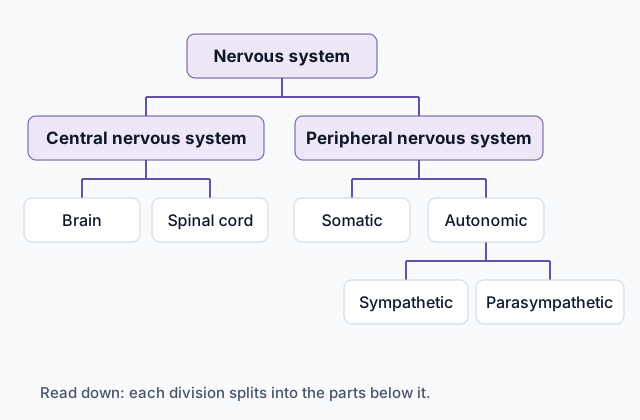 Tap to open the picture full size
Part 1 Think first A heartbeat nobody ordered
Commit to a guess first. Even a wrong one helps the answer stick.
Predict first
Jordan sprints half a block to catch his bus. By the time he drops into a seat, his heart is pounding. Over the next few minutes it slows back to normal, though he never once thinks about his heart. What changed how fast it beat?
In short. The nervous system is organized into divisions: a central nervous system that takes part in everything the body does, and a peripheral nervous system that carries its messages out to the rest of the body.
- The brain and spinal cord form the central nervous system, and the nerves outside them belong to the peripheral nervous system.
- The peripheral system splits by whether an action is chosen: the somatic nervous system governs voluntary processes and the autonomic nervous system governs involuntary ones.
- The autonomic system has two opposing parts: the sympathetic nervous system arouses the body and the parasympathetic nervous system calms it.
Part 2 Learn it The divisions, one level at a time
2a. Central and peripheral
Your nervous system has two main divisions. The central nervous system is the brain and the spinal cord, the thick column of nerve tissue that runs down inside your backbone. It is the hub where messages are sorted and decisions are made, and it interacts with all processes in the body: moving a finger, the beat of your heart, the digestion of a meal.
The central nervous system reaches the rest of you through the peripheral nervous system: all the nerves outside the brain and spinal cord, branching out to every muscle, organ and gland. The peripheral nervous system relays messages from the central nervous system to the rest of the body. (It also carries signals from your senses back in, which you will meet in the next lesson.)
When you decide to wave, the decision forms in your brain, and peripheral nerves carry the command out to the muscles of your arm. Commands to most of the body travel down the spinal cord first and leave it along peripheral nerves.
That is where students slip. The spinal cord runs down your back, far from your head, so it feels like an outlying part. It is not. The spinal cord is central, and the nerves branching out of it are peripheral.
Quick check · Decide and justify
Kenji says, "My brain and spinal cord handle my thinking and the moves I choose to make. They have nothing to do with my heartbeat or my digestion." Is he right?
Which reason supports your answer?
2b. Somatic and autonomic: chosen or automatic
The peripheral nervous system has two branches, and the test that separates them is whether the action is one you choose.
The somatic nervous system governs processes that are voluntary. It carries commands to the muscles you move on purpose: the ones that let you type a message, swing a bat or turn your head toward a friend.
The autonomic nervous system governs processes that are involuntary. It runs the organs and glands that keep working whether you think about them or not: your heart rate, digestion, the size of your pupils, sweating. The name helps, because autonomic sounds like automatic. You cannot slow your digestion by deciding to, the way you can slow your walk.
Students mix these up because somatic comes from the Greek word for body, and the heart and stomach are certainly parts of the body. Go by the test instead. If you do it on purpose, it is somatic. If it happens to you without a choice, it is autonomic.
Quick check · Sort it
Tap a response, then tap the branch of the peripheral nervous system that governs it.
Somatic nervous system
Autonomic nervous system
2c. Sympathetic and parasympathetic: revving up and settling down
The autonomic nervous system has two parts that pull in opposite directions.
The sympathetic nervous system arouses the body to meet a threat or a demand, which is why it is called the fight-or-flight system. When it takes over, your heart beats faster, your breathing quickens, your pupils widen, your palms sweat and your digestion slows, as the body shifts its energy toward action.
The parasympathetic nervous system calms the body and saves energy once the demand has passed. It slows the heart, lets digestion pick back up and brings breathing back to its resting pace. Some teachers call it rest and digest.
Breathing sits on the border between the two branches you just met. It runs on its own while you sleep, yet you can also take it over on purpose for a while and slow it down.
The two work as a balance. Picture a car horn blaring as you step off a curb. Within seconds your heart pounds, which is the sympathetic system. A few minutes later, back on the sidewalk, it settles, which is the parasympathetic system. You choose neither one, because both are autonomic.
The names trip students up. Sympathetic sounds kind and soothing, but it is the one that revs you up. Think of para as in parachute: the parasympathetic system brings you down gently.
Quick check · Fill the statement
Tap a blank, then tap a word.
A fire alarm blares while Maya is napping. Within seconds the branch of her autonomic nervous system makes her heart pound and her palms sweat. Once she learns it was only a drill, the branch slows her heart and lets her digestion pick back up.
Part 3 Watch it done Sorting one scare into its divisions
Follow each step, then take the last one yourself.
Imani is walking to her car in a dark parking lot when she hears quick footsteps behind her. Her heart races, her palms sweat, and she walks faster toward her car. Once she is inside with the doors locked, she sees it was a neighbor out jogging, and over the next few minutes her heart slows. Which divisions of her nervous system are at work?
Step 1 · Separate what she chose from what happened to her
Walking faster is something Imani does on purpose, so it is voluntary, and the somatic nervous system governs it. Her racing heart and sweating palms happen without any choice, so they are involuntary and belong to the autonomic nervous system.
Step 2 · Name the part of the autonomic system behind the racing heart
A racing heart and sweaty palms are the body gearing up to face a threat. That is arousal, the work of the sympathetic nervous system.
Why this step?
Why sort voluntary from involuntary before naming the sympathetic or parasympathetic system?
Because the sympathetic and parasympathetic systems are both parts of the autonomic nervous system. Only an involuntary response can belong to either one, so a chosen action such as walking faster is set aside first.
Your step · Decide and justify
Finish the analysis. Imani is locked in her car and sees that the footsteps were a neighbor out jogging. Over the next few minutes her racing heart slows. Which division slows it?
Which reason supports your answer?
Part 4 Try it Read a study: a racing heart on screen
Illustrative study (made up for practice, not a published study). Sixty college students volunteered. A coin flip decided whether each one watched a three-minute clip of a tense chase from a thriller or a three-minute clip of a slow nature scene. A fingertip monitor recorded each student's heart rate, in beats per minute, during the minute before the clip and during its last minute. In the thriller group, heart rate rose by a mean of 14 beats per minute. In the nature group, it fell by a mean of 1. A statistical test showed the difference between the groups was statistically significant.
Try it · Multiple choice
In an illustrative study, 60 college students were assigned by coin flip to watch a three-minute clip, either a tense chase from a thriller or a slow nature scene, while a fingertip monitor recorded heart rate in beats per minute in the minute before the clip and the last minute of it. The researchers wanted to measure how strongly each clip aroused the body. How did they operationally define that arousal?
Try it · Decide and justify
In an illustrative study, 60 college students were assigned by coin flip to watch a three-minute clip, either a tense chase from a thriller or a slow nature scene, while a fingertip monitor recorded heart rate in beats per minute in the minute before the clip and the last minute of it. Heart rate rose by a mean of 14 in the thriller group and fell by a mean of 1 in the nature group, and the difference was statistically significant. A classmate concludes that watching the thriller clip caused the rise in heart rate. Does the study support that conclusion?
Which reason supports your answer?
Part 5 Explain it Build an argument from three sources
This is a self-check. Nothing you type leaves this page.
Free response is 33.3% of the exam score. This one is shaped like Question 2, Evidence-Based Question.
Free-response practice · Question 2 style
Read the three sources, then answer the question they share: how does the nervous system change the body's arousal during a stressful event and after it? In parts B and C, cite the source you use, for example (Source 2).
Source 1. Illustrative study (made up for practice, not a published study). Eighty college students volunteered. A coin flip decided whether each student was told they would give a three-minute speech in five minutes, to be video-recorded and judged, or that they would spend five minutes reading a magazine. A sensor on two fingertips scored how much each student's palms were sweating, from 0 to 20, before the announcement and again at the end of the five minutes. In the speech group, the mean score rose from 6 to 13. In the magazine group, it stayed at 6. The difference between the groups was statistically significant. No speech was actually given.
Source 2. Illustrative study (made up for practice, not a published study). Fifty adults each spent five minutes on a timed puzzle that was too hard to finish, with a buzzer sounding at every wrong answer. Before the puzzle began, a coin flip decided what each person would do for the five minutes after it: breathe slowly along with a recorded guide, at six breaths a minute, or sit quietly. Right after the puzzle, mean heart rate was 90 beats per minute in both groups. At the end of the next five minutes, it was 73 in the slow-breathing group and 81 in the sitting group. The difference was statistically significant.
Source 3. Illustrative study (made up for practice, not a published study). Sixty-four adults watched a two-minute video filmed by a camera operator walking along the edge of a skyscraper roof. A coin flip decided whether each person was told beforehand that the operator was attached to safety lines the whole time, or was told nothing about it. The same kind of fingertip sensor scored palm sweating from 0 to 20. The mean score rose by 4 points in the told-safe group and by 9 points in the told-nothing group. The difference was statistically significant.
(A) Propose a specific and defensible claim, based in psychological science, that answers the question.
(B) (i) Support your claim using one piece of specific and relevant evidence from one of the sources. (ii) Explain how the evidence from part B (i) supports your claim, using a psychological perspective, theory, concept, or research finding.
(C) (i) Support your claim using a piece of specific and relevant evidence from a different source. (ii) Explain how the evidence from part C (i) supports your claim, using a different psychological perspective, theory, concept, or research finding from the one in part B (ii).
Model answer
(A) A stressful event raises the body's arousal through the sympathetic nervous system, and once the stress is over, the parasympathetic nervous system brings that arousal back down.
(B) (i) In Source 1, students who expected to give a judged speech saw their mean palm-sweating score rise from 6 to 13, while students who read a magazine stayed at 6. (ii) Sweating palms are a sign of the sympathetic nervous system, the part of the autonomic nervous system that arouses the body for fight or flight. The students did not choose to sweat, and a coin flip decided which group they were in, so the threat of the speech is what set off this involuntary arousal. That supports the first half of my claim: stress raised arousal.
(C) (i) In Source 2, both groups had a mean heart rate of 90 beats per minute right after the stressful puzzle, and five minutes later the sitting group was down to 81 and the slow-breathing group to 73. (ii) Once the stress ended, the heart slowed in both groups, which is the work of the parasympathetic nervous system, the part of the autonomic nervous system that calms the body after a demand has passed. Slow breathing is something people can do on purpose, and the faster drop in that group fits the idea that it helped the parasympathetic system bring arousal down. That supports the second half of my claim.
Score your own answer. This is a self-check, not a grade. Tick each point your answer makes.
Part 6 Check yourself Read the heart-rate data
Some multiple-choice questions on the exam share one set of data, the way these two do.
Illustrative data (made up for practice). Forty adults volunteered, and a coin flip put each one in one of two groups. In the stress group, people counted backward aloud from 1,000 by sevens for three minutes while an experimenter corrected every mistake. In the calm group, people read a magazine silently for three minutes. A monitor recorded heart rate before the task, during it, and ten minutes after it ended. In the stress group, both the rise from before to during and the fall from during to ten minutes after were statistically significant.
| Group | Before the task | During the task | Ten minutes after |
|---|---|---|---|
| Stress | 71 | 89 | 73 |
| Calm | 72 | 73 | 71 |
Case question 1 · Multiple choice
In an illustrative study, adults were assigned by coin flip to count backward aloud by sevens for three minutes while being corrected (the stress group) or to read a magazine for three minutes (the calm group). The stress group's mean heart rate was 89 beats per minute during the task and 73 ten minutes after it, a statistically significant fall. Which best explains that fall?
Case question 2 · Calculate
In an illustrative study, adults were assigned by coin flip to count backward aloud by sevens for three minutes while being corrected (the stress group) or to read a magazine for three minutes (the calm group). The stress group's mean heart rate was 71 beats per minute before the task and 89 during it. The calm group's was 72 before and 73 during. By how many beats per minute was the stress group's rise from before to during larger than the calm group's?
The rest stand on their own and do not use the case.
Check yourself · Spot the error
A student explains which branch governs each of Mei's responses as she sits down for a big test. Tap the first line that goes wrong.
Check yourself · Put it in order
Tomas decides to kick a soccer ball toward the goal. Tap the steps in the order the message travels.
Part 7 Keep it Reach back to heredity and environment
Coming back to an older idea is what keeps it ready when you need it.
Bring it back · Multiple choice
In an illustrative study (made up for practice), researchers tested 200 children who had been adopted as infants and had never lived with their biological parents. On a measure of how readily a person approaches strangers, the children's scores correlated r = +0.35 with their biological parents' scores and r = +0.05 with their adoptive parents' scores, and only the first correlation was statistically significant. What does this pattern most suggest?
Bring it back · Sort it
Tap an influence on Sofia, then tap whether it comes from heredity or from her environment.
Heredity (nature)
Environment (nurture)
In three lines
- The brain and spinal cord form the central nervous system, which takes part in every process in the body.
- The peripheral nervous system relays its messages to the body, through the somatic branch for voluntary processes and the autonomic branch for involuntary ones.
- Within the autonomic branch, the sympathetic system arouses the body for a threat and the parasympathetic system calms it afterward.
Vocabulary
- Central nervous system
- The brain and the spinal cord, which interact with all processes in the body.
- Spinal cord
- The column of nerve tissue inside the backbone that, with the brain, makes up the central nervous system.
- Peripheral nervous system
- The nerves outside the brain and spinal cord, which relay messages from the central nervous system to the rest of the body and include the autonomic and somatic nervous systems.
- Somatic nervous system
- The part of the peripheral nervous system that governs processes that are voluntary.
- Autonomic nervous system
- The part of the peripheral nervous system that governs processes that are involuntary, made up of the sympathetic and parasympathetic nervous systems.
- Sympathetic nervous system
- The part of the autonomic nervous system that arouses the body to meet a threat or demand, the fight-or-flight response.
- Parasympathetic nervous system
- The part of the autonomic nervous system that calms the body and conserves energy once a demand has passed.
Course alignment, for teachers
AP Psychology topic 1.2, Unit 1: Biological Bases of Behavior.
- Skill 1.A: Apply psychological perspectives, theories, concepts, and research findings to a scenario.
- Skill 3.A: Identify psychology-related concepts in descriptions or representations of data.
This lesson maps all 4 essential knowledge statements of the topic to the part that teaches each one: 4 are checked by a scored question. The map is in the lesson file.