Unit 5 · Topic 5.5 · about 30 minutes · 7 parts · 15 scored checks, 3 of them multiple choice
AP Psychology 5.5: Treatment of Psychological Disorders
Unit 5: 15 to 25% of the multiple-choice section
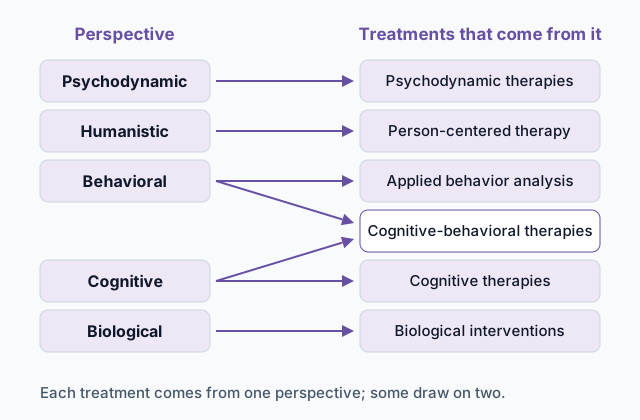 Tap to open the picture full size
Part 1 Think first Three plans for one fear
Guess before you learn. A wrong guess still makes the answer stick.
Predict first
Maya is so afraid of elevators that she climbs eleven flights of stairs to her job every morning. She talks with three therapists, and each one describes a first session. Therapist 1 will ask her to say whatever comes to mind and to describe her dreams. Therapist 2 will help her rank elevator situations from least to most frightening, then face them one at a time. Therapist 3 will mostly listen, say back what Maya tells her, and accept her without judging. Which therapist do you think believes the real cause of the fear is hidden from Maya herself?
In short. Psychological disorders are treated with psychological therapies, each built on one perspective or a mix of two, and with biological interventions that act on the body directly.
- The psychodynamic, humanistic, behavioral, cognitive and cognitive-behavioral therapies each use techniques that follow from their perspective's view of what causes a disorder.
- Biological interventions include psychoactive medications, which act on neurotransmitters and can have side effects, and surgical or invasive interventions; wider use of medication led to deinstitutionalization.
- Meta-analyses find psychotherapies generally effective, and therapy goes best with evidence-based plans, a therapeutic alliance, cultural humility and the APA's ethical principles.
Part 2 Learn it Four short ideas, each checked as you go
2a. Therapies that look inward
Every psychological therapy grows out of a perspective: a view of what causes a disorder. Know the view and the techniques make sense.
Psychodynamic therapies come from the psychodynamic perspective, which traces disorders to unconscious thoughts and experiences. They aim to uncover the unconscious mind. In free association, the client says whatever comes to mind, however trivial or embarrassing, and the therapist listens for patterns the client cannot see. In dream interpretation, the therapist looks for hidden meaning in the client's dreams.
Person-centered therapy is therapy from the humanistic perspective, which sees people as able to grow when the conditions are right. The therapist supplies those conditions. Active listening means giving full attention, saying back what the client said and checking it was understood. Unconditional positive regard means accepting and valuing the client whatever they say or feel, which is not the same as approving of every choice.
Hypnosis is a technique rather than a perspective: a clinician guides a person into a state of focused attention in which they respond more readily to suggestions. Hypnosis has shown effectiveness in treating pain and anxiety. Research does not support using it to retrieve accurate memories or to regress a person to an earlier age, however vivid the recalled scene feels.
Quick check · Sort it
Tap each thing a clinician does, then tap the approach it belongs to.
Psychodynamic therapy
Person-centered therapy
Hypnosis
2b. Changing behavior and thinking
The behavioral perspective traces disorders to learned associations, so applied behavior analysis applies the principles of conditioning to mental disorders and developmental disabilities.
- Exposure therapies bring a person into contact with what they fear. In systematic desensitization, the person learns to relax, then meets feared situations from the mildest up, staying relaxed at each step.
- Aversion therapy pairs an unwanted behavior with something unpleasant.
- A token economy rewards wanted behaviors with tokens that can be traded for privileges.
- Biofeedback shows a person a live signal from their own body, such as heart rate, so they can learn to regulate body systems, like the sympathetic and parasympathetic nervous systems, that feed feelings of anxiety or depression.
Cognitive therapies target maladaptive thinking. In cognitive restructuring, a person catches a distorted thought, tests it against the evidence and replaces it with a more accurate one. A fear hierarchy ranks feared situations from least to most frightening. In cognitive therapy, the person works up the list, catching the frightening thought at each step ("the elevator will get stuck and I will not be able to breathe") and testing it against the evidence. Systematic desensitization climbs a similar ladder, but the work there is staying relaxed, which is conditioning. Cognitive therapy also proposes focusing on the cognitive triad: negative thoughts about oneself, the world and the future.
Cognitive-behavioral therapies combine techniques from both perspectives. Dialectical behavior therapy and rational-emotive behavior therapy are two of them.
Quick check · Match
Tap a technique, then tap the example that shows it.
2c. Biological interventions, and the move out of hospitals
The biological perspective traces disorders to physiological or genetic issues, and its interventions act on the body directly.
Psychoactive medications, such as antidepressants, antianxiety drugs, lithium and antipsychotic medications, interact with specific neurotransmitters in the central nervous system to address possible biochemical causes of mental disorders. They can have side effects. One is tardive dyskinesia, a movement disorder related to the regulation of dopamine in the nervous system.
Other interventions are surgical or invasive. They include psychosurgery, which may involve lesioning (destroying a small area of brain tissue); transcranial magnetic stimulation (TMS), in which magnetic pulses from a coil held against the head stimulate a brain area; and electroconvulsive therapy (ECT), in which a brief electric current passed through the brain of a patient under anesthesia sets off a controlled seizure. The lobotomy is a form of psychosurgery that was popular in the mid-20th century but is rarely, if ever, performed today.
Medication also changed where treatment happens. As psychotropic medication (another name for psychoactive medication) came into wider use and worked better, hospitals and asylums released massive numbers of people in the late 20th century. That shift is called deinstitutionalization. Therapists now prefer to treat in decentralized ways, through many local services rather than one large institution, and often combine medication with psychological therapy.
Quick check · Fill the statement
Tap a blank, then tap a word.
In an illustrative case, a psychiatrist prescribes an antianxiety drug. Like other psychoactive medications, it works by interacting with specific in the central nervous system. A different patient, who has taken an antipsychotic medication for a long time, develops a movement disorder related to the regulation of , a side effect called . In the late 20th century, as such medications came into wider use and worked better, hospitals released massive numbers of people, a shift called .
2d. What makes therapy work
One study cannot show whether therapy works, so researchers run meta-analyses, which combine the results of many studies. Many researchers who have done meta-analyses of psychotherapy conclude that psychotherapies are generally effective. That describes therapy on average; it is not a promise that one method suits everyone. Many psychologists build a treatment plan from evidence-based interventions, approaches research supports for the client's problem.
The relationship matters too. A therapeutic alliance is a working bond of trust in which therapist and client agree on their goals. Cultural humility means the therapist does not assume they understand a client's culture, and asks and learns instead. Therapists should show both to deliver therapy successfully.
Psychologists in clinical work must follow ethical principles set by the APA, including:
- nonmaleficence: do no harm;
- fidelity: build trust and keep the commitments you make;
- integrity: be accurate, honest and truthful;
- respect for people's rights and dignity, such as their privacy and their right to make their own decisions.
Therapy can be individual, one client with a therapist, or group therapy, where a therapist works with several clients at once. In a group, members see that others share their struggles, give and get feedback, and practice relating to people, but each gets less of the therapist's individual attention.
Quick check · Match
Tap an ethical principle, then tap the therapist who shows it.
Part 3 Watch it done Naming a therapy from what the therapist does
Watch each step, then do the last one yourself.
Ines, a college student with social anxiety disorder, believes that if she speaks up in class, everyone will decide she is stupid. Her therapist has her write that thought down, list the evidence for and against it, and write a more accurate thought in its place. The therapist also gives her an assignment for the week: ask one question in class each day and record what actually happened. What kind of therapy is this?
Step 1 · Find what the first technique works on
Writing down the thought, weighing the evidence and replacing it with a more accurate one is cognitive restructuring. It works on her thinking, so it comes from the cognitive perspective.
Step 2 · Check for a second target
The daily question is different. It has Ines practice the very behavior she avoids and see what follows, which works on what she does rather than on what she thinks. Actually going into the feared situation, rather than only rethinking it, is exposure, a behavioral technique. That draws on the behavioral perspective.
Why this step?
Why look for a second target before naming the therapy?
Because cognitive restructuring on its own would make this cognitive therapy. Whether the plan also changes behavior is what decides between a therapy from one perspective and one that combines two.
Your step · Decide and justify
Finish the classification. Ines's therapist has her test the thought that classmates will think she is stupid against the evidence and replace it, and also has her ask one question in class each day and record what happened. Which kind of therapy is this?
Which reason supports your answer?
Part 4 Try it Read a study: hypnosis before a dental procedure
Illustrative study (made up for practice, not a published study). Researchers recruited 53 adults who were nervous about an upcoming dental procedure. A random number generator put 25 of them in a hypnosis group and 28 in a comparison group. Before the procedure, a trained clinician spent 15 minutes guiding each person in the hypnosis group into a focused state and suggesting calm and comfort. People in the comparison group spent the same 15 minutes listening to a recording about caring for their teeth. Afterward, everyone rated their pain from 0 (none) to 10 (the worst imaginable), and the dentist recorded who asked for extra pain relief during the procedure. A statistical test showed that both differences between the groups were statistically significant.
| Group | Adults | Mean pain rating (0 to 10) | Asked for extra pain relief |
|---|---|---|---|
| Hypnosis | 25 | 3.1 | 6 |
| Comparison | 28 | 4.6 | 14 |
Try it · Calculate
In an illustrative study, a random number generator put 25 adults in a hypnosis group and 28 in a comparison group before a dental procedure. In the hypnosis group, 6 of 25 asked for extra pain relief; in the comparison group, 14 of 28 did. The mean pain ratings were 3.1 and 4.6 out of 10. How many percentage points lower was the hypnosis group's rate of asking for extra pain relief?
Try it · Decide and justify
In the illustrative dental study, adults randomly assigned to hypnosis rated their pain lower and asked for extra pain relief less often than the comparison group, and both differences were statistically significant. A classmate concludes that hypnosis could also help a witness accurately recall the details of a crime. Does the study support the classmate?
Which reason supports your answer?
Part 5 Explain it Write it the way the exam asks
Nothing you type leaves this page.
Free response is 33.3% of the exam score. This one is shaped like Question 2, Evidence-Based Question.
Free-response practice · Question 2 style
Read the three sources, then answer the question they share: how is the relationship between a therapist and a client related to how therapy turns out? In parts B and C, cite the source you use, for example (Source 1).
Source 1. Illustrative study (made up for practice, not a published study). At a large clinic, a random number generator placed each of 40 therapists in one of two six-hour workshops. One taught cultural humility: asking clients about their backgrounds and values instead of assuming. The other taught record keeping. Over the next six months, 240 new adult clients were assigned to the therapists by lottery, 120 to each group of therapists. Of clients whose therapist took the cultural humility workshop, 22 of 120 (18%) stopped coming before their fourth session, compared with 41 of 120 (34%) of clients whose therapist took the record-keeping workshop. The difference was statistically significant.
Source 2. Illustrative study (made up for practice, not a published study). Researchers asked 180 adults in individual therapy, after their third session, to rate how much they and their therapist agreed on goals and how much they trusted the therapist. Clients completed the same symptom checklist at the start and at the end of therapy. Clients who gave higher ratings of agreement and trust tended to show larger drops in symptoms, a positive correlation of r = +0.42.
Source 3. Illustrative study (made up for practice, not a published study). Trained observers who did not know the study's purpose listened to recordings of the first sessions of 70 clients. They counted how many times each therapist said back what the client had said and checked that it was understood. Clients whose therapists did this more often attended more of their next eight scheduled sessions, a positive correlation of r = +0.31.
(A) Propose a specific and defensible claim, based in psychological science, that answers the question.
(B) (i) Support your claim using one piece of specific and relevant evidence from one of the sources. (ii) Explain how the evidence from part B (i) supports your claim, using a psychological perspective, theory, concept, or research finding.
(C) (i) Support your claim using a piece of specific and relevant evidence from a different source. (ii) Explain how the evidence from part C (i) supports your claim, using a different psychological perspective, theory, concept, or research finding from the one in part B (ii).
Model answer
(A) The stronger the working relationship between a therapist and a client, the more likely the client is to stay in therapy and to improve.
(B) (i) In Source 1, 18% of clients whose therapists took the cultural humility workshop stopped coming before their fourth session, compared with 34% of clients whose therapists took the record-keeping workshop. (ii) This fits cultural humility, which is part of how a therapist builds a working relationship with a client. Therapists trained to ask about each client's background and values, instead of assuming they understood them, kept more of their clients past the first few sessions, which is what the claim predicts if a stronger relationship keeps clients in therapy. Because therapists were placed in workshops at random and clients were assigned to therapists by lottery, the difference fits an effect of the training rather than of which clients each therapist happened to see.
(C) (i) In Source 2, clients who rated their agreement on goals and their trust in the therapist higher after the third session tended to show larger drops in symptoms by the end of therapy, a positive correlation of r = +0.42. (ii) This fits the therapeutic alliance, a different concept from part B. A working bond of trust in which therapist and client agree on goals is one of the conditions for delivering therapy successfully. Clients who reported a stronger bond tended to show larger drops in symptoms. Because this is a correlation, it cannot show that the bond caused the improvement; clients who were already feeling better by the third session may simply have rated the bond higher.
Score your own answer. This is a self-check, not a grade. Tick each point your answer makes.
Part 6 Check yourself Three programs at one clinic
On the exam, some multiple-choice questions share one set of information, the way these do.
Illustrative cases (made up for practice). A community clinic runs three programs. Read each one with the lesson's techniques in mind.
| Program | Who takes part | What happens |
|---|---|---|
| Tuesday evening group | Eight adults with social anxiety disorder and two therapists | Members take turns introducing themselves to the group, then give one another feedback |
| Points board | Teens in a residential program | Teens earn points for finished chores and attended classes, and trade the points for outings or extra free time |
| Sensor room | Adults who often feel anxious, one at a time | A screen shows the person's heart rate as a moving line, and the person tries breathing and muscle exercises to bring it down |
Case question 1 · Multiple choice
In a table of illustrative clinic programs, teens in a residential program earn points for finished chores and attended classes, and trade the points for outings or extra free time. Which principle is the points board built on?
Case question 2 · Multiple choice
In a table of illustrative clinic programs, eight adults with social anxiety disorder meet on Tuesday evenings with two therapists, take turns introducing themselves to the group, and then give one another feedback. Compared with individual therapy, what does this group format offer?
Case question 3 · Decide and justify
In a table of illustrative clinic programs, adults in the sensor room watch their heart rate as a moving line on a screen and try breathing and muscle exercises to bring it down. A classmate says the sensor room belongs with the biological interventions, because it measures the body. Is the classmate right?
Which reason supports your answer?
The rest stand on their own and do not use the case.
Check yourself · Spot the error
A student writes a summary of biological interventions and how treatment has changed. Tap the first line that goes wrong.
Check yourself · Fill the statement
Tap a blank, then tap a word or phrase.
In an illustrative case, a client keeps telling himself, "I ruin everything I try," "Nobody out there can be counted on," and "Nothing is ever going to get better." A cognitive therapist would hear negative thoughts about , about and about , which together make up the . The therapist then helps him test each thought against the evidence and replace it with a more accurate one, a technique called .
Check yourself · Sort it
Tap each example, then tap the idea it shows best.
Meta-analysis
Evidence-based intervention
Therapeutic alliance
Cultural humility
Part 7 Keep it Bring back earlier ideas
Coming back to older ideas is how they stay usable on the exam.
Bring it back · Multiple choice
In an illustrative case, a woman has stopped riding buses, avoids crowded shops and standing in lines, and no longer leaves home alone, because each of these situations brings on intense fear. She says the fear is not about what other people think of her. Which disorder do these symptoms fit, as a psychologist would describe it?
Bring it back · Fill the statement
Tap a blank, then tap a word or phrase.
For four seasons, a goalkeeper named Ana has stayed calm under pressure in every game. A trait theorist would describe her calm as an characteristic that leads to typical responses. A social-cognitive theorist would point to her belief that she can stop a penalty kick, her , and to the way that belief, her actions and her team all shape one another, which is .
In three lines
- Each psychological therapy follows from a perspective: free association and dream interpretation (psychodynamic), active listening and unconditional positive regard (humanistic), conditioning (applied behavior analysis), and cognitive restructuring and the cognitive triad (cognitive).
- Psychoactive medications act on specific neurotransmitters and can have side effects; surgical or invasive interventions include psychosurgery, TMS and ECT; wider use of medication led to deinstitutionalization.
- Therapy goes best with evidence-based plans, a therapeutic alliance, cultural humility and the APA's ethical principles; groups add shared experience and feedback, and hypnosis helps with pain and anxiety but not memory.
Vocabulary
- Meta-analysis
- A study that combines the results of many studies to reach an overall conclusion.
- Evidence-based intervention
- A treatment approach that research supports for a client's problem, used to develop a treatment plan.
- Therapeutic alliance
- The working relationship of trust and shared goals between a therapist and a client.
- Cultural humility
- A therapist's openness to learning about a client's culture instead of assuming they already understand it.
- Deinstitutionalization
- The release of massive numbers of people from hospitals and asylums in the late 20th century, as psychotropic medication came into wider use.
- Nonmaleficence
- The ethical principle that a psychologist does no harm.
- Fidelity
- The ethical principle of building trust and keeping the commitments you make.
- Integrity
- The ethical principle of being accurate, honest and truthful.
- Respect for people's rights and dignity
- The ethical principle of protecting a client's privacy and right to make their own decisions.
- Free association
- A psychodynamic technique in which the client says whatever comes to mind, to help uncover the unconscious.
- Dream interpretation
- A psychodynamic technique that looks for hidden meaning in dreams, to help uncover the unconscious.
- Cognitive restructuring
- A cognitive technique for combating maladaptive thinking by testing a thought against evidence and replacing it with a more accurate one.
- Fear hierarchy
- A ranked list of feared situations, from least to most frightening, that cognitive therapies may use to combat maladaptive thinking.
- Cognitive triad
- Negative thoughts about oneself, the world and the future, which cognitive therapy proposes people should focus on.
- Applied behavior analysis
- Applying the principles of conditioning to address mental disorders and developmental disabilities.
- Exposure therapies
- Therapies that bring a person into contact with what they fear, such as systematic desensitization.
- Systematic desensitization
- An exposure therapy in which a person stays relaxed while facing feared situations, starting with the mildest.
- Aversion therapy
- A therapy that pairs an unwanted behavior with something unpleasant.
- Token economy
- A system that reinforces wanted behaviors with tokens a person can trade for rewards.
- Biofeedback
- A technique that uses principles of conditioning to help clients regulate body systems that contribute to feelings of anxiety or depression.
- Cognitive-behavioral therapies
- Therapies, such as dialectical behavior therapy and rational-emotive behavior therapy, that combine techniques from the cognitive and behavioral perspectives.
- Person-centered therapy
- Therapy from the humanistic perspective that employs active listening and unconditional positive regard.
- Active listening
- Giving a client full attention, saying back what they said and checking it was understood.
- Unconditional positive regard
- Accepting and valuing a client whatever they say or feel.
- Group therapy
- Therapy in which a therapist works with several clients at once rather than with one client alone.
- Hypnosis
- A state of focused attention in which a person responds more readily to suggestions, shown effective in treating pain and anxiety.
- Psychoactive medications
- Drugs, such as antidepressants, antianxiety drugs, lithium and antipsychotic medications, that interact with specific neurotransmitters in the central nervous system.
- Tardive dyskinesia
- A movement disorder related to the regulation of dopamine, which can be a side effect of psychoactive medication.
- Psychotropic medication
- Another name for psychoactive medication; its increased use and effectiveness led to deinstitutionalization.
- Psychosurgery
- A surgical or invasive intervention, which may involve lesioning; the lobotomy is a form of it.
- Lesioning
- Destroying a small area of brain tissue, which psychosurgery may involve.
- Transcranial magnetic stimulation (TMS)
- An intervention in which magnetic pulses from a coil held against the head stimulate a brain area.
- Electroconvulsive therapy (ECT)
- An intervention in which a brief electric current passed through the brain of a patient under anesthesia sets off a controlled seizure.
- Lobotomy
- A form of psychosurgery that was popular in the mid-20th century but is rarely, if ever, performed today.
Course alignment, for teachers
AP Psychology topic 5.5, Unit 5: Mental and Physical Health.
- Skill 1.A: Apply psychological perspectives, theories, concepts, and research findings to a scenario.
- Skill 2.B: Evaluate the appropriate use of research design elements in experimental methodology.
- Skill 2.C: Evaluate the appropriate use of research design elements in non-experimental methodologies.
- Skill 2.D: Evaluate whether a psychological research scenario followed appropriate ethical procedures.
- Skill 3.C: Interpret quantitative or qualitative inferential data from a given table, graph, chart, figure, or diagram.
- Skill 4.B: Provide reasoning that is grounded in scientifically derived evidence to support, refute, or modify an established or provided claim, policy, or norm.
This lesson maps all 11 essential knowledge statements of the topic, and the one learning objective with none of its own, to the part that teaches each one: 12 are checked by a scored question. The map is in the lesson file.