Unit 5 · Topic 5.4 · about 30 minutes · 7 parts · 15 scored checks, 2 of them multiple choice
AP Psychology 5.4: Selection of Categories of Psychological Disorders
Unit 5: 15 to 25% of the multiple-choice section
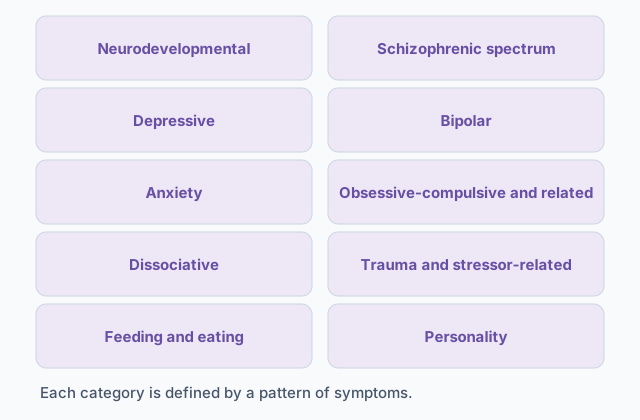 Tap to open the picture full size
Part 1 Think first Added or missing
Make a guess first. Getting it wrong still helps the right answer stick.
Predict first
A psychologist's notes describe two invented people with schizophrenia. Mara hears a voice commenting on what she does when no one else is in the room. Joel's face and voice show almost no emotion, even while he describes his sister's wedding. Psychologists sort symptoms like these into positive and negative. Which one do you think they call a positive symptom?
In short. Psychologists group psychological disorders into categories, each defined by a pattern of symptoms and linked to a set of possible causes.
- Categories are told apart by their symptoms, and sometimes by when the symptoms begin or by what a fear is about.
- Possible causes differ by category: some center on trauma or stress, while others range across biological, genetic, social, cultural, behavioral and cognitive sources.
- Personality disorders are enduring, pervasive patterns that begin by early adulthood, and they fall into three clusters.
Part 2 Learn it Ten categories, in four groups
2a. Disorders of development and the schizophrenic spectrum
Neurodevelopmental disorders begin during the developmental period. Their symptoms are judged against age: is the person behaving in ways that fit their age or maturity? A restless four-year-old is typical; the same restlessness at twelve may not be. The two in this course are attention-deficit/hyperactivity disorder (ADHD), marked by inattention and hyperactivity, and autism spectrum disorder (ASD), marked by difficulty with social communication and by restricted, repetitive behaviors or interests. Possible causes may be environmental, physiological or genetic.
Schizophrenic spectrum disorders involve problems in one or more of five areas:
- Delusions, false beliefs, such as persecution (being plotted against) or grandeur (being far more important than one is).
- Hallucinations, false perceptions, in any of the senses.
- Disorganized thinking or speech, such as word salad, words strung together in ways that make no sense.
- Disorganized motor behavior, which can show as catatonia: either excitement (agitated, purposeless movement) or stupor (little or no movement).
- Negative symptoms, where a typical behavior is missing, such as flat affect (little emotional expression) or catatonic stupor.
Delusions, hallucinations, disorganized speech and catatonic excitement are positive symptoms: something is added. Schizophrenia can be acute, coming on suddenly, often after a stressful event, or chronic, developing slowly and lasting a long time.
Its possible causes point to genes and biology, such as exposure to a virus before birth or an imbalance in certain neurotransmitters. The dopamine hypothesis links it to dopamine.
Quick check · Sort it
Each card is from notes on an invented person with schizophrenia. Tap a card, then tap the bin it belongs in.
Positive symptom
Negative symptom
Possible cause
2b. Depressive, bipolar, and feeding and eating disorders
Depressive disorders bring a sad, empty or irritable mood together with physical and cognitive changes, such as changes in sleep, energy or concentration, that affect a person's ability to function. The two in this course are major depressive disorder and persistent depressive disorder, in which a depressed mood lasts for years.
Bipolar disorders bring periods of mania, a stretch of unusually high or irritable mood with far more energy and activity than usual, and periods of depression. Bipolar cycling means moving between depression and mania in alternating periods, and each period can last a different length of time. The two in this course are Bipolar I disorder and Bipolar II disorder; in Bipolar II the high periods are milder than in Bipolar I.
Feeding and eating disorders change how a person takes in or absorbs food, in a way that harms their health or their psychological functioning. The two in this course are anorexia nervosa and bulimia nervosa.
All three categories share one list of possible causes: biological, genetic, social, cultural, behavioral or cognitive sources. A disorder shared by a parent can point to a genetic source, though families share their surroundings as well as their genes. Pressure from friends to look a certain way is a social one. A learned habit of avoiding everything that once felt good is behavioral, and expecting that nothing will ever get better is cognitive. One disorder can draw on several at once.
Quick check · Fill the statement
Tap a blank, then tap a word.
For most of the past two months, Lena, an invented student, has felt empty and irritable, sleeps far more than usual and cannot concentrate well enough to finish her work. Her symptoms fit a disorder. Omar, an invented adult, has stretches of low, empty mood that alternate with stretches of unusually high energy, very little sleep and racing plans. His symptoms fit a disorder. Over the past year, the way Jae, an invented teen, eats has changed so much that it is now harming his health. His symptoms fit a disorder. Theo, an invented man with schizophrenia, began hearing voices over a few weeks after losing his job. His symptoms came on suddenly, after a stressful event, which fits the form of schizophrenia.
2c. Anxiety and obsessive-compulsive disorders
Anxiety disorders involve excessive fear or anxiety, with changes in behavior that go with it. Five are in this course, and they differ in what the fear is about or how it arrives:
- Specific phobia: fear of one object or situation, such as heights (acrophobia) or spiders (arachnophobia).
- Agoraphobia: intense fear of situations such as public transportation, open spaces, enclosed places like shops or theaters, lines and crowds, or being outside the home alone.
- Panic disorder: panic attacks, sudden overwhelming waves of fear felt in the body, the thoughts and the emotions, that come without warning. Among people mainly of Caribbean or Iberian descent it can take a culture-bound form, ataque de nervios.
- Social anxiety disorder: intense fear of being judged or watched by others. It is distinct from agoraphobia, though it may include it. Taijin kyofusho, a culture-bound form found mainly among Japanese people, is the fear that others judge one's body as undesirable or offensive.
- Generalized anxiety disorder (GAD): long-lasting anxiety that is not about anything specific.
Obsessive-compulsive and related disorders involve obsessions, intrusive thoughts, and compulsions, intrusive and often repetitive behaviors meant to deal with the obsessions. The two in this course are obsessive-compulsive disorder and hoarding disorder.
For both categories, possible causes include learned associations between stimuli, maladaptive thinking or emotional responses, and biological or genetic sources.
Quick check · Match
Every person here is invented. Tap a disorder, then tap the notes whose symptoms fit it best.
2d. Trauma, dissociation and personality
Trauma and stressor-related disorders follow exposure to a traumatic or stressful event, with psychological distress afterward. The one in this course is posttraumatic stress disorder (PTSD). Its symptoms can include hypervigilance (staying constantly on guard), severe anxiety, flashbacks to the event, insomnia, emotional detachment and hostility.
Dissociative disorders involve dissociation, a separation from parts of experience that usually fit together: consciousness, memory, identity, emotion, perception, the sense of one's body, motor control and behavior. The two in this course are dissociative amnesia, being unable to recall important personal information, sometimes with fugue, in which the person also travels away from home confused about who they are, and dissociative identity disorder, in which two or more distinct identities take turns guiding a person's behavior.
For both of those categories, possible causes involve the experience of trauma or stress.
Personality disorders are enduring patterns of inner experience and behavior that depart from what the person's culture expects. The pattern is pervasive and inflexible, begins in adolescence or early adulthood, stays stable over time, and leads to distress or impairment. There are three clusters:
- Cluster A, odd or eccentric: paranoid, schizoid and schizotypal.
- Cluster B, dramatic, emotional or erratic: antisocial, histrionic, narcissistic and borderline.
- Cluster C, anxious or fearful: avoidant, dependent and obsessive-compulsive personality disorders.
Their possible causes come from the same list as depressive disorders: biological, genetic, social, cultural, behavioral or cognitive sources.
Quick check · Sort it
Tap a disorder, then tap the personality cluster or the category it belongs to.
Cluster A
Cluster B
Cluster C
Obsessive-compulsive and related
Dissociative
Feeding and eating
Part 3 Watch it done Telling two anxiety disorders apart
Follow each step, then finish the last one yourself.
A psychologist's notes describe Rosa, an invented woman. For about a year she has avoided crowded stores, lines and eating out, because she is sure people are watching her and noticing every mistake. She takes the bus and goes out alone without trouble. Which anxiety disorder fits her symptoms best?
Step 1 · List what she fears and avoids
Crowded stores, lines and eating out. That is several situations, not one object, so a specific phobia is a poor fit. Crowded stores and lines are on agoraphobia's list, though, so the places alone leave two disorders open.
Step 2 · Ask what the fear is about
She is sure people are watching her and noticing every mistake. The fear is about being watched and judged, so social anxiety disorder fits, even though the places overlap with agoraphobia's list. Two more situations on that list, the bus and going out alone, do not trouble her at all.
Why this step?
Why ask what the fear is about, when you already know which places she avoids?
Because two disorders can involve the same places. A crowded store can be avoided out of fear of being judged there or out of fear of the crowd itself, so the places alone cannot separate social anxiety disorder from agoraphobia.
Your step · Decide and justify
Finish the classification. Rosa, an invented woman, has for about a year avoided crowded stores, lines and eating out, because she is sure people are watching her and noticing every mistake. She takes the bus and goes out alone without trouble. Which anxiety disorder fits her symptoms best?
Which reason supports your answer?
Part 4 Try it Where a disorder may come from
Each card names a category of disorder and one possible source of it. Sort the sources first. Then read an illustrative twin study and judge what it can and cannot show.
Try it · Sort it
Tap a card, then tap the kind of source it describes.
Biological or genetic
Social or cultural
Behavioral or cognitive
Illustrative study (made up for practice, not a published study). Researchers found adult twin pairs in which at least one twin had a bipolar disorder: 45 identical pairs, who share the same genes, and 50 fraternal pairs, who share about half their genes on average. For each pair they recorded whether the other twin also had a bipolar disorder. The difference between identical and fraternal pairs was statistically significant.
| Kind of pair | Both twins | Only one twin | Total pairs |
|---|---|---|---|
| Identical | 18 | 27 | 45 |
| Fraternal | 4 | 46 | 50 |
Try it · Calculate
In an illustrative twin study, every pair had at least one twin with a bipolar disorder. Of 45 identical pairs, both twins had it in 18 pairs and only one twin had it in 27. Of 50 fraternal pairs, both twins had it in 4 pairs and only one twin had it in 46. In what percent of the identical pairs did both twins have a bipolar disorder?
Try it · Decide and justify
In the illustrative study, both twins had a bipolar disorder in 40% of 45 identical pairs and 8% of 50 fraternal pairs, a statistically significant difference. Identical twins share the same genes. A classmate says the study shows bipolar disorders are caused by genes alone. Does it show that?
Which reason supports your answer?
Part 5 Explain it Write an article analysis answer
Nothing you type leaves this page.
Free response is 33.3% of the exam score. This one is shaped like Question 1, Article Analysis Question.
Free-response practice · Question 1 style
Illustrative study (made up for practice, not a published study). Researchers wanted to know whether being kept out of one's home longer after a disaster goes with more symptoms of posttraumatic stress disorder. Six months after a flood, they invited adults from one town whose homes had flooded, and 120 agreed to take part. Before starting, each person read and signed a form explaining the study and saying they could stop at any time. Each person reported how many days they had been unable to live in their home. Each also completed a checklist of six symptoms (staying constantly on guard, severe anxiety, flashbacks to the flood, trouble sleeping, feeling emotionally cut off from others, and outbursts of hostility), marking each one they had experienced in the past month. Every person's answers were stored under a code number instead of a name, and only the research team could see them. Adults who had been out of their homes longer tended to mark more of the six symptoms, a positive correlation of r = +0.41, and a statistical test showed the correlation was statistically significant.
(A) Identify the research method used in this study.
(B) State the operational definition of posttraumatic stress symptoms in this study.
(C) Identify one ethical guideline described in the study. Describe one way the researchers applied it.
(D) Explain the extent to which the research findings may or may not be generalizable, using specific and relevant evidence from the study.
(E) Explain how the research findings support the idea that trauma or stress is a possible cause of trauma and stressor-related disorders.
Model answer
(A) This is a correlational study. The researchers measured two variables as they were, days out of the home and symptoms, and assigned no one to a condition.
(B) Posttraumatic stress symptoms were measured as the number of the six listed symptoms a person marked as experienced in the past month, from 0 to 6.
(C) Confidentiality. Each person's answers were stored under a code number instead of a name, and only the research team could see them.
(D) The findings may not generalize far. All 120 participants came from one town after one flood, and only those who agreed to take part were studied, so the link might be different after other kinds of trauma, in other places, or among people who chose not to take part.
(E) Trauma and stressor-related disorders follow exposure to a traumatic or stressful event. Adults who spent more days out of their homes, a longer stretch of stress after the flood, tended to report more of the symptoms, r = +0.41, which was statistically significant. That fits trauma or stress as a possible cause, though a correlation alone cannot show the time out of the home caused the symptoms.
Score your own answer. This is a self-check, not a grade. Tick each point your answer makes.
Part 6 Check yourself Four sets of notes
Exam multiple-choice questions sometimes come in sets that share one table or passage, like these three.
Illustrative cases (made up for practice). Each row describes an invented person the way a psychologist's notes might. A few lines of notes are never enough for a diagnosis; the questions ask only which category the symptoms fit.
| Person | Background | What the notes describe |
|---|---|---|
| Dana, age 8 | Noticed since preschool, at home and at school | Cannot stay seated or wait her turn far more than other children her age, and often loses track of tasks |
| Marco, age 34 | A serious car crash eight months ago | Stays constantly on guard on the road, relives the crash in flashbacks, sleeps badly and feels cut off from his family |
| Ines, age 27 | Survived a violent robbery last year; she was not injured | Cannot recall several weeks around the robbery, though she remembers the rest of her life |
| Gil, age 41 | No frightening or unusually stressful event in recent years | For two years has felt anxious most days about many different things, none in particular |
Case question 1 · Multiple choice
In a set of illustrative cases, Dana, an invented 8-year-old, cannot stay seated or wait her turn far more than other children her age and often loses track of tasks. Her parents and teachers have noticed this since preschool, at home and at school. Which category do her symptoms fit best?
Case question 2 · Select all
In a set of illustrative cases: Dana, 8, has been restless and unfocused since preschool. Marco, 34, has stayed on guard, had flashbacks and slept badly since a car crash. Ines, 27, cannot recall several weeks around a violent robbery in which she was not injured. Gil, 41, has felt anxious about many things for two years. For which two people do the symptoms fit a category whose possible causes, as psychologists list them, center on the experience of trauma or stress? Pick two.
Select 2 answers, then check.
Case question 3 · Decide and justify
In a set of illustrative cases, Marco stays constantly on guard on the road, relives a car crash in flashbacks, sleeps badly and feels cut off from his family. Ines cannot recall several weeks around a violent robbery in which she was not injured, though she remembers the rest of her life. A classmate says their symptoms fit the same category, because both followed a frightening event. Do they?
Which reason supports your answer?
The rest stand on their own and do not use the case.
Check yourself · Fill the statement
Tap a blank, then tap a word.
Carmen, an invented woman of Puerto Rican descent, has sudden, overwhelming waves of fear that come without warning, with shaking and a pounding heart. In her community, an episode like this is called , a culture-bound form of disorder. Kenji, an invented man in Japan, is intensely afraid that the people around him find his body unpleasant or offensive. That culture-bound pattern is called , a form of disorder.
Check yourself · Spot the error
A student explains why the notes on Rhea, an invented woman, fit the description of a personality disorder. Tap the first line that goes wrong.
Part 7 Keep it Two questions from earlier topics
Older ideas stay usable when you pull them back up now and then.
Bring it back · Fill the statement
Tap a blank, then tap a word.
A psychologist meets Noor, an invented client. Noor's rituals before leaving home now take so long that she has lost her job, which shows her level of . Noor says the rituals make her miserable, which is her perception of . No one else in her community spends hours this way, which is from the social norm.
Bring it back · Multiple choice
When the first wildfire of the season breaks out, Ravi, an invented firefighter, feels his heart pound and his breathing speed up. For the next two months he works long shifts and copes, staying alert day after day. When the season ends and his energy is used up, he catches one cold after another. In the general adaptation syndrome, which phase is Ravi in when the colds come?
In three lines
- Neurodevelopmental disorders begin in development and are judged against age; schizophrenic spectrum disorders involve delusions, hallucinations, disorganized speech or movement, and negative symptoms.
- Depressive and bipolar disorders change mood, anxiety disorders differ in what the fear is about, and obsessions are thoughts that compulsions try to deal with.
- Trauma or stress is a possible cause of PTSD and dissociative disorders, and personality disorders are lasting patterns in three clusters with many possible causes.
Vocabulary
- Neurodevelopmental disorders
- Disorders with onset during the developmental period, whose symptoms are judged by whether behavior fits the person's age or maturity; they include ADHD and autism spectrum disorder.
- Schizophrenic spectrum disorders
- Disorders marked by problems in one or more of five areas: delusions, hallucinations, disorganized thinking or speech, disorganized motor behavior, and negative symptoms.
- Delusions
- False beliefs, such as delusions of persecution or of grandeur; a positive symptom.
- Hallucinations
- False perceptions, which may involve one or more of the senses; a positive symptom.
- Word salad
- Words strung together in nonsensical ways, a sign of disorganized thinking or speech.
- Catatonia
- Disordered movement, experienced as excitement (a positive symptom) or stupor (a negative symptom).
- Negative symptoms
- The lack of a typical behavior, such as flat affect (little emotional expression) or catatonic stupor (little movement).
- Dopamine hypothesis
- The proposal that schizophrenia is linked to an imbalance in the neurotransmitter dopamine.
- Depressive disorders
- Disorders marked by a sad, empty or irritable mood with physical and cognitive changes that affect a person's ability to function; they include major depressive disorder and persistent depressive disorder.
- Bipolar disorders
- Disorders marked by periods of mania and periods of depression; they include Bipolar I disorder and Bipolar II disorder.
- Bipolar cycling
- Experiencing periods of depression and mania in alternating periods that can last various amounts of time.
- Anxiety disorders
- Disorders marked by excessive fear or anxiety with related disturbances to behavior.
- Specific phobia
- Fear or anxiety toward a specific object or situation, such as heights (acrophobia) or spiders (arachnophobia).
- Agoraphobia
- Intense fear of situations such as public transportation, open spaces, enclosed spaces, lines and crowds, or being outside the home alone.
- Panic disorder
- A disorder of panic attacks, unanticipated and overwhelming experiences of fear felt in the body, the thoughts and the emotions; ataque de nervios is a culture-bound form.
- Social anxiety disorder
- Intense fear of being judged or watched by others; taijin kyofusho is a culture-bound form.
- Generalized anxiety disorder (GAD)
- Prolonged experiences of anxiety or fear that is not about anything specific.
- Obsessive-compulsive and related disorders
- Disorders marked by obsessions (intrusive thoughts) and compulsions (intrusive, often repetitive behaviors meant to address the obsessions); they include obsessive-compulsive disorder and hoarding disorder.
- Dissociative disorders
- Disorders marked by dissociation from consciousness, memory, identity, emotion, perception, body representation, motor control or behavior; they include dissociative amnesia, with or without fugue, and dissociative identity disorder.
- Trauma and stressor-related disorders
- Disorders that follow exposure to a traumatic or stressful event, with psychological distress afterward; posttraumatic stress disorder is the one in this course.
- Feeding and eating disorders
- Disorders marked by altered consumption or absorption of food that impairs health or psychological functioning; they include anorexia nervosa and bulimia nervosa.
- Personality disorders
- Enduring patterns of inner experience and behavior that depart from one's culture, are pervasive and inflexible, begin in adolescence or early adulthood, are stable over time, and lead to distress or impairment.
- Personality disorder clusters
- Cluster A is odd or eccentric, Cluster B is dramatic, emotional or erratic, and Cluster C is anxious or fearful.
Course alignment, for teachers
AP Psychology topic 5.4, Unit 5: Mental and Physical Health.
- Skill 1.A: Apply psychological perspectives, theories, concepts, and research findings to a scenario.
- Skill 2.D: Evaluate whether a psychological research scenario followed appropriate ethical procedures.
- Skill 3.A: Identify psychology-related concepts in descriptions or representations of data.
- Skill 4.A: Propose a defensible claim.
This lesson maps all 33 essential knowledge statements of the topic to the part that teaches each one: 33 are checked by a scored question. The map is in the lesson file.