Unit 1 · Topic 1.7 · about 30 minutes · 7 parts · 11 scored checks, 2 of them multiple choice, plus 2 from earlier lessons
AP U.S. Government and Politics 1.7: Relationship Between the States and National Government
Unit 1: 15 to 22% of the multiple-choice section
What you'll be able to do
- Explain how the constitutional allocation of power between the national and state governments affects society.
Key vocabulary
| Term | What it means | The exam trap |
|---|---|---|
| Enumerated power | A governmental power expressly stated in the Constitution. | Written source and exclusive allocation are different classifications. |
| Reserved power | A power retained by states rather than delegated to the national government. | Reserved does not mean exempt from constitutional limits. |
| Concurrent power | A power that national and state governments both exercise. | Shared authority does not erase the distinct government exercising it. |
| Federalism | The division and sharing of authority between national and state governments. | National/state division differs from legislative/executive division. |
| Implied power | A means inferred as necessary and proper for carrying out an enumerated national power. | Implied means must relate to an enumerated power. |
| Tenth Amendment | The constitutional reservation of powers not delegated to the United States or prohibited to the states. | The reservation includes the people as well as the states. |
| Revenue sharing | National funding with almost no restrictions on a state’s use, the least-used funding form described in this framework. | Almost unrestricted transfer is not the same as a broad-purpose block grant. |
| Block grant | Funding for a broad purpose that permits substantial state discretion. | A broad purpose still imposes conditions. |
| Categorical grant | Funding restricted to specified expenditure categories. | A specified category offers less state spending discretion. |
| Mandate | A national requirement that states must follow. | A requirement does not by itself establish a grant or reimbursement. |
| Federalist No. 39 | An argument explaining the Constitution’s combined national and state features. | Mixed national/state features are not the same as three branches. |
| Exclusive power | Authority allocated to only one level of government. | Exclusive answers who holds a power; enumerated and implied answer how a power is established. |
| Necessary and Proper Clause | Authority for laws carrying out Congress’s enumerated powers, including implied means. | An inferred means must connect to an enumerated power; useful alone does not mean unlimited. |
 Tap to open the picture full size
Part 1 Think first Predict what the evidence supports
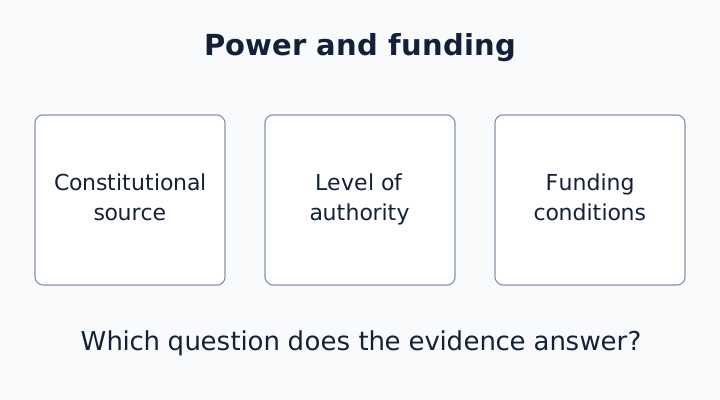
Keep a power’s source, its allocation, and a transfer’s conditions separate.
Predict first
A state is offered funds limited to one specifically defined kind of expenditure. Which feature should you examine first to distinguish the grant from a broad-purpose transfer?
In short. Federalism shares authority across national and state governments through distinct and shared powers, while funding conditions and mandates shape their relationship.
- Federalism concerns national and state levels rather than branches within one level.
- Enumerated, implied, reserved, and concurrent describe different sources or allocations of power.
- Funding conditions and mandates must be read as separate mechanisms.
Part 2 Learn it Power and funding
2a. Distinguish levels and sources of authority
Federalism shares power between national and state governments. Federalist No. 39 explains the Constitution’s mixture of national and state features: divided authority can prevent concentration and provide several access points for political participation. Federalism is therefore different from a separation of branches within one level.
An exclusive power belongs to one level. A national power can be enumerated, meaning stated in the Constitution, or implied as a means of carrying out a listed power under the Necessary and Proper Clause. The source of a power and whether it is shared are related but different questions. Do not assume that every activity involving the national government excludes all state authority.
Primary text: Federalist No. 39, concluding comparison of federal and national features.
In Federalist No. 39, Madison treats the state-based foundation through ratification as federal and the government’s operation on individual citizens as national. These different features support his mixed-system argument.
Quick check · Fill the statement
Apply the distinction in the completed statement.
A constitutional text explicitly states an power; a means inferred for carrying out a listed power is .
2b. Separate reserved powers from concurrent powers
Reserved powers are powers not delegated to the national government and retained by states under the Tenth Amendment’s reservation principle. The amendment reserves undelegated powers not prohibited to the states to the states respectively, or to the people. Concurrent powers are exercised by both national and state governments, such as taxation, making and enforcing laws, and building roads.
When both levels tax, the example establishes shared authority; it does not make either level a mere administrative office of the other. State authority also operates within constitutional limits. A claim that a power is reserved does not authorize a state to disregard valid constitutional protections or lawful national supremacy. Identify the constitutional source, the level of government, and the applicable limit.
Quick check · Fill the statement
Apply the distinction in the completed statement.
State-retained powers are , while taxation by both national and state governments illustrates powers.
2c. Read funding conditions before labeling a grant
Intergovernmental funding can come with different degrees of restriction. Revenue sharing gives states national funds with almost no restrictions on use and is the least-used form described here. Block grants allow comparatively broad state discretion within a general purpose and are often preferred by states. Categorical grants restrict funds to specified expenditure categories, are commonly preferred by the national government, and are the most commonly used form.
A mandate is a national requirement directed at states, not merely a label for money with a purpose. The distinction between a requirement and a transfer matters even when both influence state policy. Do not turn minimal restrictions into no restrictions for a block grant, or infer from a mandate alone that the national government supplied full funding.
Quick check · Fill the statement
Apply the distinction in the completed statement.
A grant restricted to a specified expenditure category is ; a broad-purpose transfer with greater state discretion is a grant.
Part 3 Watch it done Classify the authority before the funding arrangement
Three national funding proposals offer states different conditions: A permits almost unrestricted use, B permits broad use within a policy purpose, and C specifies a narrow expenditure category.
Step 1 · Read the institutional evidence
The proposals vary in how closely spending is directed. A lacks a substantial category restriction; B states a broad purpose; C specifies a narrow use.
Why this step?
Why does the presence of money alone fail to distinguish the mechanisms?
All three are national transfers. The restrictions on state use identify the funding mechanism.
Step 2 · Separate the competing explanations
A broad purpose and almost unrestricted use are different conditions, even though both offer more discretion than a narrow category.
Your step · Decide and justify
Which mechanism most directly fits Proposal C?
Which reason supports this classification?
A contrasting worked example: source and allocation
Both national and state governments tax residents under their respective authority. That makes taxation concurrent rather than reserved exclusively to states. A separate national power, coining money, illustrates an exclusive allocation. First ask who holds the power, then ask whether the national authority is explicitly enumerated or implied as a means. A block grant, by contrast, is a funding arrangement, so it does not answer either constitutional classification by itself.
Part 4 Try it Classify new situations
Original teaching scenarios: Assign each situation to the concept it most directly illustrates.
Try it · Sort it
Assign each situation to the concept it most directly illustrates.
Enumerated power
Reserved power
Concurrent power
Try it · Fill the statement
Complete the analysis of this situation.
A state asks for almost unrestricted national funds: that mechanism is , the used form in this framework. States tend to prefer grants, while the national government tends to prefer grants, the most commonly used form.
Part 5 Explain it Defend a claim about divided authority
Free response is 50% of the exam score. This one is shaped like Question 4, Argument Essay.
Free-response practice · Question 4 style
Original argument practice: develop a defensible thesis about whether mixed national and state authority can help limit concentration of power while preserving opportunities to participate. Support it with Federalist No. 39’s mixed-structure reasoning and a concrete concurrent-power or funding example. Explain the evidence and respond to the view that several governments merely complicate public influence.
Model answer
Divided national and state authority can limit concentration and create more than one route for participation because no single level holds every relevant policy decision. Federalist No. 39 explains the Constitution’s mix of national and state features. For example, both levels tax within their authority, and a group can seek a national grant while separately petitioning a state legislature about the state budget. The added steps can complicate advocacy, but the group still has distinct institutions to approach rather than only one decision maker. The mechanism creates opportunities, not equal influence or a promised outcome.
Score your own answer. This is a self-check, not a grade. Tick each point your answer makes.
Part 6 Check yourself Read conditions and powers separately
An original exercise gives a state two national funding offers and one national requirement.
| Arrangement | Stated condition |
|---|---|
| Offer A | Funds for a broad purpose with substantial state discretion |
| Offer B | Funds only for a specified expenditure category |
| Requirement C | States must follow a national rule; no funding term is stated |
Case question 1 · Multiple choice
Which comparison of the two offers is best supported?
Case question 2 · Multiple choice
What does Requirement C establish without additional funding information?
The rest stand on their own and do not use the case.
Check yourself · Spot the error
Select the statement with a conceptual or factual error.
Check yourself · Match
Match each idea to the explanation that distinguishes it from the alternatives.
Check yourself · Fill the statement
Recall the mixed structure in Madison’s Federalist No. 39.
Using Madison’s distinctions in Federalist No. 39, ratification through the states is a feature, while the government’s operation on individual citizens is a feature.
Part 7 Keep it Retrieve and connect
From 1.3 Government Power and Individual Rights · Match
Match each idea to the explanation that distinguishes it from the alternatives.
From 1.1 Ideals of Democracy · Match
Match each safeguard to the institutional arrangement it describes.
In three lines
- Federalism concerns national and state levels rather than branches within one level.
- Enumerated, implied, reserved, and concurrent describe different sources or allocations of power.
- Funding conditions and mandates must be read as separate mechanisms.
Exam strategy for this topic
- Section I, Multiple Choice: 55 questions in 80 minutes.
- Section II, Free Response: 4 questions in 100 minutes.
- This lesson's Explain it is shaped like free-response question 4, Argument Essay.
Keep a power’s source, its allocation, and a transfer’s conditions separate. Support the connection with a specific fact from the prompt.
Questions students ask
Is an implied power necessarily shared?
Implied describes a power inferred as a means of carrying out an enumerated power. Concurrent describes authority shared by both levels. These terms answer different questions.
Why do states often prefer block grants?
They permit more discretion within a broad purpose than categorical grants. That preference does not mean the grant has no conditions, and it does not make a grant a new constitutional power.
Which national transfer has almost no use restrictions?
Revenue sharing, which the framework identifies as the least-used form. Block grants retain a broad purpose; categorical grants restrict expenditures to a specified category.
How does Federalist No. 39 explain participation?
Its mixed national/state structure disperses authority. Institutions at more than one level can offer access points, although an opportunity to seek influence does not guarantee success.
Course alignment, for teachers
AP U.S. Government and Politics topic 1.7, Unit 1: Foundations of American Democracy.
- Skill 5.A: Articulate a defensible claim/thesis.
This lesson maps all 5 essential knowledge statements of the topic to the part that teaches each one: 5 are checked by a scored question. The map is in the lesson file.