Unit 2 · Topic 2.10 · about 30 minutes · 7 parts · 9 scored checks, 2 of them multiple choice, plus 2 from earlier lessons
AP U.S. Government and Politics 2.10: The Court in Action
Unit 2: 25 to 36% of the multiple-choice section
What you'll be able to do
- Explain how life tenure can lead to debate about the Supreme Court’s power.
Key vocabulary
| Term | What it means | The exam trap |
|---|---|---|
| Life tenure | Judicial service during good behavior, potentially lasting across administrations and elections. | Identify the office’s tenure rule rather than a prediction of a case outcome. |
| Judicial independence | Institutional protection for legal judgment against immediate political pressure. | Separate the safeguard from the reasoning used in the particular case. |
| Controversial decision | A ruling that generates disagreement or resistance and debate about judicial power. | Identify the reaction actually evidenced rather than assuming a national opinion total. |
| Equal Protection Clause | The Fourteenth Amendment rule that a state may not deny any person within its jurisdiction equal protection of the laws; Brown applies it to racial segregation in public education. | Identify the constitutional protection and the challenged state action. |
| Compliance | Carrying out the legal obligation imposed by a governing decision or rule. | A dispute over implementation differs from the initial decision establishing the rule. |
| Political accountability debate | Disagreement about how decision makers should answer to the public and other institutions. | Describe the institutional arguments without substituting approval of the policy outcome. |
 Tap to open the picture full size
Part 1 Think first Predict the institutional consequence
Choose a starting hypothesis, then distinguish the different institutional questions.
Predict first
A court’s ruling faces official opposition. Which evidence would you examine first to explain the controversy?
In short. Judicial tenure supports independence from immediate political pressure, allowing decisions that can generate controversy and debate about the Court’s power.
- Explain tenure as a safeguard rather than a guarantee.
- Compare the rule in Brown with compliance in the supplied Cooper profile.
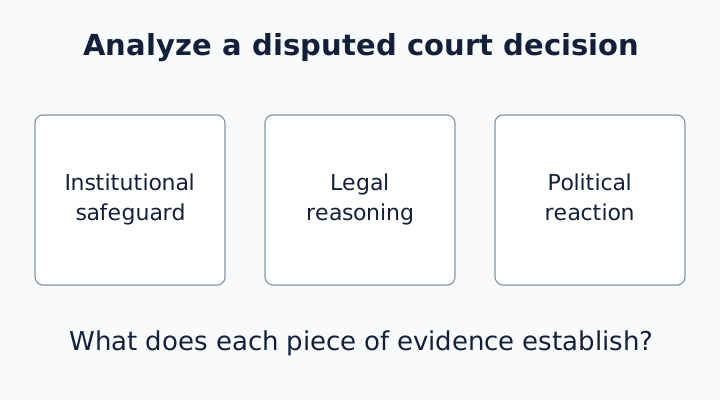
- Separate legal reasoning from evidence about political reaction.
Part 2 Learn it Explain the safeguard without promising a result
2a. Explain the safeguard without promising a result
Federal judges’ service during good behavior can extend beyond an administration or election cycle. Life tenure therefore helps courts act independently of the current political climate. A justice need not win a new election after an unpopular decision to remain in office.
This institutional safeguard can permit controversial rulings, which can produce debate about the Court’s power. Defenders may emphasize protecting constitutional rights despite pressure; critics may emphasize the distance between life-tenured decision makers and current public preferences. These are arguments about institutional design, not proof that every particular decision is legally correct or incorrect.
Keep three questions distinct: what protects the judge’s independence, what legal reasoning supports the decision, and how other actors react. Independence does not remove constitutional limits on jurisdiction or make every judgment beyond reconsideration. Explain the safeguard’s effect rather than treating tenure as a guarantee of impartiality.
Quick check · Fill the statement
Identify the institutional safeguard.
Service during good behavior supports judicial from immediate political pressure; it does not itself prove every ruling’s legal .
2b. Read the required case’s legal rule
Brown v. Board of Education (1954) involved challenges to state-imposed racial segregation in public schools. The Equal Protection issue was not resolved merely by comparing the physical quality of school buildings. The majority reasoned that educational opportunity includes effects beyond tangible facilities and that segregated educational facilities are inherently unequal.
The Court rejected the separate-but-equal doctrine in public education and held that the challenged racial segregation denied Equal Protection. The holding establishes a constitutional rule; it does not by itself describe every later implementation step or the views of all members of the public.
For this lesson, use Brown to distinguish constitutional reasoning from political reaction. A decision’s legal foundation and the controversy surrounding its application are different pieces of evidence. Primary opinion: Brown, U.S. Reports.
Quick check · Fill the statement
Identify the required case’s protection.
Brown held state-imposed school segregation unconstitutional under the Fourteenth Amendment’s Clause.
2c. Compare a supplied case about resistance
The non-required case Cooper v. Aaron (1958) arose when a Little Rock school board requested a pause in desegregation amid opposition by Arkansas officials and resulting disorder. The Court rejected the requested suspension, requiring compliance with the constitutional rule applied in Brown. It reasoned that students’ rights could not be sacrificed because other state officials generated resistance.
The comparison is specific: Brown addresses the constitutionality of school segregation; Cooper addresses compliance with that rule amid resistance. Cooper did not overrule Brown. Its facts demonstrate institutional opposition in that setting, not a national opinion poll.
Life tenure helps explain how a court can issue or maintain a ruling despite immediate pressure. The case’s legal reasoning still matters, and enforcement involves other institutions. A careful explanation connects independence to the possibility of controversial decisions without assuming that opposition either invalidates the holding or disappears after judgment. Primary opinion: Cooper, U.S. Reports.
Quick check · Fill the statement
Compare the legal questions.
Brown states the constitutional ; Cooper’s supplied profile concerns with that rule amid resistance.
Part 3 Watch it done Connect tenure to a political controversy
An original institutional scenario has a Court applying a constitutional protection despite strong opposition from current state officials. An observer argues that the justices must face an immediate reelection to keep their seats.
Step 1 · Identify the safeguard
Federal judicial service during good behavior differs from a fixed electoral term. The office’s tenure rule and the popularity of the ruling are different facts.
Why this step?
Why should the legal holding be separated from its political reception?
Constitutional reasoning addresses legal validity; opposition describes a reaction. One cannot simply substitute for the other.
Step 2 · Explain the institutional consequence
Use the tenure arrangement to evaluate the observer’s proposed immediate election requirement.
Your step · Decide and justify
Which inference follows from the stated federal tenure rule?
Which institutional reason supports the decision?
A contrasting worked example
Brown held state-imposed public-school segregation unconstitutional. Cooper later rejected a requested suspension amid official resistance. The second case applies and protects the first rule rather than overturning it. The comparison separates the constitutional holding, practical opposition, and the independent institution issuing the decision.
Part 4 Try it Classify the institutional action
Original teaching situations: distinguish what each institution can do.
Required-case profile
Brown v. Board of Education (1954), a required case: Black children challenged state-imposed racial segregation in public schools. The issue was Equal Protection under the Fourteenth Amendment. The Court held that segregated public educational facilities are inherently unequal, even if physical facilities are comparable, and rejected the separate-but-equal doctrine in public education. The reasoning concerns equal educational opportunity and segregation’s effects, not merely matching buildings.
Supplied non-required case profile
Cooper v. Aaron (1958), a supplied non-required case: a Little Rock school board sought a pause in desegregation amid opposition by Arkansas officials and resulting disorder. The Court rejected the requested suspension and insisted on compliance with the federal constitutional rule applied in Brown. Rights could not be sacrificed to resistance generated by other state officials. This summary supplies the facts and reasoning needed for comparison; memorizing this additional case is not required.
Try it · Sort it
Which question does the observation most directly address?
Tenure safeguard
Constitutional reasoning
Implementation and reaction
Part 5 Explain it Compare a required case with a supplied case
Free response is 50% of the exam score. This one is shaped like Question 3, SCOTUS Comparison.
Free-response practice · Question 3 style
Original SCOTUS-comparison practice: use the Brown and Cooper profiles above. (A) Identify the constitutional protection implicated by Brown. (B) Explain a factual similarity and a legal difference between the cases using the supplied information. (C) Explain how life tenure can help a Court maintain a disputed ruling, and why this can generate debate about its power.
Model answer
Brown concerns the Fourteenth Amendment’s Equal Protection Clause. Both profiles involve racial segregation in public education, but Brown determines the constitutional rule while Cooper addresses compliance with it amid official resistance. Cooper rejects suspension rather than reversing Brown. Service during good behavior helps justices remain in office without seeking immediate electoral approval, supporting independent application of a rule despite pressure. That distance can prompt debate: defenders emphasize protection of constitutional rights, while critics question the responsiveness of life-tenured officials. The legal reasons and evidence of resistance still need separate analysis.
Score your own answer. This is a self-check, not a grade. Tick each point your answer makes.
Part 6 Check yourself Compare the required and supplied cases
Use these paraphrased profiles for comparison. The additional case is supplied for practice rather than added to the required-case inventory.
| Case | Legal problem and response |
|---|---|
| Brown v. Board of Education | State-imposed school segregation; the Court held separate educational facilities inherently unequal under Equal Protection |
| Cooper v. Aaron | Requested delay amid resistance to desegregation; the Court rejected suspension and required compliance with the constitutional rule |
Case question 1 · Multiple choice
Which substantive constitutional concern connects the two profiles?
Case question 2 · Multiple choice
Which comparison best distinguishes their immediate legal questions?
The rest stand on their own and do not use the case.
Check yourself · Spot the error
Select the statement that makes an institutional error.
Check yourself · Match
Match each term to its distinguishing institutional feature.
Part 7 Keep it Retrieve and connect
From 2.8 The Judicial Branch · Fill the statement
Connect the source and case.
Hamilton treats the Constitution as law, so independent judicial should prefer it over a conflicting ordinary statute.
From 2.8 The Judicial Branch · Fill the statement
Separate the right from the forum’s power.
Marbury’s recognized right did not itself expand the Supreme Court’s beyond Article III.
In three lines
- Explain tenure as a safeguard rather than a guarantee.
- Compare the rule in Brown with compliance in the supplied Cooper profile.
- Separate legal reasoning from evidence about political reaction.
Exam strategy for this topic
- Section I, Multiple Choice: 55 questions in 80 minutes.
- Section II, Free Response: 4 questions in 100 minutes.
- This lesson's Explain it is shaped like free-response question 3, SCOTUS Comparison.
Choose a starting hypothesis, then distinguish the different institutional questions.
Questions students ask
Does life tenure make a decision legally correct?
No. It supports independence from immediate political pressure. The case’s reasoning and the court’s legal authority remain separate questions.
How does Cooper relate to Brown?
The supplied Cooper profile concerns compliance with Brown’s school-desegregation rule amid resistance. It applies the protection rather than overruling the required case.
Do the case facts measure national public opinion?
No. They establish the official resistance described in that setting. A national opinion claim would require different evidence.
Why can tenure generate debate?
It can protect constitutional judgment from current pressure, but also distance judicial decision makers from immediate electoral preferences. Explain those institutional arguments rather than assuming controversy decides legality.
Course alignment, for teachers
AP U.S. Government and Politics topic 2.10, Unit 2: Interactions Among Branches of Government.
- Skill 2.C: Explain how the facts, issue, holding, reasoning, decision, and majority opinion of a required Supreme Court case compare to a non-required Supreme Court case.
This lesson maps the one essential knowledge statement of the topic to the part that teaches each one: 1 is checked by a scored question. The map is in the lesson file.