Unit 2 · Topic 2.9 · about 30 minutes · 7 parts · 9 scored checks, 2 of them multiple choice, plus 2 from earlier lessons
AP U.S. Government and Politics 2.9: The Role of the Judicial Branch
Unit 2: 25 to 36% of the multiple-choice section
What you'll be able to do
- Explain the role of legal precedent in judicial decision making.
Key vocabulary
| Term | What it means | The exam trap |
|---|---|---|
| Stare decisis | The doctrine of following legal precedent in cases with similar facts. | Compare the rule and relevant facts rather than the parties’ names. |
| Distinguishing | Explaining why an earlier precedent does not control materially different circumstances. | Identify the legal difference the later opinion relies on. |
| Overruling | Rejecting an earlier legal rule through a later judicial decision. | Locate the decision replacing the rule rather than merely a different outcome. |
| Precedent | An earlier decision whose legal rule or reasoning guides later cases. | Identify which legal proposition the later court is considering. |
| Ideological composition | The mix of judicial perspectives represented in the Court’s membership. | Distinguish evidence about membership from the result of a particular case. |
| Judicial appointment | Selection through presidential nomination and Senate confirmation for the applicable judicial office. | Identify the personnel decision separately from a later judicial ruling. |
 Tap to open the picture full size
Part 1 Think first Predict the institutional consequence
Choose a starting hypothesis about the different result, then test it against the legal sequence.
Predict first
A later court reaches a different result. Which possibility would you investigate first?
In short. Precedent guides decisions in similar cases, while appointments can change the Court’s composition and influence which rules it keeps or rejects.
- Compare relevant facts before applying an earlier rule.
- Distinguish a new legal setting from rejection of a precedent.
- Separate appointment-driven composition changes from later judicial decisions.
Part 2 Learn it Compare the governing rule and relevant facts
2a. Compare the governing rule and relevant facts
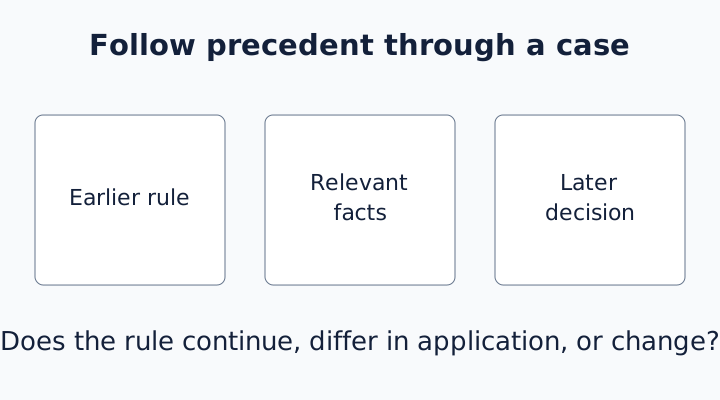
Stare decisis is the doctrine under which courts follow legal precedents when deciding cases with similar facts. A precedent is an earlier decision supplying a rule or reasoning for later cases. The doctrine supports continuity: a later case is not treated as unrelated merely because the parties have different names.
Compare legally relevant features. Under a fictional statute, an earlier decision may require written notice before a permit is withdrawn. A later dispute under the same statute with materially similar facts calls for considering that rule. A case under a different statute containing an express exception can raise a different legal question.
Distinguishing explains why a precedent does not control materially different circumstances. Overruling rejects an earlier rule. These are different actions even when both later cases have outcomes unlike the earlier one. Describe the later court’s reasoning before deciding whether the governing precedent has changed.
Quick check · Fill the statement
Apply the similarity requirement.
Following an earlier legal rule in a case with materially similar facts illustrates .
2b. A precedent can guide and still be reconsidered
Stare decisis plays an important role but does not make legal precedent unchangeable. A court can continue applying a rule, explain why another case is different, or reject an earlier rule in a later decision. The judicial act and its stated reasoning distinguish these possibilities.
A real example is Brown v. Board of Education (1954). The Court held that state-imposed racial segregation in public schools violates the Equal Protection Clause. Its majority rejected the separate-but-equal doctrine in public education, reasoning that separate educational facilities are inherently unequal. This illustrates a change in governing doctrine, not just a case with different party names.
Use the example precisely. Brown demonstrates that a previously accepted doctrine can be rejected. The holding alone does not identify the effect of every individual appointment or explain every later implementation dispute. Primary opinion: Brown v. Board of Education, U.S. Reports.
Quick check · Fill the statement
Identify the change in legal rule.
Explaining a material difference is ; rejecting the earlier governing rule is .
2c. Appointments can change the decision-making body
Presidential appointments can change the Supreme Court’s ideological composition. Such changes have led the Court to establish new precedents or reject existing ones. The president nominates and the Senate confirms; the resulting membership can affect the views represented when later cases are decided.
An appointment is not itself a judicial decision overruling an earlier case. A new justice joins a Court that still encounters precedent, facts, and legal arguments. The later opinion and its treatment of the earlier rule supply evidence about continuity or change.
In an original scenario, several new appointments change the perspectives represented on a Court. The Court later decides to reject an earlier interpretation. Describe both stages: membership change can influence judicial direction, while the later decision establishes the changed rule. Do not treat ideological composition as proof that every justice follows an appointing president’s preference in every case.
Quick check · Fill the statement
Separate membership and a decision.
Presidential appointments can change the Court’s , while a later supplies evidence that a precedent has been rejected.
Part 3 Watch it done Identify the judicial act, not just a personnel event
A fictional Court has an earlier interpretation requiring notice under a statute. A new justice joins. Later, the Court expressly rejects that interpretation and replaces it for materially similar cases.
Step 1 · Separate the events
A confirmation changes membership. A later opinion supplies the Court’s treatment of the legal rule.
Why this step?
Why compare the later opinion with the earlier rule?
It reveals whether the Court follows the rule, identifies different circumstances, or replaces the rule.
Step 2 · Use the stated legal action
The later opinion concerns materially similar cases and expressly replaces the former interpretation. Classify that act rather than the appointment alone.
Your step · Decide and justify
How does the later opinion treat the precedent?
Which institutional reason supports the decision?
A contrasting worked example
Brown held state-imposed school segregation unconstitutional under Equal Protection and rejected the separate-but-equal doctrine in public education. The change concerns the governing legal standard, not a new school’s name alone. That is an example of a Court rejecting an earlier doctrine. It does not, without more evidence, show that one appointment mechanically caused the result.
Part 4 Try it Classify the institutional action
Original teaching situations: distinguish what each institution can do.
Try it · Sort it
How does the later court treat the earlier rule?
Applies precedent
Distinguishes circumstances
Rejects earlier rule
Part 5 Explain it Explain continuity and change in a later case
Free response is 50% of the exam score. This one is shaped like Question 1, Concept Application.
Free-response practice · Question 1 style
Original concept-application practice: an earlier Court interprets a statute one way. Presidential appointments change the Court’s composition. In a later case with materially similar facts, the Court expressly rejects the earlier interpretation. (A) Describe how stare decisis would ordinarily be relevant. (B) Explain why the supplied later act is overruling rather than distinguishing. (C) Explain how appointments can influence this process without themselves deciding the case.
Model answer
Stare decisis makes the earlier rule relevant because the later case has materially similar facts under the same statute. The Court expressly rejects and replaces that rule, so the described action is overruling, not identifying a different legal setting. Presidential appointments can change the ideological composition and perspectives represented on the Court, influencing which precedents it establishes or rejects. The personnel changes remain distinct from the later judicial opinion: the appointment alone does not announce a new governing rule or prove how every justice votes.
Score your own answer. This is a self-check, not a grade. Tick each point your answer makes.
Part 6 Check yourself Read an invented precedent sequence
These are simplified invented statutory examples for reasoning practice, not statements of an actual notice law. The earlier case interprets Statute P to require written notice before permit withdrawal.
| Later event | Supplied facts and action |
|---|---|
| Case A | Under Statute P and materially similar facts, the Court orders written notice |
| Case B | A different statute contains an express exception; the Court applies it without calling the P rule incorrect |
| Case C | The Court declares the former P interpretation incorrect and replaces it for similar future cases |
Case question 1 · Multiple choice
Which event most directly illustrates applying precedent to materially similar facts?
Case question 2 · Multiple choice
Why need Case B not overrule the P precedent?
The rest stand on their own and do not use the case.
Check yourself · Spot the error
Select the statement that makes an institutional error.
Check yourself · Match
Match each term to its distinguishing institutional feature.
Part 7 Keep it Retrieve and connect
From 2.8 The Judicial Branch · Fill the statement
Connect the source and case.
Hamilton treats the Constitution as law, so independent judicial should prefer it over a conflicting ordinary statute.
From 2.5 Checks on the Presidency · Fill the statement
Explain the time horizon.
A confirmed federal judge may remain after the president leaves office because judicial is not a fixed term.
In three lines
- Compare relevant facts before applying an earlier rule.
- Distinguish a new legal setting from rejection of a precedent.
- Separate appointment-driven composition changes from later judicial decisions.
Exam strategy for this topic
- Section I, Multiple Choice: 55 questions in 80 minutes.
- Section II, Free Response: 4 questions in 100 minutes.
- This lesson's Explain it is shaped like free-response question 1, Concept Application.
Choose a starting hypothesis about the different result, then test it against the legal sequence.
Questions students ask
Does stare decisis make precedent permanent?
No. It guides decisions in similar cases, but courts can reject earlier rules. Distinguish that rejection from deciding that another case has materially different facts.
Does a different result prove overruling?
No. A different governing statute or relevant factual condition can explain a different outcome while the earlier rule remains intact.
What can appointments change?
They can change the Court’s ideological composition and influence later treatment of precedents. They do not themselves issue the judicial opinion deciding a case.
What does Brown illustrate here?
It rejected the separate-but-equal doctrine in public education and held state-imposed racial segregation in schools unconstitutional. That illustrates change in governing doctrine, without by itself proving the effect of a particular appointment.
Course alignment, for teachers
AP U.S. Government and Politics topic 2.9, Unit 2: Interactions Among Branches of Government.
- Skill 1.D: Describe political principles, institutions, processes, policies, and behaviors illustrated in different scenarios in context.
This lesson maps all 2 essential knowledge statements of the topic to the part that teaches each one: 2 are checked by a scored question. The map is in the lesson file.