Unit 2 · Topic 2.12 · about 30 minutes · 7 parts · 11 scored checks, 2 of them multiple choice, plus 2 from earlier lessons
AP U.S. Government and Politics 2.12: The Bureaucracy
Unit 2: 25 to 36% of the multiple-choice section
What you'll be able to do
- Explain how the bureaucracy carries out the responsibilities of the federal government.
Key vocabulary
| Term | What it means | The exam trap |
|---|---|---|
| Regulation | An administrative rule written and enforced under applicable legal authority. | Identify the source of authority and implementing action rather than a new statute. |
| Fine | An authorized monetary penalty for a violation. | A penalty and the general rule being enforced are different things. |
| Congressional testimony | Providing information or explanations to a congressional committee or hearing. | Identify who reports and who exercises the legislative role. |
| Bureaucracy | Administrative organizations that carry out government responsibilities and policy. | Locate the organization and task instead of treating every political actor as an agency. |
| Iron triangle | An alliance of a congressional committee, bureaucratic agency, and interest group in a policy area. | Identify all three roles and the recurring relationship. |
| Issue network | A temporary coalition formed to promote a common issue or agenda. | Look for the coalition’s participants and stated duration. |
| Merit system | Career selection and promotion emphasizing professionalism, specialization, and neutrality. | Identify job-related criteria rather than the popularity of the resulting policy. |
| Political patronage | Political appointment or sponsorship as the basis of bureaucratic job selection. | Distinguish the selection criterion from a legal judgment about an individual appointee. |
| Government corporation | A public organization using a corporate form for a governmental task. | Public status differs from a private interest group seeking influence. |
| Neutrality | Applying the public role and program criteria without party favoritism. | The term concerns official work rather than requiring the absence of personal opinions. |
| Professionalism | Job-related competence and standards in carrying out public responsibilities. | Identify performance and professional criteria rather than political sponsorship. |
| Specialization | Relevant expertise for the particular administrative task or policy area. | Look for the specific knowledge or skill required by the work. |
 Tap to open the picture full size
Part 1 Think first Predict the institutional consequence
Choose a starting hypothesis about the administrative work, then test it against the scenario.
Predict first
An agency develops a rule and receives questions from lawmakers. Which feature would you investigate first to explain its work?
In short. Federal administrative organizations implement policy through rules, enforcement, testimony, and policy relationships, while career hiring primarily uses merit.
- Identify the authorized administrative task.
- Use actors and duration to distinguish policy relationships.
- Explain merit criteria through their connection to professional implementation.
Part 2 Learn it Follow implementation through administrative organizations
2a. Follow implementation through administrative organizations
The federal bureaucracy includes departments, agencies, commissions, and government corporations. These administrative organizations carry out public policy rather than simply repeat a president’s speech or a congressional vote. The organizational names can overlap in broader usage; they are not a rule that every public body fits only one everyday label.
Implementation includes writing and enforcing regulations, issuing authorized fines, and testifying before Congress about administrative work. A regulation carries out legal authority; a fine is a monetary penalty imposed under applicable authority; congressional testimony explains actions and experience to lawmakers. These are different functions even when one agency performs all three.
A government corporation is a public organization using a corporate form to carry out a governmental task. The term does not simply mean a private business that wants a favorable policy. Identify the public institution, its task, and the authority for the action before deciding what the scenario shows.
Quick check · Fill the statement
Identify the administrative function.
An agency writes a rule under statutory authority, creating a ; an authorized monetary penalty for violating it is a .
2b. Compare durable alliances and temporary coalitions
An iron triangle is an alliance involving a congressional committee, a bureaucratic agency, and an interest group prominent in a policy area. The actors can exchange information and support while influencing policy. The concept identifies a relationship; it does not by itself prove an unlawful conspiracy or identical views on every question.
An issue network is a temporary coalition that forms to promote a common issue or agenda. Its participants and duration can differ from the recurring committee-agency-interest-group relationship. A shared topic alone does not tell which pattern is present.
For an original example, a committee, agency, and organized interest regularly cooperate around one program. Compare that with a temporary coalition of researchers, officials, and advocates assembled for a particular proposal. Use the actors, their relationship, and the stated duration. Agencies remain administrative organizations carrying out policy even when their work includes these political relationships.
Quick check · Fill the statement
Identify the roles in a recurring policy alliance.
A conducts legislative oversight, a administers the program, and an advocates policy interests.
2c. Explain the merit system and the alternative criterion
The civil service primarily uses a merit system emphasizing professionalism, specialization, and neutrality. Professionalism concerns job-related competence and standards; specialization concerns relevant expertise; neutrality concerns applying the public role without party favoritism. These features describe selection and administration, not a demand that an employee have no private opinions.
Political patronage bases bureaucratic jobs on political appointment or sponsorship rather than the career merit criteria. Federal administration also contains legitimate political appointees, including leadership positions. The comparison is about the basis and role of selection, not a claim that every political appointment is criminal or every career decision is perfect.
The teaching memo argues that relevant expertise and neutral criteria support consistent implementation. Explain the proposed connection: staff capable of understanding and applying program rules can help carry out the law. Do not turn that argument into a claim that expertise grants unlimited agency authority or removes the need for oversight.
Merit criteria apply to promotion as well as hiring. Advancement based on documented professional performance, relevant specialized expertise, and neutral administration differs from advancement primarily awarded for political sponsorship.
Quick check · Fill the statement
Compare selection criteria.
Career hiring emphasizing relevant expertise and neutral job criteria illustrates a ; hiring primarily for political sponsorship illustrates .
Part 3 Watch it done Read the actors and the duration
An original scenario describes a congressional committee, an administrative agency, and an interest group maintaining a recurring alliance around one program.
Step 1 · Identify the three roles
The committee conducts legislative work and oversight, the agency administers the program, and the interest group seeks influence.
Why this step?
Why examine roles and duration rather than just the topic?
A shared policy concern can appear in different relationships; the actor pattern and recurring cooperation distinguish this one from a temporary coalition.
Step 2 · Classify the relationship
Use the stated alliance and duration. Do not assume that every relationship is unlawful or that any group of interested people is the same arrangement.
Your step · Decide and justify
Which concept best describes this recurring three-actor alliance?
Which institutional reason supports the decision?
A contrasting worked example
Researchers, local officials, and advocacy groups temporarily coordinate around a water-monitoring proposal and disperse when that effort ends. The facts describe an issue network because the coalition promotes a shared agenda for a temporary effort. No congressional committee-agency-interest-group recurring alliance is supplied. The policy subject alone would not establish the distinction.
Part 4 Try it Classify the institutional action
Original teaching situations: distinguish what each institution can do.
Source for the written task
Original teaching memo, not an actual agency document: “Implementation is more consistent when career staff are selected for relevant expertise and apply program criteria without party favoritism. Qualifications and neutral administration help an agency carry out the law rather than distribute jobs as political rewards.” Analyze this argument; the memo is not an empirical study proving that every hiring decision works well.
Try it · Sort it
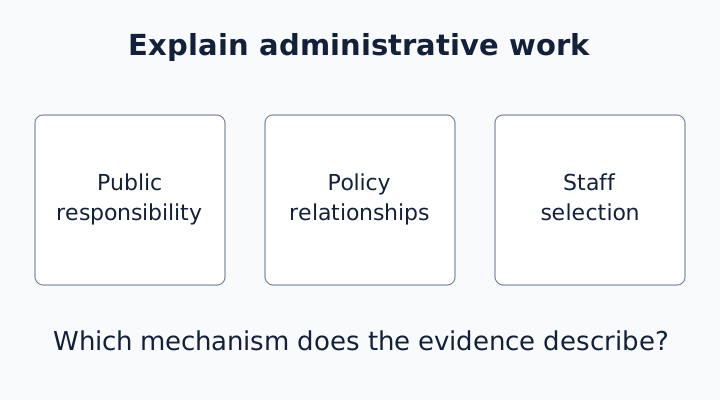
What administrative function or relationship is directly described?
Carry out or report administration
Form policy relationships
Select administrative staff
Try it · Fill the statement
Apply the institutional distinction.
A public organization using a corporate form to carry out a governmental task is a .
Try it · Fill the statement
Apply the selection distinction to advancement.
A promotion based on documented job performance and relevant expertise uses a ; another promotion awarded primarily for political sponsorship illustrates .
Part 5 Explain it Explain administration and the memo’s argument
Free response is 50% of the exam score. This one is shaped like Question 1, Concept Application.
Free-response practice · Question 1 style
Original source-based concept-application practice: use the teaching memo above. (A) Describe one way an agency carries out policy under legal authority. (B) Explain how the memo’s argument about merit criteria relates to that responsibility. (C) Explain how a recurring committee-agency-interest-group alliance differs from a temporary issue coalition.
Model answer
An agency can write and enforce an authorized regulation or issue a lawful penalty; it can also report implementation through congressional testimony. The memo links job-related expertise and neutral administration to consistent application of program rules. That is a reason for merit selection rather than a claim that staff expertise supplies unlimited legal power. A recurring alliance among a committee, agency, and interest group is an iron triangle; a temporary coalition promoting a common agenda is an issue network. The roles and duration support the comparison, not merely a shared policy topic.
Score your own answer. This is a self-check, not a grade. Tick each point your answer makes.
Part 6 Check yourself Analyze the memo’s institutional argument
Original teaching memo, not an actual agency document: “Implementation is more consistent when career staff are selected for relevant expertise and apply program criteria without party favoritism. Qualifications and neutral administration help an agency carry out the law rather than distribute jobs as political rewards.” Analyze this argument; the memo is not an empirical study proving that every hiring decision works well.
| Observed feature | Original scenario |
|---|---|
| Career selection | Applicants are assessed for relevant expertise and neutral job criteria |
| Administrative work | Selected staff apply an authorized regulation using the same program standards |
| Political leadership | A separate leadership appointment follows political selection |
Case question 1 · Multiple choice
Which system does the career-selection row illustrate?
Case question 2 · Multiple choice
How does the memo’s argument relate to bureaucratic responsibility?
The rest stand on their own and do not use the case.
Check yourself · Spot the error
Select the statement that makes an institutional error.
Check yourself · Match
Match each term to its distinguishing institutional feature.
Part 7 Keep it Retrieve and connect
From 2.11 Checks on the Judicial Branch · Fill the statement
Identify which legal rule changes.
Congress revising a program statute uses ; changing constitutional text through Article V uses a .
From 2.4 Roles and Powers of the President · Fill the statement
Identify the legal effect.
An order directs federal management under executive or delegated authority; a communicates the president’s interpretation when signing a law.
In three lines
- Identify the authorized administrative task.
- Use actors and duration to distinguish policy relationships.
- Explain merit criteria through their connection to professional implementation.
Exam strategy for this topic
- Section I, Multiple Choice: 55 questions in 80 minutes.
- Section II, Free Response: 4 questions in 100 minutes.
- This lesson's Explain it is shaped like free-response question 1, Concept Application.
Choose a starting hypothesis about the administrative work, then test it against the scenario.
Questions students ask
Is bureaucracy only rule writing?
No. The required functions include writing and enforcing regulations, issuing authorized fines, testifying before Congress, and participating in policy relationships.
Does an iron triangle mean an unlawful conspiracy?
The term identifies an alliance among a committee, agency, and interest group. Additional evidence would be needed for a claim of unlawful conduct.
What separates an issue network from that triangle?
The framework describes an issue network as a temporary coalition promoting a common issue or agenda. Identify its participants and duration rather than using the topic alone.
Does merit selection mean every job is politically appointed or no employee has opinions?
Neither. Career merit criteria emphasize competence, specialization, and neutral official work. The bureaucracy also contains political appointees, and neutrality concerns administration rather than private belief.
Course alignment, for teachers
AP U.S. Government and Politics topic 2.12, Unit 2: Interactions Among Branches of Government.
- Skill 4.B: Explain how the argument or perspective in the source relates to political principles, institutions, processes, policies, and behaviors.
This lesson maps all 2 essential knowledge statements of the topic to the part that teaches each one: 2 are checked by a scored question. The map is in the lesson file.