Unit 2 · Topic 2.13 · about 30 minutes · 7 parts · 11 scored checks, 2 of them multiple choice, plus 2 from earlier lessons
AP U.S. Government and Politics 2.13: Discretionary and Rulemaking Authority
Unit 2: 25 to 36% of the multiple-choice section
What you'll be able to do
- Explain how the federal bureaucracy uses delegated discretionary authority for rulemaking and implementation.
Key vocabulary
| Term | What it means | The exam trap |
|---|---|---|
| Delegation | A grant of authority to an agency to interpret and implement policy within its scope. | Identify who grants authority and what the grant permits. |
| Discretion | Agency choice among implementation approaches permitted by its legal authority. | Compare the proposed choice with the supplied limits. |
| Rulemaking | Creating administrative regulations under delegated authority. | Identify the institution and the rule being created. |
| Enforcement | Applying authorized rules to conduct and violations. | Separate creation of a general regulation from its application. |
| Implementation | Carrying policy into administrative operation under applicable authority. | Identify the task carried out rather than assuming a policy goal supplies every power. |
| Department of Homeland Security (DHS) | Homeland-security responsibilities. | Use the policy field and legal grant to identify the appropriate administrative role. |
| Department of Transportation (DOT) | Transportation programs and safety. | Use the policy field and legal grant to identify the appropriate administrative role. |
| Department of Veterans Affairs (VA) | Veterans’ services and benefits. | Use the policy field and legal grant to identify the appropriate administrative role. |
| Department of Education (ED) | Federal education responsibilities. | Use the policy field and legal grant to identify the appropriate administrative role. |
| Environmental Protection Agency (EPA) | Human health and environmental protection. | Use the policy field and legal grant to identify the appropriate administrative role. |
| Federal Election Commission (FEC) | Federal campaign finance. | Use the policy field and legal grant to identify the appropriate administrative role. |
| Securities and Exchange Commission (SEC) | Investors and securities markets. | Use the policy field and legal grant to identify the appropriate administrative role. |
 Tap to open the picture full size
Part 1 Think first Predict the institutional consequence
Commit to a starting question about the administrative decision, then follow its legal and institutional context.
Predict first
An agency chooses how to carry out a policy. Which feature would you examine first?
In short. Congress delegates authority that agencies use to choose lawful implementation details, create regulations, and administer different policy responsibilities.
- Separate the congressional grant from the agency’s choice.
- Explain regulations and enforcement within retained legal limits.
- Use the policy field to distinguish the framework’s agency examples.
Part 2 Learn it Separate the grant of power from its use
2a. Separate the grant of power from its use
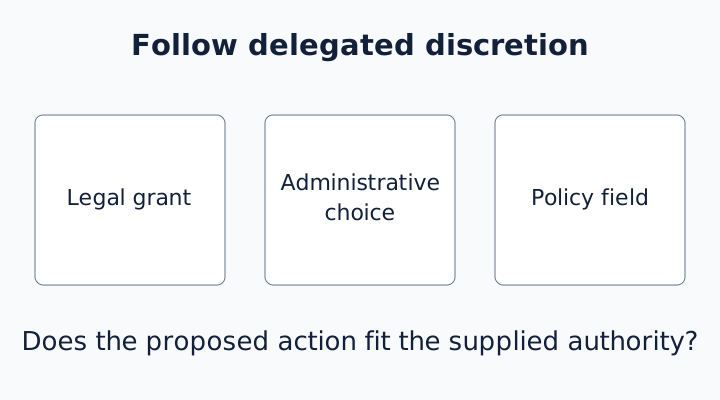
Delegation gives an agency authority to interpret and implement policy within a congressional grant. Discretion is the choice among permitted approaches when the law leaves room for agency judgment. The agency’s role is not to invent an unlimited power merely because it has expertise.
Rulemaking is one way an agency uses its authority: it creates regulations to carry out policy. The source and scope of the delegation matter. A law can establish a goal and leave technical or administrative details to specialists. Choosing a lawful detail differs from replacing the statute’s goal or removing a condition Congress retained.
In an original scenario, a transportation statute permits an agency to choose an inspection sequence. Selecting priorities within that permission illustrates discretion. The congressional grant and the later agency choice are different actions by different institutions.
Quick check · Fill the statement
Identify the source and the choice.
Congress grants an agency authority through ; choosing among approaches allowed by that grant illustrates .
2b. Follow rulemaking into implementation and enforcement
An agency uses rulemaking authority to create regulations within its delegated scope. It can then implement and enforce the applicable rules. Writing a regulation and applying it to a specified violation are different administrative actions, even when the same institution performs both.
Congress legislates the statutory framework; an agency works within its authority to interpret and carry it out. The existence of an administrative choice does not mean Congress must personally decide every permitted detail. Nor does delegation make an agency’s preference a substitute for statutory limits.
Compare the actual action with the permission supplied in a scenario. If the agency chooses an allowed procedure, identify the discretionary choice and its policy role. If it removes an express statutory condition without authority, identify the mismatch. Expertise helps explain who can administer technical work; it does not independently authorize disregarding law.
Quick check · Fill the statement
Distinguish creating and applying a rule.
Adopting a general regulation under an agency’s grant is ; applying that regulation to a violation is .
2c. Apply the framework’s agency examples
The framework includes agencies with different responsibilities. These verified general portfolios orient the practice scenarios; they are not claims about a particular current enforcement action.
- Department of Homeland Security (DHS): Homeland-security responsibilities.
- Department of Transportation (DOT): Transportation programs and safety.
- Department of Veterans Affairs (VA): Veterans’ services and benefits.
- Department of Education (ED): Federal education responsibilities.
- Environmental Protection Agency (EPA): Human health and environmental protection.
- Federal Election Commission (FEC): Federal campaign finance.
- Securities and Exchange Commission (SEC): Investors and securities markets.
For example, federal campaign-finance disclosures belong to the FEC portfolio, while securities-market disclosures concern the SEC. Both can involve financial information, so identify the policy field rather than choosing an agency merely because money is involved. In every example, the actual rulemaking and implementation authority must come from the applicable legal grant.
Quick check · Fill the statement
Identify the financial policy field.
Federal campaign-finance disclosures concern the portfolio; securities-market disclosures concern the portfolio.
Part 3 Watch it done Compare a proposed choice with its permission
A fictional transportation statute lets an agency select inspection priorities but retains a stated eligibility condition. Officials consider either choosing a permitted inspection sequence or deleting that legal condition.
Step 1 · Locate the grant and retained condition
The statute allows a choice of priorities. It separately keeps an eligibility rule in place.
Why this step?
Why identify both the permission and the condition?
They define different parts of the legal scope: what the agency may choose and what the statute still requires.
Step 2 · Test the proposed action
Compare each proposal with the supplied scope rather than treating technical expertise as the source of every power.
Your step · Decide and justify
Which proposal fits the supplied discretionary authority?
Which institutional reason supports the decision?
A contrasting worked example
A campaign-finance scenario concerns implementation of federal disclosure requirements. The relevant example is the FEC, not the SEC merely because both handle financial information. The agency’s discretion can concern lawful implementation details, while the disclosure duty still rests on the applicable legal framework. Naming the right portfolio and naming the source of discretion answer different questions.
Part 4 Try it Classify the institutional action
Original teaching situations: distinguish what each institution can do.
| Agency | General policy field |
|---|---|
| Department of Homeland Security (DHS) | Homeland-security responsibilities |
| Department of Transportation (DOT) | Transportation programs and safety |
| Department of Veterans Affairs (VA) | Veterans’ services and benefits |
| Department of Education (ED) | Federal education responsibilities |
| Environmental Protection Agency (EPA) | Human health and environmental protection |
| Federal Election Commission (FEC) | Federal campaign finance |
| Securities and Exchange Commission (SEC) | Investors and securities markets |
Try it · Sort it
How does the action relate to the legal grant supplied?
Congressional grant
Agency choice within authority
Agency action outside supplied authority
Try it · Match
Match each agency to its policy-context example.
Try it · Match
Match each agency to its policy-context example.
Part 5 Explain it Explain the grant, rule, and administrative choice
Free response is 50% of the exam score. This one is shaped like Question 1, Concept Application.
Free-response practice · Question 1 style
Original concept-application practice: Congress authorizes an agency to choose inspection priorities, while retaining a review condition. A different scenario concerns federal campaign-finance disclosures. (A) Explain how the inspection choice illustrates delegated discretion. (B) Explain how a regulation can implement the law without deleting the retained condition. (C) Identify the relevant campaign-finance agency and explain why naming its portfolio does not by itself supply unlimited authority.
Model answer
Congress supplies the grant, and the agency uses discretion to choose an inspection sequence the statute permits. A regulation can organize those implementation details while preserving the review condition; it cannot rely on preference alone to delete a retained legal requirement. The federal campaign-finance portfolio identifies the FEC, whereas securities-market disclosures concern the SEC. The appropriate agency still needs authority for its actual action. The portfolio tells what policy field to examine, while the delegation tells what choices and rules are permitted.
Score your own answer. This is a self-check, not a grade. Tick each point your answer makes.
Part 6 Check yourself Read the supplied grant before choosing a rule
Original scenario: a statute gives a transportation agency discretion over inspection sequence but requires a written review for a specified approval. No authority to remove that review is supplied.
| Event | Action |
|---|---|
| Legislative grant | Congress authorizes selection of inspection priorities |
| Administrative choice | The agency selects a sequence within the program |
| Different proposal | The agency proposes removing the retained written-review condition |
Case question 1 · Multiple choice
Which event directly illustrates use of the delegated discretion?
Case question 2 · Multiple choice
How would a regulation carrying out a permitted technical detail relate to the statute?
The rest stand on their own and do not use the case.
Check yourself · Spot the error
Select the statement that makes an institutional error.
Check yourself · Match
Match each term to its distinguishing institutional feature.
Part 7 Keep it Retrieve and connect
From 2.12 The Bureaucracy · Fill the statement
Identify the administrative function.
An agency writes a rule under statutory authority, creating a ; an authorized monetary penalty for violating it is a .
From 2.11 Checks on the Judicial Branch · Fill the statement
Identify which legal rule changes.
Congress revising a program statute uses ; changing constitutional text through Article V uses a .
In three lines
- Separate the congressional grant from the agency’s choice.
- Explain regulations and enforcement within retained legal limits.
- Use the policy field to distinguish the framework’s agency examples.
Exam strategy for this topic
- Section I, Multiple Choice: 55 questions in 80 minutes.
- Section II, Free Response: 4 questions in 100 minutes.
- This lesson's Explain it is shaped like free-response question 1, Concept Application.
Commit to a starting question about the administrative decision, then follow its legal and institutional context.
Questions students ask
Does discretion mean unlimited choice?
No. It concerns choices permitted by the legal grant. Identify both the flexibility and retained conditions in the scenario.
How does rulemaking differ from Congress passing a statute?
Congress supplies the statutory framework. An agency creates regulations under its delegated authority to interpret and implement that framework.
Why distinguish the FEC from the SEC?
The FEC portfolio concerns federal campaign finance; the SEC concerns investors and securities markets. The fact that both involve financial information does not merge their roles.
Does identifying the agency settle the legality of an action?
No. The policy portfolio helps identify the institution. The particular action still needs to fit its applicable legal authority.
Course alignment, for teachers
AP U.S. Government and Politics topic 2.13, Unit 2: Interactions Among Branches of Government.
- Skill 1.D: Describe political principles, institutions, processes, policies, and behaviors illustrated in different scenarios in context.
This lesson maps the one essential knowledge statement of the topic to the part that teaches each one: 1 is checked by a scored question. The map is in the lesson file.