Unit 2 · Topic 2.4 · about 30 minutes · 7 parts · 12 scored checks, 2 of them multiple choice, plus 2 from earlier lessons
AP U.S. Government and Politics 2.4: Roles and Powers of the President
Unit 2: 25 to 36% of the multiple-choice section
What you'll be able to do
- Explain how the president can implement a policy agenda.
Key vocabulary
| Term | What it means | The exam trap |
|---|---|---|
| Veto | A formal presidential rejection returning a bill with objections, subject to congressional override. | Identify whether the bill is returned and what Congress may do next. |
| Pocket veto | Failure to sign when congressional adjournment prevents a bill’s return within the constitutional period. | Check the circumstances of adjournment and return rather than the word unsigned alone. |
| Bargaining and persuasion | Informal negotiation and influence used to seek support for a policy agenda. | Look for a negotiation rather than treating an informal request as enacted law. |
| Policy agenda | The administration’s set of policy goals and priorities. | Separate a desired outcome from the authority available to achieve it. |
| Cabinet | Executive department leaders who advise and support the president. | Department leadership differs from congressional membership. |
| Executive Office of the President | Staff and specialized offices that assist presidential decision making and coordination. | Do not confuse presidential staff with the entire executive branch. |
| Commander in chief | The president’s formal constitutional role directing the armed forces. | Separate command from Congress’s powers to declare war and fund forces. |
| Treaty | An international agreement made through the Constitution’s treaty process with Senate advice and consent. | Identify which constitutional process is used. |
| Executive agreement | An international arrangement made outside the Senate treaty process under applicable authority. | The process differs from a treaty; identify the authority rather than assuming identical legal treatment. |
| Executive order | A presidential directive managing federal operations under executive or delegated power. | Look for the actor and the kind of directive described. |
| Signing statement | A presidential explanation of how the administration interprets a law being signed. | Distinguish an interpretation from a textual amendment or returned bill. |
| Vice president | The executive officeholder who can advise the president and support agenda coordination, among the office’s constitutional and assigned duties. | Identify the task described rather than assuming every action uses the same institutional role. |
 Tap to open the picture full size
Part 1 Think first Predict the institutional consequence
Consider the proposed change in agency practice, then commit to your initial interpretation.
Predict first
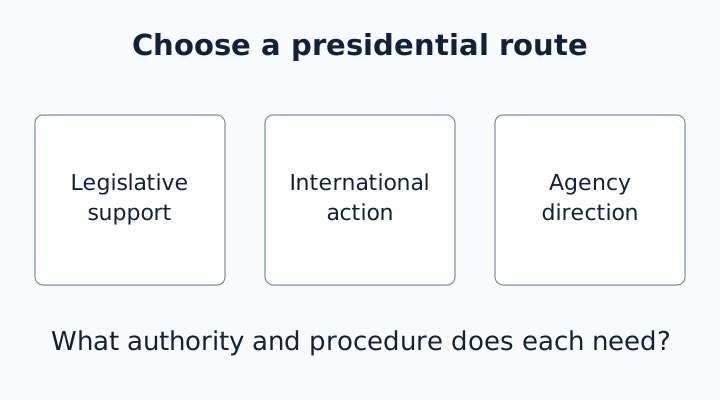
A president directs an agency to change implementation practices. What must you identify before treating the directive as legally effective?
In short. Presidents pursue policy through formal powers, bargaining, foreign-policy tools, and executive management supported by an advisory and administrative team.
- Separate presidential goals from the authority to act.
- Use the return conditions to distinguish veto procedures.
- Connect foreign-policy and administrative tools to their actual effects.
Part 2 Learn it An agenda needs institutions and support
2a. An agenda needs institutions and support
A president’s policy agenda is the set of goals the administration seeks to advance. The president does not personally perform every task needed to carry those goals out. The vice president, Cabinet, and Executive Office of the President provide support through advice, coordination, and specialized work.
The Cabinet’s department heads connect the administration’s goals to executive departments. The Executive Office of the President provides staff and specialized assistance near the president. These are supporting institutions, not interchangeable names for Congress or the courts. A policy goal alone does not establish the president’s power to accomplish it: identify which official can act and what authority is available.
The vice president can support the agenda through advice and coordination assigned by the president. For example, helping coordinate a domestic initiative connects the administration’s policy goals with executive work; it is a supporting role rather than the Senate’s separate confirmation decision.
Quick check · Fill the statement
Locate the supporting institution.
A president asks executive department leaders for implementation advice through the , while specialized presidential staff assist through the .
2b. Distinguish a constitutional check from persuasion
A regular veto returns a bill with objections and is a formal check on Congress. Congress can override it with a two-thirds vote in each chamber. A pocket veto occurs when the president does not sign a bill and congressional adjournment prevents its return within the constitutional period. That bill does not become law, and this action cannot be overridden through the regular two-thirds procedure. Mere inaction while Congress can receive a returned bill is not enough to identify a pocket veto.
The Constitution’s return period is ten days, excluding Sundays. The important mechanism is whether adjournment prevents return. A pocket veto does not create a new presidential power to edit individual provisions of a bill.
Bargaining and persuasion are informal powers. The president may negotiate with legislators, offer political support for a shared priority, or seek a compromise to secure congressional action. These interactions can change incentives, but a persuasive speech or negotiation is not itself a congressional vote or enacted law.
The return and override rules appear in Article I, Section 7 of the National Archives Constitution transcription. The commander-in-chief and treaty provisions appear in Article II, Section 2 of that same text.
Quick check · Fill the statement
Distinguish regular and pocket vetoes.
A returned veto can be overridden by a vote in each chamber. A pocket veto depends on adjournment preventing of the bill.
2c. Connect each tool to its legal effect
Foreign-policy powers include the formal role of commander in chief and the treaty power. Treaties use the constitutional process with Senate advice and consent. Executive agreements provide an informal route for international arrangements outside that treaty process, within the applicable authority. The existence of an agreement does not make every foreign-policy commitment legally identical.
An executive order directs management of the federal government under the president’s vested executive power or power delegated by Congress. Identify the constitutional or statutory source and the implementing action. An order does not automatically rewrite a statute because the president favors a different policy.
A signing statement communicates the president’s interpretation of a law when signing it. It informs Congress and the public about that interpretation; it is not the same as returning the bill through a veto or changing the enacted text. A strong explanation specifies the tool, the source of authority, and the action it can accomplish.
Quick check · Fill the statement
Identify the legal effect.
An order directs federal management under executive or delegated authority; a communicates the president’s interpretation when signing a law.
Part 3 Watch it done Read the return condition
A bill is presented to the president. The president does not sign it within the constitutional period, and congressional adjournment prevents its return. A legislator proposes using the regular two-thirds override procedure.
Step 1 · Identify the condition supplied
The prompt states both non-signature within the constitutional period and adjournment preventing return. These are more specific facts than merely an unsigned bill.
Why this step?
Why must the return condition be examined?
The constitutional treatment of an unsigned bill depends on whether adjournment prevents its return. Non-signature alone does not identify the same mechanism.
Step 2 · Choose the applicable procedure
Determine which veto mechanism fits those conditions before deciding whether the proposed congressional procedure applies.
Your step · Decide and justify
Does the regular two-thirds override procedure apply to this pocket-veto situation?
Which institutional reason supports the decision?
A contrasting worked example
The president meets legislators to negotiate changes that might win support for a bill. No veto is used. The mechanism is bargaining and persuasion because the president seeks voluntary legislative cooperation. Even if the negotiation succeeds politically, Congress must still take the relevant legislative action; the meeting itself is not passage.
Part 4 Try it Classify the institutional action
Original teaching situations: distinguish what each institution can do.
| Teaching period | Executive orders | Bargaining meetings |
|---|---|---|
| 1 | 5 | 12 |
| 2 | 8 | 9 |
| 3 | 11 | 6 |
Try it · Sort it
Classify the presidential action’s immediate function.
Legislative interaction
Foreign policy and military command
Domestic civilian administration
Try it · Fill the statement
Apply the institutional distinction.
The president directs armed forces as . An international agreement using Senate advice and consent is a , while an arrangement outside that treaty process under applicable authority is an .
Try it · Fill the statement
Describe the pattern in the fictional activity table.
Across the three periods, the order count , while the meeting count . The counts alone do not establish which tool had greater policy impact.
Try it · Fill the statement
Independent coordination scenario, separate from the activity-count table: identify the supporting function.
A president asks the vice president to coordinate work on a domestic initiative. The task illustrates .
Part 5 Explain it Explain a president’s policy strategy
Free response is 50% of the exam score. This one is shaped like Question 1, Concept Application.
Free-response practice · Question 1 style
Original concept-application practice: an administration wants a new statutory program and also wants agencies to implement an existing program more effectively. (A) Identify one informal tool for seeking the new law and explain why Congress must still act. (B) Explain how a valid executive order could address implementation of the existing program. (C) Describe how the Cabinet or Executive Office of the President can support one of these efforts.
Model answer
The president can bargain with legislators to build support for the new program, but negotiation does not itself enact the statute. For the existing program, an executive order can direct administration under vested executive or delegated authority; that requires identifying a lawful source rather than assuming a power to rewrite the statute. Cabinet department leaders can advise about implementation, while Executive Office staff can coordinate presidential priorities and specialized advice. These supporting roles help pursue the agenda without turning the president into Congress.
Score your own answer. This is a self-check, not a grade. Tick each point your answer makes.
Part 6 Check yourself Separate the tool and its effect
An original scenario describes three presidential actions. Assume the administrative order acts within valid delegated authority.
| Action | Observed feature |
|---|---|
| Bill response | The president returns a bill with objections |
| Legislative negotiation | The president seeks a compromise with congressional leaders |
| Administrative directive | The president directs agencies to carry out an existing statutory program |
Case question 1 · Multiple choice
Which action uses a formal presidential check on Congress?
Case question 2 · Multiple choice
What supports the administrative directive’s policy role in this scenario?
The rest stand on their own and do not use the case.
Check yourself · Spot the error
Select the statement that makes an institutional error.
Check yourself · Match
Match each term to its distinguishing institutional feature.
Part 7 Keep it Retrieve and connect
From 2.2 Structures, Powers, and Functions of Congress · Fill the statement
Follow the bill’s stage.
A committee hears witnesses and then revises the proposed text through . If the chambers pass different wording, a can reconcile it.
From 2.3 Congressional Behavior · Fill the statement
Distinguish review from a new map.
Baker v. Carr allowed federal courts to hear an challenge to representation; this concerns , not an immediate judicial design for every district.
In three lines
- Separate presidential goals from the authority to act.
- Use the return conditions to distinguish veto procedures.
- Connect foreign-policy and administrative tools to their actual effects.
Exam strategy for this topic
- Section I, Multiple Choice: 55 questions in 80 minutes.
- Section II, Free Response: 4 questions in 100 minutes.
- This lesson's Explain it is shaped like free-response question 1, Concept Application.
Explain what the presidential tool actually does and identify the source or procedure that makes it available.
Questions students ask
Does an unsigned bill always face a pocket veto?
No. The constitutional conditions include adjournment preventing return within the period. Mere non-signature is insufficient.
How does a treaty differ from an executive agreement?
A treaty uses the constitutional process with Senate advice and consent. An executive agreement operates outside that treaty process under its applicable authority.
Can an executive order automatically amend a statute?
No. It must rest on executive or delegated authority, and its implementing role does not itself rewrite enacted statutory text.
What does a signing statement accomplish?
It communicates the president’s interpretation of a law being signed. It is different from a veto, a congressional amendment, or a court’s judgment.
Course alignment, for teachers
AP U.S. Government and Politics topic 2.4, Unit 2: Interactions Among Branches of Government.
- Skill 3.B: Describe patterns and trends in data.
This lesson maps all 2 essential knowledge statements of the topic to the part that teaches each one: 2 are checked by a scored question. The map is in the lesson file.