Unit 2 · Topic 2.5 · about 30 minutes · 7 parts · 10 scored checks, 2 of them multiple choice, plus 2 from earlier lessons
AP U.S. Government and Politics 2.5: Checks on the Presidency
Unit 2: 25 to 36% of the multiple-choice section
What you'll be able to do
- Explain how the president’s agenda can create tension and frequent confrontations with Congress.
Key vocabulary
| Term | What it means | The exam trap |
|---|---|---|
| Cabinet appointment | Selection of an executive department leader, subject to the applicable Senate confirmation process. | Identify the office rather than treating all presidential staff as department leaders. |
| Ambassador | An official representing the United States abroad whose appointment is subject to Senate confirmation. | A foreign-policy role differs from a judge deciding a case. |
| Federal judicial appointment | Appointment to a federal court through nomination and Senate confirmation. | Identify the court and the separate nomination/confirmation decisions. |
| Senate confirmation | The Senate’s decision approving an appointment subject to its advice-and-consent role. | Locate which institution is acting at each stage. |
| Life tenure | Judicial service during good behavior, potentially extending beyond a presidential administration. | Consider the appointment’s possible duration without predicting a particular verdict. |
| Congressional agenda | The formal list of policies Congress is considering. | A president’s preference is distinct from congressional consideration or passage. |
| Executive directive | An instruction to executive institutions under applicable legal authority. | Identify the existing authority and the implementation action. |
| District Court | A federal trial court. | Identify whether the court initially hears a case or reviews a lower court’s decision. |
| Court of Appeals | A federal court that reviews lower-court decisions within its authority. | Review of a decision is different from a new trial or a confirmation vote. |
| Supreme Court | The highest court in the federal judicial system. | Distinguish the court’s place in the system from the separate process for appointing a justice. |
 Tap to open the picture full size
Part 1 Think first Predict the institutional consequence
Name the institution, decision, and legal effect before explaining how a presidential strategy succeeds.
Predict first
A president supports a Cabinet nominee. Does that fact by itself establish Senate confirmation?
In short. Senate confirmation, life-tenured judicial appointments, and conflicts over policy agendas shape presidential strategies and congressional checks.
- Separate presidential nomination and Senate confirmation.
- Explain durable judicial influence through tenure rather than predicted votes.
- Connect administrative strategy to existing legal authority.
Part 2 Learn it A nomination encounters another institution
2a. A nomination encounters another institution
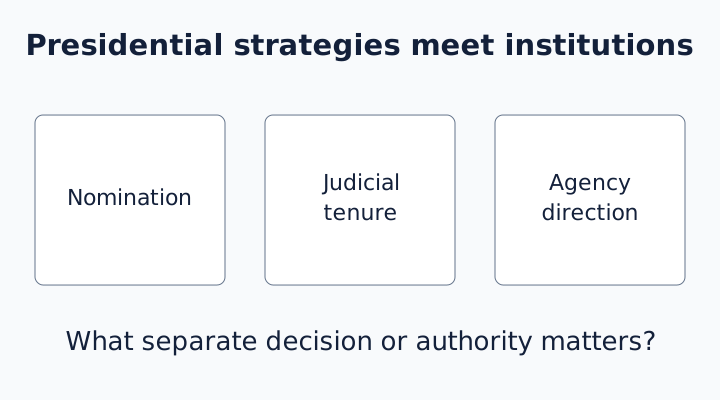
Presidential appointment power operates with a Senate check. Senate confirmation matters for Cabinet members, ambassadors, some positions in the Executive Office of the President, and federal judges on the Supreme Court, courts of appeals, and district courts. A president’s preference for a nominee does not itself complete a confirmation decision.
Conflict can arise over a nominee’s qualifications or policy perspective. The president and senators can pursue different agendas through the same appointment process. Distinguish the official choosing a nominee from the institution deciding confirmation. Also preserve the word some for Executive Office positions: the existence of confirmed positions does not mean every presidential staff appointment requires Senate confirmation.
An ambassador represents the United States abroad; Cabinet leaders direct executive departments. Federal judges decide cases within their courts’ authority. These functions help explain why a nomination can matter to policy, even though nomination and confirmation do not themselves decide every later action of the officeholder.
District Courts are the federal trial courts. Courts of Appeals review lower-court decisions, and the Supreme Court is the highest federal court. This hierarchy distinguishes judicial offices without treating an appellate review as a new presidential appointment.
Quick check · Fill the statement
Identify the check.
A president selects a nominee for an ambassadorship. The separate appointment check is by the .
2b. Different appointments can have different time horizons
Judicial appointments provide a potentially long-lasting presidential influence because federal judges hold office during good behavior rather than serving a fixed presidential term. Life tenure permits service beyond the nominating president’s administration. Senate confirmation therefore checks an appointment that may affect the judiciary long after the immediate political dispute.
Duration does not establish a guaranteed outcome in a particular case. Judges are not simply presidential employees instructed to produce a verdict, and a president’s appointment does not remove the need for legal reasoning. The institution and tenure distinguish this influence from a short-term administrative instruction.
For example, a confirmed judge can remain on the bench after a new president takes office. That is evidence of durable institutional influence, not proof that every judicial decision will match the former president’s policy preference. Explain the mechanism of continued service rather than treating the word lasting as an electoral prediction.
Quick check · Fill the statement
Explain the time horizon.
A confirmed federal judge may remain after the president leaves office because judicial is not a fixed term.
2c. A conflict over the agenda changes strategy, not the law automatically
Congress’s agenda is the formal list of policies it is considering. A president may want a policy that does not advance on that list. Conflict can encourage executive orders or directives to the bureaucracy as another route for pursuing the administration’s own priorities.
These tools still need lawful executive or delegated authority. A directive implementing an existing program differs from a president creating a new statutory power merely because legislators disagree. The relevant causal explanation is that a blocked legislative route can make an available administrative route more attractive; it is not that disagreement eliminates congressional checks.
Suppose Congress does not advance a proposal for a new program. A president may direct an agency to improve administration of an already authorized program within its legal discretion. The directive can change executive implementation while leaving the unpassed statutory proposal unpassed. Identify both the strategic incentive and the authority limiting the response.
Quick check · Fill the statement
Connect conflict and a lawful response.
If Congress does not advance a proposed program, a president may instead use an available executive to improve an existing program, but still needs legal .
Part 3 Watch it done Follow nomination and confirmation
A president names a person to lead an executive department. The Senate has not yet acted. A news summary treats the president’s preference as a completed Senate approval.
Step 1 · Identify the office and decisions
The person is nominated for a Cabinet post. The president’s selection and Senate confirmation are separate institutional actions.
Why this step?
Why does support from the president not establish the Senate’s decision?
The appointment process assigns confirmation to another institution, whose members may have different views of the nominee.
Step 2 · Locate the missing action
Identify which institution has not acted before describing the appointment process as complete.
Your step · Decide and justify
New condition: the Senate confirms a Cabinet nominee, but that person declines the post. The president nominates a replacement. What institutional requirement applies to the replacement?
Which mechanism supports the inference in the new situation?
A contrasting worked example
A confirmed federal judge remains on the bench after the nominating president leaves office. The continued service illustrates why judicial appointments can provide lasting influence. The result follows from judicial tenure, not an executive instruction controlling the judge’s next ruling.
Part 4 Try it Classify the institutional action
Original teaching situations: distinguish what each institution can do.
Try it · Sort it
Which institutional feature is most directly described?
Appointment check
Durable judicial influence
Administrative policy response
Try it · Fill the statement
Apply the institutional distinction.
A president nominates judges to the national trial courts, courts of appeals, and highest court. These are respectively the , , and , each included in the required appointment categories.
Part 5 Explain it Explain checks and strategic choices
Free response is 50% of the exam score. This one is shaped like Question 1, Concept Application.
Free-response practice · Question 1 style
Original concept-application practice: senators oppose a president’s Cabinet nominee, a confirmed judge continues serving after the administration ends, and Congress declines to advance a separate statutory proposal. (A) Identify the appointment check. (B) Explain why the judicial appointment can have lasting influence. (C) Explain one lawful administrative response to the agenda conflict and its limit.
Model answer
The Senate’s confirmation role checks the Cabinet nomination. Judicial service during good behavior permits a confirmed judge to remain after the nominating president leaves, creating a durable institutional influence without guaranteeing a particular ruling. If Congress does not advance a new program, the president may direct implementation of an existing program under executive or delegated authority. That response can advance priorities administratively, but it does not by itself enact the stalled statutory proposal or create a missing power.
Score your own answer. This is a self-check, not a grade. Tick each point your answer makes.
Part 6 Check yourself Compare appointments and an agency instruction
An original scenario records different presidential actions. The directive is within the program’s existing legal authority.
| Action | Institutional feature |
|---|---|
| Department leader nominated | A Cabinet office awaits the relevant Senate decision |
| Federal judge confirmed | The judge can serve during good behavior beyond the administration |
| Agency instructed | The agency changes implementation within an existing program |
Case question 1 · Multiple choice
Which action illustrates the Senate’s appointment check rather than agency implementation?
Case question 2 · Multiple choice
What explains the potential duration of the judicial appointment’s influence?
The rest stand on their own and do not use the case.
Check yourself · Spot the error
Select the statement that makes an institutional error.
Check yourself · Match
Match each term to its distinguishing institutional feature.
Part 7 Keep it Retrieve and connect
From 2.4 Roles and Powers of the President · Fill the statement
Distinguish regular and pocket vetoes.
A returned veto can be overridden by a vote in each chamber. A pocket veto depends on adjournment preventing of the bill.
From 2.1 Congress: The Senate and the House of Representatives · Fill the statement
Identify the power.
When Congress questions an agency about how a law is implemented, it is conducting , rather than deciding an individual case through .
In three lines
- Separate presidential nomination and Senate confirmation.
- Explain durable judicial influence through tenure rather than predicted votes.
- Connect administrative strategy to existing legal authority.
Exam strategy for this topic
- Section I, Multiple Choice: 55 questions in 80 minutes.
- Section II, Free Response: 4 questions in 100 minutes.
- This lesson's Explain it is shaped like free-response question 1, Concept Application.
Name the institution, decision, and legal effect before explaining how a presidential strategy succeeds.
Questions students ask
Does every presidential staff position need Senate confirmation?
No. The required content identifies some Executive Office positions. Cabinet members, ambassadors, and federal judges are also appointment categories subject to the Senate check.
Why can judicial appointments outlast an administration?
Judges serve during good behavior rather than for the president’s term. That explains a potential long-term influence without guaranteeing outcomes in particular cases.
Can an agenda conflict justify an unlimited executive order?
No. Conflict can motivate use of an available administrative tool, but the action still requires executive or delegated authority.
How is nomination different from confirmation?
The president selects the nominee. The Senate makes a separate approval decision for positions subject to its confirmation role.
Course alignment, for teachers
AP U.S. Government and Politics topic 2.5, Unit 2: Interactions Among Branches of Government.
- Skill 1.E: Explain how political principles, institutions, processes, policies, and behaviors apply to different scenarios in context.
This lesson maps all 3 essential knowledge statements of the topic to the part that teaches each one: 3 are checked by a scored question. The map is in the lesson file.