Unit 3 · Topic 3.10 · about 30 minutes · 7 parts · 10 scored checks, 2 of them multiple choice, plus 2 from earlier lessons
AP U.S. Government and Politics 3.10: Social Movements and Equal Protection
Unit 3: 13 to 18% of the multiple-choice section
What you'll be able to do
- Explain how constitutional provisions have supported and motivated social movements.
Key vocabulary
| Term | What it means | The exam trap |
|---|---|---|
| Civil rights | Legal protections against discriminatory treatment. | Identify the unequal treatment being challenged. |
| Equal Protection Clause | The Fourteenth Amendment requirement that states provide equal protection of the laws. | A constitutional claim and a successful legal outcome are different. |
| Social movement | Sustained collective action aimed at social or political change. | One official decision is not itself a movement. |
| Civil disobedience | Open, conscientious violation of law as a form of protest. | Distinguish a protest tactic from a court's legal ruling. |
| Direct action | Action intended to confront a problem and create pressure for change. | Pressure can encourage negotiation without guaranteeing agreement. |
| Pro-life movement | An abortion-policy movement broadly seeking legal protection for prenatal life through restrictions on abortion. | Specific proposals and exceptions vary among participants. |
| Pro-choice movement | An abortion-policy movement broadly seeking to protect the choice and availability of abortion. | Distinguish a broad policy goal from every participant's view on details. |
 Tap to open the picture full size
Part 1 Think first Predict the institutional consequence
Explain what the source's perspective could change about political behavior or institutional incentives, and identify a limit on that inference.
Predict first
A protest movement writes a persuasive constitutional argument. What would you examine to predict its political effect?
In short. Social movements use constitutional claims and collective action to seek protection against discrimination and changes in public policy.
- Identify the discrimination claim and its constitutional basis.
- Trace a source argument toward a possible institutional effect.
- Separate shared rights language from identical demands or guaranteed success.
Part 2 Learn it Rights provide a language for collective claims
2a. Rights provide a language for collective claims
Civil rights protect people against discrimination based on characteristics such as race, national origin, religion, and sex. Constitutional guarantees, including due process and equal protection, and acts of Congress provide legal foundations. The Fourteenth Amendment's Equal Protection Clause directs states to provide equal protection of the laws to persons within their jurisdiction. A civil-rights claim asks how people are treated, rather than assuming majority support alone settles the issue.
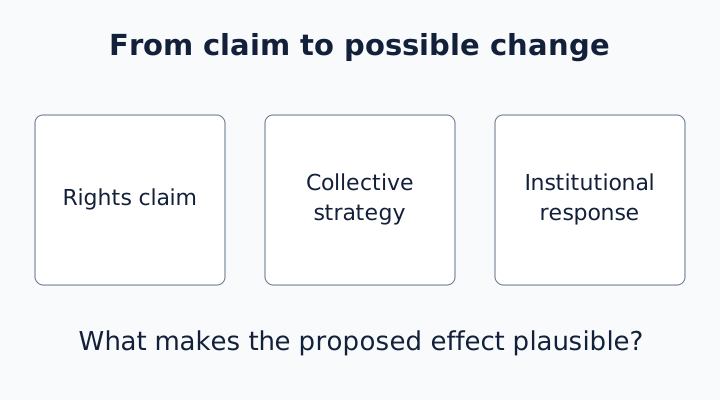
A social movement is sustained collective action seeking social or political change. Constitutional principles can motivate a movement by exposing a gap between a public ideal and lived treatment. They also support concrete strategies: litigation challenges state practices; petitions and demonstrations seek public attention; lobbying seeks legislation. Naming equal protection does not automatically win a lawsuit or enact a statute. Explain the mechanism: a legal claim can supply a standard courts can apply, while public action can increase the pressure on officials to act. Do not treat the constitutional text, the movement, and the eventual government response as the same thing.
Quick check · Fill the statement
Complete the explanation using the specific legal mechanism.
A claim against discriminatory treatment invokes , while a challenge to arbitrary deprivation methods emphasizes .
2b. King argues that pressure can open negotiation
Martin Luther King Jr.'s Letter from a Birmingham Jail (1963) responded to clergy who called the Birmingham campaign unwise and untimely. King described a nonviolent campaign involving fact-finding, negotiation, self-purification, and direct action. The letter is an argument defending action against segregation, not a court order. In the excerpt reproduced by Stanford's King Institute, he writes that the repeated request to wait had almost always meant never. That reasoning challenges delay as a neutral response to unequal treatment. Letter excerpts and historical context, King Institute.
Source excerpt: King describes the campaign's steps as “collection of the facts to determine whether injustices exist; negotiation; self-purification; and direct action.” His argument links action to making genuine negotiation possible after other efforts failed. Explain its implications: if accepted, officials could face stronger incentives to negotiate because nonviolent public pressure raises the cost of maintaining discriminatory practices. This is an inference about political behavior, not a guarantee that any demonstration succeeds. The civil rights movement of the 1960s used both constitutional claims and organized action to demand change.
Quick check · Fill the statement
Complete the explanation using the specific legal mechanism.
King linked nonviolent direct action to creating conditions for ; the letter's argument challenged indefinite .
2c. A shared constitutional vocabulary, different demands
The women's rights movement, including the National Organization for Women (NOW), sought to reduce discrimination and expand equal opportunity. Advocacy for LGBTQ rights has also invoked equal protection in challenges to unequal legal treatment. These examples show how a constitutional commitment can become a resource for organized groups. Their claims, tactics, and legal outcomes differ; shared language does not mean identical programs or automatic judicial agreement.
Pro-life and pro-choice movements illustrate competing claims about rights, governmental power, and the protection of life and liberty. Broadly, pro-life advocacy seeks legal protection for prenatal life through abortion restrictions, while pro-choice advocacy seeks to protect a pregnant person's ability to choose abortion and access related care. Participants within each movement differ on details and exceptions. Both seek policy through elections, lobbying, litigation, and public advocacy. Describe each movement's claims without treating one movement's preferred policy as the Constitution's undisputed meaning. Dobbs changed the constitutional abortion precedent in 2022, returning abortion regulation to the political process; it did not end movement activity. A useful source-analysis explanation traces a chain: what a source argues, what action that argument encourages, which institution can respond, and why that response remains uncertain. This method applies across movements rather than assuming constitutional language always produces the same result.
Quick check · Fill the statement
Complete the explanation using the specific legal mechanism.
NOW is associated with the movement; advocacy challenging unequal treatment based on sexual orientation is associated with rights.
Part 3 Watch it done Trace the implications of a primary-source argument
Source: the Letter from a Birmingham Jail excerpts reproduced by the King Institute. Original application: local officials tell a movement to stop public action and wait indefinitely.
Step 1 · Describe the argument before projecting an effect
King treats nonviolent direct action as a means to open negotiation and rejects delay that perpetuates injustice.
Why this step?
Why must an implication explain an institutional effect rather than repeat the quotation?
The task asks what acceptance of the argument could change. Connecting pressure to officials' incentives adds the political mechanism.
Step 2 · Distinguish a rationale from evidence of an effect
The source explains why organizers choose a strategy. Testing whether that strategy affected officials requires evidence about the officials' behavior; the source alone cannot supply that later observation.
Your step · Decide and justify
New development: researchers want to test whether the campaign operated through King's proposed mechanism. Which observation would be more directly relevant?
Which legal reason supports your conclusion?
A contrasting worked example
Original contrast: NOW advocates cite unequal employment opportunities in a petition to Congress. Step 1: describe the discrimination claim. Step 2: identify Congress as a lawmaking target. Step 3: explain that petitions can raise an issue's prominence and support a legislative remedy. A constitutional vocabulary gives a reason for action, while votes and implementation still determine the policy outcome.
Part 4 Try it Test the boundaries in new situations
Original teaching situations: distinguish what each institution can do.
Try it · Sort it
Classify what each statement contributes to a source analysis.
Argument in the source
Possible political implication
Limit on the inference
Try it · Fill the statement
Apply the two movements' contrasting broad goals.
A coalition lobbying for stronger abortion restrictions to protect prenatal life illustrates advocacy. A coalition lobbying to protect access to abortion illustrates advocacy.
Part 5 Explain it Write, then compare with the model
Free response is 50% of the exam score. This one is shaped like Question 1, Concept Application.
Free-response practice · Question 1 style
Original concept-application practice. Use King's argument and short excerpt presented above. (A) Describe his argument about delay and nonviolent direct action. (B) Explain how accepting that argument could affect local officials' willingness to negotiate. (C) Explain how equal protection can support a different movement's strategy, naming the institution it seeks to influence and a limit on predicting success.
Model answer
King argues that indefinite waiting can maintain injustice, and defends nonviolent direct action as a means to make negotiation possible. Accepting that argument can legitimate continued collective pressure, raising the political cost of official inaction and making negotiations more attractive. An equal-opportunity women's rights coalition could cite equal protection while petitioning legislators for nondiscrimination protections. That connects a constitutional principle to a legislative strategy, but the petition does not guarantee passage because lawmakers must still gather support and enact a law.
Score your own answer. This is a self-check, not a grade. Tick each point your answer makes.
Part 6 Check yourself Read movement claims and implications
Original teaching scenarios, not quotations or a record of actual organizations' positions.
| Source claim | Proposed action |
|---|---|
| A movement argues that delay preserves unequal public treatment | Use nonviolent demonstrations to seek negotiation |
| An equal-opportunity coalition argues an existing statute leaves a gap | Petition lawmakers for a broader nondiscrimination rule |
| Two abortion-policy coalitions disagree about rights and state authority | Organize voters and lobby legislators |
Case question 1 · Multiple choice
Which explanation best states an implication of the first source claim?
Case question 2 · Multiple choice
What does the third row most directly illustrate?
The rest stand on their own and do not use the case.
Check yourself · Spot the error
Select the statement that makes an institutional error.
Check yourself · Match
Match each legal concept to its defining feature.
Part 7 Keep it Retrieve and connect
From 2.9 The Role of the Judicial Branch · Fill the statement
Apply the similarity requirement.
Following an earlier legal rule in a case with materially similar facts illustrates .
From 3.9 Amendments: Due Process and the Right to Privacy · Fill the statement
Complete the explanation using the specific legal mechanism.
A right named in constitutional text is ; one inferred without a separate express listing is .
In three lines
- Identify the discrimination claim and its constitutional basis.
- Trace a source argument toward a possible institutional effect.
- Separate shared rights language from identical demands or guaranteed success.
Exam strategy for this topic
- Section I, Multiple Choice: 55 questions in 80 minutes.
- Section II, Free Response: 4 questions in 100 minutes.
- This lesson's Explain it is shaped like free-response question 1, Concept Application.
Explain what the source's perspective could change about political behavior or institutional incentives, and identify a limit on that inference.
Questions students ask
Are civil rights only created by court decisions?
No. Constitutional provisions and acts of Congress can protect against discrimination. Courts interpret and enforce legal protections, while lawmakers can enact statutory ones.
Was King's letter a judicial decision?
No. It was an argument responding to critics of the Birmingham campaign. Its political and moral reasoning can support action without itself changing law.
Do all equal-protection movements seek identical policies?
No. Movements can share constitutional language while differing in their demands, constituencies, tactics, and interpretations.
Can opposing movements both invoke rights?
Yes. Pro-life and pro-choice movements illustrate competing claims about rights and governmental power pursued through political institutions.
Course alignment, for teachers
AP U.S. Government and Politics topic 3.10, Unit 3: Civil Liberties and Civil Rights.
- Skill 4.C: Explain how the implications of the argument or perspective in the source may affect political principles, institutions, processes, policies, and behaviors.
This lesson maps all 2 essential knowledge statements of the topic to the part that teaches each one: 2 are checked by a scored question. The map is in the lesson file.