Unit 3 · Topic 3.9 · about 30 minutes · 7 parts · 9 scored checks, 2 of them multiple choice, plus 2 from earlier lessons
AP U.S. Government and Politics 3.9: Amendments: Due Process and the Right to Privacy
Unit 3: 13 to 18% of the multiple-choice section
What you'll be able to do
- Explain the extent to which the government is limited by substantive due process from infringing upon individual rights.
Key vocabulary
| Term | What it means | The exam trap |
|---|---|---|
| Unenumerated right | A right not expressly listed as a separate constitutional guarantee. | An omitted label does not settle the constitutional argument. |
| Substantive due process | Constitutional scrutiny of governmental infringement of protected liberty itself. | Separate the content of a restriction from how it is administered. |
| Procedural due process | Constitutional protection governing the methods of deprivation. | A fair hearing and a permissible restriction answer different questions. |
| Precedent | An earlier judicial decision used in resolving later cases. | State whether it remains controlling or has been overruled. |
| Enumerated right | A right expressly identified in constitutional text. | Distinguish a named guarantee from an inference drawn from it. |
| Right to privacy | Constitutional protection recognized for certain private decisions or relationships. | Identify the particular activity and current precedent before assuming a general result. |
 Tap to open the picture full size
Part 1 Think first Predict the institutional consequence
Describe the right, the governmental restriction, and the status of the relevant precedent before evaluating a privacy claim.
Predict first
A state gives a flawless hearing before restricting a private choice. Has that fact alone resolved every possible constitutional objection?
In short. Substantive due process examines governmental infringements of protected liberty, including debated unenumerated privacy rights.
- Distinguish enumeration from constitutional protection.
- Describe process and substance separately.
- Separate historical holdings from current precedent.
Part 2 Learn it A protected right need not appear as a named item
2a. A protected right need not appear as a named item
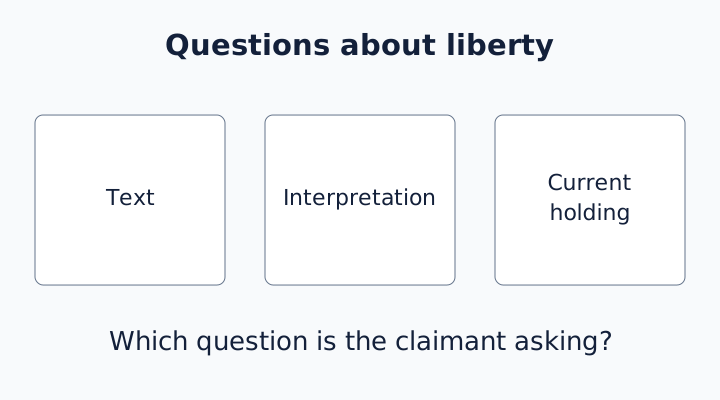
An enumerated right is expressly listed in constitutional text. An unenumerated right is not expressly named as a separate right but may still receive constitutional protection. Privacy is a central example. Judges and scholars have reasoned that express guarantees imply protected private choices or relationships. The Ninth Amendment also warns that listing certain rights must not be read to deny others retained by the people.
These arguments support the existence of rights beyond a literal list, but do not by themselves settle which claimed right qualifies or how far it extends. A court must identify a constitutional basis and a method for interpreting it. Distinguish the proposition that additional rights exist from a claim that every personal preference is constitutionally protected. Bill of Rights, Ninth Amendment. The disagreement is often about interpreting the Constitution's protections, not about whether the word privacy appears in it. A careful description separates the text, the inference drawn from it, and the particular activity at issue.
Quick check · Fill the statement
Complete the explanation using the specific legal mechanism.
A right named in constitutional text is ; one inferred without a separate express listing is .
2b. Method and substance ask different questions
Procedural due process asks whether government uses fair, nonarbitrary methods when depriving a person of life, liberty, or property. Substantive due process asks whether the law or action itself impermissibly infringes a constitutionally protected liberty. Giving a person a hearing cannot automatically make every governmental restriction valid. Conversely, an objection to unfair notice does not necessarily establish a substantive right to engage in the regulated activity.
For example, imagine a fictional law restricting a private family decision. A challenge to the absence of a hearing raises a procedural issue. A claim that the government cannot constitutionally impose that restriction, even after a flawless hearing, raises a substantive issue. Courts have used substantive due process in examining alleged arbitrary infringements of individual rights. The approach remains debated: disagreement can concern the existence of the right, the constitutional text supporting it, and the permissible governmental restriction. Describe those separate questions instead of saying due process simply means that government must always get the same outcome.
An unenumerated right is one not expressly listed as a separate constitutional guarantee. Arguments based on implied guarantees or the Ninth Amendment support examining such rights; they do not automatically protect every private preference.
Quick check · Fill the statement
Complete the explanation using the specific legal mechanism.
An objection to an unfair hearing concerns ; an objection to the restriction itself can concern .
2c. Read privacy decisions in chronological order
Griswold v. Connecticut (1965) invalidated a state prohibition on married couples' use of contraceptives. It protected marital privacy. The majority described zones of privacy implied by specific guarantees in the Bill of Rights; separate opinions more directly emphasized due process or the Ninth Amendment. The lesson's substantive-due-process framework connects these privacy arguments, but do not attribute every justice's rationale to the majority. Griswold, majority opinion, pages 484-486.
Roe v. Wade (1973) extended constitutional privacy protection to abortion. Dobbs v. Jackson Women's Health Organization (2022) overruled Roe and Casey, holding that the Constitution does not confer a right to abortion and returning regulatory authority to the people and their elected representatives. The majority reasoned that the claimed abortion right was neither textually specified nor deeply rooted in national history and tradition. It distinguished abortion from other privacy precedents and stated that its decision concerned abortion. Do not describe Roe as current controlling law or infer that Dobbs itself repealed every privacy protection. Dobbs, majority opinion, parts II and VI. This account describes the holdings, not a preferred policy position.
Quick check · Fill the statement
Complete the explanation using the specific legal mechanism.
protected marital contraceptive privacy; overruled Roe's constitutional abortion holding.
Part 3 Watch it done Separate a precedent from its current force
Original scenario: a student cites Roe to claim that the Constitution currently guarantees an abortion right under the same holding.
Step 1 · Identify the old holding
Roe recognized constitutional protection for abortion. A historical description of Roe must preserve that fact.
Why this step?
Why is the date and subsequent treatment of Roe essential to the answer?
A precedent can be accurately described as a historical holding while no longer controlling after a later decision overrules it.
Step 2 · Locate the change
Dobbs held in 2022 that the Constitution does not confer a right to abortion and overruled Roe and Casey. It left abortion regulation to the political process, subject to other applicable law.
Your step · Decide and justify
Does a correct historical description make Roe's holding currently controlling?
Which legal reason supports your conclusion?
A contrasting worked example
Original contrast: a student says privacy cannot have constitutional protection because the Constitution does not name a right to privacy. Step 1: identify that the argument treats enumeration as exhaustive. Step 2: describe the Ninth Amendment and implied-guarantee arguments. Step 3: use Griswold as a concrete privacy holding. These establish that omission of the label alone does not decide the issue; they do not prove every claimed private choice is protected.
Part 4 Try it Test the boundaries in new situations
Original teaching situations: distinguish what each institution can do.
Try it · Sort it
Classify the kind of claim, assuming the activity and right remain disputed.
Procedural objection
Substantive objection
Textual argument for unenumerated rights
Part 5 Explain it Write, then compare with the model
Free response is 50% of the exam score. This one is shaped like Question 1, Concept Application.
Free-response practice · Question 1 style
Original concept-application practice: a fictional law restricts a private family decision. One challenger asks for a fair hearing; another claims the restriction itself infringes protected liberty. (A) Describe the difference between the claims and explain why a fair hearing cannot by itself resolve the second claim. (B) Describe two arguments for unenumerated rights and explain why they do not automatically protect every private preference. (C) Describe what changed from Roe to Dobbs and the limit of that change.
Model answer
The first claim concerns procedural due process because it challenges the decision-making method. The second concerns substantive due process because the restriction itself allegedly infringes protected liberty. Even a fair hearing leaves that substantive restriction in place, so correcting the hearing would not answer the second challenge. Arguments for unenumerated rights include implications of specified guarantees and the Ninth Amendment's recognition of other retained rights. Neither argument names every protected activity; the asserted liberty must still qualify for constitutional protection under the governing interpretation. Roe recognized constitutional abortion protection, but Dobbs overruled that holding and concluded the Constitution does not confer an abortion right. That ruling concerns abortion and did not automatically overrule every other privacy precedent.
Score your own answer. This is a self-check, not a grade. Tick each point your answer makes.
Part 6 Check yourself Describe the constitutional claim
Original comparison of legal arguments, not a report of pending litigation.
| Claim | Reason offered |
|---|---|
| A | The state provided no meaningful opportunity to challenge its evidence |
| B | The restriction itself infringes protected private liberty |
| C | Listing some rights does not deny other retained rights |
Case question 1 · Multiple choice
Which description best fits Claim B?
Case question 2 · Multiple choice
Which constitutional provision most directly supports Claim C's stated reasoning?
The rest stand on their own and do not use the case.
Check yourself · Spot the error
Select the statement that makes an institutional error.
Check yourself · Match
Match each legal concept to its defining feature.
Part 7 Keep it Retrieve and connect
From 2.8 The Judicial Branch · Fill the statement
Identify the constitutional check.
A court refuses effect to a statute because it conflicts with the Constitution. This illustrates .
From 3.8 Amendments: Due Process and the Rights of the Accused · Fill the statement
Complete the explanation using the specific legal mechanism.
The Amendment due process clause limits the national government, while the Amendment clause limits states.
In three lines
- Distinguish enumeration from constitutional protection.
- Describe process and substance separately.
- Separate historical holdings from current precedent.
Exam strategy for this topic
- Section I, Multiple Choice: 55 questions in 80 minutes.
- Section II, Free Response: 4 questions in 100 minutes.
- This lesson's Explain it is shaped like free-response question 1, Concept Application.
Describe the right, the governmental restriction, and the status of the relevant precedent before evaluating a privacy claim.
Questions students ask
Is privacy explicitly named as a constitutional right?
The Constitution does not expressly name a general right to privacy. Courts have recognized privacy protections through interpretation of constitutional guarantees.
Does the Ninth Amendment list every additional right?
No. It says enumeration should not be construed to deny or disparage other rights retained by the people; it does not provide a catalog.
Did Griswold involve abortion?
No. It involved a Connecticut prohibition on contraceptive use by married couples. Roe later addressed abortion.
Did Dobbs overrule every privacy precedent?
The majority stated that its decision concerned abortion and should not be understood to cast doubt on precedents that do not concern abortion.
Course alignment, for teachers
AP U.S. Government and Politics topic 3.9, Unit 3: Civil Liberties and Civil Rights.
- Skill 1.A: Describe political principles, institutions, processes, policies, and behaviors.
This lesson maps all 2 essential knowledge statements of the topic to the part that teaches each one: 2 are checked by a scored question. The map is in the lesson file.