Unit 3 · Topic 3.13 · about 30 minutes · 7 parts · 9 scored checks, 2 of them multiple choice, plus 2 from earlier lessons
AP U.S. Government and Politics 3.13: Affirmative Action
Unit 3: 13 to 18% of the multiple-choice section
What you'll be able to do
- Describe Supreme Court debates about affirmative action policies.
Key vocabulary
| Term | What it means | The exam trap |
|---|---|---|
| Affirmative action | Policies intended to address specified disparities in educational and workplace opportunities. | The label does not identify the actual selection rule. |
| Disparity | A difference in outcomes, access, or opportunity across groups. | A measured difference and its cause require separate evidence. |
| Equal Protection Clause | The Fourteenth Amendment guarantee constraining unequal state treatment. | Ask which actor and classification are involved. |
| Racial classification | A policy distinction that assigns treatment based on race. | A claimed beneficial purpose does not settle the constitutional analysis. |
| Individualized consideration | Evaluation of a person's specific experiences and demonstrated qualities. | Distinguish experiences from automatic assumptions about group membership. |
 Tap to open the picture full size
Part 1 Think first Predict the institutional consequence
Explain the link from a rule to the specific scenario and preserve limits when the scenario differs from the decided case.
Predict first
Two programs share the goal of wider opportunity but use different selection rules. What matters to applying a court holding?
In short. Affirmative action debates concern efforts to address disparities and the constitutional limits on governmental classifications.
- Define the policy and identify its actual decision rule.
- Distinguish debate arguments from current holdings.
- Apply the holding while preserving its scope.
Part 2 Learn it Identify the policy before evaluating it
2a. Identify the policy before evaluating it
Affirmative action refers to policies intended to address workplace and educational disparities related to race, ethnic origin, gender, disability, and age. The label covers different designs. A program could recruit applicants more widely, remove access barriers, or use a protected characteristic in selection. Those mechanisms raise different legal questions. Do not infer a program's exact rule from its stated goal alone.
The constitutional debate focuses on the Fourteenth Amendment's Equal Protection Clause and whether governmental classifications can lawfully be used to remedy unequal opportunity or promote asserted benefits. Supporters of particular policies argue that formally identical treatment can leave the effects of past exclusion untouched. Critics argue that classifying individuals by race can itself deny equal treatment or impose burdens on people who did not cause past discrimination. These are competing arguments to describe accurately before applying the governing holding. The general definition does not establish that every policy using the label is lawful, or that every program addressing disability or age is governed by the rule for a university's race-based admissions system.
Quick check · Fill the statement
Complete the explanation using the specific legal mechanism.
Affirmative action can address educational and disparities. The constitutional debate centers on .
2b. Read the actual admissions holding
In Students for Fair Admissions v. Harvard and UNC (2023), the Supreme Court held the universities' challenged race-conscious admissions systems unlawful. UNC, a public university, was subject to the Equal Protection Clause; Harvard's federally funded program was analyzed under Title VI's corresponding antidiscrimination requirement. The majority concluded the programs failed strict scrutiny, used race negatively and through stereotypes, and lacked a meaningful end point. Students for Fair Admissions, majority opinion, parts III through VI.
The majority permitted consideration of an applicant's discussion of how race affected the person's life, tied to an individual quality such as courage or leadership. It warned against using essays to recreate the rejected racial preferences indirectly. Distinguish assessing an individual's demonstrated experiences from awarding a benefit simply because the person belongs to a racial category. The decision did not resolve every policy addressing age, disability, sex, workplace opportunity, or recruitment. These details illustrate the equal-protection debate and its current admissions limits; this non-required case is supplied here rather than assumed prior knowledge.
Quick check · Fill the statement
Complete the explanation using the specific legal mechanism.
The supplied 2023 holding rejected the challenged race-based systems while permitting discussion of individual tied to personal qualities.
2c. Apply the mechanism, setting, and scope
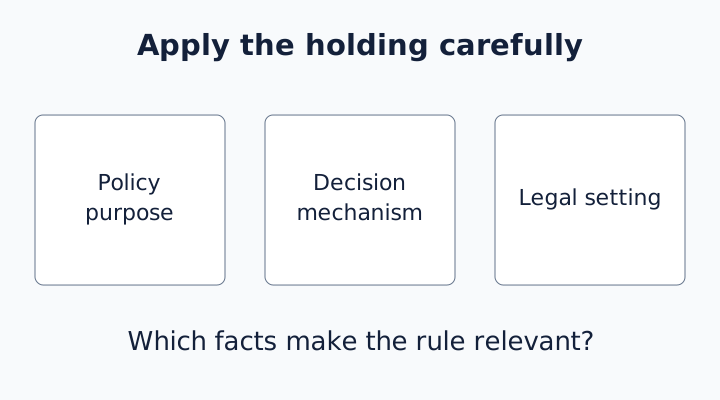
An application explanation needs a chain of reasoning. First identify what the policy does: broadens outreach, removes an access barrier, or allocates an advantage by a classification. Next identify who acts and in what setting. Then connect the relevant constitutional or statutory rule to that mechanism. A public university and a private employer are not interchangeable legal settings. A policy's purpose alone does not determine the result.
Original contrast: a public university supplies fee waivers based on financial need and broadens recruiting across underrepresented geographic areas. The supplied SFFA holding does not itself ban those measures merely because officials hope to reduce disparities. A different policy that restores the rejected race-based admissions advantage through an essay proxy conflicts with the majority's warning. Describe that difference without asserting every hypothetical program is automatically lawful under all other laws. The lesson's task is to explain why a particular holding applies or why its scope does not decide a different scenario. Equal-protection debate continues because the goal of opportunity and the lawful means for pursuing it must be analyzed separately.
Quick check · Fill the statement
Complete the explanation using the specific legal mechanism.
A rule's method of assigning an advantage is its ; whether it operates in a university or workplace identifies its .
Part 3 Watch it done Explain the difference between purpose and means
Original scenario: a public university wants broader opportunity. Proposal A restores an advantage based on racial category; Proposal B considers a specific applicant's account of organizing a community response to discrimination as evidence of leadership.
Step 1 · Identify the mechanisms
Proposal A allocates an advantage by racial category. Proposal B evaluates an individual experience for a demonstrated quality.
Why this step?
Why does a shared goal of broader opportunity fail to give both proposals the same legal analysis?
The supplied holding evaluates the means used. The same goal can be pursued through category-based preference or individual experience, which the majority treated differently.
Step 2 · Apply the supplied limitation
SFFA rejects the challenged racial preferences and permits discussion of individual experiences tied to personal qualities. Essays cannot serve as a disguised return to the rejected preference.
Your step · Decide and justify
Can the common purpose alone justify Proposal A under the supplied holding?
Which legal reason supports your conclusion?
A contrasting worked example
Original contrast: a program addresses age-related workplace disparities through training. Step 1: identify its workplace setting and the characteristic addressed. Step 2: compare that with the supplied holding about race-based university admissions. Step 3: explain that the holding does not decide every age-related workplace program. Other law may govern; refusing to overgeneralize is part of applying a precedent accurately.
Part 4 Try it Test the boundaries in new situations
Original teaching situations: distinguish what each institution can do.
Try it · Sort it
Classify by the specific relationship to the supplied holding: conflict, its express individual-experience permission, or a different policy design whose legality the holding does not decide.
Conflicts with the supplied admissions holding
Other policy design outside this holding's determination
Express individual-experience permission within its limit
Part 5 Explain it Write, then compare with the model
Free response is 50% of the exam score. This one is shaped like Question 1, Concept Application.
Free-response practice · Question 1 style
Original concept-application practice. A public university proposes to use essays as a substitute for its rejected racial admissions preference. It also proposes financial-need fee waivers and evaluation of applicants' specific experiences as evidence of leadership. Explain how the supplied SFFA holding applies differently to these proposals. Describe one argument offered in the broader affirmative-action debate and distinguish that argument from the controlling holding.
Model answer
The essay proxy conflicts with the majority's warning against indirectly recreating the rejected racial preferences. Evaluation of a specific experience may be considered when tied to a demonstrated personal quality such as leadership, without turning group membership into an automatic advantage. The supplied holding does not itself ban financial-need waivers without a racial preference, although other applicable law still matters. Supporters of some affirmative-action policies argue that past exclusion can persist through unequal opportunity even under formally identical treatment. That is an argument in the debate, not a statement that the Court approved the challenged admissions systems.
Score your own answer. This is a self-check, not a grade. Tick each point your answer makes.
Part 6 Check yourself Apply a supplied current holding to new proposals
Original teaching proposals. Assume the university is public. The SFFA summary above supplies the governing admissions comparison.
| Proposal | Decision rule |
|---|---|
| A | Award a category-based racial admissions advantage |
| B | Evaluate specific leadership described in an applicant's experience of discrimination |
| C | Provide need-based fee waivers without a racial preference |
Case question 1 · Multiple choice
Which explanation most accurately applies the supplied holding to proposal B?
Case question 2 · Multiple choice
Why does the supplied holding alone fail to establish that proposal C is unlawful?
The rest stand on their own and do not use the case.
Check yourself · Spot the error
Select the statement that makes an institutional error.
Check yourself · Match
Match each legal concept to its defining feature.
Part 7 Keep it Retrieve and connect
From 3.12 Balancing Minority and Majority Rights · Fill the statement
Complete the explanation using the specific legal mechanism.
The proclamation asserted wartime authority; permanent constitutional abolition followed through the .
From 3.12 Balancing Minority and Majority Rights · Fill the statement
Complete the explanation using the specific legal mechanism.
Shaw permitted an challenge to racial sorting; it the case for further proceedings.
In three lines
- Define the policy and identify its actual decision rule.
- Distinguish debate arguments from current holdings.
- Apply the holding while preserving its scope.
Exam strategy for this topic
- Section I, Multiple Choice: 55 questions in 80 minutes.
- Section II, Free Response: 4 questions in 100 minutes.
- This lesson's Explain it is shaped like free-response question 1, Concept Application.
Explain the link from a rule to the specific scenario and preserve limits when the scenario differs from the decided case.
Questions students ask
Does affirmative action mean only racial college-admissions preferences?
No. The term includes policies addressing disparities related to several characteristics in education and workplaces. Specific policies use different mechanisms.
Did SFFA approve the challenged admissions systems?
No. It held the challenged Harvard and UNC systems unlawful under the applicable equal-protection and statutory framework.
May an applicant describe an experience involving race?
The majority allowed consideration of how race affected an individual's life when tied to qualities or abilities. It warned against using essays to recreate rejected preferences.
Does the admissions decision resolve every workplace or disability program?
No. Its holding does not decide every policy addressing other characteristics or settings. Applying a precedent requires attention to its actual scope.
Course alignment, for teachers
AP U.S. Government and Politics topic 3.13, Unit 3: Civil Liberties and Civil Rights.
- Skill 1.E: Explain how political principles, institutions, processes, policies, and behaviors apply to different scenarios in context.
This lesson maps the one essential knowledge statement of the topic to the part that teaches each one: 1 is checked by a scored question. The map is in the lesson file.