Unit 3 · Topic 3.7 · about 30 minutes · 7 parts · 10 scored checks, 3 of them multiple choice, plus 2 from earlier lessons
AP U.S. Government and Politics 3.7: Selective Incorporation
Unit 3: 13 to 18% of the multiple-choice section
What you'll be able to do
- Explain the implications of the doctrine of selective incorporation.
Key vocabulary
| Term | What it means | The exam trap |
|---|---|---|
| Selective incorporation | The doctrine applying particular Bill of Rights protections to states through the Fourteenth Amendment’s Due Process Clause. | Trace a specific protection rather than assuming every clause applies identically. |
| Due Process Clause | The Fourteenth Amendment provision barring states from deprivation of life, liberty, or property without due process of law. | The Fifth Amendment also contains due process language, so identify the actor and text. |
| State action | Government conduct attributable to a state or its local governments. | Private conduct does not automatically become state conduct. |
| Equal Protection Clause | The Fourteenth Amendment provision requiring equal protection of the laws. | An equal-treatment claim and an incorporation claim can ask different questions. |
| Constitutional floor | A minimum level of protection required by the U.S. Constitution. | A floor is a constraint on state action, not a transfer of every state power. |
| Fundamental liberty | A basic protected liberty recognized in the constitutional order. | Fundamental status and the result for a specific regulation are separate steps. |
| Privileges or Immunities Clause | The Fourteenth Amendment provision addressing state abridgment of privileges or immunities of U.S. citizens. | This clause and due process are distinct constitutional texts. |
 Tap to open the picture full size
Part 1 Think first Predict the institutional consequence
Explain the relationship between a required case and the specific constitutional provisions that supply its right and state-application framework.
Predict first
A city claims that a right in the Bill of Rights concerns only the national government. What constitutional connection would you investigate?
In short. Selective incorporation applies particular Bill of Rights guarantees to state and local government through the Fourteenth Amendment’s Due Process Clause.
- Identify a particular Bill of Rights liberty.
- Trace its application through the Fourteenth Amendment.
- Explain the limit imposed on state or local government.
Part 2 Learn it The original actor and the later constitutional bridge
2a. The original actor and the later constitutional bridge
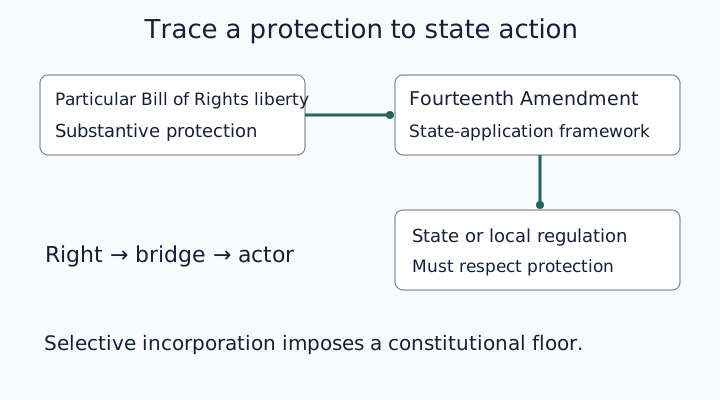
The Bill of Rights originally constrained the national government. State and local governments did not become subject to all ten amendments merely because the amendments existed. After the Civil War, the Fourteenth Amendment created additional constitutional limits on states. Its Due Process Clause says that no state may deprive any person of life, liberty, or property without due process of law. Source: National Archives, Fourteenth Amendment, Section 1.
Selective incorporation is the doctrine applying particular protections from the Bill of Rights to the states through that clause. A court identifies a particular guarantee as fundamental and treats the protected liberty as limiting state action. The word selective matters: incorporation developed protection by protection through decisions, rather than one decision automatically applying every provision identically.
Original example: a resident challenges a local government’s restriction on a protected liberty. Two questions arise. What is the underlying guarantee? What makes that guarantee apply to this government actor? The First or Second Amendment can identify the substantive protection, while the Fourteenth Amendment supplies the incorporation bridge. Neither question replaces the other.
Quick check · Fill the statement
Complete the distinction in this situation.
The identifies the arms right; the supplies the state-application framework.
2b. Read McDonald as a relationship among sources
McDonald v. Chicago (2010) connects the Second Amendment’s arms protection, Heller’s individual-right interpretation, and the Fourteenth Amendment’s application to state action. Chicago and Oak Park residents challenged local handgun restrictions. The issue was whether the right recognized against the federal District of Columbia in Heller also bound state and local government. The Court held that it did, reversed the lower judgment, and remanded. Source: McDonald v. Chicago, 561 U.S. 742 (2010).
The controlling majority portions treated the right as fundamental to ordered liberty and deeply rooted in American history and tradition. Four justices applied that right through the Due Process Clause; Justice Thomas agreed with application through the Privileges or Immunities Clause. Do not describe those two routes as one unanimous rationale.
To explain the case’s relationship to a foundational document, do more than name the Constitution. Explain how the Second Amendment identifies the right and how the Fourteenth Amendment provides the framework for applying protection to a state or local actor. That connection explains why the defendant city could not avoid the constitutional question by calling handgun regulation a local matter.
Quick check · Fill the statement
Complete the distinction in this situation.
McDonald held that the recognized self-defense right applies to government, following Heller’s setting.
2c. Incorporation limits states without making all powers national
Incorporation imposes a national constitutional floor on state and local regulation of civil liberties. State officials remain responsible for many public policies, but they must exercise those powers within incorporated constitutional protections. The doctrine changes the legal limit on their action, rather than transferring every state function to Congress.
Original comparison: a federal rule restricting a protected liberty and a city rule restricting the same liberty can both face constitutional review. The federal restriction directly implicates the Bill of Rights; the city restriction requires attention to the Fourteenth Amendment’s incorporation framework. Different actors can be bound by the same substantive protection through different constitutional routes.
The Due Process Clause is also different from the Equal Protection Clause, although both appear in the Fourteenth Amendment. Incorporation concerns applying particular liberty guarantees to state action. Equal protection concerns government classifications and treatment. Do not use the phrases interchangeably. A strong explanation traces right, government actor, constitutional bridge, and resulting limit. It preserves the distinction between applying a protection to a state and deciding whether every particular regulation violates that protection.
Quick check · Fill the statement
Complete the distinction in this situation.
Incorporation uses to extend particular liberties; a classification dispute may instead raise .
Part 3 Watch it done Connect McDonald to constitutional text
Read together: the Second Amendment identifies the arms right; the Fourteenth Amendment provides that no state shall deprive a person of liberty without due process of law. McDonald concerns local handgun restrictions.
Step 1 · Identify the action and right
Chicago and Oak Park are local government actors. The residents asserted the self-defense right recognized in Heller.
Step 2 · Explain the constitutional connection
The Fourteenth Amendment supplies the state-application framework. The due process incorporation approach treats a fundamental Bill of Rights liberty as a limit on state action.
Why this step?
Why does naming the Second Amendment alone leave part of this explanation unfinished?
It identifies the right but does not explain the constitutional route by which a Bill of Rights protection constrains a state or city.
Your step · Decide and justify
What implication of McDonald follows for a city defending its rule as purely local?
Which institutional reason supports the decision?
A second worked example
Original comparison: a federal agency restricts religious expression, while a city adopts a similar restriction. The substantive liberty is identified in the First Amendment. For the city, explain the Fourteenth Amendment incorporation route; for the federal agency, the Bill of Rights already supplies the direct limit.
Part 4 Try it Apply the rights distinction
Original teaching situations: distinguish what each institution can do.
Try it · Sort it
Identify the role each statement plays in an incorporation explanation.
Underlying liberty guarantee
Constitutional bridge to states
Resulting constraint on local action
| Source | Text or relationship |
|---|---|
| Second Amendment | “the right of the people to keep and bear Arms” |
| Fourteenth Amendment, Section 1 | “nor shall any State deprive any person of life, liberty, or property, without due process of law” |
| McDonald holding | The self-defense right recognized in Heller applies to state and local government. |
Part 5 Explain it Concept application: explain the source connection
Free response is 50% of the exam score. This one is shaped like Question 1, Concept Application.
Free-response practice · Question 1 style
Use the constitutional excerpts and McDonald relationship table above. Explain how McDonald relates to the Second and Fourteenth Amendments. Identify the local action, the underlying right, the constitutional bridge, and one implication for the city.
Model answer
McDonald involved Chicago and Oak Park restrictions on handguns. The Second Amendment supplied the self-defense right recognized in Heller. The Fourteenth Amendment supplied the state-application framework, with the due process incorporation approach treating the fundamental liberty as a limit on state and local government. Justice Thomas reached application through privileges or immunities instead. The holding means a city must respect the incorporated right when regulating; local authority does not by itself resolve the constitutional challenge.
Score your own answer. This is a self-check, not a grade. Tick each point your answer makes.
Part 6 Check yourself The right, the bridge, and the actor
Read the primary-source relationships, then apply them. The quotations are short extracts from the constitutional text; the case summary is an original paraphrase.
| Source | Text or relationship |
|---|---|
| Second Amendment | “the right of the people to keep and bear Arms” |
| Fourteenth Amendment, Section 1 | “nor shall any State deprive any person of life, liberty, or property, without due process of law” |
| McDonald holding | The self-defense right recognized in Heller applies to state and local government. |
Case question 1 · Multiple choice
How does the Fourteenth Amendment row relate to McDonald?
Case question 2 · Multiple choice
Which explanation properly connects both constitutional sources to the case?
Case question 3 · Multiple choice
What does selective incorporation imply about a city’s regulatory authority?
The rest stand on their own and do not use the case.
Check yourself · Spot the error
Select the statement that makes an institutional error.
Check yourself · Match
Match each constitutional term to its defining feature.
Part 7 Keep it Retrieve and connect
From 3.4 First Amendment: Freedom of the Press · Fill the statement
Complete the distinction in this situation.
In the Pentagon Papers cases, the government failed to meet its for stopping .
From 3.3 First Amendment: Freedom of Speech · Fill the statement
Recall the expression and legal distinction in Tinker v. Des Moines.
In Tinker, students used black armbands to oppose a war. Their nonverbal expression was . The Court distinguished unsupported fear of disturbance from facts supporting a forecast of .
In three lines
- Identify a particular Bill of Rights liberty.
- Trace its application through the Fourteenth Amendment.
- Explain the limit imposed on state or local government.
Exam strategy for this topic
- Section I, Multiple Choice: 55 questions in 80 minutes.
- Section II, Free Response: 4 questions in 100 minutes.
- This lesson's Explain it is shaped like free-response question 1, Concept Application.
Explain how the case connects to the actual constitutional language, rather than merely naming a document.
Questions students ask
Why is incorporation called selective?
The doctrine developed by applying particular protections through decisions. It was not one automatic application of every provision in the first ten amendments.
Does incorporation make the original right disappear?
No. The original amendment identifies the substantive guarantee. The Fourteenth Amendment explains its application to state and local government.
Is the Fifth Amendment the state incorporation bridge?
The Fifth constrains national government and contains its own due process language. The Fourteenth Amendment’s state-directed Due Process Clause supplies the standard incorporation framework.
Does incorporation transfer all state authority to Congress?
No. It constrains state and local exercises of authority with a constitutional floor. Governments retain functions but must respect the incorporated protection.
Course alignment, for teachers
AP U.S. Government and Politics topic 3.7, Unit 3: Civil Liberties and Civil Rights.
- Skill 2.B: Explain how a required Supreme Court case relates to a foundational document or to other primary or secondary sources.
This lesson maps the one essential knowledge statement of the topic to the part that teaches each one: 1 is checked by a scored question. The map is in the lesson file.