Unit 3 · Topic 3.6 · about 30 minutes · 7 parts · 10 scored checks, 3 of them multiple choice, plus 2 from earlier lessons
AP U.S. Government and Politics 3.6: Amendments: Balancing Individual Freedom with Public Order and Safety
Unit 3: 13 to 18% of the multiple-choice section
What you'll be able to do
- Explain how the Supreme Court has attempted to balance claims of individual freedom with laws and enforcement procedures that promote public order and safety.
Key vocabulary
| Term | What it means | The exam trap |
|---|---|---|
| Eighth Amendment | The constitutional provision addressing excessive bail, excessive fines, and cruel and unusual punishments. | The punishment and the defendant category can raise distinct constitutional questions. |
| Death penalty statute | A law authorizing capital punishment under specified conditions. | Legislative authorization does not by itself establish constitutionality. |
| Fourth Amendment | The constitutional protection against unreasonable searches and seizures, including warrant requirements. | The absence of message content does not alone decide a privacy claim. |
| Metadata | Information about an activity or communication, such as timing or location, rather than necessarily its content. | A technical label does not reveal everything the information can expose. |
| Public safety | Protection of the community against harm, often used to justify government rules. | An asserted benefit must be distinguished from evidence and constitutional justification. |
| Warrant | Judicial authorization for a search or seizure under constitutional requirements. | Not every legal authorization is a warrant satisfying the applicable standard. |
| Probable cause | A constitutionally required level of justification for a warrant. | An investigative goal and a demonstrated basis for a warrant are different. |
| Capital punishment | The death penalty imposed as a criminal sentence. | Distinguish the general penalty from a particular statutory procedure or defendant category. |
 Tap to open the picture full size
Part 1 Think first Predict the institutional consequence
Support a claim with specific relevant evidence and explain what that evidence actually establishes.
Predict first
Officials defend severe punishment, a firearm restriction, and digital record collection by invoking public safety. What else would you need?
In short. Courts weigh constitutional freedoms against public-order and safety claims in disputes about punishment, firearms, and searches of digital information.
- Constitutional punishment limits apply despite legislative authorization.
- Firearm debates require attention to rights and claimed safety benefits.
- Digital metadata arguments require specific evidence and bounded conclusions.
Part 2 Learn it The Eighth Amendment constrains punishment
2a. The Eighth Amendment constrains punishment
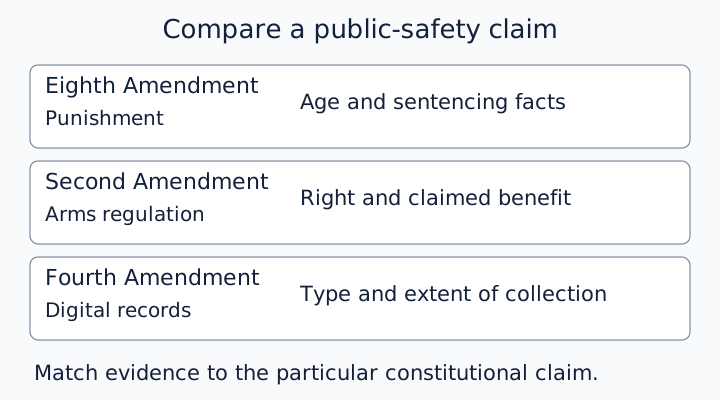
The Eighth Amendment prohibits cruel and unusual punishment. Courts interpret that protection when reviewing death penalty statutes and their application. A legislature’s approval of a penalty does not settle its constitutionality. The judicial question concerns whether the punishment, the defendant category, or the sentencing process fits constitutional limits.
Background illustration: Roper v. Simmons (2005) held that the Eighth and Fourteenth Amendments prohibit executing individuals for crimes committed before age eighteen. Justice Kennedy’s majority considered evidence about state practices and the differences between juveniles and adults, including immaturity and vulnerability to influence. The relevant age was the offender’s age at the time of the crime. Source: Roper v. Simmons, 543 U.S. 551, 568-578 (2005).
That decision limits a category of death sentences; it does not say that every criminal punishment is invalid or that public safety lacks importance. When supporting an argument about punishment, identify the exact constitutional protection, the particular restriction the Court placed on government, and the evidence connecting the two. A claim that punishment must satisfy constitutional limits is narrower and better supported than a claim that judges simply reject every public-safety law.
Quick check · Fill the statement
Complete the distinction in this situation.
A death sentence for a crime committed at age seventeen raises the limit illustrated by .
2b. Firearm debates involve rights and safety claims
Debates about the Second Amendment involve an individual right to keep and bear arms and government claims about public safety. One argument emphasizes that restrictions can burden lawful self-defense. Another argues that regulations can reduce risks associated with firearm misuse. These are arguments about a constitutional boundary and policy consequences; neither is established merely by repeating the phrase public safety.
McDonald applies the recognized self-defense right against state and local government. That provides relevant evidence for a claim that a city’s safety policy remains constitutionally constrained. It does not establish that every proposed regulation violates the right. Conversely, an asserted safety benefit does not automatically establish a restriction’s constitutionality. Source: McDonald v. Chicago, 561 U.S. 742 (2010).
In an evidence-supported argument, distinguish three things: the constitutional protection, the claimed practical benefit, and what the supplied evidence actually demonstrates. Original example: a city predicts fewer injuries from a new rule. A forecast is evidence about the city’s expected benefit, not a court ruling on the rule’s validity. Explain the relationship rather than substituting the policy goal for the constitutional analysis.
Quick check · Fill the statement
Complete the distinction in this situation.
McDonald supplies evidence that safety policies remain subject to the recognized .
2c. Digital metadata creates a Fourth Amendment debate
The Fourth Amendment protects against unreasonable searches and seizures. Digital metadata describes information about communications or activity, such as times, durations, or location records, rather than necessarily the content of a message. Collection can still reveal patterns about a person’s life. Arguments favoring collection cite investigative usefulness; arguments for limits cite privacy and the government’s ability to reconstruct detailed behavior.
Background illustration: Carpenter v. United States (2018) involved government acquisition of historical cell-site location information from wireless carriers. Chief Justice Roberts’s majority held that acquiring the records at issue was a search and generally required a warrant supported by probable cause. The depth, breadth, and revealing character of location information mattered to its privacy reasoning. Source: Carpenter v. United States, majority Parts II through IV (2018).
The majority called its decision narrow. It did not resolve all business records, real-time tracking, tower dumps, or every national security collection issue. Those limits matter: metadata is not automatically outside the Fourth Amendment, but Carpenter is not a ruling that every form of digital collection is unconstitutional. Support a claim with the particular records and reasoning rather than the broad label digital data.
Quick check · Fill the statement
Complete the distinction in this situation.
Carpenter concerned historical ; the Court held their acquisition was a .
Part 3 Watch it done Support a claim without overstating its evidence
Original argument: the usefulness of digital records to police means that collecting them cannot raise a constitutional issue.
Step 1 · State a narrower defensible claim
Investigative usefulness and constitutional limits can coexist. Usefulness does not by itself answer the Fourth Amendment question.
Step 2 · Select relevant evidence
Carpenter treated acquisition of the historical cell-site records at issue as a search because they revealed detailed movements over time.
Why this step?
Why is a location-record holding stronger evidence than a general statement that privacy matters?
It identifies an actual government action and the Court’s constitutional response, giving specific support for the claim that useful investigations remain bounded.
Your step · Decide and justify
Which conclusion is supported by that evidence?
Which institutional reason supports the decision?
A second worked example
Roper supplies a parallel form of argument. A state can have a strong interest in punishing serious crime, while constitutional interpretation still bars a death sentence based on age at the offense. Cite that category-specific limit; do not turn it into an unsupported claim that no punishment is allowed.
Part 4 Try it Apply the rights distinction
Original teaching situations: distinguish what each institution can do.
Try it · Sort it
Identify what the proposed evidence actually supports.
Evidence of a constitutional limit
Claimed practical benefit requiring support
Overstatement beyond the supplied decision
| Evidence card | What it states |
|---|---|
| A: Roper | Execution is barred for crimes committed before eighteen. |
| B: City forecast | Officials predict fewer firearm injuries under a proposed rule. |
| C: Carpenter | Acquiring the historical cell-site location records at issue was a search generally requiring a warrant. |
Part 5 Explain it Argument essay practice: select relevant evidence
Free response is 50% of the exam score. This one is shaped like Question 4, Argument Essay.
Free-response practice · Question 4 style
Use the evidence cards above. Support a defensible claim that public-order and safety objectives remain subject to constitutional protection. Use card A and either McDonald or card C. Explain how each item supports the claim. Distinguish the fictional forecast from a constitutional holding.
Model answer
Public-order and safety objectives remain constitutionally bounded even when government identifies a legitimate enforcement goal. Roper bars execution for crimes committed before eighteen, demonstrating that authorization of punishment cannot override the Eighth Amendment limit. Carpenter likewise treated acquisition of the detailed historical location records at issue as a search generally requiring a warrant, so investigative value did not eliminate Fourth Amendment protection. The city forecast states an expected benefit; it is not evidence that a court has upheld the proposed rule.
Score your own answer. This is a self-check, not a grade. Tick each point your answer makes.
Part 6 Check yourself Build an evidence-supported claim
Original policy discussion with accurately identified judicial illustrations. Forecasts are fictional and are not measured results.
| Evidence card | What it states |
|---|---|
| A: Roper | Execution is barred for crimes committed before eighteen. |
| B: City forecast | Officials predict fewer firearm injuries under a proposed rule. |
| C: Carpenter | Acquiring the historical cell-site location records at issue was a search generally requiring a warrant. |
Case question 1 · Multiple choice
Which claim is most directly supported by card A?
Case question 2 · Multiple choice
What does card B establish about the proposed rule?
Case question 3 · Multiple choice
Which statement uses card C within its stated scope?
The rest stand on their own and do not use the case.
Check yourself · Spot the error
Select the statement that makes an institutional error.
Check yourself · Match
Match each constitutional term to its defining feature.
Part 7 Keep it Retrieve and connect
From 3.5 Second Amendment: Right to Bear Arms · Fill the statement
Complete the distinction in this situation.
A source’s position to be established is its ; supporting facts or text serve as .
From 3.3 First Amendment: Freedom of Speech · Fill the statement
Complete the distinction in this situation.
The hours when a rally occurs concern ; limits on amplifier volume concern .
In three lines
- Constitutional punishment limits apply despite legislative authorization.
- Firearm debates require attention to rights and claimed safety benefits.
- Digital metadata arguments require specific evidence and bounded conclusions.
Exam strategy for this topic
- Section I, Multiple Choice: 55 questions in 80 minutes.
- Section II, Free Response: 4 questions in 100 minutes.
- This lesson's Explain it is shaped like free-response question 4, Argument Essay.
Select specific judicial evidence that supports the claim rather than simply naming an amendment or repeating a policy goal.
Questions students ask
Does public safety automatically override a right?
No. Identify the particular right and applicable constitutional rule. A government purpose matters to the argument but is not automatically decisive.
Does the Eighth Amendment forbid every death sentence?
The lesson’s Roper illustration bars a category based on age at the offense. Do not infer a universal rule from that specific limit.
Why can metadata raise privacy issues?
Patterns of location or communication can reveal private activity even without the literal contents of a message. The kind and extent of collection matter.
Did Carpenter settle every digital surveillance dispute?
No. Its majority described the holding as narrow and reserved several questions. Use the actual historical location-record holding when supporting an argument.
Course alignment, for teachers
AP U.S. Government and Politics topic 3.6, Unit 3: Civil Liberties and Civil Rights.
- Skill 5.B: Support an argument or claim/thesis using relevant evidence.
This lesson maps all 2 essential knowledge statements of the topic to the part that teaches each one: 2 are checked by a scored question. The map is in the lesson file.