Unit 4 · Topic 4.10 · about 30 minutes · 7 parts · 9 scored checks, 2 of them multiple choice, plus 2 from earlier lessons
AP U.S. Government and Politics 4.10: Ideology and Social Policy
Unit 4: 10 to 15% of the multiple-choice section
What you'll be able to do
- Explain how political ideologies vary on the role of the government in addressing social issues.
- Explain how different ideologies affect policy on social issues.
Key vocabulary
| Term | What it means | The exam trap |
|---|---|---|
| Social policy | Government policy concerning social issues such as education and public health. | Separate the policy’s subject from which institution administers it. |
| National standard | A requirement or benchmark established for application across the country. | A common benchmark need not specify every implementation detail. |
| State discretion | Authority for state governments to make choices within their legal responsibilities. | Moving power to states still leaves a government role. |
| Libertarian social-policy position | A preference for little national or state involvement beyond protecting property and individual liberty. | Minimal overall involvement differs from expanded state administration. |
| Policy trend | A pattern in public decisions over time. | A promise alone does not establish a pattern of enacted policy. |
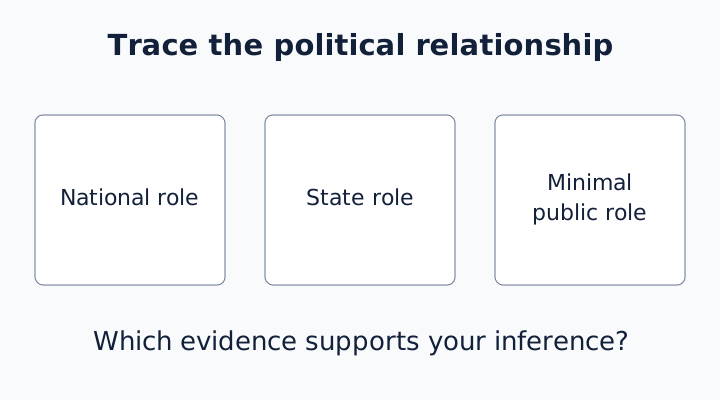 Tap to open the picture full size
Part 1 Think first Predict the institutional consequence
Explain a source’s policy implications and support a rebuttal with the mechanism it actually proposes.
Predict first
A proposal reduces national education rules but expands state program choices. Has it necessarily removed government from education?
In short. Social policy reflects competing ideological views of national, state, and individual responsibility, and shifts as those views gain influence within political parties.
- Liberal and conservative positions differ over national and state roles.
- Libertarian positions generally minimize both levels’ involvement.
- Ideological success can shape party commitments and policy trends.
Part 2 Learn it National and state responsibility
2a. National and state responsibility
Liberal ideologies generally favor more national government involvement in addressing some social issues, including education and public health, with less responsibility left to states. A national funding standard can be defended as expanding access across states. Conservative ideologies generally favor less national involvement in these areas and more responsibility for state governments. A state-discretion proposal can be defended as responding to different local conditions.
These are general tendencies. Identify the level of government and the proposed mechanism. A conservative argument for state responsibility does not automatically reject every public program, and a liberal argument for national involvement does not necessarily give the national government every implementation decision.
For the end-of-lesson concept match, review this section together with the next two sections; the match combines their definitions.
Quick check · Fill the statement
Complete the explanation using the evidence.
A national education standard generally aligns more closely with a approach; transferring more responsibility to states with a approach.
2b. Minimal involvement is another position
Libertarian ideologies generally favor little national or state government involvement except to protect private property or individual liberty. This differs from transferring responsibility from Washington to state agencies. If both levels are limited, the proposal changes the overall government role, not merely its location.
An original fictional policy statement says families should arrange optional training privately while courts protect voluntary contracts. Its implication is less public provision at both levels, not an expanded state program. Explain what the argument would mean for administration, funding, or individual choice. The source’s preference is a normative position; it does not itself prove a policy’s actual effects.
Quick check · Fill the statement
Complete the explanation using the evidence.
A proposal minimizing both national and state provision while protecting voluntary contracts expresses a approach.
2c. Party influence and policy trends
Policy trends in social issues reflect the relative success of liberal or conservative perspectives within political parties. When advocates of national standards gain influence in a party coalition, its proposals can place more responsibility at the national level. When state-discretion advocates gain influence, proposals can move authority toward states. Implementation depends on institutions as well as ideological success.
Read a platform or policy statement for its implications. What institution would gain responsibility? What discretion would change? What values justify the choice? A platform documents commitments, not proof that every promised measure became law. Trends in enacted policy require evidence of actual decisions over time, not only a single campaign statement.
Quick check · Fill the statement
Complete the explanation using the evidence.
A party faction gaining influence can change its , while a policy trend must be shown through over time.
Part 3 Watch it done Explain a source’s policy implications
Original fictional policy statement: A party faction argues that education programs should be designed primarily by states because state officials can respond to differing conditions. It seeks fewer national requirements.
Step 1 · Identify the evidence
Identify the argument: state discretion should expand.
Step 2 · Connect the mechanism
Connect the perspective to a general conservative preference for less national responsibility in these social issues.
Why this step?
Why does the source’s state role matter to the implication?
It shows that fewer national requirements can increase state responsibility rather than eliminate government action.
Step 3 · Limit the inference
Infer the proposed change in implementation: states gain program-design choices, while the source alone does not prove enactment.
Your step · Decide and justify
New condition: the faction’s platform wins support, but Congress rejects its proposed statutory revision. Which conclusion follows?
Which explanation supports this inference?
A contrasting worked example
Contrasting example: Another faction argues for common national public-health access standards. If that view gains influence, the platform may seek expanded national responsibility, but legislation and administration are still needed to implement the commitment.
Part 4 Try it Classify the institutional action
Original teaching situations: distinguish what each institution can do.
Try it · Sort it
Classify each situation by the feature it directly describes.
More national involvement
More state responsibility
Minimal involvement at both levels
| Statement | Perspective |
|---|---|
| A | National public-health access standards are needed to reduce unequal access across states. |
| B | States should design education programs under fewer national requirements. |
| C | Neither national nor state agencies should provide optional training; protect private contracts and liberty. |
Part 5 Explain it Explain implications and rebut an alternative
Free response is 50% of the exam score. This one is shaped like Question 4, Argument Essay.
Free-response practice · Question 4 style
Read the three fictional policy statements directly above. Make a defensible claim about how ideological influence in a party could change the government’s role in education or public health. Use at least two specific statements as evidence and explain the connection. Explicitly rebut the claim that reducing national involvement always eliminates government involvement, using Statement B and its policy mechanism. State why platform success alone does not prove an enacted trend.
Model answer
If the faction favoring common access standards gains party influence, its program could seek a larger national public-health role, while success for the state-discretion faction could shift education design toward states. A links unequal access to national standards; B links differing conditions to state discretion. The claim that reducing national involvement always eliminates government involvement is false: B retains state program design, so authority moves between levels rather than disappearing. C offers a distinct minimal-government position. Platform commitments require legislative and administrative action before they establish an enacted policy trend.
Score your own answer. This is a self-check, not a grade. Tick each point your answer makes.
Part 6 Check yourself Read the evidence, then test the claim
Original fictional statements from competing factions. These are teaching sources, not current party-platform quotations.
| Statement | Perspective |
|---|---|
| A | National public-health access standards are needed to reduce unequal access across states. |
| B | States should design education programs under fewer national requirements. |
| C | Neither national nor state agencies should provide optional training; protect private contracts and liberty. |
Case question 1 · Multiple choice
If Statement A shaped enacted policy, which change would most directly follow its reasoning?
Case question 2 · Multiple choice
How does Statement C differ from Statement B?
The rest stand on their own and do not use the case.
Check yourself · Spot the error
Select the statement that makes an institutional error.
Check yourself · Match
Match the concept to its defining feature.
Part 7 Keep it Retrieve and connect
From 1.1 Ideals of Democracy · Fill the statement
Complete the distinction between rights and the source of public power.
Rights people possess apart from government permission are . The principle that public authority comes from the people is .
From 2.1 Congress: The Senate and the House of Representatives · Fill the statement
Apply the representation rule.
The House uses representation, while the Senate gives states representation.
In three lines
- Liberal and conservative positions differ over national and state roles.
- Libertarian positions generally minimize both levels’ involvement.
- Ideological success can shape party commitments and policy trends.
Exam strategy for this topic
- Section I, Multiple Choice: 55 questions in 80 minutes.
- Section II, Free Response: 4 questions in 100 minutes.
- This lesson's Explain it is shaped like free-response question 4, Argument Essay.
Explain a source’s policy implications and support a rebuttal with the mechanism it actually proposes.
Questions students ask
Does less national involvement mean no government?
No. States can retain or gain responsibility for program design and implementation.
Is state discretion the same as libertarian policy?
No. State discretion can involve substantial public provision; libertarian positions generally favor little involvement at either level.
Do party platforms prove policy trends?
They show commitments. Evidence of enacted decisions over time is needed to establish an actual policy trend.
How can you rebut a claim without merely disagreeing?
Identify the claim’s reasoning, give relevant counterevidence, and explain why that evidence defeats or limits the claim. A retained state role rebuts the assertion that all government involvement disappears.
Course alignment, for teachers
AP U.S. Government and Politics topic 4.10, Unit 4: American Political Ideologies and Beliefs.
- Skill 4.C: Explain how the implications of the argument or perspective in the source may affect political principles, institutions, processes, policies, and behaviors.
This lesson maps all 4 essential knowledge statements of the topic to the part that teaches each one: 4 are checked by a scored question. The map is in the lesson file.