Unit 5 · Topic 5.1 · about 30 minutes · 7 parts · 11 scored checks, 2 of them multiple choice, plus 2 from earlier lessons
AP U.S. Government and Politics 5.1: Voting Rights and Models of Voting Behavior
Unit 5: 20 to 27% of the multiple-choice section
What you'll be able to do
- Describe the voting rights protections in the Constitution and in legislation.
- Describe different models of voting behavior.
Key vocabulary
| Term | What it means | The exam trap |
|---|---|---|
| Citizenship | Legal membership in a political community. | Membership and eligibility rules answer different questions. |
| Retrospective voting | Evaluating a candidate or party by past performance. | Locate the time period used as evidence. |
| Prospective voting | Evaluating candidates by expected future performance. | A campaign prediction differs from an observed record. |
| Rational choice voting | Choosing according to perceived personal interests. | Perceived benefit does not guarantee an accurate forecast. |
| Straight ticket voting | Selecting every candidate of one party on a ballot. | Look at selections across offices. |
| Poll tax | A payment required as a condition of voting. | Distinguish a voting condition from a campaign donation. |
 Tap to open the picture full size
Part 1 Think first Investigate a political mechanism
Explain a mechanism using specific evidence. A label by itself does not establish how an outcome follows.
Predict first
A voter supports a mayor because last term’s improvements helped her neighborhood. What evidence would best clarify her reason?
In short. Voting protections expand access to elections, while voting models describe the different reasons people choose candidates.
- Identify the precise legal protection.
- Use the voter’s stated reasoning.
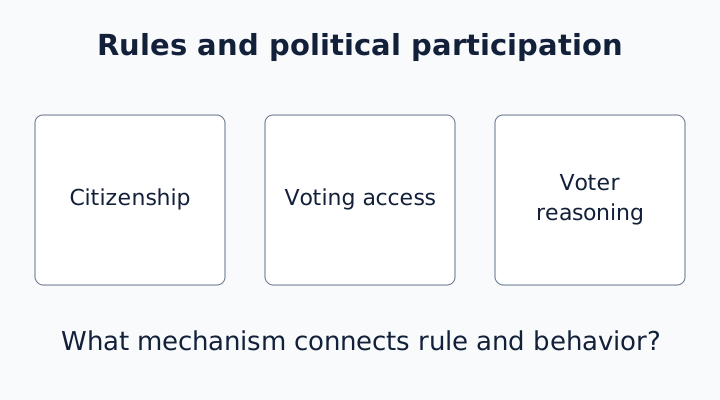
- Distinguish citizenship, access, and candidate choice.
Part 2 Learn it Citizenship and the franchise are distinct
2a. Citizenship and the franchise are distinct
The Fourteenth Amendment establishes citizenship for people born or naturalized in the United States and subject to its jurisdiction. Citizenship is an important legal status, but the amendment did not by itself eliminate every voting restriction. The Fifteenth bars denial of voting rights on account of race, color, or previous condition of servitude. It protected African American men in the Reconstruction context; discriminatory practices continued despite that protection.
The Nineteenth bars denial on account of sex. The Twenty-sixth protects voting rights of citizens age eighteen or older against age-based denial. Read each amendment as a protection against a specified exclusion, rather than a promise that every eligible person will cast a ballot. The Voting Rights Act of 1965 gave the federal government enforcement tools against racial discrimination in voting, including tests used to exclude voters. Legal protection and effective access require separate attention. National Archives, Amendments XIV, XV, XIX, and XXVI; DOJ voting-rights history.
Quick check · Fill the statement
Complete the explanation using the evidence.
Citizenship for persons born or naturalized under its terms is addressed by the Amendment; racial discrimination in voting is barred by the .
2b. Changing selection and removing a financial barrier
The Seventeenth Amendment replaced selection of U.S. senators by state legislatures with direct popular election. This changed who selects a national officeholder; it did not change senators into members of the House. The Twenty-fourth prohibits poll taxes in federal elections. Its text concerns presidential and congressional elections, so do not describe its text as independently abolishing poll taxes in every state election. Later constitutional litigation addressed state poll taxes.
A tax demanded as a condition of voting is a structural barrier because the institution imposes a cost of entry. Removing it differs from persuading a person to support a candidate. Likewise, changing the selector of senators expands direct participation without necessarily changing any particular voter’s preferences. When describing a scenario, identify the precise legal change and the people or process it affects. Amendments XVII and XXIV, sections 1.
Quick check · Fill the statement
Complete the explanation using the evidence.
Direct popular election of senators comes from the Amendment. The ban on poll taxes in federal elections comes from the .
2c. Read the voter’s stated reasoning
A rational choice voter chooses the option perceived to serve the voter’s best interest. A retrospective voter evaluates the recent record of the incumbent or governing party. A prospective voter compares expectations about future performance. A straight ticket voter selects all candidates of one party on a ballot.
These models describe different aspects of behavior and can overlap. A voter might believe a party served the voter well, expect it to do so again, and choose its whole ticket. In a question asking which model is most directly illustrated, use the evidence emphasized in the scenario. “Jobs improved during this administration, so I will retain it” emphasizes the past. “This proposal should improve jobs next year” emphasizes the future. Do not infer a person’s reasoning from demographic identity or party label alone.
Citizenship is legal membership in the political community. It is distinct from the past- and future-performance reasons used to describe voting choices.
Quick check · Fill the statement
Complete the explanation using the evidence.
A voter rewarding the incumbent’s past record uses reasoning. A voter comparing future plans uses reasoning.
Part 3 Watch it done Describe the reason, not the label
Original scenario: Morgan supports the incumbent because the last term brought the improvements Morgan wanted.
Step 1 · Locate the evidence
Morgan cites outcomes during the last term.
Why this step?
Why does the time reference matter?
Retrospective voting evaluates past performance; prospective voting emphasizes expectations.
Step 2 · Keep models distinct
The scenario does not describe choices across all offices, so it does not establish straight ticket voting.
Your step · Decide and justify
A different voter chooses a challenger because the challenger’s proposal should improve services next year. Which model is emphasized?
Which reason supports this new inference?
A contrasting worked example
Contrast: Lee chooses a challenger because a proposed transit plan would reduce Lee’s commute. Step 1: identify the expected benefit. Step 2: describe perceived self-interest, which supports rational choice. Step 3: the future prediction also supports a prospective interpretation; these models need not exclude one another.
Part 4 Try it Classify the institutional action
Original teaching situations: distinguish what each institution can do.
Try it · Sort it
Sort each example by its defining feature.
Legal protection
Voting model
Try it · Fill the statement
Apply the institutional distinction.
Sex-based voting exclusions are addressed by the Amendment; protection against age-based denial for citizens eighteen or older comes from the .
Try it · Fill the statement
Apply the institutional distinction.
Federal enforcement against racially discriminatory voting tests was strengthened by the of 1965.
Part 5 Explain it Describe access and reasoning
Free response is 50% of the exam score. This one is shaped like Question 1, Concept Application.
Free-response practice · Question 1 style
Original concept-application practice: A guide says the Fourteenth, Fifteenth, Nineteenth, and Twenty-sixth all did the same thing. Correct the guide by describing each protection. Then describe why a citizen voting for an expected personal tax benefit may illustrate both rational choice and prospective voting.
Model answer
The Fourteenth establishes citizenship under its terms, the Fifteenth bars racial discrimination in voting, the Nineteenth bars denial on account of sex, and the Twenty-sixth protects citizens eighteen or older against age-based denial. The expected tax benefit reflects perceived self-interest, while the prediction about a future benefit makes prospective voting relevant too.
Score your own answer. This is a self-check, not a grade. Tick each point your answer makes.
Part 6 Check yourself Access and choice
Original civic-education scenarios. The table states legal protections or voter reasoning; no actual voter data are reported.
| Situation | Evidence |
|---|---|
| A voting restriction excludes women | Denial rests on sex |
| A voter endorses the mayor | The voter cites the completed term’s safety record |
Case question 1 · Multiple choice
Which amendment most directly addresses the restriction?
Case question 2 · Multiple choice
Which model best describes the mayoral voter’s stated evidence?
The rest stand on their own and do not use the case.
Check yourself · Spot the error
Select the statement that makes an institutional error.
Check yourself · Match
Match each concept to its defining feature.
Part 7 Keep it Retrieve and connect
From 1.5 Ratification of the U.S. Constitution · Fill the statement
Apply the distinction in the completed statement.
The Great Compromise tied House representation to and gave states representation in the Senate.
From 1.6 Principles of American Government · Fill the statement
Apply the distinction in the completed statement.
In an attributed paraphrase of Federalist No. 51, one branch’s institutional interest can restrain another through , limiting the concentration of power and possible abuse.
In three lines
- Identify the precise legal protection.
- Use the voter’s stated reasoning.
- Distinguish citizenship, access, and candidate choice.
Exam strategy for this topic
- Section I, Multiple Choice: 55 questions in 80 minutes.
- Section II, Free Response: 4 questions in 100 minutes.
- This lesson's Explain it is shaped like free-response question 1, Concept Application.
Explain a mechanism using specific evidence. A label by itself does not establish how an outcome follows.
Questions students ask
Did an amendment guarantee actual turnout?
No. A legal protection removes a specified exclusion. People still face institutional conditions and make choices about participating.
Why distinguish the Fourteenth and Fifteenth?
The Fourteenth establishes citizenship under its terms. The Fifteenth protects voting rights against racial discrimination.
Can voting models overlap?
Yes. One choice can reflect self-interest and a forecast; describe the evidence the prompt emphasizes.
Does the Twenty-fourth’s text cover state elections?
Its poll-tax prohibition explicitly covers federal elections. State poll taxes were addressed through separate constitutional litigation.
Course alignment, for teachers
AP U.S. Government and Politics topic 5.1, Unit 5: Political Participation.
- Skill 1.D: Describe political principles, institutions, processes, policies, and behaviors illustrated in different scenarios in context.
This lesson maps all 2 essential knowledge statements of the topic to the part that teaches each one: 2 are checked by a scored question. The map is in the lesson file.