Unit 4 · Topic 4.8 · about 30 minutes · 7 parts · 9 scored checks, 2 of them multiple choice, plus 2 from earlier lessons
AP U.S. Government and Politics 4.8: Ideology and Policymaking
Unit 4: 10 to 15% of the multiple-choice section
What you'll be able to do
- Explain how U.S. political culture (e.g., democratic ideals, principles, and core values) influences the formation, goals, and implementation of public policy over time.
Key vocabulary
| Term | What it means | The exam trap |
|---|---|---|
| Public policy | Government action or an established course of action addressing public matters. | A proposal must pass through institutions before becoming enacted policy. |
| Political participation | Activity intended to influence government or public decisions. | Participants are not automatically representative of all residents. |
| Individual liberty | Freedom of persons to act without unjustified government restraint. | Identify the specific activity at issue before judging the burden. |
| Public order | Conditions of stability and safety that government seeks to maintain. | A stated purpose does not by itself justify every proposed restriction. |
| Visual argument | A perspective communicated through images, arrangement, and other visual features. | Separate the message of a graphic from measured evidence. |
 Tap to open the picture full size
Part 1 Think first Predict the institutional consequence
Explain how specific visual elements communicate the relationship between participation, values, and policy.
Predict first
A council hears only from one organized group. What remains uncertain about the city?
In short. Public policy reflects the beliefs of participating citizens and continuing debates about individual liberty, stability, and order.
- Policy reflects beliefs brought into political participation.
- Liberty and order create recurring policy tradeoffs.
- A visual argument communicates a perspective without proving population proportions.
Part 2 Learn it Participants bring values into policy
2a. Participants bring values into policy
In a diverse democracy, people disagree about public problems and the government’s proper response. Public policy at a given time reflects the attitudes and beliefs of citizens who choose to participate, filtered through political institutions. Voting, organizing, contacting officials, and speaking at hearings can bring priorities into the policy process.
Participation is uneven. A public hearing filled by one organized group does not show that every resident shares that group’s views. Officials also operate under legal limits and institutional rules. Explain how participating citizens can affect an agenda without assuming that the enacted policy is a perfect measure of all citizens’ beliefs.
For the end-of-lesson concept match, review this section together with the next two sections; the match combines their definitions.
Quick check · Fill the statement
Complete the explanation using the evidence.
A hearing dominated by organized supporters reveals the views of , rather than necessarily representing all .
2b. Liberty and order create tradeoffs
Debates over public rules often balance individual liberty with efforts to promote stability and order. A public assembly rule can protect access to streets while also burdening expression. A strong explanation identifies the protected activity, the proposed government mechanism, and the claimed public purpose.
The balance can change as conditions, participation, and beliefs change over time. A temporary emergency policy may later be narrowed after citizens challenge its burdens. Describing the competing principles does not decide that every proposed restriction is lawful or wise. It identifies the reasoning that different participants bring to policymaking.
Quick check · Fill the statement
Complete the explanation using the evidence.
A rule restricting access to a public square can create tension between individual and public .
2c. Interpret a visual argument
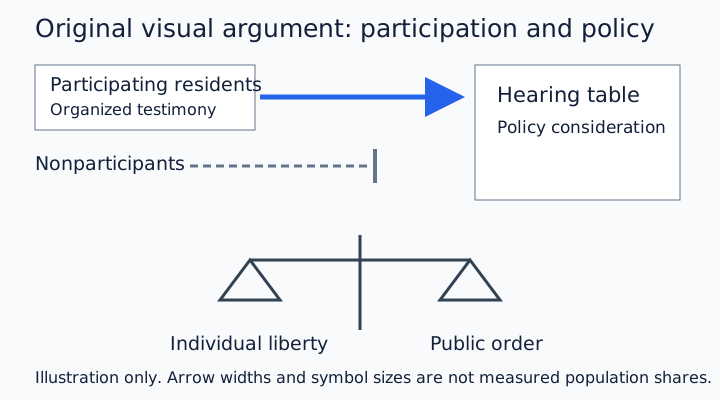
An infographic’s arrows, sizes, labels, and symbols communicate a perspective. In the original fictional visual used here, a larger stream of participating residents reaches the hearing table while a smaller stream of nonparticipants ends before it. That layout argues that participation gives beliefs a more direct route into policy consideration. The visual does not prove the size of any real group.
A second panel places individual liberty and public order on a balance. Its arrangement shows a tension that policymakers must negotiate; it does not supply a legal test or establish that one side always wins. Explain how the visual elements make the argument. Then distinguish the source’s perspective from empirical proof about a specific policy outcome.
Quick check · Fill the statement
Complete the explanation using the evidence.
Arrows from active residents toward a hearing table illustrate a route of political ; an image alone is not a measured .
Part 3 Watch it done Read what the infographic argues
Original fictional infographic: an arrow labeled organized testimony connects residents to a hearing table; a separate liberty/order balance represents a debate about a proposed square-access rule.
Step 1 · Identify the evidence
Identify the arrow as a route from citizens’ action to institutional attention.
Step 2 · Connect the mechanism
Identify the balance as competing public principles, rather than evidence that either side always prevails.
Why this step?
Why interpret the arrow’s endpoint rather than just list its color?
The endpoint connects citizen participation to an institution and therefore explains the political relationship the source depicts.
Step 3 · Limit the inference
The source argues that participation affects which concerns enter the balancing debate.
Your step · Decide and justify
New condition: a revised infographic shows a second arrow from previously absent residents to the hearing table, labeled expression concerns. What implication does the new arrow add?
Which explanation supports this inference?
A contrasting worked example
Contrasting example: If a new residents’ group later testifies that the rule burdens access to expression, the additional participation can bring a neglected value into review. The new input does not guarantee repeal, but it can change the debate.
Part 4 Try it Classify the institutional action
Original teaching situations: distinguish what each institution can do.
Try it · Sort it
Classify each situation by the feature it directly describes.
Participation mechanism
Liberty concern
Order concern
| Stage | Action |
|---|---|
| Initial | Safety advocates dominate testimony; a broad square-access restriction is adopted. |
| Review | Additional residents describe expression burdens; the rule is narrowed. |
Part 5 Explain it Explain the infographic’s political argument
Free response is 50% of the exam score. This one is shaped like Question 1, Concept Application.
Free-response practice · Question 1 style
Use the original infographic directly above. Explain how the arrows and endpoints illustrate the effect of participation on policy consideration. Explain how the balance represents liberty and order. Use the fictional policy record to explain how policy can change when different participants bring new concerns. State one limit of using this visual as evidence about all residents.
Model answer
Arrows carry active residents’ input to the hearing table, while nonparticipants’ route ends before it. This depicts a more direct route for participants’ concerns. The balance represents tension between freedom of activity and the government’s order goals. Later testimony about burdens on expression can lead officials to narrow an earlier restriction. The graphic is an original illustration without measured proportions, so symbol size cannot establish the whole city’s opinion distribution.
Score your own answer. This is a self-check, not a grade. Tick each point your answer makes.
Part 6 Check yourself Read the evidence, then test the claim
Original fictional policy record accompanying the infographic. The entries describe participation and policy choices, not a poll of all residents.
| Stage | Recorded action |
|---|---|
| Initial hearing | Safety advocates dominate testimony; a broad access restriction is adopted. |
| Later review | Additional residents describe burdens on expression; the rule is narrowed. |
Case question 1 · Multiple choice
How do the arrows toward the hearing table illustrate the political process?
Case question 2 · Multiple choice
How does the policy record illustrate change over time?
The rest stand on their own and do not use the case.
Check yourself · Spot the error
Select the statement that makes an institutional error.
Check yourself · Match
Match the concept to its defining feature.
Part 7 Keep it Retrieve and connect
From 1.1 Ideals of Democracy · Fill the statement
Complete the distinction between rights and the source of public power.
Rights people possess apart from government permission are . The principle that public authority comes from the people is .
From 2.1 Congress: The Senate and the House of Representatives · Fill the statement
Apply the representation rule.
The House uses representation, while the Senate gives states representation.
In three lines
- Policy reflects beliefs brought into political participation.
- Liberty and order create recurring policy tradeoffs.
- A visual argument communicates a perspective without proving population proportions.
Exam strategy for this topic
- Section I, Multiple Choice: 55 questions in 80 minutes.
- Section II, Free Response: 4 questions in 100 minutes.
- This lesson's Explain it is shaped like free-response question 1, Concept Application.
Explain how specific visual elements communicate the relationship between participation, values, and policy.
Questions students ask
Does public policy perfectly mirror public opinion?
No. Participation is uneven and institutions filter which preferences become action.
Can policy change without every citizen changing ideology?
Yes. Different participants, institutional choices, or conditions can alter the policy balance.
Is the infographic a poll?
No. It is an original visual argument about participation and tradeoffs, with no measured population proportions.
Does balancing mean liberty always yields to order?
No. The balance identifies competing claims; the outcome depends on law, institutional judgment, and the proposal’s actual burdens.
Course alignment, for teachers
AP U.S. Government and Politics topic 4.8, Unit 4: American Political Ideologies and Beliefs.
- Skill 4.D: Explain how the visual elements of the source (a cartoon, map, or infographic) illustrate or relate to political principles, institutions, processes, policies, and behaviors.
This lesson maps all 2 essential knowledge statements of the topic to the part that teaches each one: 2 are checked by a scored question. The map is in the lesson file.